
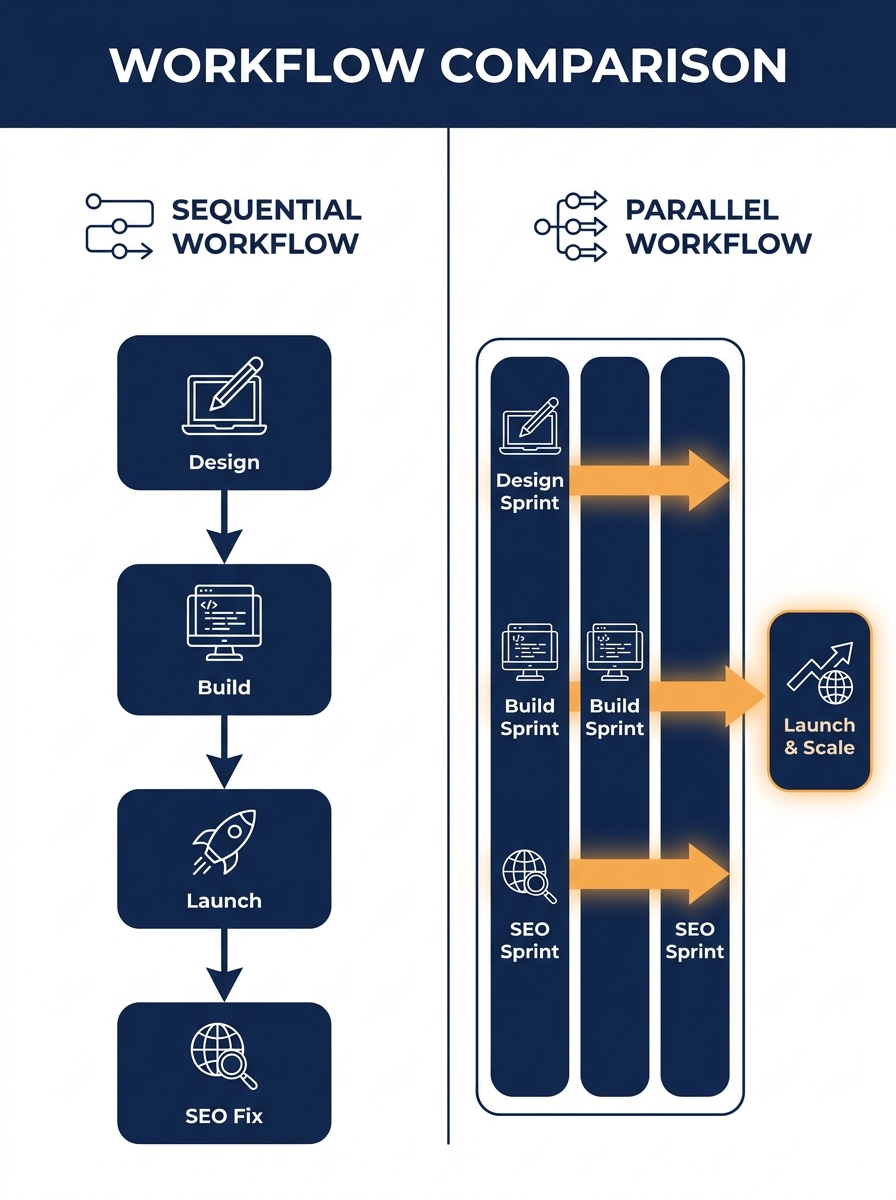
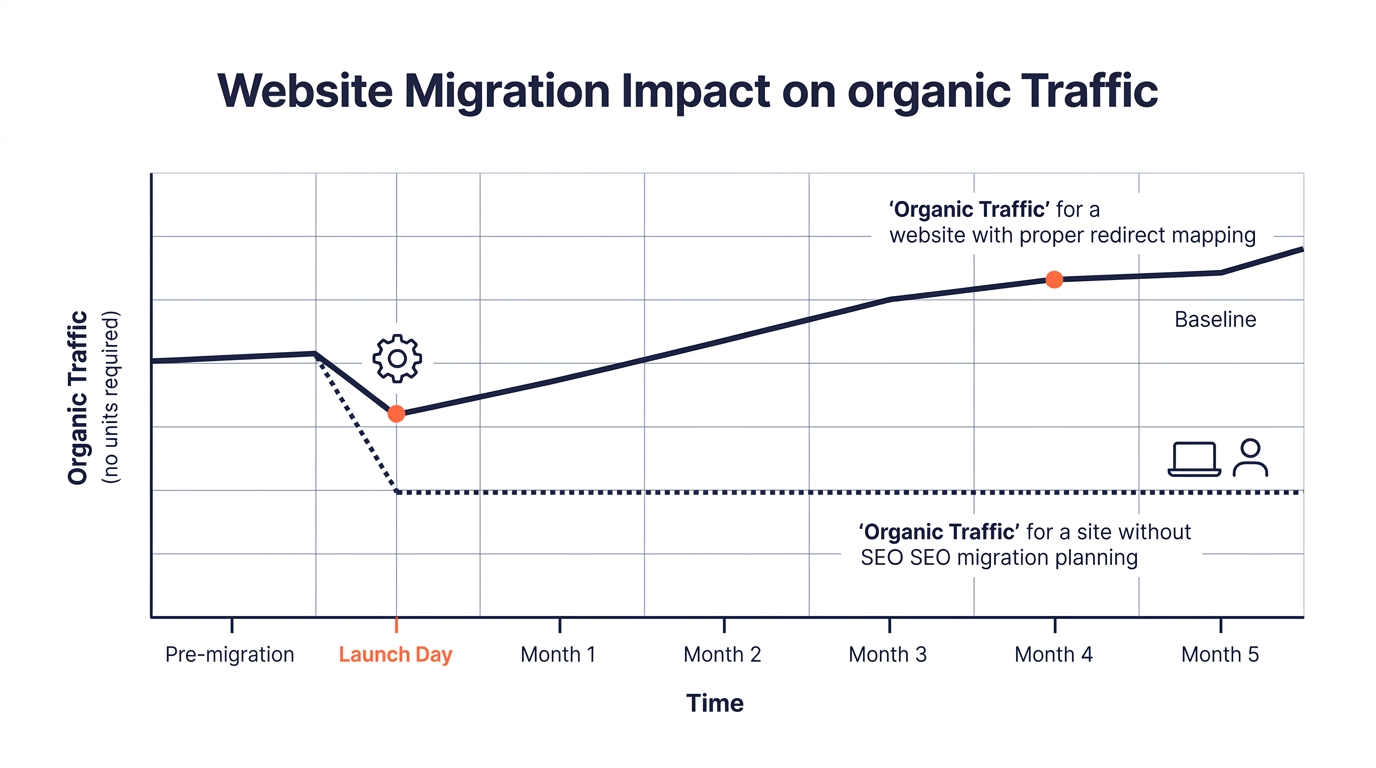
Platform migrations fail SEO when redirect mapping happens after the new site launches instead of during development. Philippine SEO teams that embed into the development sprint cycle from sprint zero, running URL inventories, redirect maps, and content audits alongside design and build, consistently preserve organic traffic through the transition. According to Morningscore’s 2026 analysis, most sites see initial recovery within 2-3 months if redirects are implemented correctly and technical SEO is sound.
TL;DR: Website migration SEO depends on parallel execution: SEO work running inside the development cycle, not after it. Teams that preserve search visibility during redesigns use a three-tier URL priority system, validate everything on staging before launch, and monitor for 90 days post-launch to catch delayed regressions.
Why Sequential Migration Kills Organic Traffic
The traditional approach (redesign the site, launch it, then call in SEO to fix what broke) is responsible for most platform redesign traffic preservation failures. Development teams build the new site without an SEO specialist reviewing URL structures, canonical tags, or internal linking patterns. By the time someone notices that 40% of the old URLs now return 404 errors, Google has already started deindexing pages that took years to rank.
According to Search Engine Journal’s migration guide, migrations “might require a complete mapping of old URLs to new ones,” and “missing redirects will tank your rankings and affect organic traffic.” The word “might” understates it. On any site with more than 50 indexed pages, cross-platform URL mapping is non-negotiable.
Philippine SEO teams working within BPO structures have a structural advantage here: they’re already embedded in the same organization as the development team. When you’re running outsourced web development and SEO under one roof, the SEO specialist sits in the same standup as the front-end developer. There’s no handoff email that gets buried. There’s no “we’ll loop in SEO before launch” that never happens.
The Three-Tier URL Priority Model
Not every URL on your current site deserves the same level of attention during a migration. A 2,000-page e-commerce site has product pages generating $50K/month in organic revenue sitting next to old blog posts from 2018 with zero traffic. Treating them equally wastes 60-70% of migration prep time.
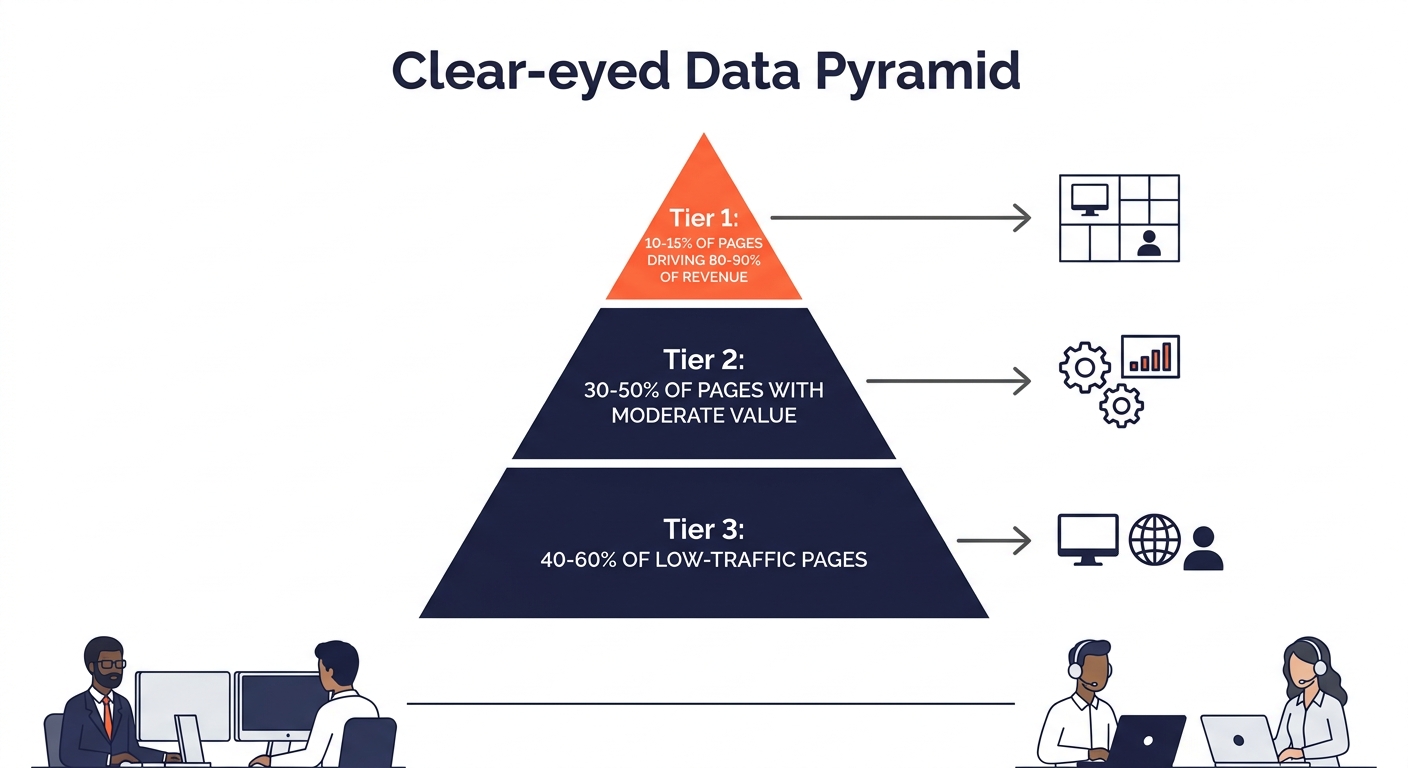
Philippine SEO teams typically sort the full URL inventory into three tiers using 12 months of analytics data (not 3 months, because you need a full year to account for seasonal traffic patterns):
Tier 1: Preserve exactly. These are the top 10-15% of pages by organic traffic and backlink count. They keep their URL structure, meta data, internal links, and structured data intact. If the new platform forces a URL change, these pages get 1:1 301 redirects with zero exceptions.
Tier 2: Redirect with mapping. Pages with moderate traffic or valuable backlinks that won’t carry their exact URL to the new platform. Each one gets a manually verified 301 redirect to the most relevant new page. On a 1,000-page site, this tier typically covers 300-500 URLs.
Tier 3: Consolidate or remove. Thin content, duplicate pages, and URLs with fewer than 10 sessions per month across the full 12-month window. These pages either get merged into stronger existing content or are allowed to return 410 (gone) signals. Removing dead weight from the index actually improves overall site authority.
| Tier | % of Pages | Traffic/Link Value | Migration Action | Typical Effort |
|---|---|---|---|---|
| Tier 1 | 10-15% | High (80-90% of organic revenue) | Preserve URL or exact 1:1 redirect | Manual review, page-by-page |
| Tier 2 | 30-50% | Moderate | Mapped 301 redirects | Semi-automated with manual verification |
| Tier 3 | 40-60% | Low (<10 sessions/month) | Consolidate or 410 | Batch processing |
This tiered approach cuts the total migration workload by 40-50% while concentrating effort where the vast majority of organic revenue lives. The 12-month data window is critical because AI-powered SEO tools can identify patterns faster, but they still need the seasonal baseline to avoid flagging a page as “low value” when it drives 30% of its annual conversions during a 6-week holiday window.
Staging Environment Validation Before Launch
The second most common migration failure point: skipping technical SEO validation on staging. Development teams test functionality on staging (forms submit, checkout works, images load), but nobody checks whether the staging environment’s canonical tags point to the staging domain, whether structured data renders correctly, or whether redirect chains have accumulated.
Redirect chains are a particular problem. URL A redirects to URL B, which redirects to URL C, which finally reaches URL D. Each hop bleeds PageRank. Google will follow up to 5 hops before giving up, but by hop 3, you’ve already lost significant link equity. As Influize’s 2026 migration guide notes, “a well-executed migration can lead to improved site architecture” and “maintained or improved search engine rankings with valuable links and domain authority preserved when the site is reindexed.”
Philippine SEO teams run parallel QA on staging environments using tools like Screaming Frog to crawl the pre-launch site and compare it page-by-page against the production crawl. They’re checking for:
- Redirect chains longer than 1 hop (every redirect should go directly from old URL to final destination)
- Canonical tags that reference staging URLs instead of production
- Missing or altered structured data and schema markup
- Internal links pointing to old URLs instead of new ones
- Meta titles and descriptions that didn’t transfer from the CMS export
- Hreflang tags for multilingual sites that reference old domain paths
This parallel QA process typically runs during the final 2-3 development sprints, giving the team enough time to fix issues before launch day. Teams working across multiple frameworks understand that each platform handles redirects, canonical tags, and URL generation differently, which makes platform-specific QA checklists essential.
Warning: A common oversight during platform redesign: the staging environment’s robots.txt blocks all crawlers. If this setting accidentally carries over to the production launch, Google can’t index the new site at all. Verify robots.txt permissions are updated as part of your launch-day checklist.
The 90-Day Post-Launch Monitoring Window
Why 90 days? Because search engines continue processing URL changes and redirect chains for months after a migration. A site with 10,000 redirects might take 4 weeks for Google to fully process, or it might take 12 weeks. Nobody can control that timeline, and short monitoring windows miss delayed regressions that show up in week 6 or 8.
Here’s what that monitoring looks like in practice: the SEO team checks Google Search Console daily for the first 2 weeks, then 3 times per week for months 2 and 3. They’re tracking coverage errors (pages returning 404 or 5xx status codes), crawl rate changes, impressions and click data by page compared against the 12-month baseline, Core Web Vitals shifts, and index coverage reports showing pages dropped from the index.
The first 14 days after launch are when 70-80% of critical issues surface. A redirect that maps to the wrong page, a batch of product URLs that lost their schema markup, a sitemap that still references old URLs. Philippine SEO teams working in a time zone 12-16 hours ahead of US clients can catch and fix these issues overnight, so the client wakes up to a resolved ticket instead of an escalating traffic drop.
The first 14 days after a platform launch are when 70-80% of critical SEO issues surface, and overnight resolution by Philippine teams means US clients wake up to fixed problems instead of mounting traffic losses.
This overnight coverage model pairs well with the async coordination frameworks that Philippine teams already use for cross-timezone project management. The SEO monitoring board runs on the same Kanban flow as the development board, with clear escalation paths for issues that require developer intervention.
The Cost Math on Botched Migrations
Website redesign disasters are recoverable, but the cost compounds with every week of inaction. One documented case from KC SEO Pro describes recovering a site by reverse-engineering it “around ideal client search behaviors,” creating new content, then optimizing “from top-to-bottom with proper keywords, meta descriptions, internal linking and structured data.” The site recovered within 3 months of the relaunch.
But “recovered within 3 months” glosses over the revenue lost during that period. A site doing $100K/month in organic-driven revenue that drops 50% during a botched migration loses roughly $150K over a quarter. The cost of embedding SEO into the migration from sprint zero is typically $5K-15K for an outsourced Philippine team running 3-6 months of parallel work.
As Seeker Digital notes, “by outsourcing your migration project to an experienced agency, you transfer the risk and effort to experts who exclusively focus on these complex transitions.” For SMBs running migrations on Shopify, WordPress, Webflow, or Magento, this transfer of risk is where dedicated SEO migration teams deliver the clearest ROI. The outsourced SEO during technical migration becomes a managed process rather than a scramble after the fact.
Remaining Questions
Platform redesign traffic preservation has gotten more reliable with better tooling and clearer playbooks, but several problems remain unsolved. Google’s processing time for large-scale redirect maps is still unpredictable, and nobody can give a stakeholder a firm date when traffic will fully normalize.
AI Overviews add another layer of uncertainty. A page that ranked position 3 and pulled healthy organic traffic pre-migration might return to position 3 post-migration but receive 40% fewer clicks because Google now answers the query directly. Separating migration-caused traffic loss from AI Overview-caused traffic loss requires careful baseline comparison, and most monitoring setups don’t account for this distinction yet.
And as headless CMS architectures and JavaScript-heavy frameworks become more common, the technical requirements for search visibility during redesign keep shifting. A migration to a React-based front end introduces client-side rendering issues that didn’t exist when sites ran on server-rendered WordPress. The playbook adapts, but the fundamentals hold across every platform change: inventory every URL, redirect with precision, validate before launch, and monitor for 90 days after it.