
Offshore real estate web development helps U.S. businesses build websites faster, reduce costs, and access skilled global talent. By outsourcing to the Philippines, real estate firms can cut expenses by up to 75%, speed up project timelines by 35%, and scale resources based on demand – all while focusing on their core business activities. Offshore teams specialize in modern technologies like AI, blockchain, and advanced UI/UX design, ensuring high-quality solutions tailored for the real estate industry.
Key Benefits:
- Cost Savings: Save 60–75% on development costs compared to U.S. teams.
- Access to Talent: Work with skilled developers experienced in real estate tech.
- Faster Timelines: Leverage time zones for 24/7 progress and quicker launches.
- Scalability: Adjust team size without long-term commitments.
- Focus on Business: Free up internal teams to prioritize sales and marketing.
- Modern Tech Skills: Utilize advanced tools like React, Python, and MLS integrations.
- Risk Reduction: Gain reliable processes, security measures, and ongoing support.
Offshore development is reshaping how real estate firms approach digital projects, offering a mix of affordability, expertise, and flexibility.
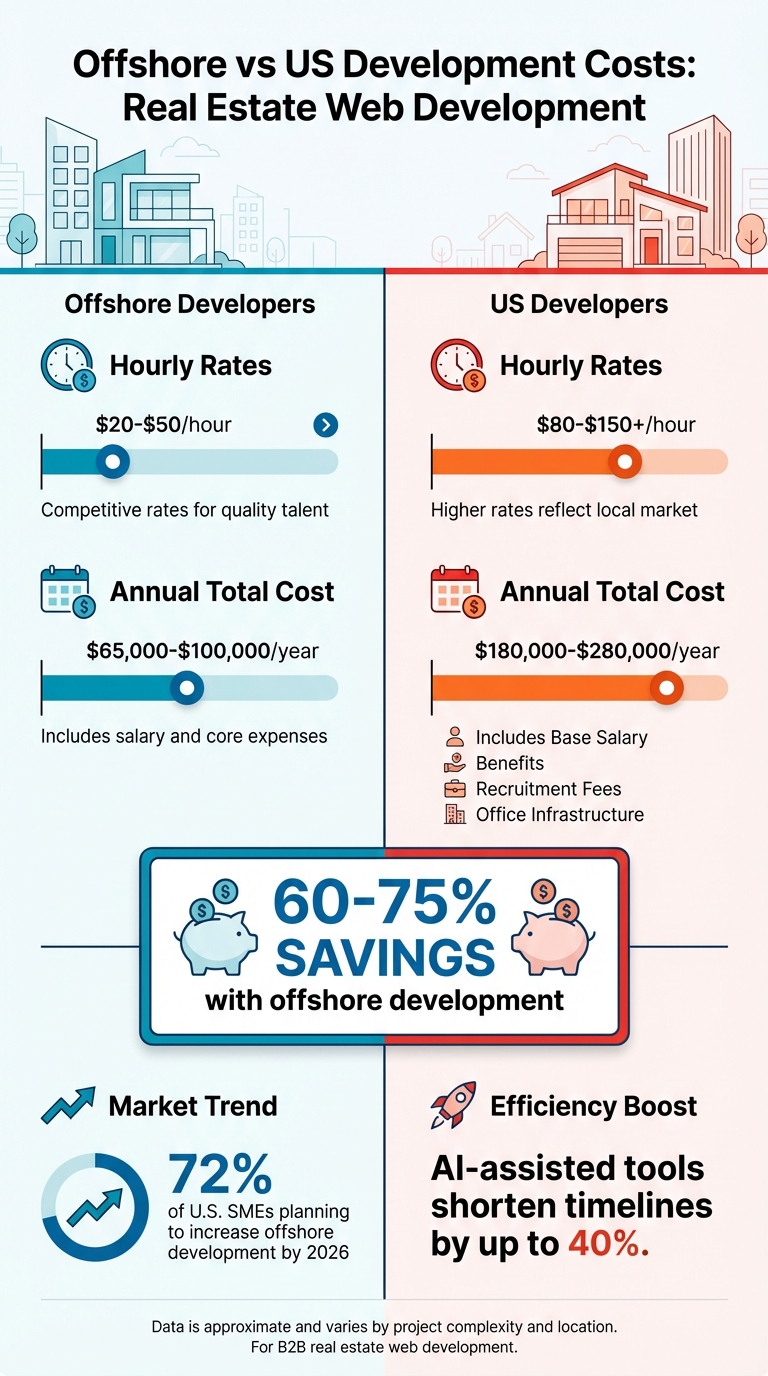
Offshore vs US Real Estate Web Development Cost Comparison
A Complete Guide to Offshore Software Development | Benefits, Challenges, Models
sbb-itb-5665bbf
1. Lower Development Costs
Choosing offshore web development can slash expenses dramatically. By hiring offshore developers, businesses can save between 60% and 75% on development costs compared to maintaining an in-house team in the U.S.. Offshore developers typically charge $20 to $50 per hour, while U.S.-based counterparts demand $80 to $150+ per hour.
The annual cost comparison paints an even starker picture. A U.S. developer costs between $180,000 and $280,000 annually when you include base salary, benefits, recruitment fees, and office infrastructure. Meanwhile, an offshore developer with similar expertise costs around $65,000 to $100,000 annually.
"A U.S. company can hire a qualified offshore web developer for $30 to $50 an hour, which is less than half of what it would cost to hire experts with the same talent in San Francisco or London." – Kapil Kumar, Chairperson of The NineHertz
Local hiring comes with hefty overheads – benefits, recruitment costs, and office expenses – that offshore providers typically absorb into their rates.
These savings free up funds for real estate firms to invest in areas like digital marketing, local SEO strategies, or property acquisitions, rather than being locked into high developer salaries and office costs. The trend is gaining momentum, with 72% of U.S. SMEs planning to increase their reliance on offshore web development by 2026. Plus, AI-assisted tools are shortening offshore development timelines by up to 40%, making this option even more cost-effective.
Cutting costs doesn’t just stretch budgets – it also opens doors to skilled talent, which we’ll explore in the next section.
2. Access to Qualified Developers
Offshore outsourcing opens the door to a worldwide network of skilled developers who specialize in real estate web technologies. For example, developers from the Philippines are often highly experienced in crafting property listing systems, integrating MLS platforms, and working with modern frameworks like React.js, Angular.js, and Python/Django. This global talent pool provides expertise tailored specifically for the real estate industry, making it easier to implement the technical solutions your business needs.
These developers often excel in specialized tasks, such as integrating APIs for MLS platforms like MLSGrid or SimplyRETS, setting up secure payment gateways, and managing large-scale property databases using SQL or MongoDB.
"Offshore developers often bring niche expertise and experience in various technologies and domains, which can enhance the quality and innovation of your project." – PrimeOutsourcing
To ensure you hire the right talent, take a close look at their portfolios. Look for examples of real estate projects that include IDX/MLS integrations, virtual tours (like Matterport 3D), or custom property search tools. You can also assess their technical skills through live coding sessions or take-home projects to confirm their ability to handle complex property listing systems. Starting with a short paid trial period – around 2 to 4 weeks – can help you evaluate both their technical output and how well they collaborate with your team.
For businesses looking for cost-effective solutions, platforms like 365Outsource.com connect you with developers in the Philippines who are proficient in WordPress, PHP, and mobile app development – perfect for real estate firms aiming to build specialized digital tools without breaking the bank.
3. Faster Project Completion
Offshore teams can help speed up your project timeline by as much as 35%, making it possible to launch your real estate website sooner. This is largely thanks to the time zone differences, which allow for a continuous, 24/7 workflow. Here’s how it works: while your in-house team in the U.S. finishes for the day, offshore developers in countries like the Philippines or India are just starting theirs. For instance, you could assign tasks at 5:00 PM EST, and by 9:00 AM the next morning, significant progress – like coding updates or bug fixes – has already been made. This round-the-clock collaboration keeps your project moving without unnecessary delays.
"Offshore teams, located in different time zones, can keep your project moving forward while your in-house team is offline. This round-the-clock work schedule ensures continuous progress and faster turnaround times." – CodeRower
To make the most of this advantage, plan for 2 to 4 hours of overlapping work time for daily stand-ups and real-time troubleshooting. Tools like Jira or Asana can help streamline task assignments, ensuring your offshore team can work independently without constant supervision. For businesses racing against tight deadlines, this setup can be a game-changer – especially when trying to launch ahead of peak market seasons.
What sets offshore teams apart is their dedicated focus on your project. Whether it’s building property portals, integrating MLS systems, or developing CRM platforms, these teams are fully aligned with your goals. Companies like 365Outsource specialize in providing round-the-clock offshore support, helping businesses complete projects faster and maintain a competitive edge.
4. Easy Scaling Options
Offshore teams give you the flexibility to adjust your development resources as needed. Imagine launching a new property portal with a larger team of developers, then scaling back during the maintenance phase – all without being tied to long-term contracts or dealing with severance costs. This adaptability allows you to align your technical resources directly with market demands.
This approach works particularly well in the real estate market, where demand can fluctuate significantly. Instead of keeping a large, costly in-house team on payroll all year, you can ramp up your team during a major project and scale down when things quiet down. It’s this kind of flexibility that has made offshore web development an attractive option for U.S. firms in the real estate sector.
"When your project requires your development team to scale quickly, offshore developers can help you do so without the lengthy hiring lead times that come with local employment." – PrimeOutsourcing
Hiring locally can be a slow process, often taking weeks or even months. Offshore teams, on the other hand, can provide skilled developers in just days or weeks. This quick turnaround eliminates the administrative burden and enables you to react swiftly to market changes – whether it’s a sudden surge in user traffic or the need to match a competitor’s new feature.
The ability to scale efficiently is a cornerstone of offshore solutions. Companies like 365Outsource offer flexible engagement models, allowing you to hire entire teams for large-scale projects or individual specialists for tasks like API integration or UI/UX design. This targeted approach ensures you’re only paying for the skills you need, when you need them, without the added costs of office space, equipment, or employee benefits that come with permanent staff.
5. More Time for Core Business
Running a real estate business involves juggling property showings, client negotiations, and marketing campaigns. The last thing you need is to get bogged down with technical headaches like API integrations or debugging. By outsourcing web development to offshore teams, you can free up your internal staff to focus on what they excel at – building strong client relationships and driving revenue. This approach allows your team to prioritize client engagement and overall business growth.
"Your in-house team may work on marketing, strategy, and customer service while offshore developers resolve technical problems." – Kapil Kumar, Chairperson, The NineHertz
Take the example of REAZ Realty owner Yaxkin Rony Velasquez. Over seven years, culminating in 2025, Velasquez transitioned from relying on local talent to working with dedicated offshore professionals. By outsourcing administrative and technical tasks, he avoided dealing with U.S. tax issues, unemployment insurance, and workers’ compensation. This move not only cut costs but also allowed him to reinvest resources into scaling his business.
Offshore teams can handle technical responsibilities like selecting the right tech stack, integrating MLS databases, and troubleshooting issues. Meanwhile, your in-house team can focus on activities that directly add value, such as property management, lead generation, and client consultations. Thanks to time zone differences, these offshore teams can even provide round-the-clock support, ensuring your website stays optimized during critical hours.
Administrative hassles also become a thing of the past. You won’t have to spend weeks recruiting developers, managing payroll taxes, or overseeing employee benefits. Instead, you can channel that energy into expanding your property portfolio, launching targeted marketing campaigns, and improving customer service. Companies like 365Outsource make it easy by providing skilled web developers from the Philippines who can take care of everything from website maintenance to creating custom features.
6. Modern Technology Skills
Offshore teams bring a wealth of technical expertise to the table, particularly in cutting-edge technologies. They excel in front-end frameworks like React, Angular, and Vue.js, which are perfect for creating responsive property search interfaces. On the back end, they leverage tools such as Node.js, Python (Django), PHP (Laravel), and .NET to handle tasks like MLS integrations and custom CRM systems. This combination of skills allows them to craft tailored solutions specifically for the real estate industry.
These teams don’t stop at basic development – they tackle industry-specific challenges with precision. For example, they can integrate MLS databases using APIs like Bridge API and SimplyRETS, build virtual tour platforms incorporating AR/VR, and connect CRM systems for automated lead management. Their expertise in cloud platforms like AWS, Azure, and Google Cloud ensures your system is scalable, ready to grow alongside your property portfolio.
The stats back this up: 98% of websites rely on JavaScript for interactive features. Offshore teams also use AI-powered tools to speed up development significantly. Financially, the benefits are clear – a senior React developer in the Philippines costs around $3,042/month, with hourly rates ranging from $20–$55, compared to $80–$150 domestically. This means you get access to skills like database management with MySQL and MongoDB, responsive design, and even blockchain integration for secure transactions – all at a fraction of the cost.
"Offshore developers are often skilled in modern technologies such as AI, blockchain, cloud computing, and IoT, enabling companies to stay technologically competitive." – Enosis Outsourcing
Companies like 365Outsource make it easy to tap into this talent pool. Their developers handle everything from structured data implementation for SEO to optimizing property listings so they load in under three seconds. This is critical when you consider that 43% of homebuyers start their search online, and slow-loading sites can lose up to 32% of visitors.
7. Reduced Business Risk
Offshore teams not only bring advanced technical skills and efficiency to the table but also help reduce business risk. By partnering with well-established offshore development teams, you gain access to proven methodologies like Agile, Scrum, and DevOps. These approaches, combined with standardized quality assurance frameworks, automated testing, and continuous integration pipelines, help catch and resolve potential issues early, saving both time and money.
To further minimize risk, robust security measures are a priority. Reliable offshore teams implement tools like role-based access controls, end-to-end encryption, and multi-factor authentication (MFA). Regular penetration testing ensures vulnerabilities are identified and addressed promptly. They also adhere to global compliance standards such as GDPR, HIPAA, and CCPA. Non-disclosure agreements (NDAs) are a standard practice, safeguarding your intellectual property and sensitive data.
Transparency and communication play a significant role in managing risks. Offshore teams rely on collaborative platforms like Jira, Trello, Asana, and Slack to keep you updated on project milestones and deliverables. This level of visibility helps reduce the chances of missed deadlines or scope creep. Dedicated project managers ensure progress is tracked closely, allowing potential challenges to be identified and resolved before they impact your timeline.
Post-launch support is another layer of risk reduction. Providers like 365Outsource offer ongoing maintenance services, including bug fixes, security updates, and performance improvements. Their 24/7 development cycle means issues can be addressed promptly, often while your in-house team is offline, ensuring your systems remain stable and secure over time.
"Working with a reputed offshore software development company that follows mature development processes (like Agile, Scrum, or DevOps) ensures that quality is not compromised throughout the project lifecycle." – CodeRower
Conclusion
Offshore web development offers U.S. real estate firms a chance to stay competitive while keeping costs in check. By leveraging this approach, companies can benefit from lower development expenses, access to skilled developers, faster project timelines, scalable team options, modern tech expertise, and reduced risk. In fact, real estate firms can cut development costs by 60%–75% while tapping into specialized skills in areas like AI, blockchain, and advanced UI/UX design – fields where local talent is often scarce or costly.
The advantages go beyond just saving money. Time zone differences allow for a 24/7 development cycle, speeding up project completion by 35%. This accelerates the launch of digital solutions, giving real estate businesses a competitive advantage. Additionally, the flexibility to adjust team sizes based on project needs means companies can seize market opportunities without the long-term commitment of expanding local staff.
Another key benefit? Offshore development frees up internal teams to focus on core business activities like sales, marketing, and client engagement. This focus on growth can be further supported by white hat SEO link building to improve online visibility. According to a Gartner survey conducted in 2026, 70% of U.S. tech CEOs highlighted that "access to specialized skills and speed to market" were the primary drivers for choosing offshore development – not just cost savings. This trend highlights how offshore partnerships are reshaping strategies for growth, emphasizing innovation and agility over simple cost-cutting.
FAQs
How do I choose the right offshore real estate web development team?
When selecting an offshore team for your real estate web development project, keep these important factors in mind:
- Proven Expertise: Seek out teams that have direct experience in real estate web development. A strong portfolio showcasing relevant projects can help you gauge their capabilities.
- Clear Communication: Make sure the team communicates well and understands your business needs. A team that aligns with your working style and values will make collaboration much smoother.
- Technical Know-How: Verify their skills in key technologies like responsive web design and IDX integration, which are crucial for real estate websites.
- Client Reviews: Look into testimonials and references from past clients. This can give you insights into their reliability, work quality, and ability to meet expectations.
- Pricing and Deadlines: Aim for a balance between competitive costs and on-time delivery. While affordability is important, timely execution is equally critical for your project’s success.
How can I protect my data and IP when working offshore?
To keep your data and intellectual property (IP) safe when working with offshore teams, here are some practical steps to follow:
- Sign NDAs: Have offshore teams sign non-disclosure agreements to ensure confidentiality is maintained.
- Establish Clear Contracts: Clearly outline ownership rights, confidentiality clauses, and security protocols in all agreements.
- Restrict Data Access: Limit access to sensitive information, granting permissions only to authorized personnel.
- Implement Strong Security Measures: Use tools like encryption, secure access controls, and conduct regular security audits to safeguard your data.
Working with reliable providers, such as 365Outsource, can further strengthen your efforts to protect data and intellectual property.
What’s the best way to manage time zone and communication challenges?
Navigating time zone differences in offshore web development can be tricky, but it’s manageable with the right strategies. Start by setting up overlapping work hours to enable real-time collaboration. Even a few shared hours can make a big difference for quick discussions or resolving urgent issues.
Leverage tools like Slack for instant messaging or Zoom for video calls to keep communication seamless. Regularly scheduled updates – whether daily or weekly – help ensure everyone stays aligned and informed.
To avoid miscommunication, provide detailed documentation that clearly outlines project goals, tasks, and processes. Define expectations upfront to eliminate ambiguity, and assign dedicated points of contact on both sides. This ensures there’s always someone available to address questions or concerns, keeping things running smoothly despite the distance.