
A three-person PPC team in the Philippines will outperform your first in-house hire on every metric that matters within 90 days, at roughly 40% of the total cost. That sounds like marketing copy. It reads like the kind of claim an outsourcing company makes to sell seats. But the math is stubborn, and when you pull apart the actual economics of a first PPC campaign, the numbers defend this claim without much help from me.
The reason is structural, not cultural. Your first in-house PPC hire is learning two things at once: the platform mechanics and your account’s specific dynamics. A Philippine team with 200+ accounts behind them already finished the first lesson years ago. They’re only solving the second problem. That head start compounds in every direction, from cost-per-click to conversion rate improvement to the speed at which your budget starts generating positive returns.
Here are three pieces of evidence.
The Total Cost Equation Breaks In-House on Day One
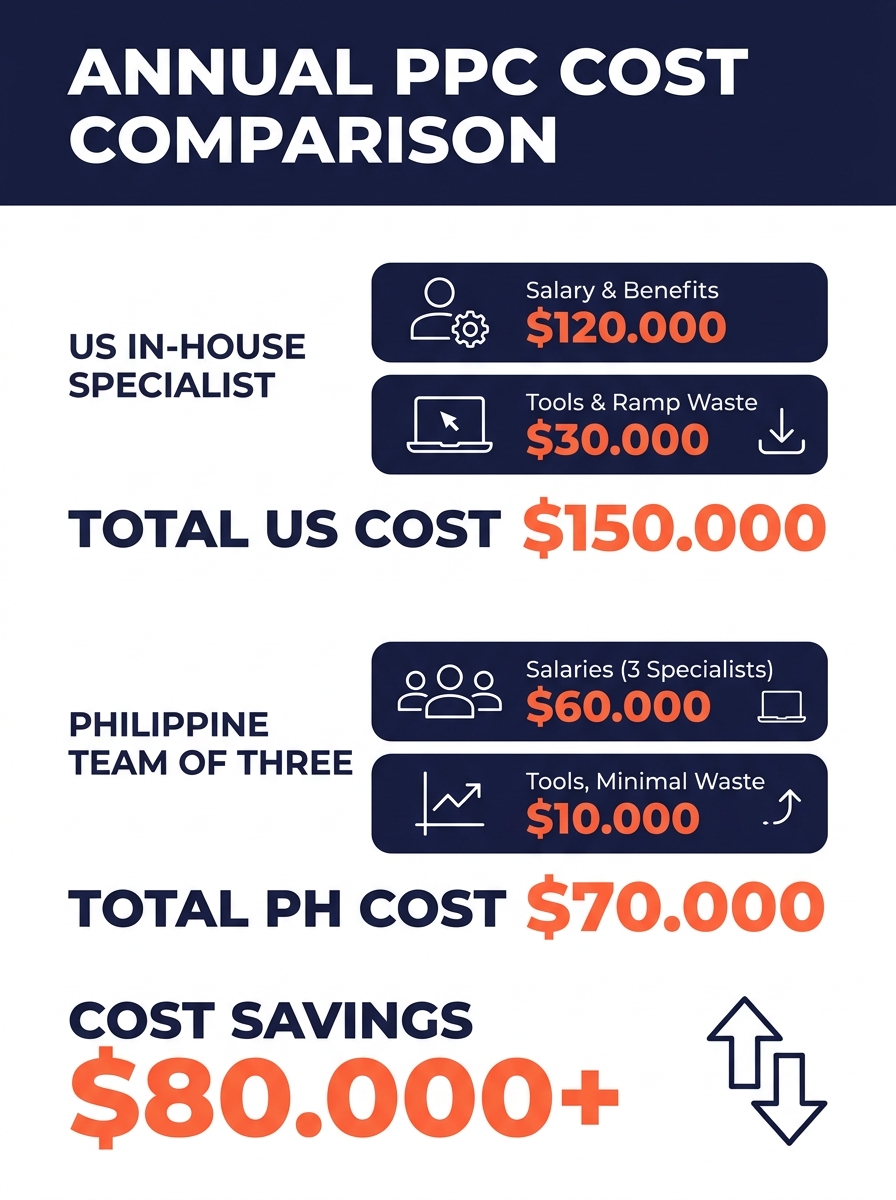
A mid-level PPC specialist in the US pulls a base salary between $55,000 and $85,000 depending on market. Add benefits (typically 25-35% of base), and you’re at $69,000 to $115,000 before they touch a single ad account. Then layer on the tools: Google Ads management software, analytics platforms, A/B testing suites, competitor research subscriptions. Conservative estimate for a functional tool stack is $500 to $1,200 per month, so another $6,000 to $14,400 per year.
Philippine PPC specialists with genuine Google Ads and Meta certifications typically cost between $800 and $1,800 per month in fully loaded compensation. That’s $9,600 to $21,600 per year per person. For the cost of one US hire, you can field two to three specialists who split responsibilities across campaign strategy, ad copy testing, and landing page optimization.
But the salary gap is the obvious part. The hidden number is what your in-house hire costs you in wasted ad spend during their ramp-up period. According to benchmarking data from Cometly, strong PPC performance means 200-300% ROI on ad spend. If your first in-house hire takes three months to reach baseline competence on your account, and you’re running $5,000/month in ad spend during that period, the delta between their learning-curve performance and what a seasoned team would produce can easily represent $4,000 to $8,000 in squandered budget. Philippine marketing teams cost comparison works in their favor on both the labor line and the waste line.
Outsourcing can reduce costs by 60-70% compared to Western markets, and in PPC specifically, the savings hit differently because they compound with the performance gap during ramp-up.
Iteration Speed Is Where Campaigns Are Actually Won
PPC campaign optimization ROI doesn’t come from setting up campaigns correctly on day one. It comes from how fast you can run the test-measure-adjust cycle. A first-time in-house hire is building their testing framework from scratch. They’re deciding which variables to test, learning your analytics setup, figuring out attribution models, and debating internally (often with themselves) whether to try broad match or phrase match keywords first.
A Philippine team that’s managed dozens of accounts across similar verticals already has a playbook. They’ve seen what happens when you test emotional headlines against benefit-driven headlines for service businesses. They know that local service businesses typically see conversion rates between 3-5%, while e-commerce runs 1-2%, and they calibrate expectations accordingly on day one instead of spending weeks collecting baseline data.
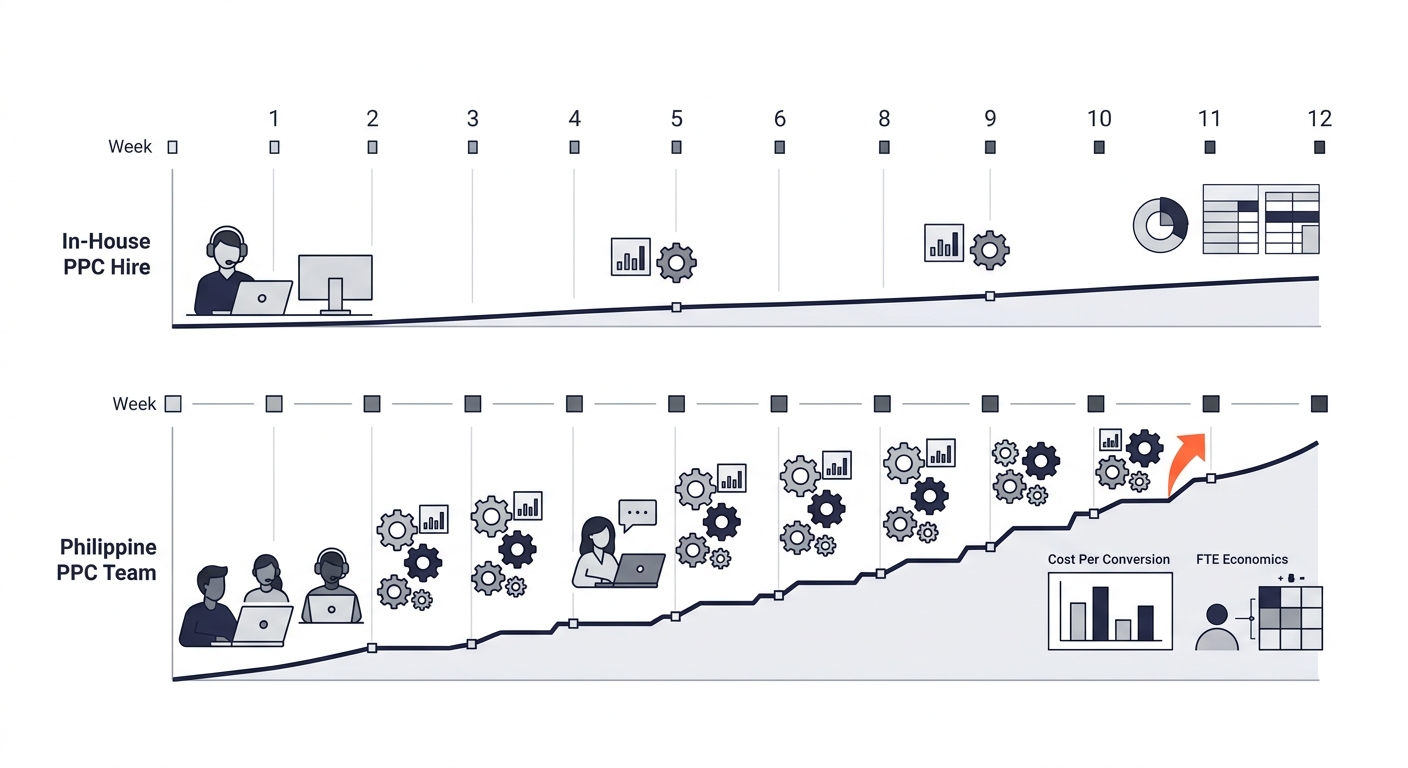
The speed advantage is quantifiable. An experienced team can run two to three A/B tests per week across ad copy, landing page elements, and bidding strategies. A solo in-house hire, even a good one, typically manages one test per week because they’re also handling campaign monitoring, budget pacing, reporting, and the dozen Slack messages from stakeholders asking why the CPC went up on Tuesday.
The real advantage of outsourced digital marketing metrics isn’t that the team is cheaper. It’s that they’ve already made the mistakes your in-house hire is about to make, on someone else’s budget.
This is the same principle behind why offshore teams win through speed testing in broader digital marketing contexts. The compounding effect of faster iteration means a Philippine team can reach your account’s optimal settings in four to six weeks, while an in-house generalist might take three to four months to reach the same point. Every week of that gap costs real money in sub-optimal ad spend.
The First-Campaign Problem Is a Specialization Problem
Your first campaign is uniquely vulnerable to a specific failure mode: the generalist trap. Small and mid-size businesses typically hire a “digital marketing person” and expect them to handle PPC alongside SEO, social media, email marketing, and whatever else needs doing. That person ends up spending maybe 8-12 hours per week on PPC management. A Philippine team dedicated to PPC puts in 40+ collective hours per week on your account’s paid campaigns alone.
And those hours aren’t equal. Someone spending 10 hours a week on Google Ads develops pattern recognition slowly. Someone spending 40 hours a week across multiple accounts develops it fast. They notice that your cost-per-click is climbing because your quality score dropped, and they know from experience that the fix is usually a landing page relevance issue before it’s a bidding strategy problem.
The conversion rate improvement data backs this up. Effective optimization depends on enhancing landing pages, conducting A/B testing, and applying technical optimizations like site speed and mobile UX. Those are all specialization-dependent skills. A dedicated PPC team tests landing page variants as part of their standard workflow. A stretched-thin in-house marketer treats landing page changes as a separate project that requires a ticket in the dev queue, which means it happens quarterly instead of weekly.
When you outsource digital marketing in the Philippines for PPC specifically, you’re buying access to concentrated expertise that a single hire can’t replicate. The math is straightforward: three specialists at $1,200/month each ($3,600 total) collectively deliver more campaign optimization cycles, more granular keyword analysis, and faster response to performance shifts than one US-based generalist at $6,500/month.
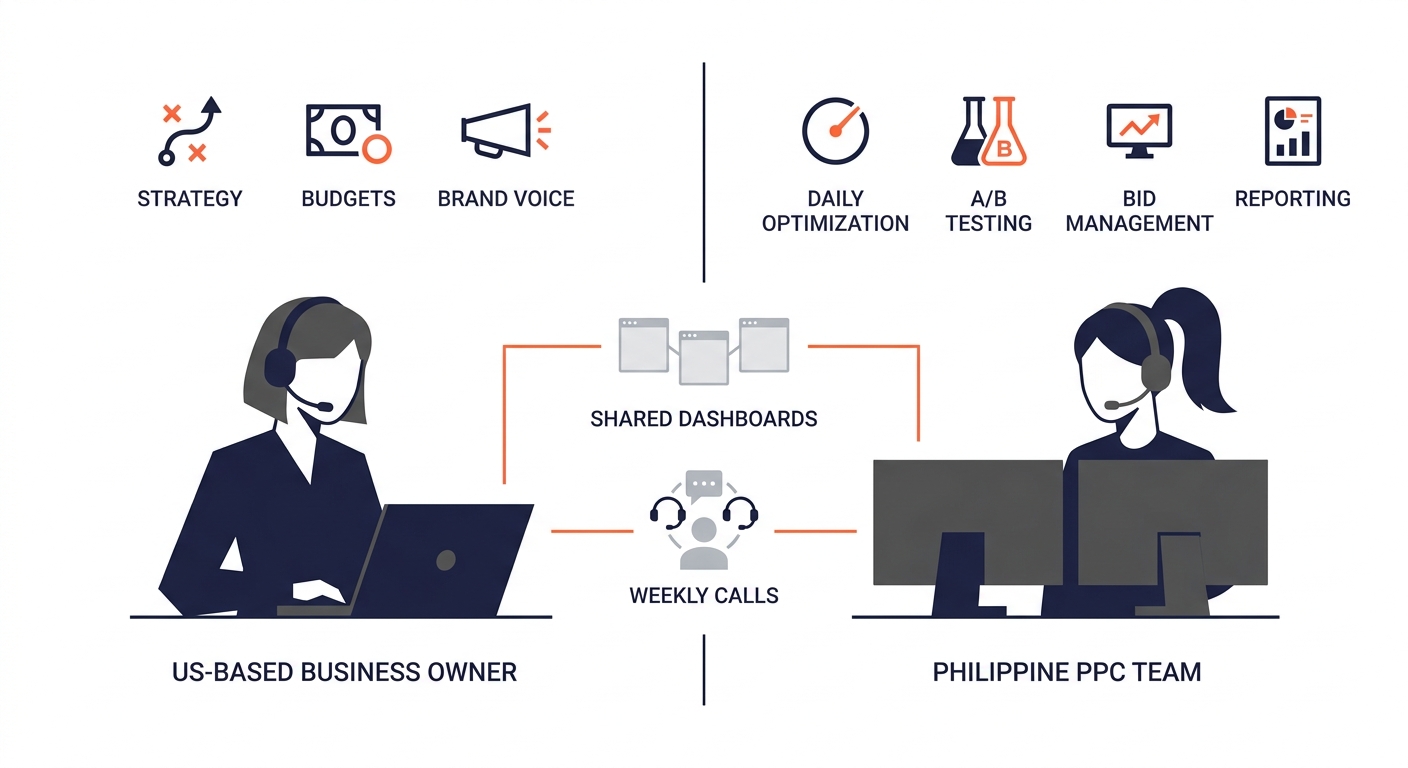
This specialization advantage matters most on the first campaign because that’s when the learning curve is steepest. Your first campaign needs someone who can look at an account with no historical data and make educated decisions about match types, bid strategies, negative keyword lists, and audience segments based on pattern matching from previous accounts. And this is where thinking about the hybrid model of keeping strategy in-house while outsourcing execution becomes practical. You own the business knowledge and strategic direction. They own the platform execution and testing velocity.
Tip: Set specific, measurable targets before engaging any PPC team. Aim for benchmarks like a 15% drop in CPC or a defined conversion rate threshold. These numbers give your outsourced team clear direction and make performance easy to evaluate within the first 60 days.
The Claim, Revisited
The argument here isn’t that Philippine PPC teams are inherently more talented than American marketers. Plenty of excellent PPC specialists work in the US, and for companies with six-figure monthly ad budgets and complex multi-channel attribution needs, an in-house senior hire might make sense. The argument is narrower and more specific: for your first campaign, the economics and the expertise gap both tilt decisively toward an outsourced Philippine team.
Your first campaign is when you can least afford wasted spend. It’s when you have no historical data to guide decisions. It’s when you need someone who’s seen a hundred cold-start accounts and knows what to do in weeks two, three, and four while the algorithm is still learning. The Philippine team’s cost advantage means you can allocate more of your budget to actual ad spend rather than labor overhead. Their experience advantage means that spend converts at a higher rate, sooner.
Run the numbers on your own situation. Take your expected monthly ad budget, add the fully loaded cost of an in-house hire (salary, benefits, tools, management time), and compare it to the cost of a dedicated Philippine PPC team plus the same ad budget. Then factor in a conservative three-month ramp-up penalty for the in-house option, where you’re paying full labor costs but getting 50-70% of optimal campaign performance. For businesses spending $3,000 to $15,000 per month on PPC, the outsourced model typically wins by $20,000 to $40,000 in the first year when you account for both labor savings and reduced waste. That’s a meaningful number for any SMB, and it’s the kind of outsourced digital marketing metrics advantage that shows up in the P&L, not just the marketing dashboard.
Philippine PPC teams scale well for growing agencies too. If your first campaign works, adding a second or third campaign doesn’t require a new hire. It requires a conversation about capacity with the same team that already understands your brand, your audience, and your conversion patterns. That operational continuity is worth something the ROI calculator doesn’t capture, but your quarterly results will.