
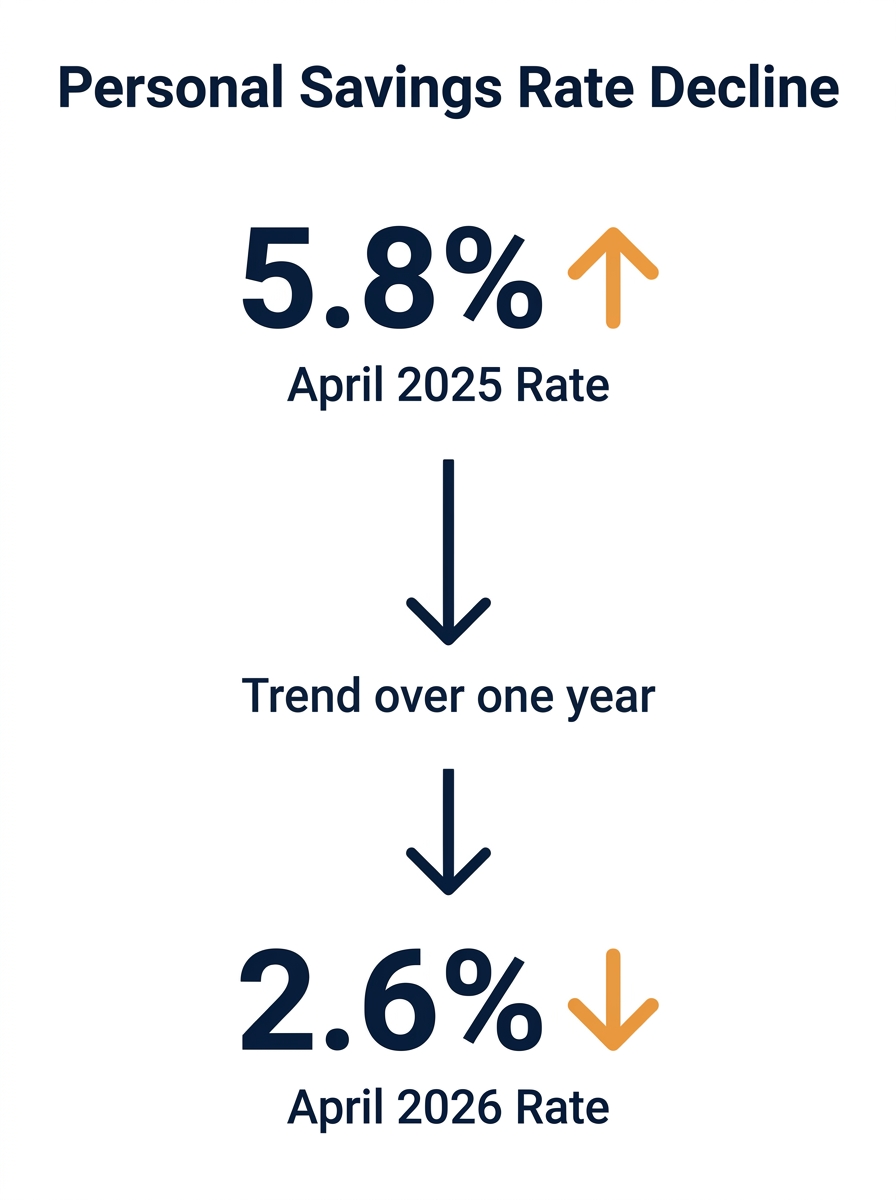
American household savings fell to 2.6% of income in April, the lowest rate since June 2022, as 3.8% inflation outpaced 3.6% wage growth, the Bureau of Economic Analysis reported May 28. Over a third of households now use credit to cover basic monthly expenses.
TL;DR: The personal savings rate hit a four-year low in April 2026 as inflation running at 3.8% exceeded wage increases of 3.6%, forcing 37% of households to rely on credit for expenses and pushing more workers to tap retirement accounts.
The April reading represents a sharp decline from 3.2% in March and 5.8% a year earlier, according to BEA data. “I thought 2.6% for April was a typo at first. It is so low,” said Heather Long, chief economist at Navy Federal Credit Union, in an email to clients. “Outside of the revenge spend era of 2022, the personal savings rate has almost never been this low in the past 65 years.”
The last time the savings rate fell this far was June 2022, when it reached 2.2% during record-high inflation. That earlier drop occurred while Americans still held pandemic stimulus funds and spent heavily as the economy reopened, Long noted. The current decline reflects a different dynamic: households depleting reserves while facing sustained cost increases.
Gas Prices and Essential Costs Drive Decline
Gasoline prices reached $4.43 per gallon nationally as of May 28, according to AAA data, driven by supply disruptions from the Iran conflict that began earlier this year. The fuel cost surge compounds price increases across groceries, utilities, and healthcare, categories that households cannot easily reduce.
“Even with tax cuts, paychecks aren’t keeping up with inflation right now,” Long said. “It’s more than just high gas prices. It’s rising electricity, healthcare and food prices. These are the basics that people must pay. It’s harder to skimp on these items.”
Bureau of Labor Statistics data shows wage growth began lagging inflation in April for the first time since late 2023. Average hourly earnings rose 3.6% year-over-year in April, falling below the 3.8% inflation rate reported for the same month, the highest inflation reading since May 2023.
The wage-inflation crossover means real purchasing power declined in April even as nominal paychecks increased. For business owners facing the same inflation pressures while trying to retain staff, the data creates a dual squeeze: employee compensation must rise to match cost-of-living increases, while business revenue often fails to keep pace with input cost inflation.
Credit Reliance and 401(k) Withdrawals Accelerate
Thirty-seven percent of Americans reported they will need to use credit cards, Buy Now Pay Later services, or other loans to cover at least some expenses in May, according to a NerdWallet survey of 2,072 U.S. adults conducted in early May. The credit reliance extends to higher-income brackets, with 35% of households earning at least $100,000 annually saying they’ll use borrowed funds for monthly expenses.
Fidelity data released May 28 shows the share of workers with an outstanding 401(k) loan climbed to 19.2% in the first quarter of 2026, up from 18.8% a year earlier. The financial services firm also reported increases in both new loan originations and hardship withdrawals during the quarter.
“Many consumers still have enough cash for now, but they will have to belt-tighten later this year as the tax refunds are spent and there isn’t any additional income boost on the horizon for most households,” Long said. The economist’s forecast suggests the savings decline may accelerate through the second half of 2026 as households exhaust temporary cash reserves.
The retirement account withdrawal pattern particularly affects small and mid-sized employers, who face potential retention challenges if employees begin seeking higher-paying roles to offset personal financial stress. The same cost pressures that drive workers to tap 401(k) accounts make it difficult for SMBs to offer competitive wage increases without cutting other operating expenses.
What This Means for US
The savings rate decline and wage-inflation gap create direct pressure on US SMB payroll economics. When 3.8% inflation runs ahead of 3.6% wage growth, maintaining workforce purchasing power requires raises that exceed revenue growth for most small businesses. The April data validates what operators have reported anecdotally since early 2026: domestic headcount costs are rising faster than the value those roles deliver, particularly for back-office functions where output doesn’t scale with inflation.
Philippine BPO teams became cost-competitive against US hiring years ago, but the current wage-inflation crossover makes the FTE-cost differential harder to ignore. A $55K/year US administrative role carries $75K in fully loaded costs when accounting for benefits, taxes, and overhead; the equivalent Philippine role runs $18-24K annually at current exchange rates. That $50K+ gap per FTE creates room to absorb inflation pressure without cutting service capacity. Businesses facing the revenue threshold decision between in-house and outsourced teams now confront a lower breakeven point as domestic wage inflation compounds.
The retirement account withdrawal data suggests workforce financial stress will increase through the year. SMBs that lock in offshore partnerships before wage pressure accelerates further preserve 2026 cost structures rather than chasing 2027 market rates for domestic hiring. The savings rate trend points toward sustained pressure, not a temporary dip, April’s 2.6% represents the lowest reading outside the post-pandemic spending surge, and household cash reserves are declining rather than building.