
AI web app development in 2026 runs on three interlocking layers: AI-assisted coding that generates and reviews pull requests in real time, microservices architecture that lets distributed engineers ship features independently, and DORA-based metrics that replace vanity output counts with deployment frequency and cycle time. Misunderstand any one layer and the whole system looks like magic. It isn’t.
TL;DR: Offshore AI-powered development teams produce scalable apps through a specific mechanism: AI handles code generation and review at the task level, microservices let each developer deploy without waiting for the full team, and outcome metrics (cycle time, change failure rate, deployment frequency) keep quality visible across time zones. The result is up to 50% cost savings with measurable velocity parity.
AI-Assisted Coding Is the Task-Level Engine
Every line of code an offshore developer writes in 2026 passes through an AI coding layer. Tools like GitHub Copilot, Cursor, and Codeium generate boilerplate, suggest function implementations, and flag errors during the writing process itself. The developer’s role shifts from typing syntax to reviewing, editing, and directing output. According to Figma’s 2026 web development analysis, AI-driven workflows and server-first performance patterns are now reshaping how teams build across the industry.
What does this look like in an actual sprint? A Philippine developer working on a payment integration module describes the feature in natural language, gets a generated code block, then refines it against the project’s existing patterns. PR throughput (the number of pull requests merged per developer per week) rises because the mechanical work compresses. A Forbes Tech Council analysis published January 20, 2026 identified cycle time and lead time as the metrics that matter: “How quickly did an idea move from backlog to production?” The answer, with AI tooling layered onto an experienced offshore team, is measurably faster than manual coding alone.
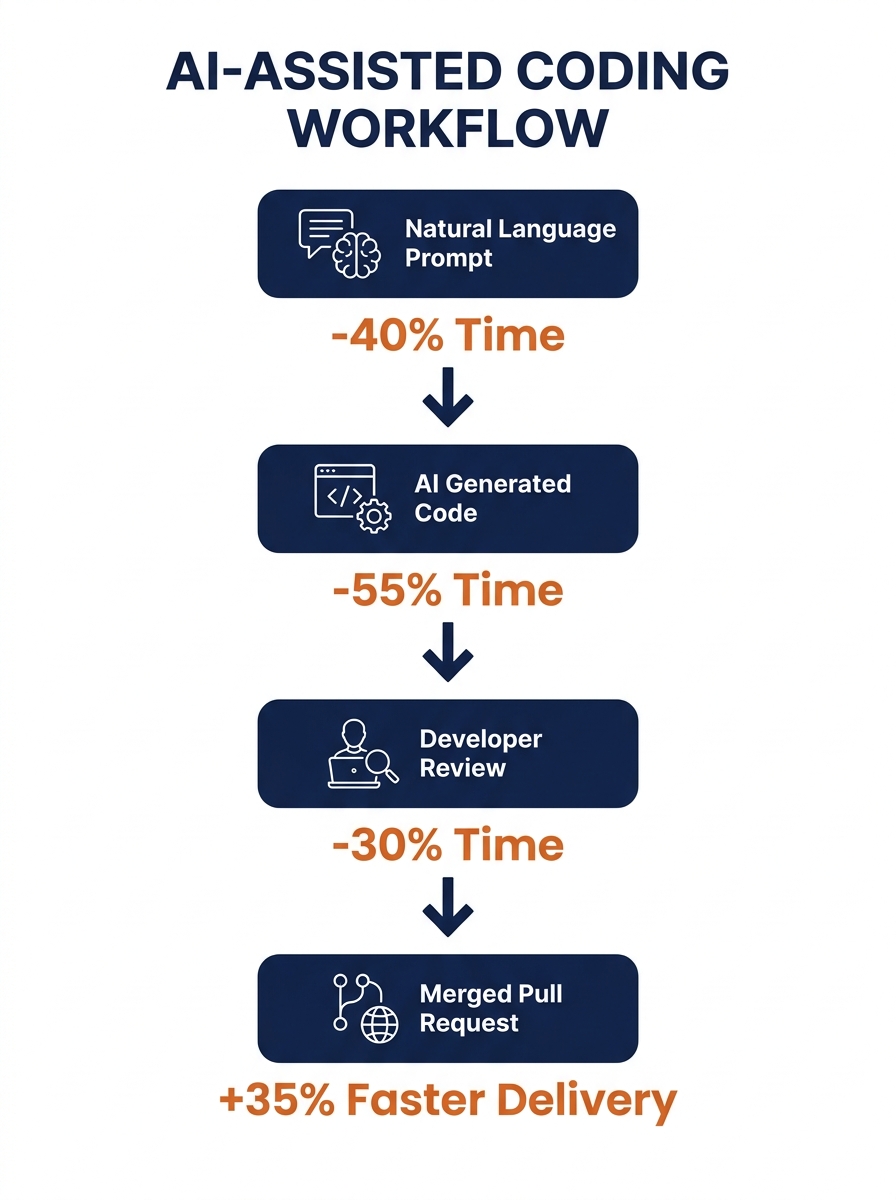
This is where outsourcing web development 2026 diverges from the 2020 model. Five years ago, you paid for keystrokes. Now you pay for the judgment that sits on top of AI-generated output. Offshore development cost efficiency improves because the AI compresses the low-value portion of each task, and the developer’s hourly rate buys more architectural thinking per dollar. Businesses hiring offshore AI engineers save up to 50% on development costs compared to equivalent onshore hires, according to Spaculus Software’s 2026 analysis.
Microservices Decomposition Makes Distribution Possible
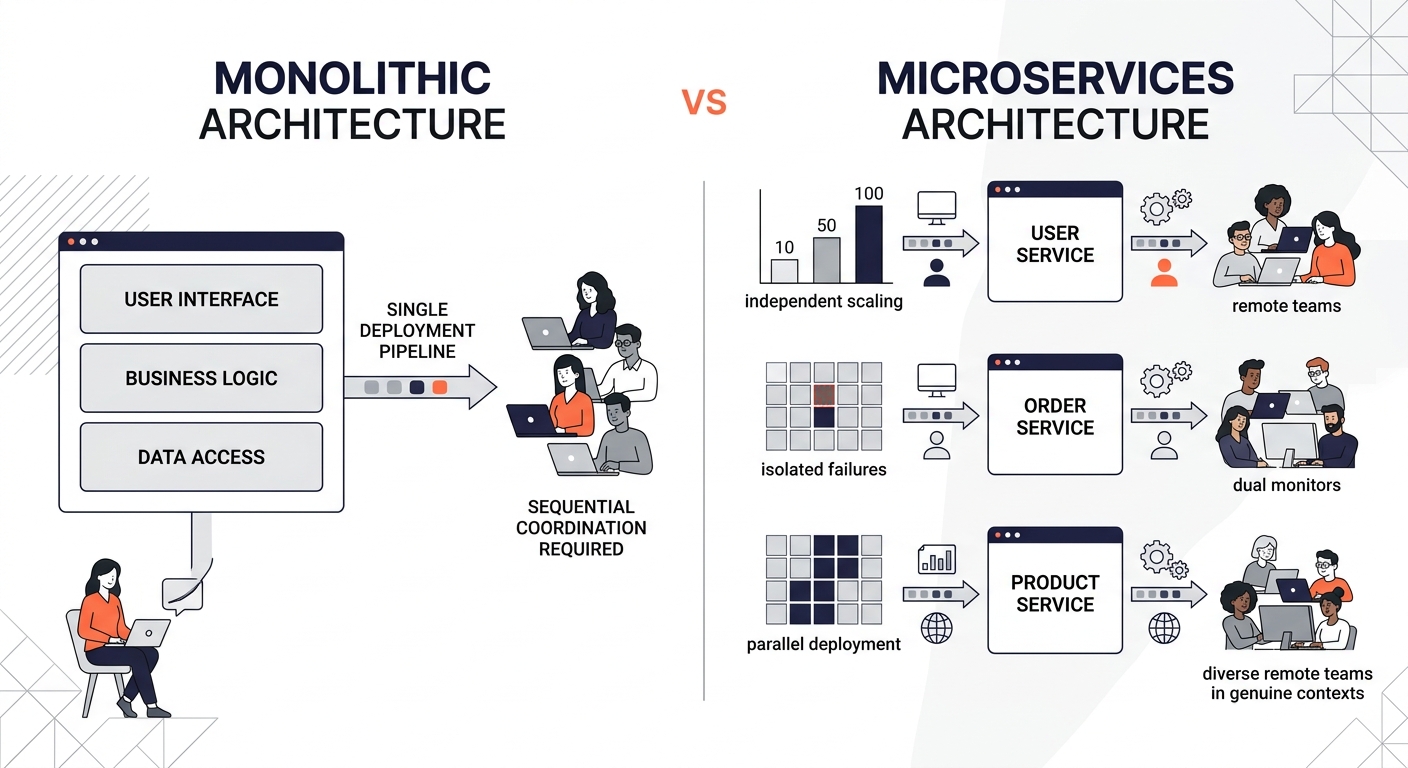
Scalable app architecture depends on breaking the application into independent services, each responsible for a single function (authentication, payments, notifications, search). As ByteByteGo’s microservices guide describes it, each piece “focuses on a specific function such as payments, inventory, or user management” and can be “developed, tested, deployed, and scaled independently.”
Why does this matter for distributed teams? Because microservices eliminate the coordination bottleneck that killed monolithic offshore projects. When your entire app is one codebase, every developer’s commit touches the same deployment pipeline. Merge conflicts multiply. Time-zone gaps between your US-based product owner and your Philippine engineering team turn into 24-hour blocking cycles.
Microservices dissolve that problem. Developer A in Manila deploys the notifications service at 3 PM Philippine time. Developer B in Cebu ships a search indexing update at 5 PM. Neither deployment touches the other’s code. The ACM’s research on microservice architectures confirms that these architectures are “built on several core principles” ensuring they remain scalable and maintainable as team size and geographic distribution grow.
Amazon’s own infrastructure illustrates the pattern at scale. Amazon developed Kinesis for real-time data streaming and Aurora for high-performance relational databases, both designed around event-driven, decoupled architecture principles. Your offshore team doesn’t need Amazon’s budget to apply the same structural logic. A 4-person Philippine development team building a SaaS product can assign one engineer per service boundary and ship features without stepping on each other’s deployments.
If you’ve already explored how scalable systems work with distributed teams, the AI layer adds a new dimension: each microservice gets its own AI-assisted development context, meaning the coding tools can specialize in the patterns and libraries specific to that service.
The Measurement Layer That Keeps It Honest
AI-powered development teams need different metrics than traditional offshore engagements. Lines of code, hours logged, and tickets closed are vanity numbers when AI generates 40% of the initial code. The industry has converged on 5 DORA metrics as the standard: deployment frequency, lead time for changes, change failure rate, time to restore service, and (added in the AI era) AI-specific capability assessment.
GetDX, a developer experience platform, recommends teams start by measuring PR throughput, code review cycle times, and deployment success rates alongside developer-reported friction surveys. The combination catches something pure output metrics miss: whether the AI tools are actually reducing friction or just generating more code that requires more review.
Offshore development cost efficiency in 2026 isn’t about cheaper hours. It’s about compressing the low-judgment portion of each task with AI so the developer’s time concentrates on architecture, edge cases, and integration logic.
For buyers evaluating an outsourced web development engagement, these metrics create transparency that hourly billing never could. You can see deployment frequency by service, track change failure rates per developer, and compare lead times against your onshore benchmarks. This connects directly to the same principles behind setting KPIs that measure real VA and team ROI: define the outcome, measure the outcome, ignore the activity metrics that make everyone feel busy.
Where SEO Intersects With Architecture Decisions
The reason this topic belongs in an SEO outsourcing conversation: every architectural decision your development team makes directly affects crawlability, page speed, and Core Web Vitals scores. A monolithic app that renders everything server-side might score well on Largest Contentful Paint but collapse under traffic spikes. A poorly configured microservices setup with a JavaScript-heavy frontend might load fast on fiber connections and timeout on mobile networks in secondary markets.
According to LogRocket’s 2026 trends analysis, frontend developers are now “building systems that expect AI input and output as part of normal operation,” including generating UI variations and adapting content dynamically. These AI-driven features affect how search engines parse and index your pages. If your offshore development team builds dynamic content modules without considering how Googlebot renders JavaScript, you lose organic visibility.
Warning: AI-generated UI components that render client-side can be invisible to search crawlers. Make sure your offshore dev team implements server-side rendering or pre-rendering for any content that needs to rank.
This is where having seo services integrated with your development workflow pays for itself. The architecture choices happen in sprint planning, not after launch. Teams that treat SEO as a post-development audit consistently lose traffic during platform migrations and spend months recovering rankings that never needed to drop.
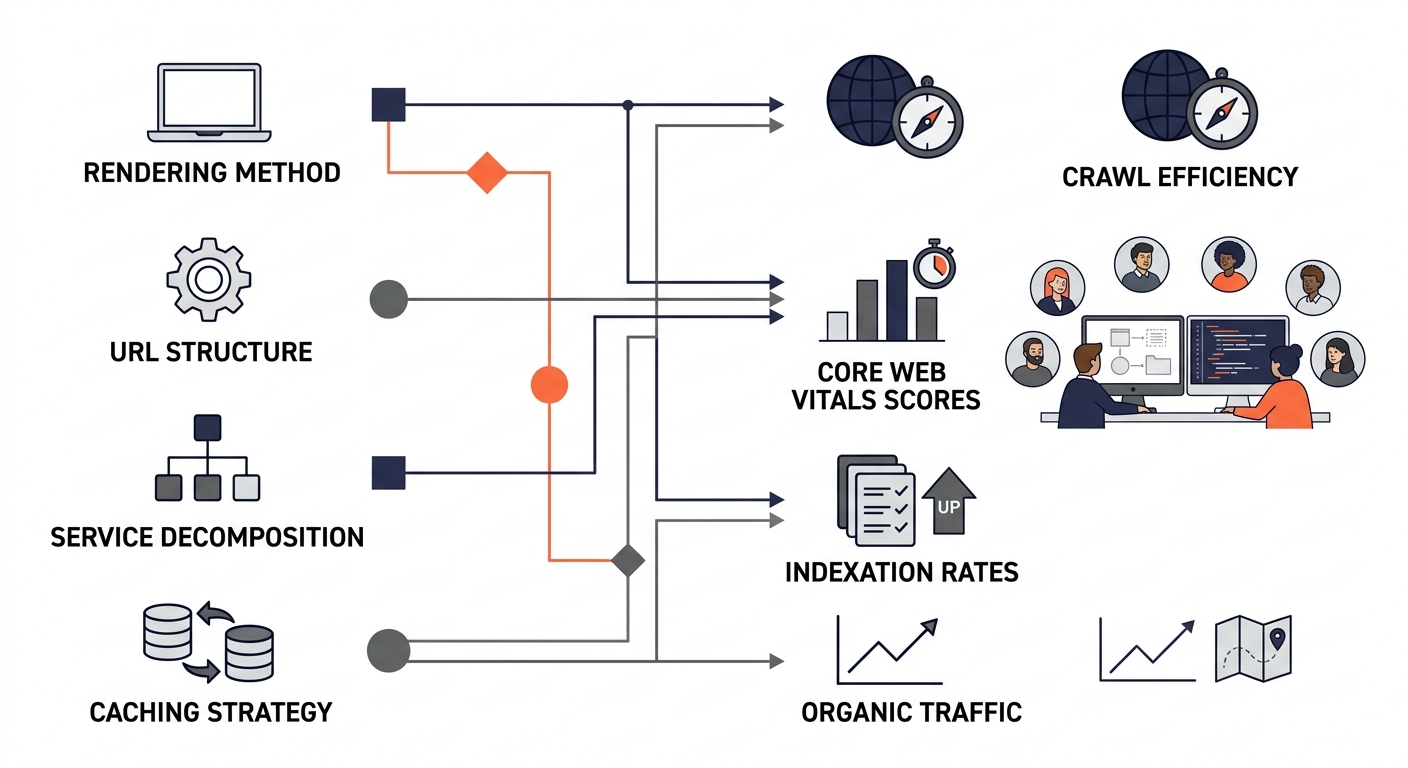
The top web development trends in 2026 include headless architecture, progressive web apps, and serverless computing. Each of these has specific SEO implications. Headless CMS setups require explicit sitemap management. PWAs need proper service worker configuration to avoid caching stale content for crawlers. Serverless functions can introduce cold-start latency that tanks Time to First Byte. Your AI-powered development team needs to know these tradeoffs before writing the first line of code, not after the app ships.
The Cost Arithmetic in Practice
The math works like this. A mid-level US-based full-stack developer costs $140,000 to $180,000 per year fully loaded. An equivalent Philippine developer with AI tooling access runs $35,000 to $55,000 fully loaded, including tool licenses, management overhead, and infrastructure. That’s the 50% to 70% savings figure you’ll see quoted across the industry.
But the mechanism matters more than the number. The savings don’t come from paying someone less to do the same work. They come from a structural change: AI compresses the routine 30% to 40% of coding tasks (boilerplate, test generation, documentation), the developer’s time concentrates on architecture and integration logic, and microservices let each developer operate independently without coordination tax. The cost-per-feature drops because each hour of developer time yields more shippable output.
For SMBs weighing these decisions, the revenue threshold framework for deciding when to outsource versus build in-house still applies. The threshold has shifted downward because AI tooling makes smaller offshore teams viable for projects that previously required 6 or more engineers.
Where the Model Breaks
Three failure modes show up repeatedly. First, AI-generated code creates a false sense of velocity. Teams ship features faster but accumulate hidden bugs in edge cases the AI didn’t consider. Change failure rate (one of those DORA metrics) catches this, but only if someone is tracking it. Teams that measure deployment frequency without measuring failure rate are driving fast with no brakes.
Second, microservices introduce network complexity. Each service-to-service call adds latency and a potential failure point. A 4-service app has manageable complexity. A 20-service app built by a team that decomposed too aggressively turns every debugging session into a distributed systems puzzle. The architecture needs to match the team’s size and the product’s actual scaling requirements, not an idealized diagram.
Third, time-zone gaps still matter for decisions, even when they don’t matter for deployments. Microservices let developers ship independently, but product decisions (which features to build, how to handle conflicting requirements, when to take on technical debt intentionally) still require synchronous conversation. Teams that assume async communication covers everything end up with technically excellent services that don’t cohere into a usable product. The mechanism works when the deployment layer is independent and the decision layer has enough overlap hours to stay aligned.
The model is durable. It handles scaling, it handles cost pressure, and it handles the AI transition better than monolithic alternatives. It breaks when teams confuse deployment independence with decision independence, or when AI-generated velocity masks declining code quality. Track the right metrics, staff the right overlap hours, and the mechanism holds.