
US agencies outsourcing digital marketing strategy to offshore partners gain access to specialized planning capacity at 40–70% lower cost than domestic hires. The mechanism works because strategic outsourcing restructures how agencies allocate senior talent, rather than replacing them.
TL;DR: The shift from tactical outsourcing (farm out blog posts and ad management) to strategic outsourcing (hand off channel planning, competitive analysis, and performance architecture) lets US agencies redeploy expensive domestic staff to client relationships and business development. Philippine digital marketing agencies running dedicated strategy pods are the fastest-growing segment of a market projected to reach $74.76 billion by 2034.
The Execution-Only Ceiling
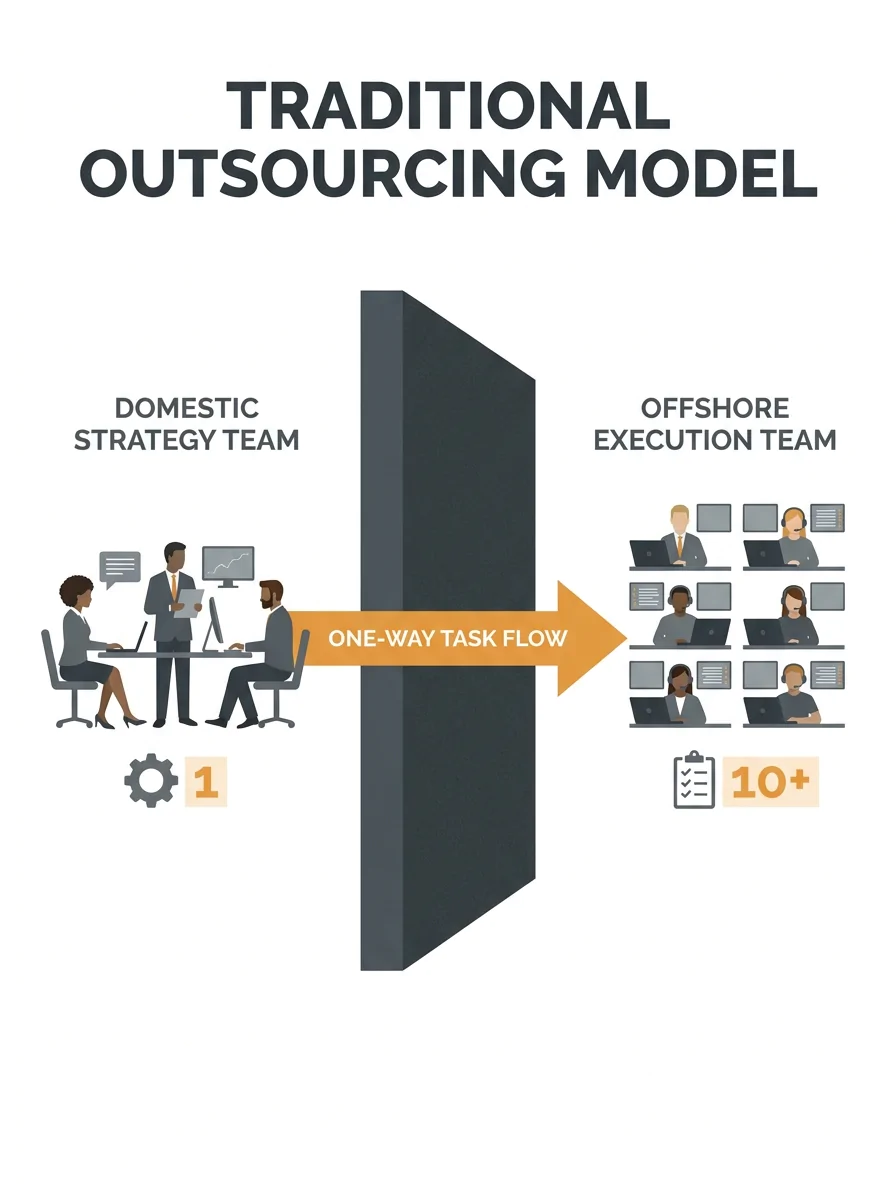
For most of the past decade, agency outsourcing followed a predictable pattern: keep strategy domestic, send production offshore. Content writing, ad trafficking, social scheduling, report formatting. These tasks traveled well across time zones and cost 40–70% less when handled by offshore SEO strategy services in the Philippines or India.
That model worked when the work itself was simple. But enterprise marketers now manage over 120 MarTech tools, according to Neowork’s 2026 Digital Marketing Outsourcing Companies Guide. The volume of strategic decisions required each week grew too: which audiences to target, how to weight spend across channels, when to shift budget from paid search to programmatic. A small domestic team couldn’t handle all of that while also managing client relationships and pitching new business.
Kruti, an industry expert at IMS nHance, described the shift in February 2026: “The conversation has completely shifted. It’s no longer about social posts; clients want to understand attribution, performance, and ROI.”
The old approach assumed strategy was inherently domestic work and that execution was the only function worth sending offshore. Agencies that held onto that assumption found their senior staff buried in competitive audits instead of growing accounts.
How Strategic Outsourcing Restructures Agency Capacity
The mechanism behind strategic outsourcing is straightforward once you see it: agencies aren’t paying offshore teams to think instead of domestic staff. They’re paying offshore teams to think so domestic staff can stop being overloaded strategists and become full-time relationship managers and closers.
Here’s the math. A US-based technical SEO expert costs $80,000–$100,000 per year, according to Floowitalent’s SEO outsourcing analysis. An offshore strategy team with comparable tooling (Ahrefs, SEMrush, GA4, Looker Studio) runs $3,000–$5,000 per month, or roughly $36,000–$60,000 annually for an entire team’s output. That single line item frees up the domestic expert’s hours for client-facing work that actually grows revenue.
The split in practice:
Offshore strategy team handles:
- Competitive landscape analysis and quarterly strategy decks
- Channel allocation recommendations based on attribution data
- Audience segmentation and persona development
- Content calendar architecture tied to search demand curves
- Performance benchmarking and reforecasting
Domestic team focuses on:
- Client presentations and relationship management
- New business pitching and proposals
- Brand voice governance and final creative approval
- High-level budget sign-off
This is the same structural logic we’ve explored in the context of keeping strategy in-house while outsourcing execution, but the current version pushes the boundary further upstream. The offshore team drafts the plan itself for domestic review and approval, rather than waiting to receive a finished brief.
Pods Versus Individual Contractors
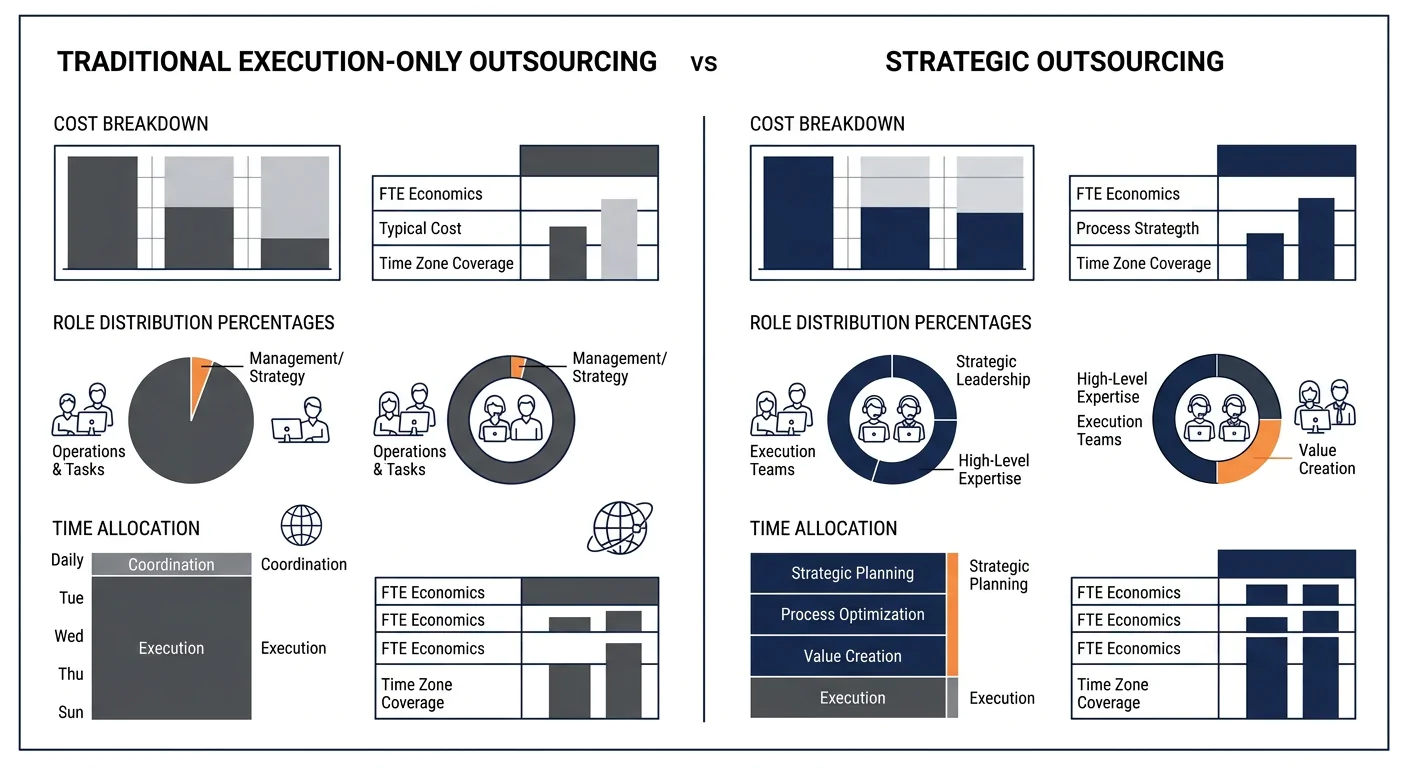
Why does this work at the team level? The answer is organizational design. Successful digital marketing strategy outsourcing in 2026 doesn’t involve hiring three freelancers in different cities. It uses what the industry calls “pods,” dedicated cross-functional teams that combine SEO strategists, paid media planners, content strategists, and analytics specialists into a single unit.
Bruntwork’s 2026 research highlighted that pods resolve a chronic problem with contractor-based models: channel conflict. When an independent SEO freelancer and an independent PPC freelancer both make recommendations in isolation, their suggestions frequently contradict each other. A pod works through those conflicts internally before presenting a unified recommendation.
The pod model works because it absorbs the coordination cost that previously fell on the agency’s domestic team, the very cost that made execution-only outsourcing feel cheap but exhausting.
Brand Vantage, writing in January 2026, emphasized the stability dimension: “Control doesn’t come from doing everything internally. It comes from systems, accountability, and working with partners who understand agency delivery at a strategic level.”
Philippine digital marketing agencies have been building pod infrastructure for years. Companies that treat Philippine outsourcing as strategic infrastructure for growth rather than tactical cost reduction consistently outperform those running ad-hoc contractor networks. The Philippines’ 96.3% English literacy rate and strong cultural alignment with American business norms make the strategy layer viable in ways that pure cost-arbitrage destinations often can’t sustain.
The pod approach also explains why offshore teams frequently outpace new full-time hires in the first 90 days. The team arrives pre-integrated, with internal processes already running.
The Three-Layer Outsourcing Stack
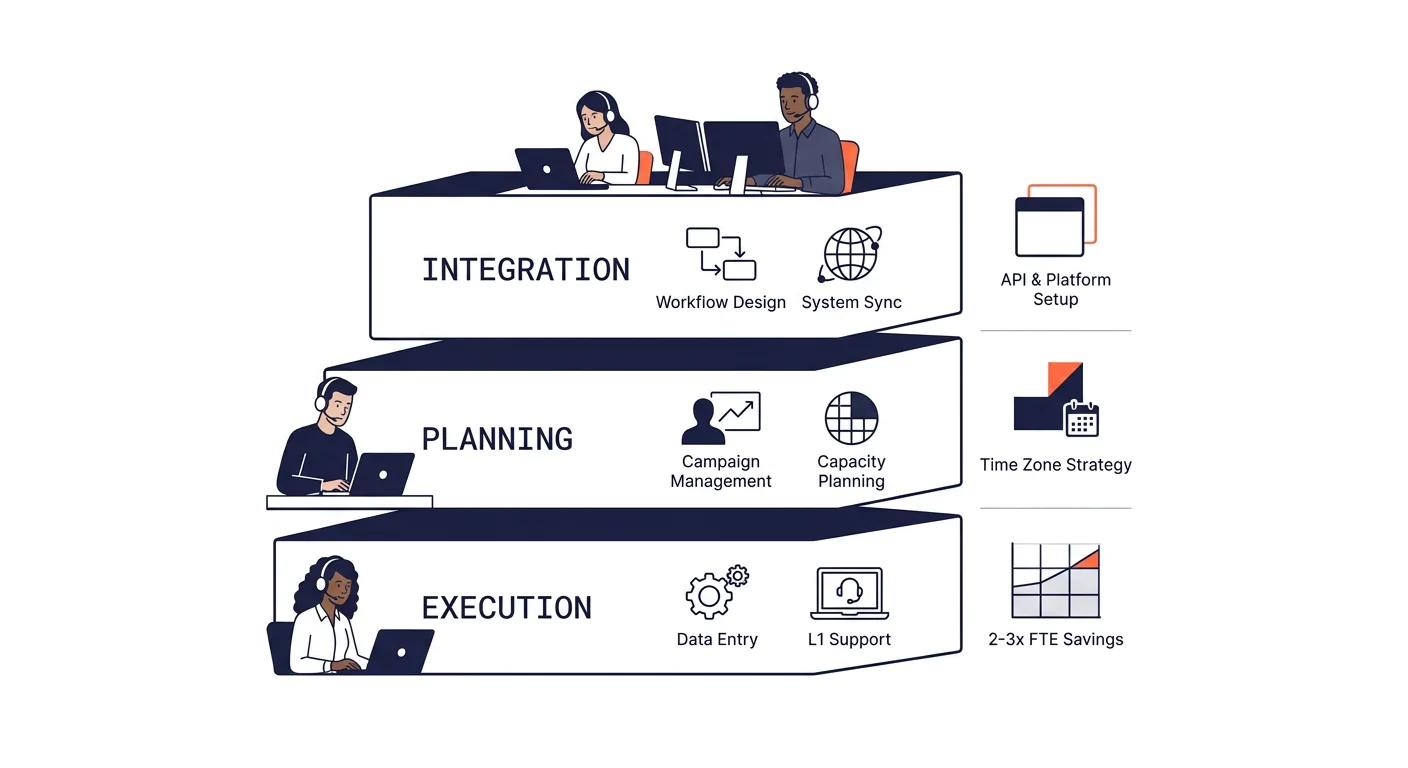
To evaluate whether an agency is ready for strategic outsourcing (and where the model applies versus where it doesn’t), it helps to think in three layers:
| Layer | What Gets Outsourced | Domestic Role | Risk Level |
|---|---|---|---|
| Execution | Content production, ad trafficking, report formatting, social scheduling | Brief creation, QA review | Low |
| Planning | Channel strategy, audience segmentation, budget allocation modeling, competitive analysis | Approval, client presentation | Medium |
| Integration | Joint strategy sessions, real-time campaign pivots, client-facing analytics | Shared ownership, co-creation | High |
Most agencies that tried outsourcing before 2024 operated exclusively at the Execution Layer. The current shift moves them into the Planning Layer, where the offshore team generates strategy artifacts like media plans, audience maps, and attribution models for domestic leadership to review and present.
The Integration Layer is where a few advanced agencies now operate, with offshore strategists joining client calls and co-presenting recommendations. This layer carries higher risk because it requires deep cultural fluency and real-time communication, but it also delivers the highest capacity gain.
A useful benchmark: agencies billing under $2M annually typically benefit most from the Planning Layer. Agencies above $5M are experimenting with Integration. The revenue threshold framework for outsource-versus-build decisions provides a more detailed decision matrix.
What the Numbers Actually Show
The digital marketing outsourcing market is projected to grow from $25.4 billion (2024) to approximately $74.76 billion by 2034, reflecting an 11.4% CAGR. That growth rate confirms the model is working at scale, but the interesting economics are at the individual agency level.
Consider a mid-size US agency running $150K/month in managed ad spend across 15 clients. The traditional staffing model requires 2 senior strategists at $180K–$200K combined salary plus benefits, 3 execution specialists at $150K–$180K combined, and $5,000–$10,000/year in tool subscriptions for platforms like Ahrefs, SEMrush, and GA4 premium. Total annual cost: roughly $350K–$400K.
The strategic outsourcing model: 1 domestic strategist/client lead at $90K–$100K, plus 1 offshore strategy pod of 3–4 specialists at $4,000–$5,000 per month ($48K–$60K annually), with tool subscriptions absorbed by the offshore partner who already maintains enterprise licenses. Total annual cost: roughly $140K–$165K.
That’s a 55–60% reduction in fixed costs while maintaining or increasing strategic output. The agency’s remaining domestic strategist spends 80% of their time on client relationships and new business instead of building competitive audits and media planning spreadsheets.
As Trends4tech noted: “Digital marketing strategies in 2026 demand range, strategy, data, creativity, and tech. Expecting one person to master all of that is unrealistic.”
This cost structure extends beyond SEO and content strategy. Agencies running outsourced PPC management through Philippine teams see similar economics on the paid search side, while social media outsourcing follows the same pod-based model for organic and paid social planning.
Info: The AI factor matters here too. Offshore teams in 2026 bring AI-powered automation for reporting, bid optimization, and content analysis that saves 10–15 hours monthly per client. We’ve covered how [AI-driven SEO services are reshaping outsourcing economics](/blog/ai-driven-seo-outsourcing-economics) in detail. The short version: AI compresses task costs while raising the strategic bar, which makes human strategists more valuable, not less.
Where the Model Breaks
Strategic outsourcing fails in three specific scenarios, and recognizing them early saves agencies from expensive mistakes.
The agency can’t articulate its own positioning. If you don’t know what your agency stands for, an offshore strategy team will produce generic work. Outsourced strategists are excellent at executing against a clear brief and brand framework. They’re poor at inventing that framework from scratch for an agency that hasn’t done the internal work.
High turnover at the offshore partner. Brand Vantage flagged this as the most underestimated risk: “Team stability is a crucial, often overlooked element. High turnover in outsourced teams erodes knowledge and increases management overhead.” A pod that loses its senior strategist every six months becomes a training cost center instead of a strategic asset. Vet partners on retention rates before signing.
The agency treats the pod as a vendor instead of an extension. Neowork’s 2026 guide emphasizes that agencies must share deep context, including product updates, customer feedback, and competitive intelligence, for offshore strategists to make sound decisions. Agencies that withhold information and expect magic get execution-quality output at strategy-level prices.
The model also has a natural ceiling. Client relationships that depend heavily on in-person rapport, hyperlocal campaigns for a single metro area, or regulated industries requiring domestic-only data handling don’t translate well to offshore strategy. These remain domestic functions.
And the honest truth about strategic outsourcing vs. tactical outsourcing: the payoff comes in months four through twelve, when the pod operates independently and the domestic team’s capacity opens up. The first 60–90 days require real investment in onboarding, context transfer, and workflow design. Agencies expecting instant results from week one will be disappointed and will blame the model when the implementation was the actual failure point. The mechanism is sound. The patience required to let it work is where most agencies fall short.