
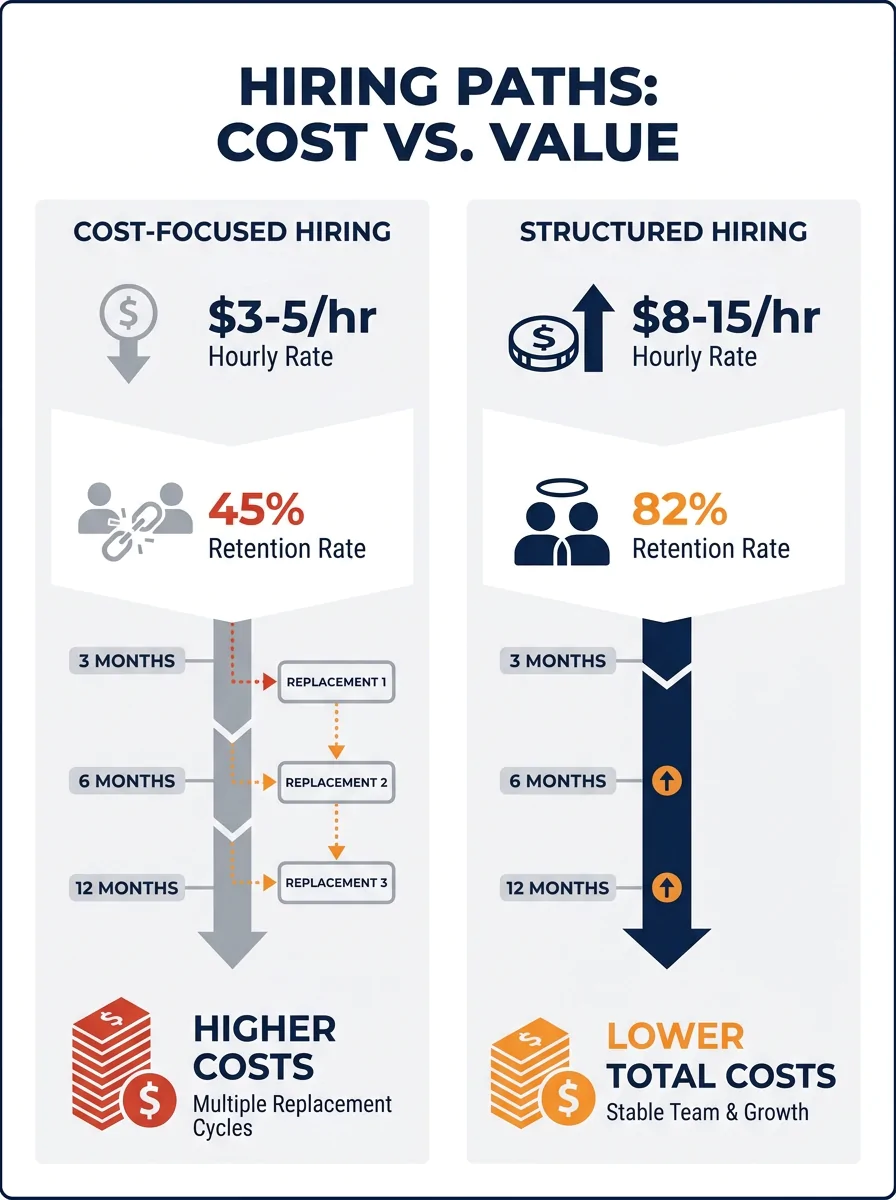
Directly hired freelance virtual assistants retain at a 45% rate over twelve months, while agency-vetted VAs retain at 82%. That 37-point gap represents the strongest available evidence that optimizing for the lowest hourly rate produces the highest total cost of ownership.
TL;DR: Businesses paying rock-bottom VA rates ($3–$5/hr) cycle through 4–5 replacements per ten-person team annually, while those paying fair-market rates ($8–$15/hr for Filipino talent) see 18% turnover and $11,600–$17,400 in annual savings from reduced churn alone. Structured onboarding cuts early attrition by more than 50%.
The 45% vs. 82% Retention Split
The freelance marketplace model optimizes for a single variable: price. Structured placement models screen for reliability, cultural fit, and role-specific skills through multi-stage vetting. That difference in process creates a 37-percentage-point retention gap that compounds with every replacement cycle.
At an outsourced VA turnover rate of 18%, a ten-person team experiences roughly 1.8 turnovers per year, costing $3,600–$5,400 in replacement expenses. Direct freelance hires, with their 45% twelve-month retention rate, generate 4–5 replacements per ten-person team annually. The replacement math alone (recruiting, onboarding, ramp-up productivity loss, institutional knowledge drain) often exceeds the hourly rate “savings” within the first quarter.
The pattern among clients who come to us after failed VA relationships is consistent: they hired at $3–$5/hour, lost 2–3 VAs within six months, and spent more cycling through hires than they would have spent on a single $10–$12/hour placement that lasted the full year.
What a $5/Hour VA Actually Costs You
The turnover savings for a ten-person outsourced team run between $11,600 and $17,400 per year compared to a team staffed through direct freelance channels, according to VA Masters’ analysis of real company numbers. Those figures don’t include the harder-to-quantify costs: the hours you personally spend re-explaining processes, the client deliverables that slip during each transition, and the trust deficit that builds when your team can’t hold institutional knowledge past a single project cycle.
A Forbes Business Council contributor wrote in May 2026 that the VA market is experiencing “a shift in both cost and capability. Rather than getting the same output for less, businesses are getting better output at a lower price point.” That observation lines up with what retention data shows: 73% of VAs now use AI tools weekly, boosting individual productivity by 2.4x. The VAs delivering that kind of output don’t work for $3/hour. They work for $8–$15/hour, and they stay with employers who recognize what they bring.
This is the core miscalculation behind most virtual assistant hiring mistakes. The $5/hour VA isn’t cheaper. They’re a different product entirely, with different retention characteristics, different skill depth, and different total cost of ownership. If you need a framework for measuring whether your current VA investment is actually working, the approach we outlined for setting KPIs that measure real VA ROI applies directly.
The Onboarding Deficit Driving Early Attrition
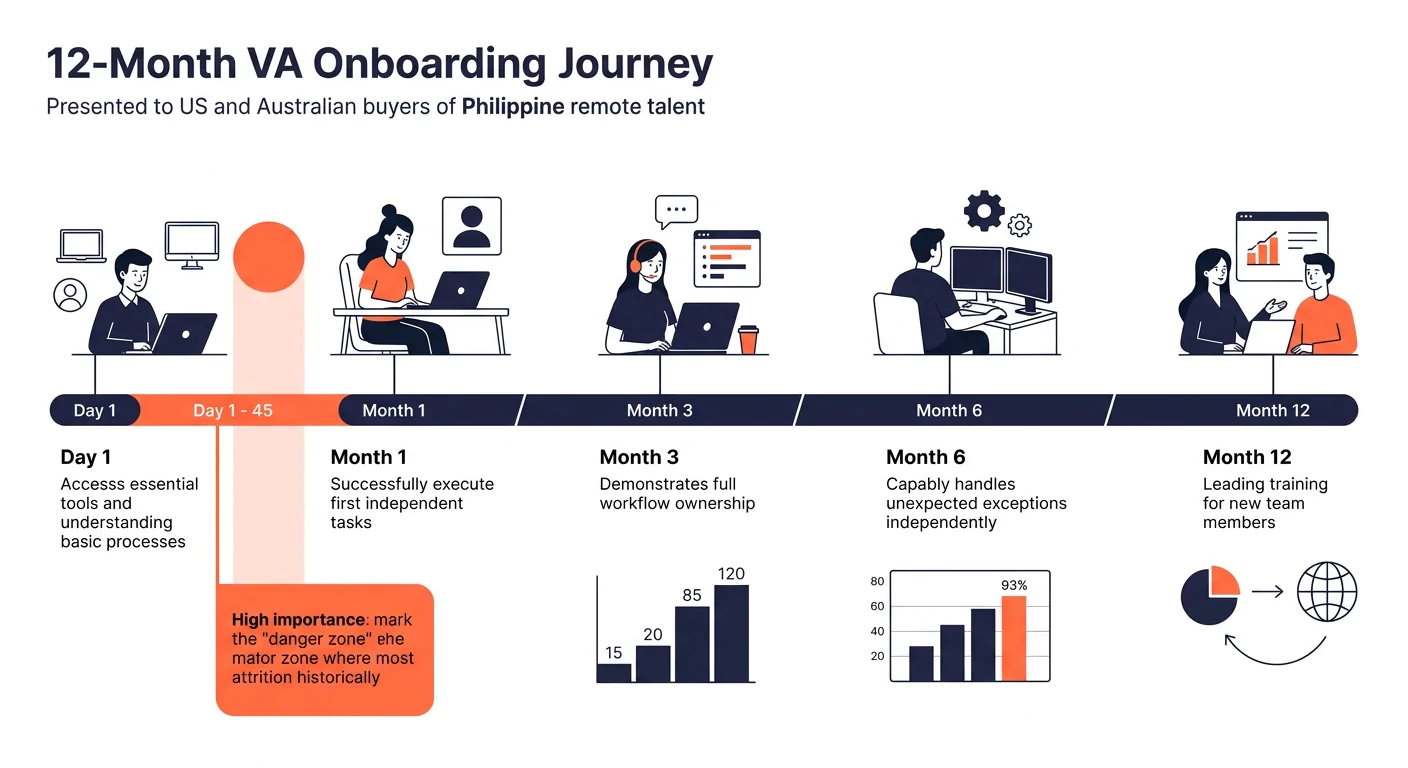
Poor onboarding pushes many remote staff to quit within their first 45 days, according to HR onboarding research compiled by Mosey. That 45-day window is where cost-focused hires fail most often, because the employer who optimized for the cheapest rate also tends to under-invest in onboarding. The logic runs something like: “I’m paying $4/hour, so I shouldn’t need to spend two weeks training them.” That logic destroys retention.
HR Morning’s research found that switching to structured online onboarding cut early turnover by more than 50%. Some researchers go further, recommending that organizations extend onboarding to at least a year for remote employees, arguing that sustained ramp-up improves retention by making new hires feel valued and aligned with company culture.
A year sounds long. But consider what “onboarding” actually means for a VA handling your operations: they need to learn your tools, your communication rhythms, your client preferences, your escalation procedures, and the unwritten norms that define how your business actually runs (as opposed to how your SOPs say it runs). That doesn’t happen in a 90-minute Loom walkthrough.
The employer who optimized for the cheapest rate also tends to under-invest in the onboarding process. That combination is the single most predictable VA retention failure.
We’ve written before about how offshore teams actually outpace new full-time hires in their first 90 days when the onboarding structure is right. The same principle applies to VAs across every function: a well-designed VA onboarding strategy pays for itself in reduced re-hiring costs within a single quarter.
Fair-Market Rates Change the Retention Math
Filipino VAs with strong English, professional experience, and AI tool proficiency command $8–$15/hour depending on specialization, according to current pricing benchmarks. The real ROI of hiring at these rates typically shows payback within the first month, driven by productivity gains and elimination of the replacement cycle.
Here’s how the economics break down for a single VA position over twelve months:
| Metric | $4/hr Direct Hire | $12/hr Vetted Placement |
|---|---|---|
| Annual base cost | $8,320 | $24,960 |
| Expected replacements (12 mo) | 1.2 | 0.2 |
| Replacement cost per cycle | $2,000–$3,000 | $2,000–$3,000 |
| Total replacement costs | $2,400–$3,600 | $400–$600 |
| Productivity loss (weeks) | 8–12 | 1–2 |
| Effective annual cost | $10,720–$11,920 | $25,360–$25,560 |
| Output consistency | Variable | Predictable |
The $12/hour VA costs more in raw dollars. But the $4/hour VA delivers inconsistent output, requires your direct supervision time (which has its own cost), and introduces risk into client-facing workflows. For businesses billing $100–$200/hour for their own services, 8–12 weeks of productivity loss from turnover represents $16,000–$48,000 in opportunity cost that doesn’t appear in the table above.
When you hire a virtual executive assistant at fair-market rates through a structured placement, you’re buying predictability. And predictability is what allows you to actually delegate rather than just assign tasks and hope.
Remote Team Management as Retention Infrastructure
Gallup’s research found that roughly three in four employees experience burnout at some point, with one in four reporting frequent episodes. For remote VAs, the risk compounds: they work in isolation, often across time zones, with limited visibility into whether their employer values their contribution or views them as interchangeable.
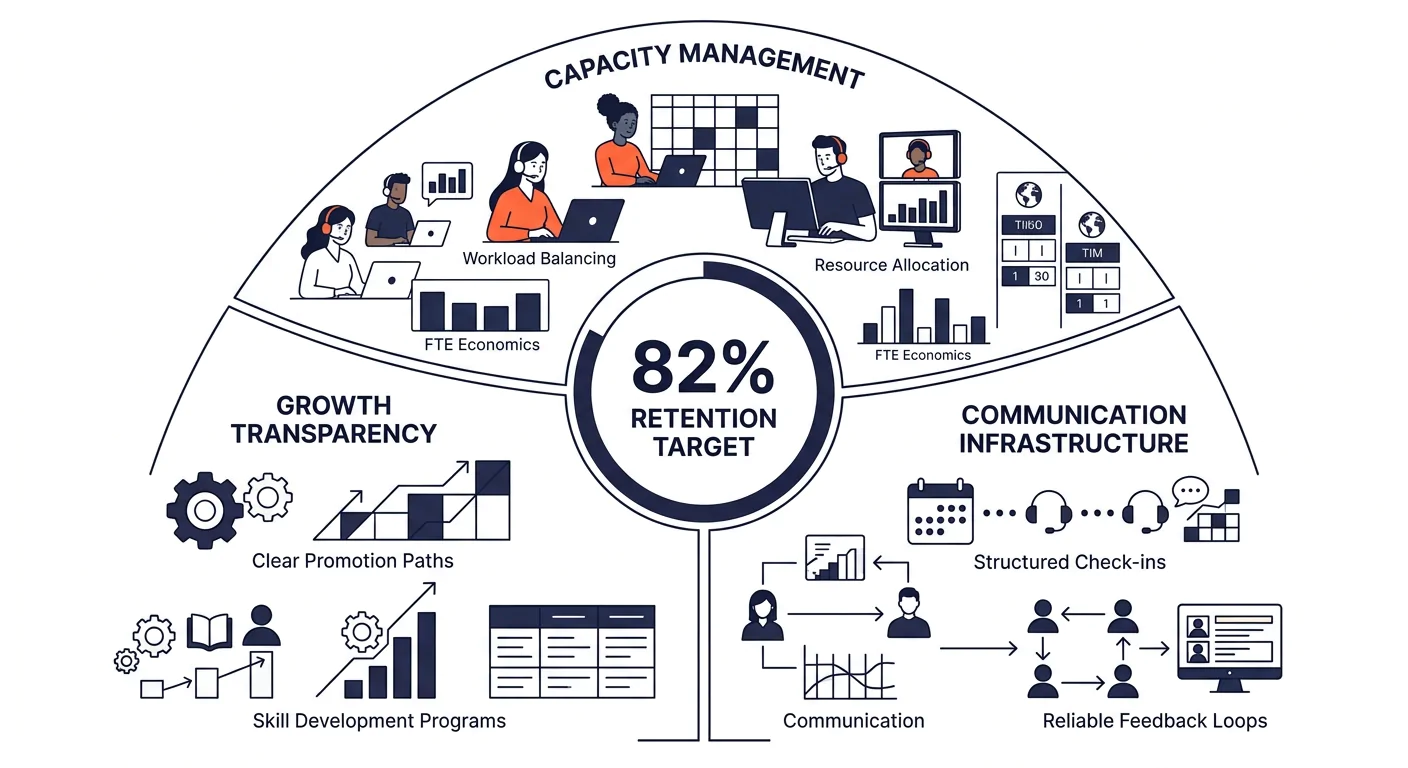
The most common outsourcing mistakes that cost companies productivity trace back to treating remote workers as task-completion machines rather than team members. Effective remote team management for VAs includes three structural elements:
- Regular capacity reviews. Workload creep is the leading cause of VA burnout. Monthly check-ins on task volume prevent the slow accumulation of “just one more thing” that pushes a good VA toward resignation.
- Transparent growth paths. As one HR Chief analysis noted, “Employees need to know what they can expect from you as an employer in terms of learning, growth, and new opportunities.” VAs who see a clear path from general admin to specialized roles, or from 20 hours/week to 40, stay longer than those who feel stuck.
- Communication infrastructure. Running a smooth remote team requires tooling across three areas: communication, project tracking, and document sharing. The specific tools matter less than having all three covered and documented.
Tip: If your VA’s workload has grown by more than 25% since their start date without a corresponding rate adjustment or role reclassification, you’re in the burnout zone. Address it before they start job-searching.
The businesses that fall into the scaling trap with flexible outsourcing models are often the same ones losing VAs to preventable attrition. The fix in both cases is structural: build the system before you scale the team.
What The Data Doesn’t Tell Us
The 45% vs. 82% retention split is the clearest signal available, but it has real limits. The data doesn’t segment by VA specialization, so we don’t know whether retention patterns differ for general admin VAs versus those in specialized roles like Amazon PPC management (89% year-over-year growth) or medical virtual assistance (76% YoY growth). It also doesn’t account for employer size: a ten-person agency managing one VA operates in a fundamentally different dynamic than an enterprise managing fifty.
The onboarding data carries similar constraints. The 50% reduction in early turnover from structured online onboarding was measured across all remote workers, not VA-specific populations. Whether VA turnover responds identically to the same interventions is plausible but unproven at scale.
What the numbers do establish is a consistent direction. Cost-focused hiring produces a measurable, repeatable retention penalty. Structured onboarding produces a measurable, repeatable retention benefit. Fair-market compensation ($8–$15/hour for Filipino talent) correlates with offshore VA retention rates that approach or exceed domestic employee benchmarks. And the businesses getting 3–5x average ROI from their VA investments are overwhelmingly the ones paying for quality and supporting that investment with management systems, not the ones who found the cheapest freelance listing and crossed their fingers.
The variable worth watching in the coming quarters: as AI tool adoption among VAs pushes past the current 73% weekly usage rate and individual productivity continues climbing, the retention gap between cost-focused and quality-focused hiring will likely widen. The VAs capable of operating AI-augmented workflows have options. They’ll choose employers who pay and manage accordingly.