
Companies that share financial data with employees achieve 90–100% retention rates while competitors offering free snacks and in-office perks struggle with attrition, according to a survey of 507 firms on Inc.’s 2026 Best Workplaces list released June 6.
TL;DR: Employers with the highest retention rates open financial books to employees—quarterly margins, revenue against benchmarks, and profit-sharing data—not ping-pong tables or barista bars.
What the Survey Found
Tim Huelskamp, co-founder of 1440 Media, a Chicago-based daily newsletter with 4.7 million subscribers, said his company maintains 90% employee retention over five years by sharing quarterly revenue figures and margins against industry benchmarks. “I don’t want people operating in fear,” Huelskamp told Inc. “When employees don’t have to worry about their job security, they can just do their jobs.”
1440 Media employs 27 people, has never conducted layoffs, and generates revenue exceeding $1 million per employee. Huelskamp attributed that performance directly to the clarity and trust financial transparency creates.
Anne Fulenwider, co-founder of women’s health platform Alloy Health, operates a dashboard where employees monitor customer acquisition and company revenue. Alloy has grown 100% year-over-year since founding. “It’s an instant feedback loop,” Fulenwider said. “We don’t want anyone ever to feel like they’re working on something that’s not important.”
Retention Benchmarks From 2026 Honorees
Lighthouse Creative, a New York City advertising agency with $7 million in annual revenue, distributes quarterly profit-sharing to its 28 employees and has achieved 100% retention since 2023, according to the Inc. report.
Halo Collar, a 90-person company with $100 million in annual revenue, has maintained 100% key-personnel retention while operating fully remote. The company cited removing geographic barriers and enabling access to world-class talent regardless of location as core to its retention strategy.
Among the practices shared by 2026 honorees: remote work, flexible scheduling, asynchronous collaboration, and financial transparency. Inc. noted these were described not as perks or benefits, but as operational common sense.
Why This Matters Now
The retention data from Inc.’s 2026 Best Workplaces list offers a direct brief for BPO providers and agencies managing Philippine teams: financial transparency outperforms perks as a retention driver. Virtual assistant retention issues rarely stem from base pay rates, the anxiety that causes offshore attrition is about uncertainty. Workers leave because they cannot verify whether the company is stable or whether their role remains secure.
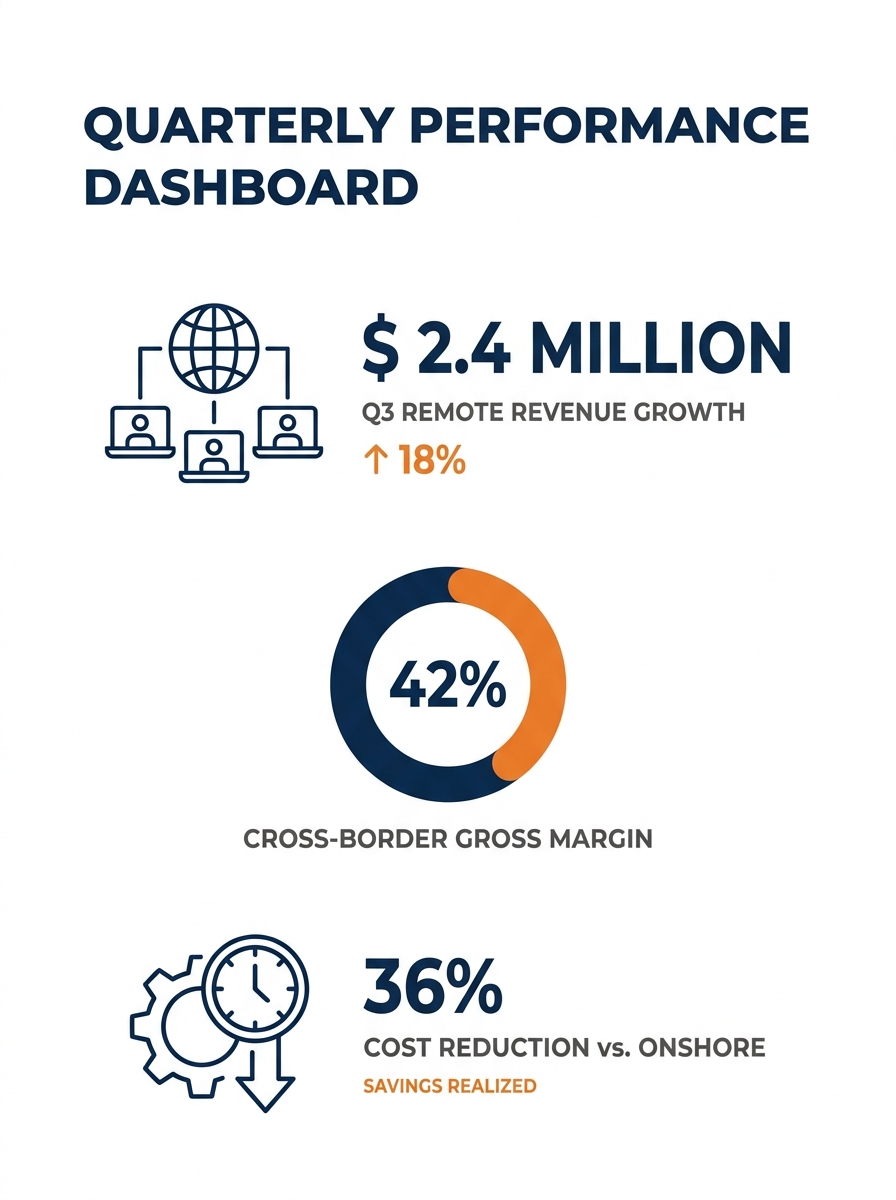
BPO operators who extend financial visibility beyond leadership, open margins, revenue data, quarterly business updates, address that anxiety at its source. The same dashboard architecture that drives retention at US-based remote companies applies to cross-border teams. Sharing quarterly performance against benchmarks gives offshore team members the same clarity Huelskamp described: evidence that the work is paying off, that the business model is sound, that their role is not at risk from arbitrary budget cuts.
Setting measurable KPIs matters less if the underlying anxiety is “does this client have the runway to keep me employed?” Transparent financials answer that question quarterly, not through reassurances but through data employees can verify themselves.