
Harvard Business Review published an analysis on June 5, 2026, arguing that generative AI is eroding the labor-arbitrage model that powered decades of outsourcing growth. The Philippine IT-BPM sector, projected to hit $42 billion in export revenue this year with 1.97 million workers, is responding by merging AI agents with human teams rather than choosing one over the other.
TL;DR: The hybrid outsourcing model pairs AI tools handling 75-85% of routine tasks with Filipino virtual assistants managing complex work. Early adopters report 67% lower cost per contact ($2.15 vs. $6.50) and 85% faster resolution, while VA compensation for “AI Pilot” roles has climbed 30-50%.
HBR’s Case Against Pure Labor Arbitrage
Harvard Business Review’s June 5 analysis frames the economics plainly: generative AI automates routine, rules-based tasks that companies once sent offshore for labor savings. The old equation (US salary minus Philippine salary equals savings) weakens when AI handles those same tasks at near-zero marginal cost. Leaders now need to rethink whether entire functions like finance, HR, or IT should be outsourced at all, the piece argues.
But the Philippine BPO industry’s $42 billion revenue projection for 2026 tells a different story. Revenue is growing, not shrinking. The reason: the industry pivoted before the disruption fully arrived. According to VA industry data compiled by VA Masters, the virtual assistant market alone reached $6.5 billion in 2026, with over 1.5 million Filipino VAs actively working and 54% of SMBs now using VA services. Growth is happening because these workers are absorbing AI tools into their daily workflows rather than competing against them.
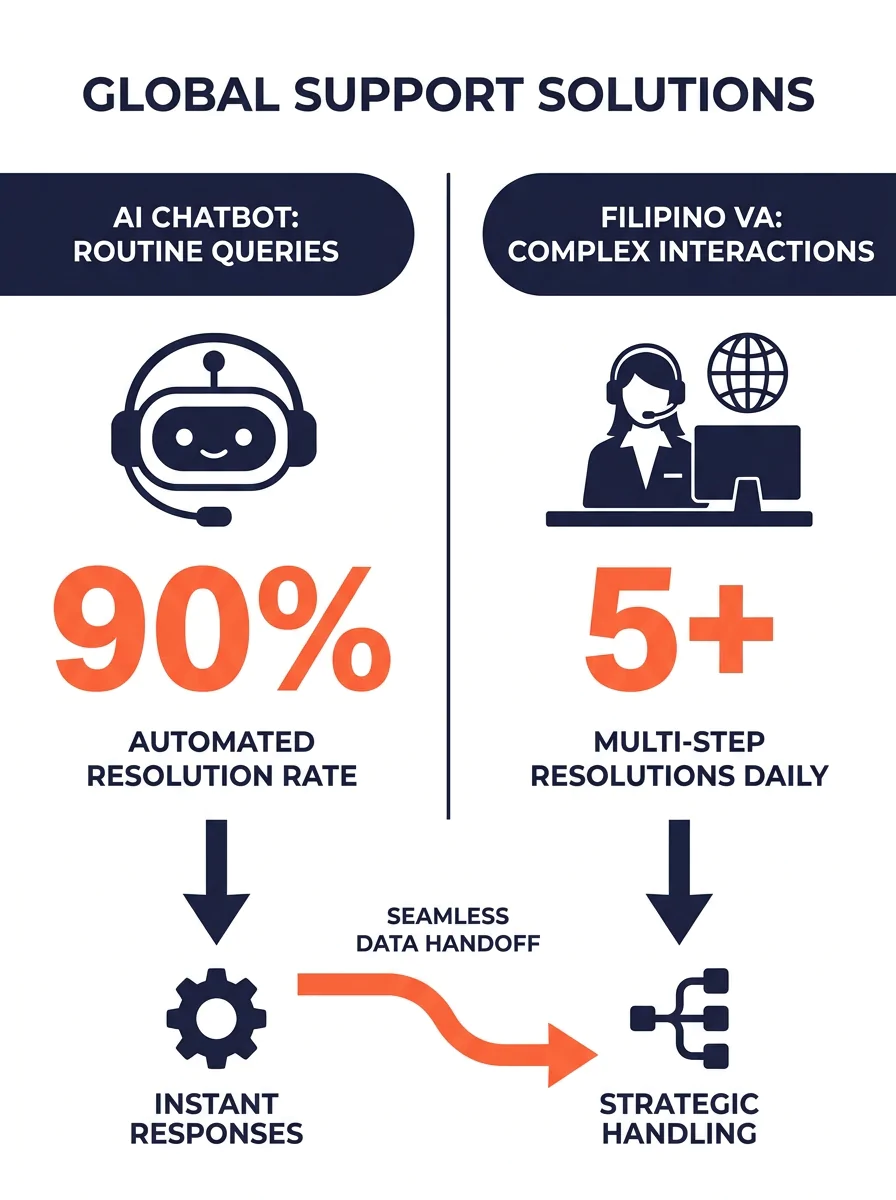
The Performance Data Behind AI Virtual Assistants 2026
The Philippine VA vs AI automation debate keeps producing the wrong framing because people treat it as a binary. Performance data from hybrid deployments makes the answer clear.
AI-augmented teams in the Philippines post an average resolution time of 35 seconds, compared to 4 minutes for traditional human-only setups. That’s an 85% improvement. First-contact resolution rates hit 91%. Cost per contact dropped from $6.50 to $2.15, a 67% reduction. These figures come from early adopters running what the industry now calls “AI Pilot” configurations, where one human agent manages 5 to 10 AI instances at the same time.
CNA reported on June 5 that millions of employees in the Philippines and India are racing to adapt as automation replaces tasks they once handled manually. The piece frames this as a threat. The data paints something more nuanced: workers who do adapt earn 30-50% more in their new AI Pilot positions. The transition is painful for those who fall behind, and lucrative for those who don’t.
Juan Gabriel Felix, a researcher at Sigla Research Center studying digital labor, told Rest of World that “influencers and thought leaders stand to gain from this practice where a self-sustaining industry of humans and bots generates an illusion of engagement.” His observation about LinkedIn engagement networks points to something broader: the boundary between human and AI work is already blurred across industries. The hybrid outsourcing model formalizes that blur into a repeatable, measurable system.
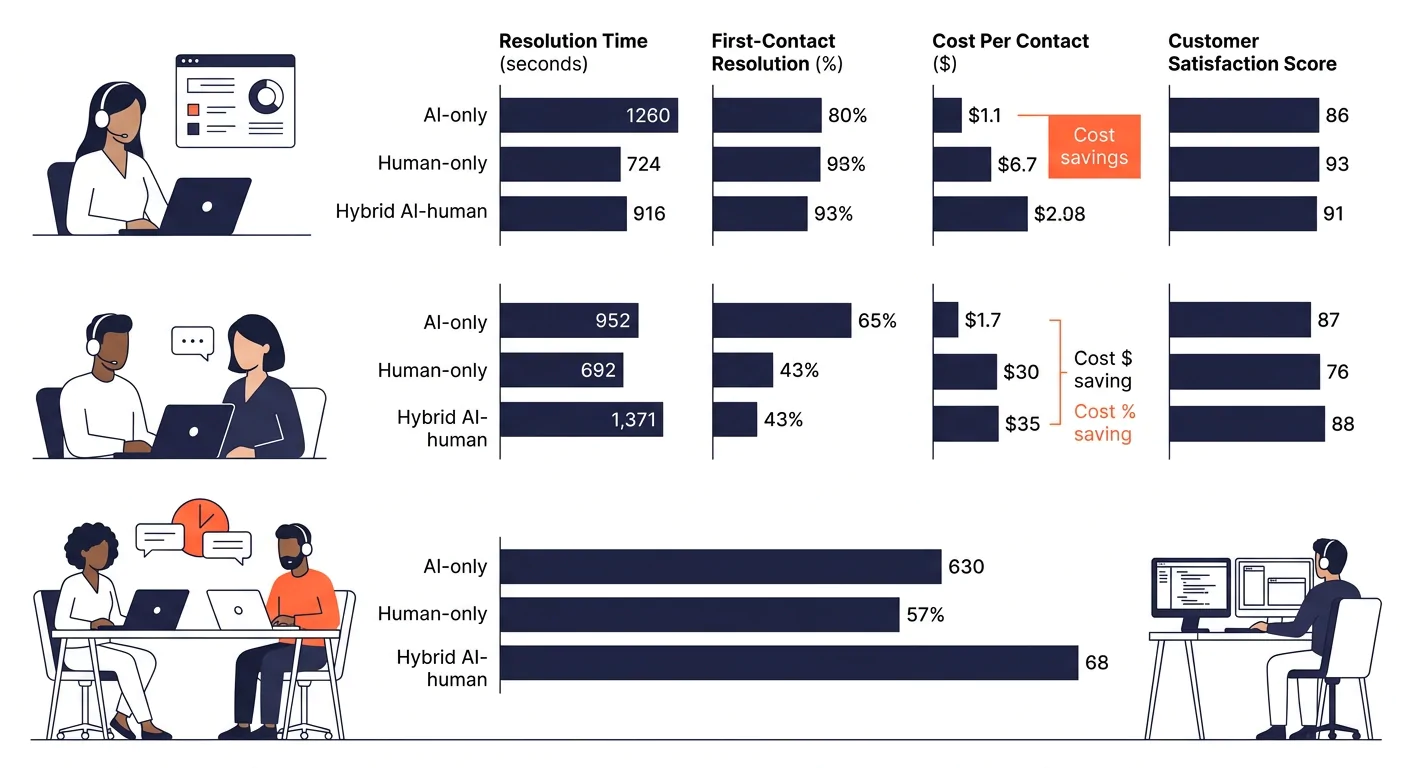
What These Hybrid Teams Actually Do Day-to-Day
The technology stack powering hybrid setups has standardized quickly. Leading providers use Retrieval-Augmented Generation (RAG) systems grounded in verified knowledge bases. Agentic AI orchestrators handle multi-step workflows like loan originations, clinical record integration, and claims pre-checking. Filipino team members sit above these systems as supervisors, exception handlers, and quality controllers.
According to Creathink Solutions’ analysis of AI-enhanced VA workflows, forward-thinking founders hire virtual assistants in the Philippines to act as the “human-in-the-loop” for their technology ecosystems. These VAs don’t follow scripts. They manage the systems that keep AI operations running, ensure data integrity for inputs feeding large-scale models, and handle judgment calls AI can’t make.
The Philippines offers 50-70% cost savings with 130,000+ IT graduates entering the workforce annually, per Second Talent’s 2026 Philippine team-building guide. English-proficient tech talent with 8-hour US time zone overlap is available at $25-$50/hour. Building an equivalent in-house AI support department stateside costs hundreds of thousands per year.
The most successful outsourcing arrangements in 2026 don’t choose between AI and human talent. They combine both.
This cost structure explains why the hybrid outsourcing model works for SMBs specifically. If you’re running outsourced data entry workflows, AI handles extraction and categorization while a Philippine team member validates accuracy, catches edge cases, and flags anomalies the model misses. The same pattern applies to a Shopify virtual assistant managing product listings: AI generates descriptions and pricing recommendations, and the VA handles supplier negotiations, customer escalations, and brand consistency checks.
| Model | Cost Per Contact | Resolution Time | First-Contact Resolution | Best For |
|---|---|---|---|---|
| AI-Only | $0.50-$1.00 | 12 seconds | 68% | FAQ, status checks, password resets |
| Human-Only (PH) | $6.50 | 4 minutes | 74% | Complex disputes, VIP accounts, legal |
| Hybrid AI + PH Team | $2.15 | 35 seconds | 91% | Full customer support, claims, onboarding |
| US In-House | $12-$18 | 3.5 minutes | 79% | Highly regulated, exec-level accounts |
Where Gemini AI Offshore Team Integration Fits
Google’s Gemini tools have accelerated the hybrid model for marketing and advertising teams. If your outsourced team runs Google Ads campaigns, Gemini’s deeper integration into the Ads platform changes which tasks need human oversight and which ones don’t. We broke down the implications when we covered how Gemini reshapes outsourced digital marketing.
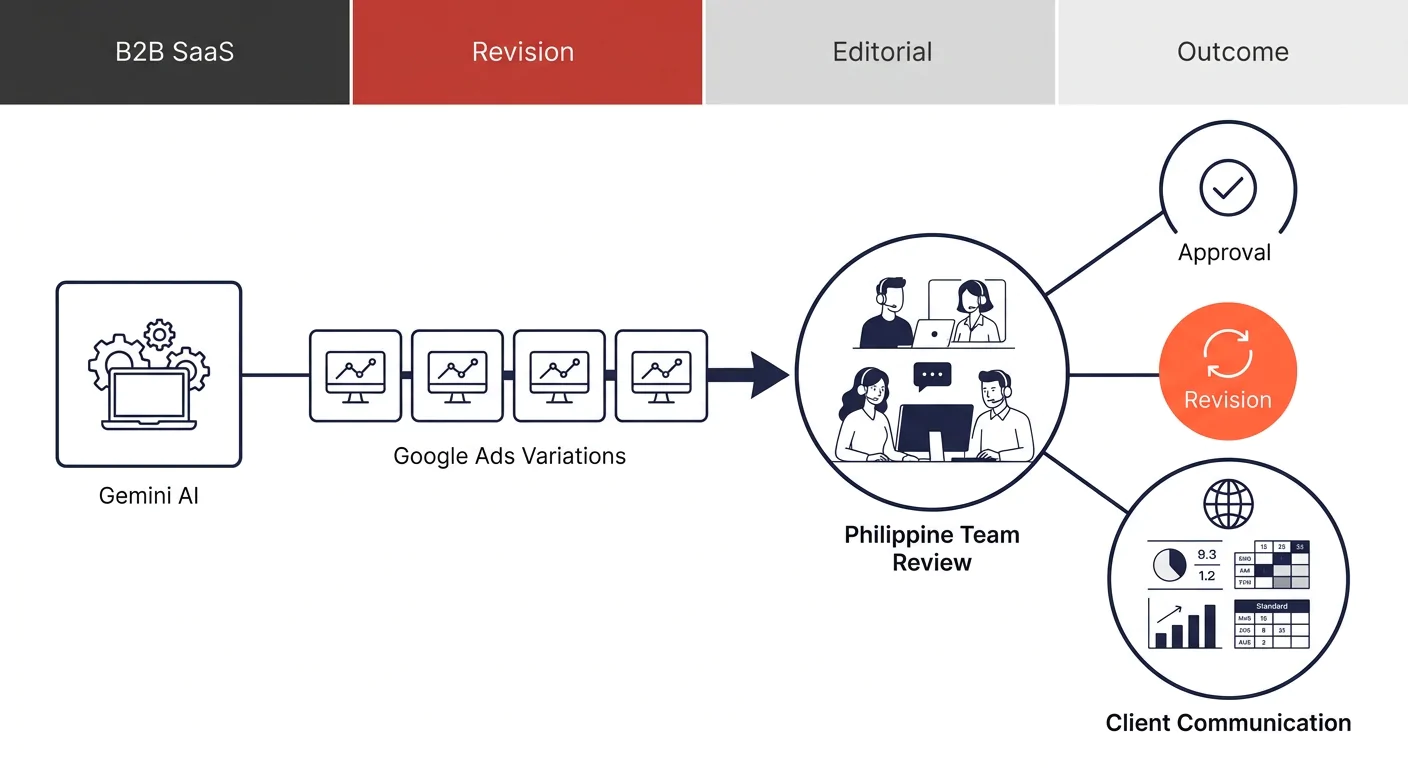
The pattern stays consistent: AI generates ad copy variations, audience segments, and bid strategies. The Philippine team reviews outputs for brand alignment, monitors performance anomalies Gemini’s automation misses, and manages client communication. A Forbes council post published June 5 argued that organizations using agentic AI need to establish clear protocols for how work travels between humans and AI systems. This handoff design is exactly what hybrid teams are building every day.
For agencies scaling operations, the strategy-execution split between AI and Philippine teams has become the default. AI owns execution at scale. Humans own strategy, client relationships, and quality assurance.
This extends beyond marketing. An Amazon virtual assistant using AI tools can monitor listing performance, flag Buy Box losses, and auto-generate A+ content drafts across hundreds of SKUs. The human VA then prioritizes which listings need manual intervention, handles seller support tickets, and coordinates with supply chain contacts. One person with AI tooling now covers work that used to require three.
The Retention Factor That Cost Models Miss
The hybrid model creates a retention advantage that raw cost data doesn’t capture. Filipino VAs in AI Pilot roles report higher job satisfaction because the work is more interesting. They’re solving problems, not copying and pasting. Companies that share financial data and growth metrics with their offshore teams see 90-100% retention rates, according to surveys of firms on Inc.’s 2026 Best Workplaces list.
The VA retention crisis, which we’ve analyzed in our breakdown of why cost-focused hiring backfires, gets partially solved by the hybrid model itself. Workers earning 30-50% more in AI-augmented roles, doing cognitively engaging work, with clear skill development paths are far less likely to churn. That stability compounds over time. A team that stays together for 12+ months develops institutional knowledge about your business that no AI system can replicate.
Info: 60% of BPO adopters now deploy Robotic Process Automation tools, per Deloitte’s 2026 data. Gartner projects 75% of customer interactions will be AI-powered by end of year. The organizations winning are the ones using those numbers to upgrade their human teams, not eliminate them.
What the Data Doesn’t Tell Us
The performance data for hybrid outsourcing is strong, but three gaps remain worth watching.
First, the 91% first-contact resolution rate comes from early adopters with mature processes. No one has published reliable data on what happens when mid-market companies with less operational discipline try to implement the same model. The learning curve could be steeper than the success stories suggest.
Second, the regulatory picture is still forming. The Philippines’ CREATE MORE Act allows up to 50% remote work while maintaining tax incentives, which supports hybrid infrastructure. But AI governance regulations across both the US and the Philippines remain early-stage. Compliance costs for AI-augmented outsourcing haven’t been quantified in any public study.
Third, the 30-50% wage premium for AI Pilot roles is good news for workers who make the transition. The CNA report from June 5 captures the other side: workers who can’t adapt face real displacement risk. The $42 billion projection for Philippine IT-BPM assumes the workforce transitions fast enough. Whether 1.97 million workers can all reskill at the pace the industry demands will determine whether the hybrid outsourcing model scales broadly or concentrates among a smaller group of high-performing teams. The next two quarters of hiring and training data will tell us more than any forecast can.