
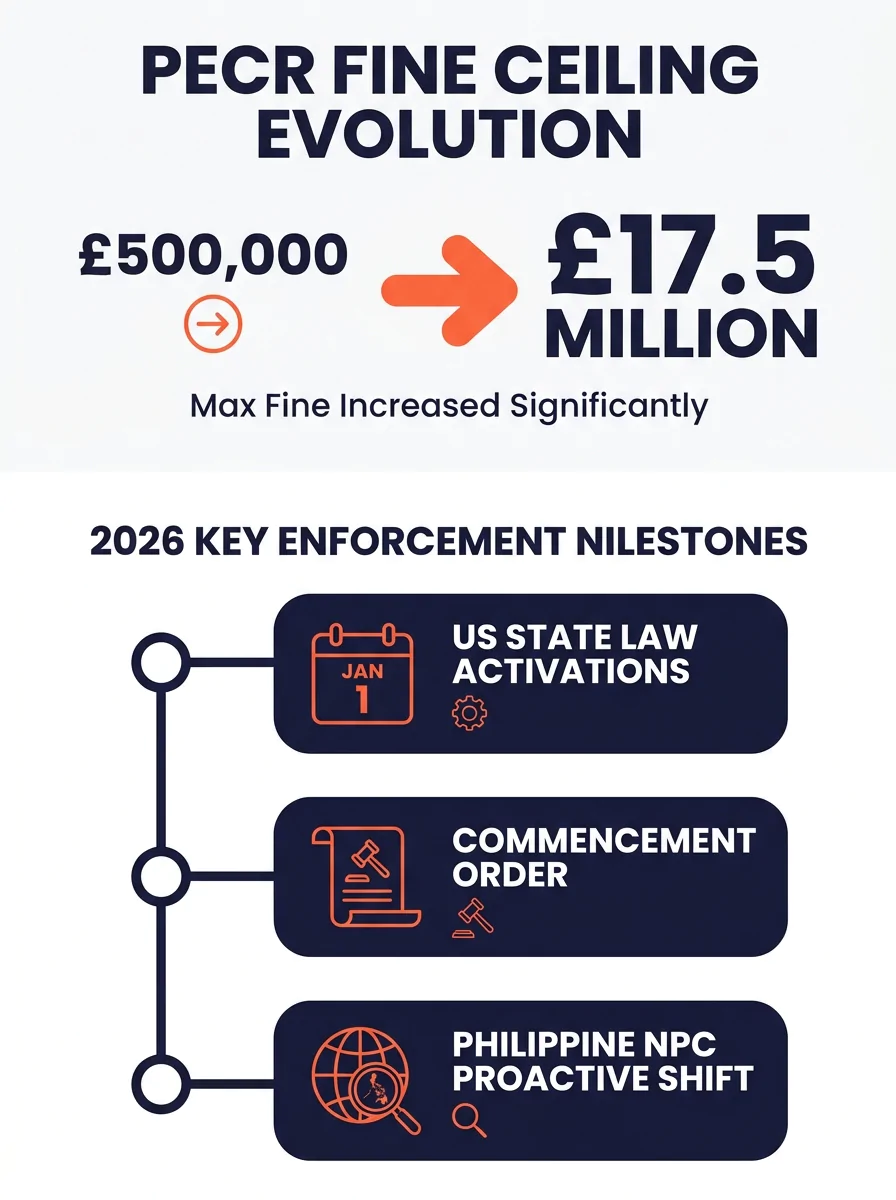
£17.5 million or 4% of global annual turnover, whichever is higher. That’s the penalty ceiling the UK Information Commissioner’s Office locked in under a February 2026 commencement order, raising PECR fines to UK GDPR levels for the first time. Every Philippine marketing team running campaigns into the UK now operates under that number.
TL;DR: Three overlapping enforcement regimes hit Philippine outsourced marketing teams simultaneously in 2026: the UK’s new £17.5M PECR fine ceiling, three additional US state privacy laws requiring Global Privacy Control recognition, and the Philippine NPC’s shift to proactive enforcement. Teams that treat compliance as a per-campaign operations problem instead of an annual checkbox are pulling ahead.
The February 2026 PECR Shift and Its Real Weight
Why did the UK’s fine adjustment land so hard on offshore digital marketing teams? Because PECR covers the exact activities Philippine teams execute daily. The ICO’s updated guidance addresses tracking pixels, scripts, tags, and device fingerprinting under the Privacy and Electronic Communications Regulations. A Slaughter and May analysis described the shift as “an area of intense focus” across enforcement priorities. Before February 2026, PECR violations carried a maximum penalty of £500,000. The jump to £17.5 million represents a 35x increase in maximum exposure.
For US and Australian SMBs that outsource campaign management to the Philippines, the math changed overnight. A mid-market e-commerce company with $40 million in annual revenue faces a theoretical PECR exposure of $1.6 million (4% of turnover) for something as routine as a misconfigured email tracking pixel. That’s not a hypothetical the compliance department worries about. That’s a number the CFO needs on a risk register.
The ICO has been explicit that “meaningful opt-out” is the standard for all tracking technologies going forward. Consent management platforms like CookieYes and OneTrust now need to cover pixel-level consent, not just cookie banners. Philippine teams managing UK-facing campaigns need to audit every tag, every script injection, and every fingerprinting mechanism before a single impression fires.
Pixel Tracking Compliance Across Three Jurisdictions
The pixel tracking compliance 2026 landscape splits into three distinct regulatory expectations depending on where your audience sits. Italy’s Garante has already issued specific guidelines on tracking pixels in emails, requiring transparency disclosures and explicit consent before any pixel fires. The UK’s PECR alignment extends similar requirements to all device-level tracking. And US state laws now require honoring Global Privacy Control (GPC) signals, which means a browser-level opt-out must propagate through every tracking pixel in the stack.
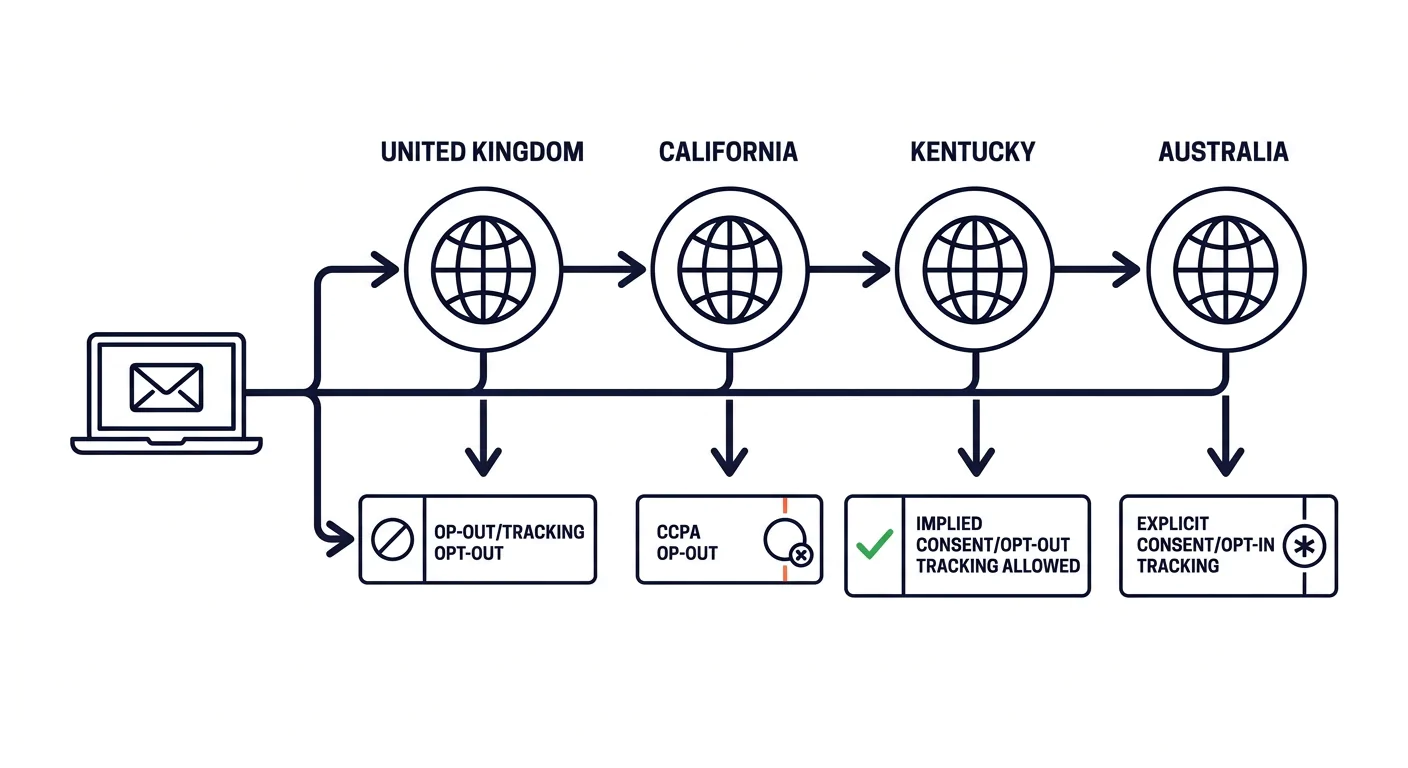
Here’s where Philippine marketing teams privacy regulations knowledge gets tested. A single email campaign targeting recipients in London, Los Angeles, and Sydney hits three different consent regimes:
| Jurisdiction | Consent Standard | Tracking Pixel Rule | Max Penalty | GPC Required? |
|---|---|---|---|---|
| UK (PECR/UK GDPR) | Meaningful opt-out, prior consent for most tracking | All pixels require consent; device fingerprinting covered | £17.5M or 4% turnover | No (but ICO encourages) |
| California (CCPA/CPRA) | Opt-out right; under-16 data classified as sensitive | Pixels considered “sale” of data if shared with third parties | $7,500 per intentional violation | Yes, mandatory |
| Kentucky/Rhode Island/Indiana (2026) | Consumer data rights: access, correct, delete | Opt-out mechanisms required for targeted advertising | Up to $7,500 per violation | Yes, mandatory |
| Australia (Privacy Act) | APP compliance; notice required | Covered under APP 5 notification obligations | Up to AUD $50M per violation | No |
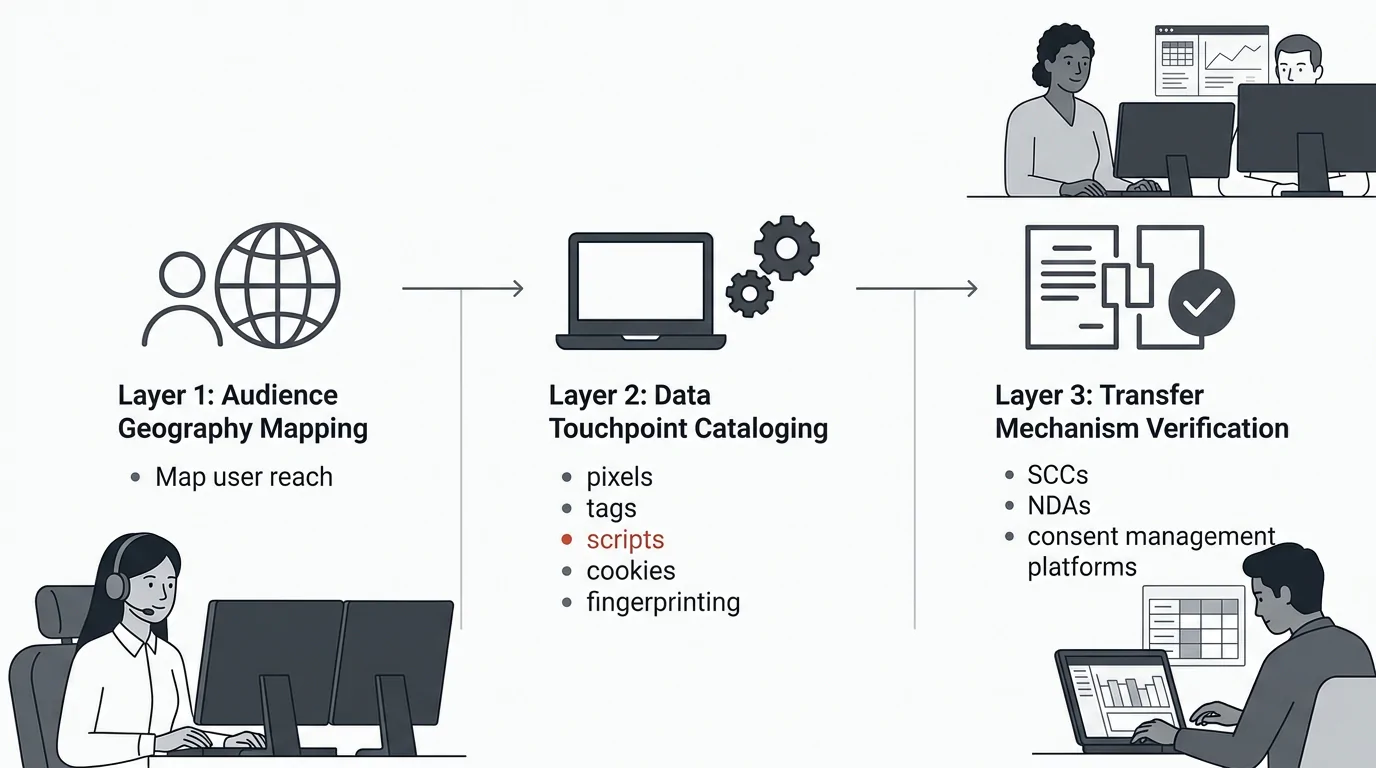
That table represents four separate compliance workflows for a single campaign. Philippine teams that handle this well run what I’d call a Three-Layer Jurisdiction Audit before any campaign launches: first, map audience geography to determine which regimes apply; second, catalog every data touchpoint (pixels, tags, scripts, cookies, fingerprinting) against each regime’s requirements; third, verify the transfer mechanism covering cross-border data flow.
Warning: A tracking pixel that fires before consent is captured isn’t a minor technical glitch. Under the updated PECR framework, it’s a violation carrying the same penalty weight as a UK GDPR breach. Philippine teams running UK-facing campaigns should treat pixel audit as a pre-launch gate, not a quarterly review item.
The US State Patchwork Creates Compound Risk
Three new US state privacy laws took effect on January 1, 2026: Kentucky, Rhode Island, and Indiana. Each requires Global Privacy Control recognition and data protection impact assessments, according to a MarTech analysis of state-level privacy obligations. California simultaneously classified data of individuals under 16 as sensitive under CCPA amendments, adding another layer to audience segmentation requirements.
The offshore digital marketing legal risk here is arithmetic. Each violation can carry a penalty of up to $7,500. A campaign that touches 10,000 users across these states without proper GPC honoring creates theoretical exposure in the tens of millions. The enforcement bodies are still ramping up, but the statutes are live.
For Philippine teams executing paid media, email marketing, and landing page optimization, this means every campaign targeting US audiences needs state-level consent logic baked into the ad tech stack. GPC signals must suppress tracking and data sharing automatically. There’s no grace period for “we didn’t know the user was in Rhode Island.”
When you’re deciding which marketing services to delegate first, privacy infrastructure should be a top-three consideration. A team that can run campaigns without understanding consent architecture is a team that generates liability faster than leads.
Cross-Border Data Transfers: Where the Philippine Angle Gets Specific
When you hire offshore staff in the Philippines, those staff access and process personal data belonging to your customers. That access triggers cross-border transfer requirements in multiple markets. As Penbrothers documented in their compliance guide, the UK ICO describes “restricted transfers” and requires that they be covered by transfer mechanisms such as adequacy regulations or appropriate safeguards like Standard Contractual Clauses (SCCs).
The Philippines has its own Data Privacy Act (Republic Act No. 10173), administered by the National Privacy Commission (NPC). OneTrust’s compliance guidance on the Philippines’ PDPA requirements outlines practical steps for building a scalable, privacy-forward program. The NPC has shifted from paper-based compliance checks to proactive enforcement, meaning Philippine BPO operations face domestic regulatory pressure alongside international obligations.
A Philippine team processing EU customer data sits at the intersection of three privacy regimes simultaneously: the EU or UK GDPR governing the data subjects, US state laws governing the client’s domestic obligations, and the Philippine DPA governing the processor’s local requirements.
This triple obligation is where GDPR compliance outsourcing either works or collapses. The mechanism that holds it together is a combination of SCCs for EU/UK transfers, employee contracts with NDAs and IP assignment clauses for the Philippine side, and state-specific consent management for US campaigns. Teams that build this infrastructure once can scale it across clients. Teams that handle it ad hoc per project accumulate undocumented risk with every new engagement.
Organizations building hybrid outsourcing models should keep privacy architecture decisions in-house while delegating execution to teams that operate within a documented compliance framework. The split matters because liability doesn’t transfer to the vendor. The data controller remains responsible.
Operationalizing Compliance at the Team Level
Philippine BPO operations that handle multi-jurisdiction campaigns well share a few structural patterns. They appoint dedicated Data Protection Officers rather than distributing compliance knowledge across project managers. They run consent management platforms with geo-detection logic that serves the correct consent mechanism per jurisdiction. And they treat pixel audits as a pre-launch checklist item with the same weight as creative review or QA.
The Three-Layer Jurisdiction Audit framework mentioned earlier translates into three concrete pre-campaign steps:
- Audience Geography Mapping pulls analytics data and media buy targeting parameters to identify which privacy regimes apply. A campaign targeting “English-speaking markets” isn’t specific enough. The team needs country-level and, for the US, state-level audience breakdowns.
- Data Touchpoint Cataloging documents every pixel, tag, script, cookie, and fingerprinting mechanism in the campaign stack. Each touchpoint gets classified against the applicable regime’s requirements. A Meta pixel firing on a UK landing page has different consent requirements than the same pixel on an Australian page.
- Transfer Mechanism Verification confirms that the cross-border data flow is covered by the appropriate legal instrument. SCCs for EU/UK data, DPA-compliant processing agreements for Philippine-side obligations, and state-specific opt-out honoring for US traffic.
Teams tracking pipeline quality rather than volume metrics already have the measurement infrastructure to layer compliance data into their dashboards. Adding consent rate, GPC signal frequency, and pixel audit pass/fail rates to an existing quality dashboard takes the compliance conversation from abstract risk to concrete operational numbers.
The cost of running this compliance infrastructure sits between $2,000 and $8,000 per month for a mid-size Philippine team, depending on the consent management platform, DPO allocation, and audit frequency. That’s 15-30% of typical team cost. But compare that to $7,500 per US state violation or the £17.5 million PECR ceiling, and the ROI math is straightforward.
What The Numbers Still Can’t Answer
The enforcement data we have covers statutory maximums and per-violation penalties, but actual enforcement against Philippine-based processors remains thin. The UK ICO has issued guidance and raised fine ceilings, but the volume of cross-border enforcement actions targeting Southeast Asian processors is still small enough that pattern recognition is unreliable. The three new US state laws are months old, and the first wave of enforcement actions won’t establish precedent until late 2026 at the earliest.
What the numbers also miss is how the Philippine NPC’s shift to proactive enforcement will interact with client-side obligations. If a US company’s Philippine team mishandles UK data, the enforcement action could theoretically originate from the ICO, the NPC, or both. Dual-jurisdiction enforcement against a single processing operation has no well-documented precedent in the Philippine BPO context.
The Philippine Data Privacy Act carries both criminal and administrative liability for breaches. Whether that exposure extends to individual team members or stays at the organizational level depends on NPC interpretation that hasn’t been fully tested. Teams building AI-augmented hybrid models face an additional unknown: how automated data processing decisions interact with human-oversight requirements under the EU AI Act’s expanding scope.
The numbers tell you the ceiling. They tell you the per-violation floor. They give you the cost of compliance infrastructure and the count of jurisdictions you’re exposed to. What they can’t tell you yet is how aggressively regulators will pursue cross-border cases, how quickly the Philippine NPC will align its enforcement posture with EU and UK expectations, or whether the current consent management tooling will keep pace with the regulatory acceleration. Those answers are still forming, and the teams paying attention to enforcement trends quarter by quarter will be the ones best positioned when they arrive.