
Cursor 3.6, Claude Opus 4.8, and Aider all shipped major updates within the same week in late May 2026. Philippine dev teams running hybrid stacks of these AI-powered web development tools report 35–55% faster cycle times and 30–45% lower total engineering costs compared to US in-house equivalents.
Three Releases in Five Days
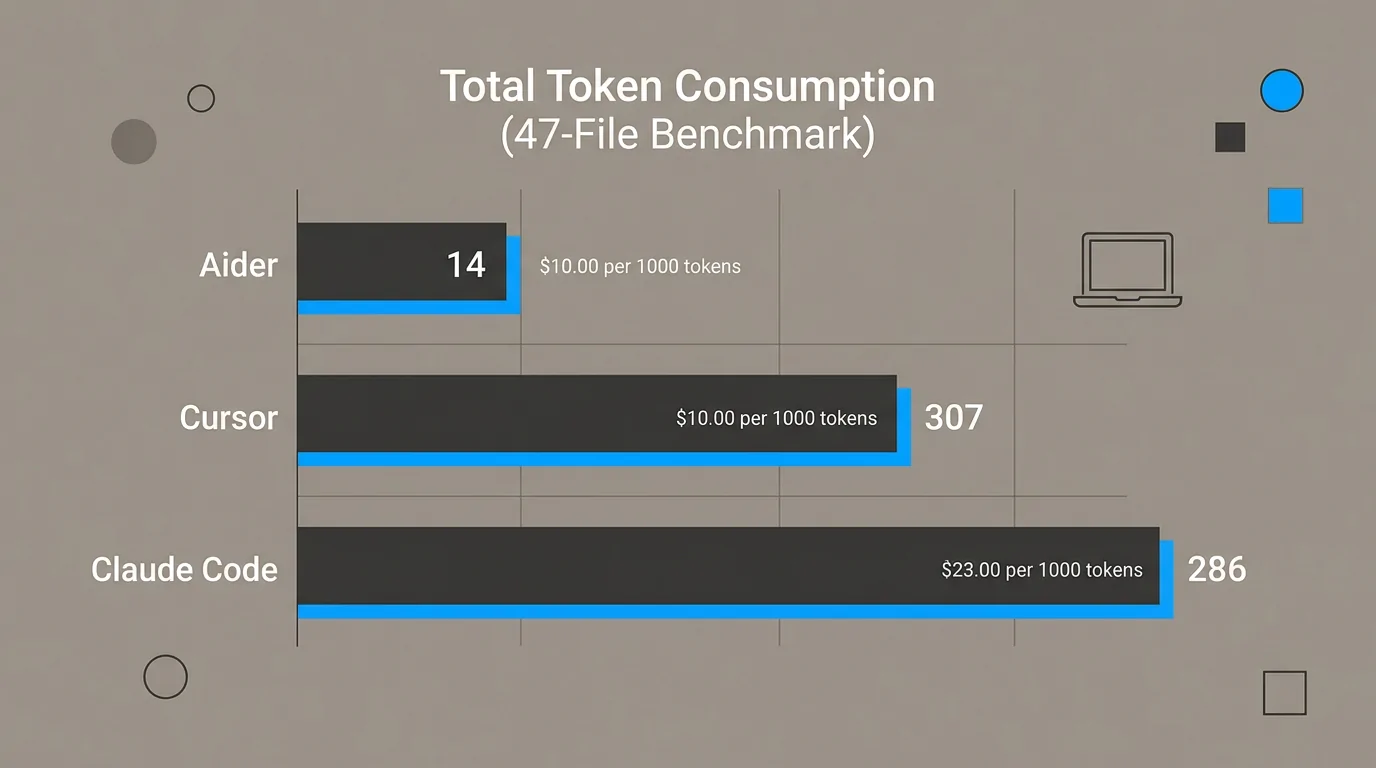
Between May 24 and May 29, the three most-used LLM-assisted coding tools all pushed significant updates. Anthropic released Claude Opus 4.8 on May 28 with a 1M default context window and adaptive thinking capabilities. Cursor followed a day later with version 3.6, introducing an Auto-review run mode that gates Shell, MCP, and Fetch tool calls through allowlists and sandboxes. And Aider, the open-source terminal-based coding agent, published benchmark results across 47 files showing it consumed 4.2× fewer tokens than Claude Code on identical tasks.
For Philippine web development agencies, these weren’t abstract product announcements. Each release solved a specific bottleneck in how offshore teams write, review, and ship code for US and Australian clients.
“I have been using Claude Code as my primary development tool for about seven months now,” wrote developer Kevin Gabeci in a June 2026 analysis on Medium. “I have also used Cursor extensively… Where they are brilliant and where they are terrible are very specific.” That specificity, knowing which tool to reach for at which moment, defines the Philippine dev team operating model that’s taken shape over the first half of 2026.
The Philippine IT-BPM sector generated $40 billion in revenues and employed 1.9 million workers in 2025, with American AI firms now actively targeting the sector for expansion. The overlap between that investment and tool-level improvements creates a market where LLM-assisted coding outsourcing has moved from experiment to default.
How the Three-Tier Workflow Took Shape
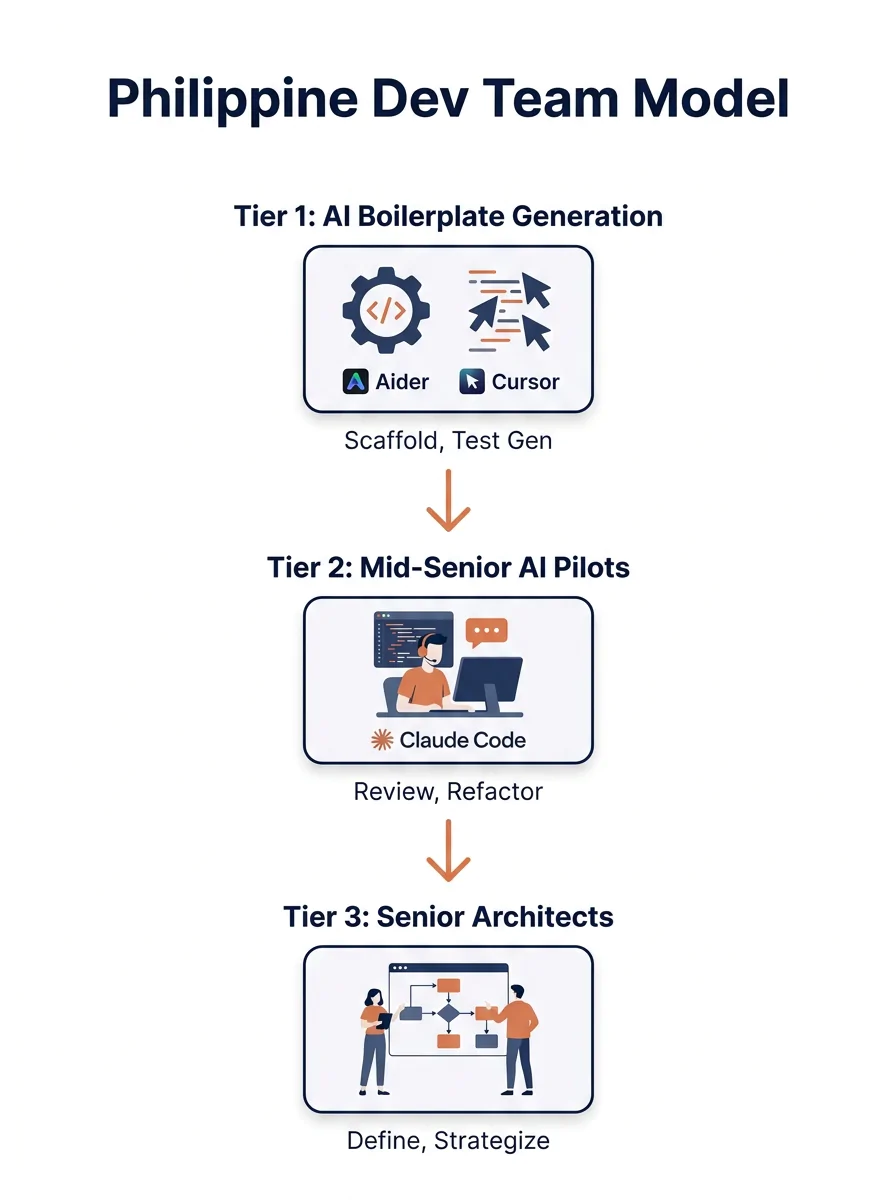
The effective Philippine dev team now operates on a structure where AI handles boilerplate code generation at Tier 1, mid-to-senior engineers serve as AI pilots at Tier 2, and senior architects focus exclusively on system design at Tier 3. This model didn’t appear overnight. It evolved through trial and error as teams figured out which AI-powered web development tools belonged at which layer.
Tier 1 work (scaffolding components, generating CRUD endpoints, writing test boilerplate) gets routed to Aider or Cursor’s inline completions. A junior developer prompts, reviews the output, and commits. Tier 2 is where Claude Code earns its $200/month subscription: mid-level engineers delegate entire features to the agent, review the architectural decisions it makes, and intervene when the model drifts. Tier 3 architects never touch the AI tools directly. They write system design documents and review pull requests.
This three-tier split explains why a five-person offshore team can deliver output comparable to a 15-person US shop. The hybrid outsourcing model pairs AI tools handling 75–85% of routine tasks with human engineers managing complex work, and early adopters report 67% lower cost per contact ($2.15 vs. the US average).
If you’re assembling a team for the first time, this tier structure maps well to the frameworks in our offshore team-building guide, adapted for engineering rather than marketing workflows.
Aider Rewrote the Token Economics
Why does token consumption matter for outsourcing economics? Because API costs are the hidden line item that can turn a $35/hour Philippine developer into a $55/hour one if the tooling burns tokens inefficiently.
The 47-file benchmark included a Python data pipeline spanning 31 files and 8,500 lines of ETL logic, API integrations, and test coverage. All three tools ran Claude Sonnet 4.5 as the backing model, isolating tool quality from model quality. Aider used 4.2× fewer tokens than Claude Code on the same tasks. That’s a direct cost multiplier. For a Philippine agency running 10 developers through 8-hour shifts, the difference between 50,000 tokens per task and 210,000 tokens per task compounds into thousands of dollars monthly.
| Tool | Token Efficiency | Best Use Case | Cost Model |
|---|---|---|---|
| Aider | 4.2× fewer tokens than Claude Code | File-level edits, refactors, migrations | Free (BYO API key) |
| Cursor | Mid-range; optimized in Composer 2.5 | Line-level edits, UI work, inline completions | $20/mo Pro plan |
| Claude Code | Highest consumption; 1M context window | Goal-level delegation, shipping full features | $200/mo Max plan |
The DEV Community’s tool comparison noted that Aider’s “ability to handle massive search-and-replace refactors with surgical precision makes it the safest bet for high-stakes migrations.” For Philippine teams doing white-label WordPress development where a botched migration means a client’s site goes down, that precision has direct business value.
Offshore development cost efficiency improves because the AI compresses the low-value portion of each task, and the developer’s hourly rate buys more architectural thinking per dollar. That’s the web dev outsourcing cost reduction AI makes possible: the savings come from output density, not cheaper labor.
65% of Engineers Now Run Two Tools Daily
By mid-2026, the single-tool dev setup is a minority position. Roughly 65% of engineers working on AI-native projects use two tools daily, typically Claude Code Max for shipping complete features with ~70% task completion autonomy and Cursor Pro for fine-grained edits and UI polish.
Sameer Saleem framed the consensus on DEV Community: “In 2026, the real pros are using hybrid workflows.” That tracks with what Philippine agencies report. A senior developer at a Manila-based agency might open Claude Code to scaffold an entire authentication flow, then switch to Cursor for component-level tweaks, then run Aider for a bulk refactor across 20 files before committing.
This hybrid approach changes staffing economics. Premium Philippine teams, the ones who’ve built structured AI workflows, charge $65/hour. Teams that treat AI as a typing speed enhancer charge $35/hour. The gap reflects Philippine developer productivity 2026: the tool stack is the differentiator, not the headcount.
Local LLM toolkits add another dimension. BrightCoding’s analysis of agent frameworks found productivity increased 40% when developers could iterate without waiting for API calls, using locally-hosted models for rapid prototyping before switching to cloud-hosted Claude or GPT for production-quality output. When you factor those savings alongside true outsourcing ROI calculations, the economic case for AI-native offshore teams becomes hard to argue against.
The $65/hour Philippine team running Cursor, Claude Code, and Aider in a structured three-tier workflow produces output matching a 15-person US shop. The $35/hour team using AI as autocomplete produces output matching one person typing faster.
97% Adoption, 30% Governance
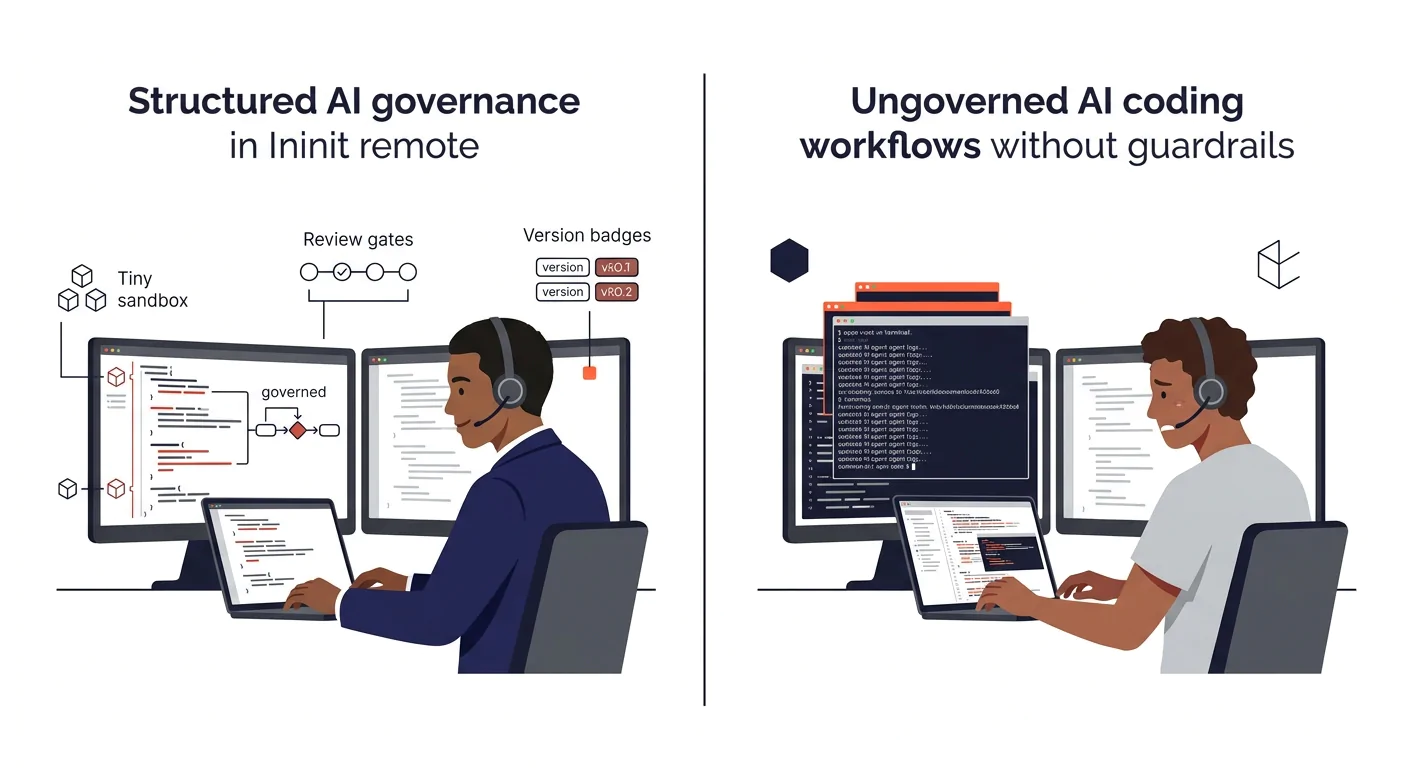
Infosecurity Magazine reported on June 10, 2026, that AI coding assistant adoption has hit 97% across development teams globally. The same survey found only 30% of those teams have full governance frameworks in place. That 67-percentage-point gap between usage and oversight is where outsourcing risk now concentrates.
Cursor’s recent Git RCE vulnerability (patched in version 2.5+) showed what happens when AI agents operate with implicit trust on a developer’s machine. The version 3.6 patch gated agent actions through sandboxes and allowlists, but teams running older versions were exposed for weeks.
For US and Australian companies buying web development from Philippine teams, this means asking harder questions during vendor evaluation. Does the agency enforce repo trust rules? Do developers run the latest patched versions? Is there a credential hygiene policy for AI tools that have terminal access? Pairing AI coding output with outsourced QA testing becomes essential when the volume of code generated per developer doubles or triples.
Warning: If your outsourced dev team can’t explain their AI governance policy (which tools have shell access, how credentials are managed, what review gates exist before AI-generated code hits production) treat that as a red flag equivalent to not having version control.
Cursor’s announcement of a London EMEA office, growing to approximately 200 employees by year-end, signals that the company expects enterprise adoption to keep accelerating. Enterprise adoption means enterprise governance requirements, which will filter down to outsourcing vendors within months.
Meanwhile, CNA reported this week that outsourcing jobs in the Philippines face mounting pressure as workers race to adapt to AI. The teams that survive this transition are the ones building governance and workflow documentation, the same skills that make them trustworthy vendors for international clients.
Where This Lands in June 2026
Over 51% of GitHub commits now involve AI-generated or AI-assisted code. The software development outsourcing market has hit $618 billion globally, and the Philippine BPO sector absorbs $40 billion of that while American AI companies actively push into the market. The tools are here. The adoption numbers are overwhelming. The governance infrastructure is playing catch-up.
Three things are true simultaneously right now. Philippine dev teams have adopted AI coding tools faster than most Western shops. The security and oversight infrastructure around those tools lags behind the adoption curve. And the pricing model for outsourced development is transitioning from hourly rates to value-based billing, where a five-person team’s output gets measured against the 15-person equivalent.
The agencies that documented their AI-native workflows and trained engineers on structured three-tier models are the ones winning contracts today. The ones that bolted Cursor onto an existing process and called it AI-native are losing bids to competitors who can explain exactly how Claude Code, Aider, and Cursor divide labor across their team. That division of labor, specific and documented and auditable, is what clients pay the $65/hour premium for.