
A 4-to-6-month engineering hire cycle forces product companies into fixed-scope outsourcing contracts that break under scope change, according to a June 16 dedicated development team guide published by Patoliya Infotech, an India-based offshore development provider. The guide frames dedicated teams as a middle path between in-house hiring timelines and project-based outsourcing scope constraints, with a minimum $15,000 monthly budget threshold.
TL;DR: Patoliya Infotech published a practical guide June 16 contrasting dedicated offshore development team economics against in-house hiring (4–6 months per engineer) and project outsourcing, targeting product companies with evolving roadmaps and budgets above $15,000/month.
The publication addresses engagement model confusion that drives SMBs toward mismatched offshore arrangements—staff augmentation when they need managed teams, or fixed-price projects when scope changes weekly. Hitesh S, the guide’s author, positions dedicated teams as vendor-employed squads operating under client direction without employment overhead, distinct from both staff augmentation (where clients carry full management weight) and project outsourcing (where vendors control scope and delivery).
Cost and Timeline Thresholds for Viable Dedicated Teams
The guide sets $15,000 per month as the minimum viable budget for dedicated team engagements, a threshold that excludes one-to-two specialist arrangements and favors full squad deployments. Companies operating below that threshold should consider staff augmentation or freelance models, according to the guide’s decision framework.
Ramp-up velocity follows a structured 12-week curve: 10–20% capacity in weeks 1–2, climbing to 30–40% by week 4, reaching 50–70% by week 8, and hitting 80–100% capacity between weeks 9 and 12. The guide contrasts this 8-to-12-week timeline against structured onboarding with a 3-to-6-month drift when access provisioning and technical leadership are handled reactively. Teams working on outsourced mobile app development projects face the same velocity curve whether the roadmap addresses iOS, Android, or cross-platform frameworks.
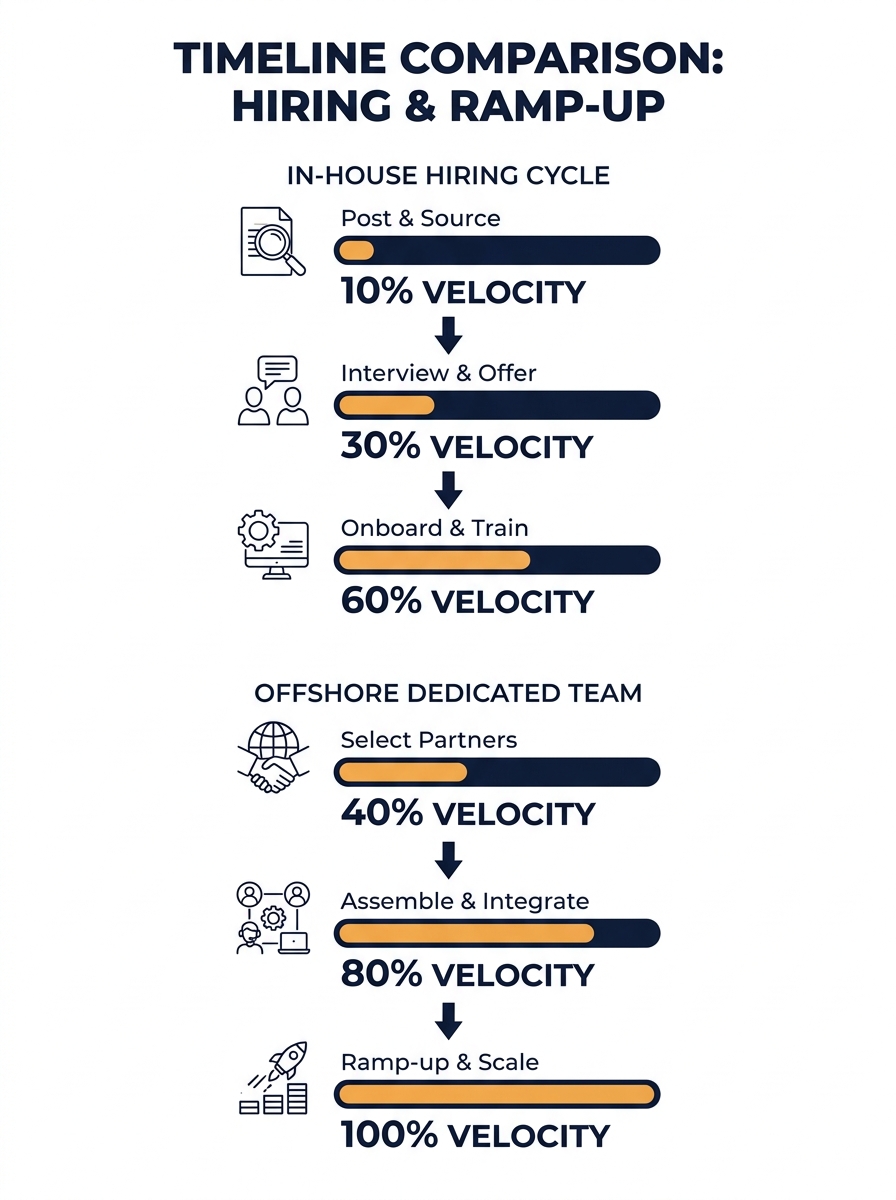
Three factors accelerate onboarding past the 8-week mark, according to the guide: repository and tool access granted before day one, an internal technical lead available two hours daily during weeks 1–4, and written architecture documentation shared during the scoping phase. The inverse—reactive access requests, absent technical authority, and deferred sprint planning—extends ramp-up by 8 to 16 weeks.
Five Engagement Models and Their Control Splits
Patoliya Infotech’s guide distinguishes dedicated development teams from four adjacent models by mapping who manages scope, who employs the team, and where flexibility lives. The comparison addresses a decision point that offshore digital marketing team frameworks tackle with similar control-split logic across service verticals.
Dedicated teams place directional control with the client while the vendor manages HR, infrastructure, and retention—a structure the guide positions as high-flexibility with long-term product work as the primary use case. Staff augmentation shifts full management to the client with medium flexibility; project outsourcing hands scope management to the vendor with low flexibility and fixed-scope delivery as the fit; extended team models split management with high flexibility for scaling existing squads; freelance arrangements return full client management with high flexibility for short task-based assignments.
The distinction between dedicated teams and staff augmentation—the most commonly confused pair, per the guide—determines who carries delivery risk when a developer exits. Dedicated teams assign that risk to the vendor through managed retention and replacement; staff augmentation leaves the client holding continuity risk.
Four Conditions That Signal Dedicated Team Fit
The guide specifies four conditions where dedicated teams outperform alternatives: product roadmaps extending beyond six months with evolving requirements, in-house hiring cycles too slow for delivery timelines, need for full directional control without employment overhead, and frequent scope changes that break fixed-price contracts.
Four inverse signals indicate dedicated teams are the wrong choice: fixed scope with a defined end date, need for one or two specialists rather than a full squad, unclear or fragmented internal product ownership, and total budgets under $15,000 per month. The $15,000 floor appears twice in the guide’s framework—once as a budget threshold, once as a scope-complexity proxy that separates squad-scale work from specialist insertion.
Companies evaluating outsourced IT services encounter parallel fit criteria: sustained infrastructure work versus project-based implementations, and internal capacity to manage individual contractors versus appetite for vendor-managed teams.
Onboarding Phase Reality and Failure Points
Patoliya Infotech’s guide frames weeks 5–8 as the integration and onboarding phase, following a two-week scoping window and two-week team assembly period. Most client underinvestment lands in this phase, according to the guide, producing low velocity at month two when teams should approach 50–70% capacity.
Three failure points dominate the first 90 days: access not provisioned before day one, no internal technical lead available for questions, and sprint ceremonies skipped in weeks 1–3. The guide positions these as structural breaks rather than team performance issues, with the access-provisioning gap extending ramp-up timelines by 4 to 8 weeks when handled reactively.
The four-phase engagement model—scoping (weeks 0–2), team assembly and contracting (weeks 2–4), integration and onboarding (weeks 5–8), and ongoing operations (month 3 onward)—assigns IP clauses, repository access, and exit terms to phase two rather than deferring contract detail to later stages. The guide flags this sequencing as a determinant of whether teams reach 80% velocity by week 9 or drift past week 16.
Reading Between the Lines
Patoliya Infotech’s June 16 guide is the third offshore development provider publication this month addressing engagement model confusion with cost thresholds and timeline breakdowns. A Pakistan-based dev agency published a New York startup guide June 12 pegging local engineering costs at $400K–$750K versus $168K–$240K offshore; Hireplicity released an AI-augmented offshore developer hiring guide June 13 with 2026 pricing and model comparison. The clustering suggests offshore providers are competing on buyer education rather than rate compression—a shift from 2024–2025 positioning that led with cost-per-hour arbitrage.
The $15,000 monthly minimum sits at the midpoint of the $3,000–$30,000 budget range most US and Australian SMBs allocate to offshore operations, making the guide’s thresholds directly actionable for operators evaluating whether their scope justifies a managed team or requires staff augmentation. The 8-to-12-week ramp-up timeline, when structured with day-one access and dedicated technical leadership, competes favorably against 4-to-6-month in-house cycles for product companies that need velocity without employment overhead.
The guide’s control-split framework—client directs, vendor employs—maps cleanly to the hybrid model that’s replaced pure project outsourcing for SaaS and ecommerce operators carrying multi-quarter roadmaps. Teams that hit 80% capacity by week 9 deliver meaningful output by month three; teams drifting to week 16 because access was handled reactively burn budget without shipping features, reinforcing the guide’s emphasis on phase-two contract detail and phase-three onboarding investment as ramp-up determinants.