
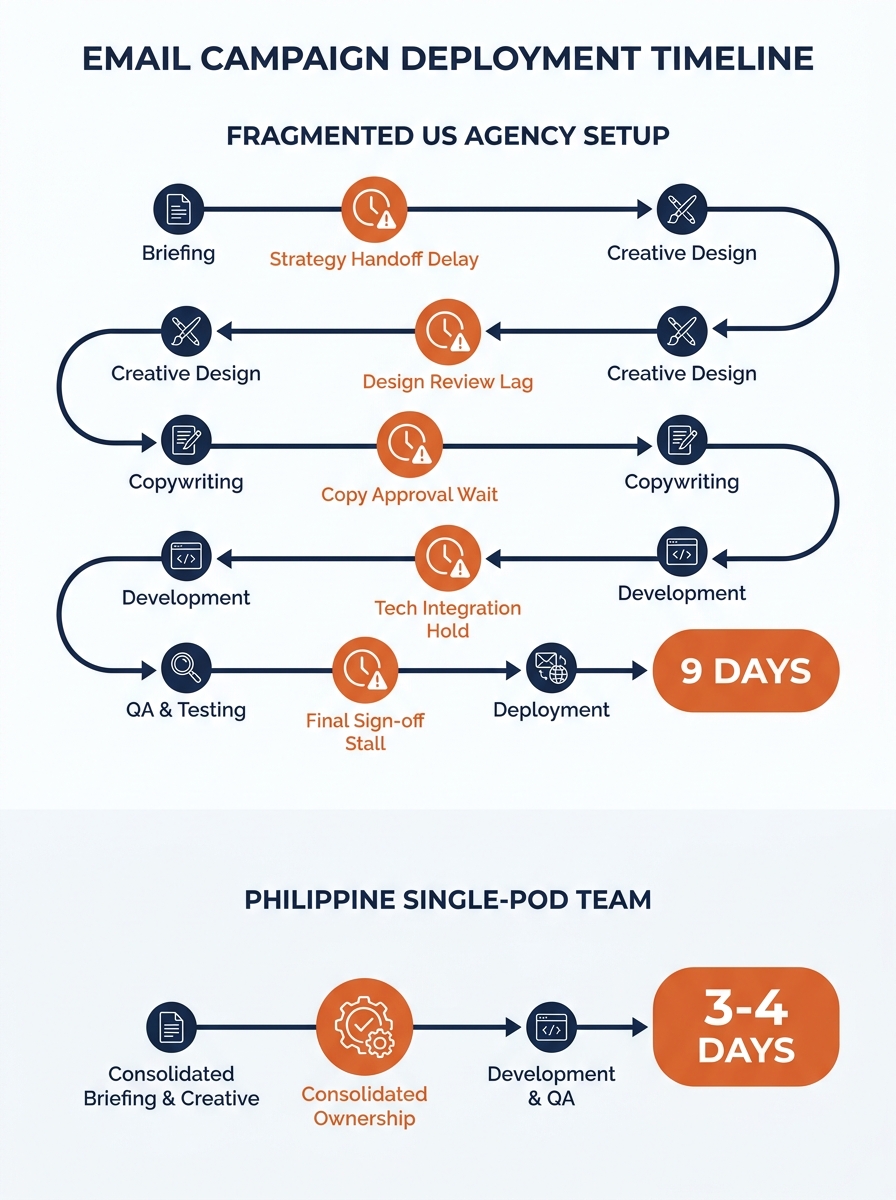
Fragmented vendor setups inside US agencies add 5-6 days to every email nurture sequence deployment. Philippine single-pod teams eliminate that penalty by stacking copywriting, design, automation configuration, and analytics under one roof, compressing launch cycles from 9 days to 3-4.
TL;DR: US agencies lose nearly a week per email campaign to multi-vendor handoff delays. Philippine pods running stacked email marketing automation outsourcing cut deployment to 3-4 days by consolidating sequence ownership under one team with tiered decision authority, rather than bouncing briefs between separate contractors.
The Coordination Tax on Campaign Sequencing
Every handoff between a copywriter, a designer, an automation specialist, and an analytics reviewer introduces a 16-hour async delay when those people sit in different companies, use different project management tools, and report to different account managers. For a typical 5-email nurture sequence, those delays stack. US agencies using separate vendors for email copy, creative, and platform configuration see 2-3 weeks between brief approval and a live campaign, according to workflow audits documented across multi-vendor marketing setups.
The math is straightforward. If each of four handoff points introduces a one-day lag (waiting for Slack replies, revision rounds, platform access requests), a sequence that should take 72 hours of actual work stretches to 9 business days. And that’s before anyone factors in conflicting creative direction. When your copywriter works for one agency, your designer freelances, and your HubSpot admin is a third contractor, nobody owns the full sequence. Conflicting recommendations slow everything further.
This is what makes nurture sequence delegation Philippines teams solve well. The problem was never about email marketing talent in the US being scarce. Skilled email marketers exist everywhere. The problem is organizational: US agencies fragment the work across too many parties, and each fragment creates friction.
How Capability Stacking Fixes the Sequencing Problem
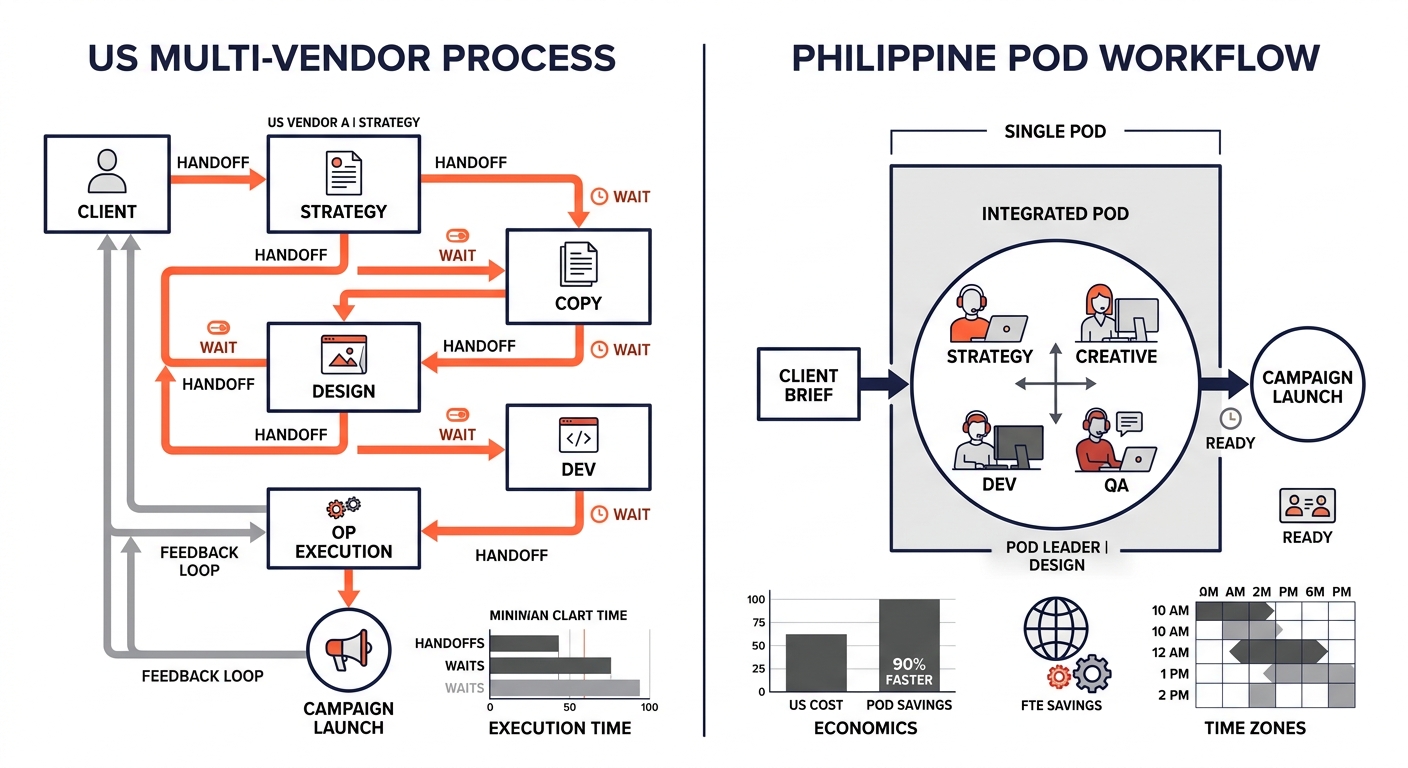
The capability stacking model runs email copy, template design, automation logic, and campaign analytics through a single Philippine pod rather than distributing those tasks across separate US vendors. The result is a 40-60% reduction in total marketing spend and, more importantly for campaign velocity, a compression of request-to-deployment cycles from days to hours.
Why does consolidation produce faster email campaigns specifically? Because email sequences are tightly interdependent. The subject line affects the CTA. The CTA needs to match the landing page. The landing page conversion rate determines whether the next email in the sequence triggers or the lead gets rerouted. When one person writes the copy and a different person (in a different time zone, at a different company) builds the automation logic, misalignment is the default. A stacked pod where the copywriter sits next to the automation specialist catches those mismatches before they ship.
As Martal Group’s outsourcing guide notes, the fastest way to boost outsourced email marketing results is to split test landing pages, subject lines, and CTAs from the start. That advice sounds obvious, but it requires all three elements to be under the same team’s control. A fragmented vendor setup makes simultaneous split testing across copy, design, and landing pages logistically painful. A single pod makes it routine.
And this stacking effect multiplies across channels. When your outsourced digital marketing pod handles both email and paid media, the data from email engagement directly informs ad targeting. Agencies that run these separately lose that feedback loop entirely.
The Sequence Ownership Model
Effective offshore email campaign management requires a clear framework for what the Philippine team can act on independently and what needs client-side approval. Without this structure, you get one of two failure modes: either the team waits for approval on every send (killing the speed advantage) or they act autonomously on strategic decisions that should involve the client (killing trust).
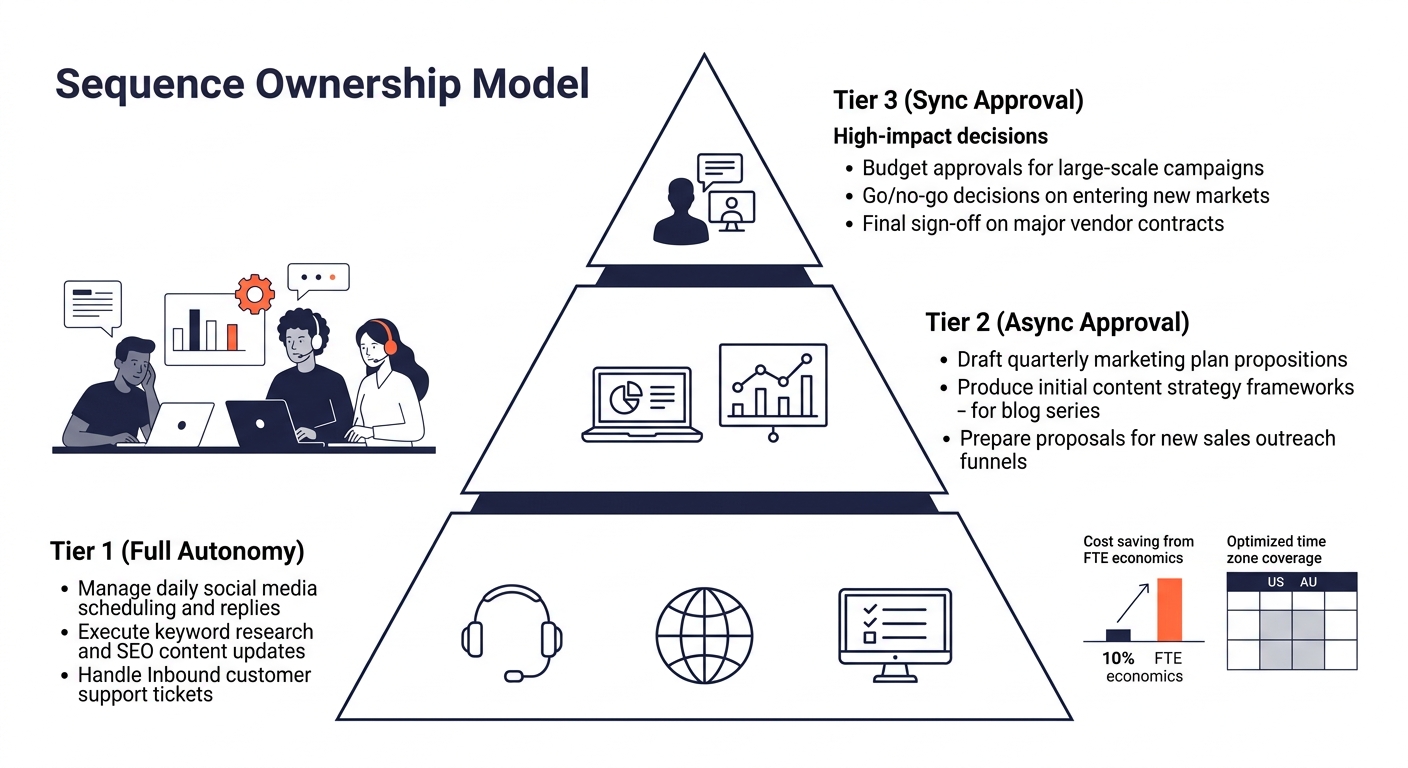
The marketing automation handoff framework that works best in practice has three tiers:
Tier 1 — Full Autonomy. The Philippine team executes without waiting for approval. This covers routine sends, A/B test variants on subject lines and CTAs, template formatting updates, list hygiene, and bid adjustments under $50/day on complementary outsourced PPC management campaigns. These are operational decisions where waiting for a US-based approval adds delay without adding judgment.
Tier 2 — Async Approval. The team drafts and queues, then the client approves within a defined window (typically 12-24 hours). This tier covers new email sequences, segment definition changes, and landing page copy that touches brand voice. The team proposes; the client confirms via a shared approval doc, not a Slack thread.
Tier 3 — Sync Approval. Reserved for strategic shifts: new audience segments, changes to lead scoring thresholds, campaign budget reallocation above $500/month. These require a live call because the context is too nuanced for async.
Benjamin Laker, writing in MIT Sloan Management Review, describes this graduated approach well: “Progressively expanding the scope of responsibility is one of the most effective ways to build leadership readiness without overwhelming people or compromising quality.” The same principle applies to outsourced marketing teams. You start a new Philippine pod at Tier 1, then expand their authority as they demonstrate pattern recognition for your brand and audience.
The workflow integration checklist we’ve documented elsewhere covers the system alignment prerequisites in detail. Without shared data access and structured handoff protocols, even a well-defined tiered model breaks down at the tool level.
Why Overnight Iteration Compounds Performance
Time-zone difference is usually discussed as a coordination challenge. For email campaign sequencing specifically, it’s an operational advantage that US agencies cannot replicate domestically.
Here’s the pattern: your US team reviews campaign performance at the end of their workday and flags that the second email in a 5-part nurture sequence has a 1.8% click-through rate against a 3.2% benchmark. They leave a note in the project management tool. The Philippine team picks it up at the start of their day (which is the US evening), rewrites the CTA, adjusts the send time, queues the variant, and has updated results waiting when the US team logs in the next morning. That’s a full optimization cycle completed during US off-hours.
Businesses that enforce automated routing and closed-loop feedback mechanisms between marketing and sales see this compound quickly. When leads from a nurture sequence hit a qualification threshold, the CRM triggers a real-time notification to the sales team. The Philippine email team monitors which sequences produce qualified leads and adjusts accordingly, often within 24-48 hours of identifying underperformance.
A full optimization cycle completed during US off-hours means your email sequences improve while you sleep. That’s the structural advantage no domestic agency can match.
This overnight turnaround delivers approximately 2x the iteration cycles per week compared to a fully US-based team. Over a 90-day campaign, that’s the difference between 12 optimization cycles and 24. At scale, this produces measurably higher open rates, click-through rates, and ultimately conversion rates because every underperforming element gets caught and corrected faster.
Philippine teams experienced in curated email storytelling bring an additional advantage here. They understand how individual sequence emails connect to the broader content strategy, so their overnight edits maintain narrative coherence rather than optimizing each email in isolation.
What the Comparison Looks Like in Practice
| Attribute | US Multi-Vendor Setup | Philippine Single-Pod Model |
|---|---|---|
| Brief-to-deployment time | 9 business days average | 3-4 business days |
| Handoff points per sequence | 4-6 (copy → design → dev → QA → analytics) | 1-2 (internal pod review → client async approval) |
| A/B test turnaround | 3-5 days per variant | 24-48 hours per variant |
| Cost per campaign (5-email sequence) | $3,000-$5,000 at US agency rates | $800-$1,500 at Philippine pod rates |
| Optimization cycles per month | 4-6 | 10-14 |
| Data access lag | 3-7 day old exports common | Live dashboard access standard |
The cost differential matters, but the speed differential matters more. An agency spending $4,000 per nurture sequence that takes 9 days to deploy gets outperformed by a pod spending $1,200 that deploys in 4 days and iterates twice as often. Over a quarter, the Philippine pod has run 24+ optimization cycles while the US setup has managed 12.
Knowing What to Delegate First
Sequencing is where email marketing automation outsourcing delivers the clearest ROI, but not every email function should be handed off simultaneously. The delegation order matters. Start with the highest-volume, most process-driven work: recurring newsletter production, drip sequence management, list segmentation and hygiene. These tasks have clear inputs, measurable outputs, and low ambiguity.
Hold back on email strategy and audience definition until the pod has completed at least 60-90 days of execution work. By then, they’ll have absorbed enough about your brand voice, audience behavior, and conversion patterns to contribute strategic recommendations rather than just executing briefs. The progression from Tier 1 to Tier 2 authority should feel earned, not assumed.
Tip: Before handing off your first nurture sequence, document your lead scoring thresholds, brand voice guidelines, and CTA conventions in a shared reference doc. This eliminates 70-80% of the revision rounds that slow down initial campaigns.
What Still Isn’t Settled
Two open questions remain for agencies considering this model. First, platform expertise concentration. Philippine email marketing talent is deep on HubSpot, Mailchimp, ActiveCampaign, and Klaviyo. Agencies running less common platforms (Pardot, Marketo Engage, Customer.io at enterprise scale) will find the talent pool thinner and onboarding longer. The stacking advantage holds, but the ramp-up from 2 weeks to 4-6 weeks on complex platforms is real.
Second, the handoff between email-qualified leads and US-based sales teams hasn’t been fully solved by automation alone. CRM triggers and lead scoring can route leads in real time, but the contextual notes that help a salesperson open a warm conversation still require human judgment. Philippine pods that sit close to the email data are well-positioned to write those handoff notes, but few agencies have formalized this as part of the email team’s scope. The teams that figure out this final mile of the marketing-to-sales handoff will pull further ahead in conversion rate while competitors keep debating whether to outsource at all.