
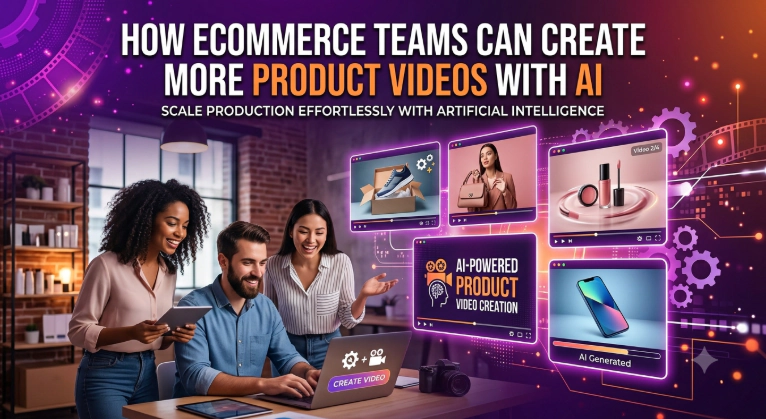
For an ecommerce team, the pressure to create video rarely comes from one campaign. A new product launches, a sale starts, a collection needs promotion, and social channels need fresh creative at the same time.
The traditional answer is usually another shoot. But that does not scale well when a brand has a large catalog or needs dozens of creative variations.
AI offers a different approach. Rather than treating every video as a standalone production, teams can build a system where one product brief can lead to multiple concepts, formats, and campaigns.
The Shift From Video Projects to Video Systems
The biggest change is not that AI can make a video from text. It is the way ecommerce teams can rethink their production pipeline.
Instead of asking, “How do we make a video for this product?” teams can ask, “How many useful stories can we tell about this product?”
That small change can open up far more creative possibilities.
Start With the Buying Journey
A product does not need the same message at every stage.
Someone discovering a product may want to understand what it is. A shopper considering a purchase may want proof that it works. A returning visitor may simply need a reason to come back.
This gives marketers several natural video directions before they even begin production.
Invideo Agent Brings Different Creative Tasks Together
Invideo agent can fit into this workflow by treating the product campaign as one connected project instead of a series of isolated video tasks.
Teams can provide product information, existing footage, scripts, PDFs, brand material, or other references and use them as the foundation for new creative work. The platform provides access to 200+ AI models, supporting different stages such as scripting, visual development, scene creation, voiceovers, music, AI video dubbing, and editing.
Invideo agent two can maintain context as the project develops. For example, a team can establish the product positioning, audience, visual direction, and campaign requirements and continue building from those decisions. Specialist agents can also take on different creative responsibilities, such as script development, creative direction, or product marketing.
This makes it possible to explore several campaign ideas without treating each one as an entirely new project.
One Product, Several Creative Stories
The same product can mean different things to different shoppers.
A coffee machine, for example, could be presented through its speed, ease of cleaning, morning routine, design, or the quality of the coffee it produces.
Each angle can become its own video.
Move Beyond Feature Lists
Feature-heavy videos often tell viewers what a product has without showing why they should care.
A stronger approach is to connect the feature with a real situation.
Instead of simply saying a vacuum has a long battery life, show what that means for someone cleaning an entire apartment without stopping to recharge.
The product remains the focus, but the story becomes easier to understand.
Customer Behaviour Can Become the Creative Brief
Ecommerce teams already have access to useful creative research. They just may not think of it that way.
Product reviews, search queries, customer support conversations, social comments, and questions from sales teams can reveal where shoppers hesitate.
Turn Questions Into Videos
If shoppers ask how large a product really is, create a scale demonstration.
If they wonder whether it is difficult to use, show the setup.
If they compare two versions, create a side-by-side explanation.
This approach gives every video a specific job instead of producing generic product content.
Make the Product Look Different Without Reshooting
A physical shoot captures only what the production team planned for that day.
AI can help expand how those assets are presented afterward.
Rework Existing Creative
A single product photograph or piece of footage can become part of different concepts, depending on the campaign.
The same asset might appear in a product-focused ad, a lifestyle story, or a short educational video.
This is particularly useful for ecommerce teams with large catalogs where arranging a new shoot for every creative angle would be impractical.
Build Creative Variations Around the Hook
The first few seconds of an ecommerce ad can determine whether someone continues watching.
Instead of producing one opening, teams can develop several approaches around the same product.
Try Different Reasons to Watch
One version might open with a problem.
Another might start with an unexpected product benefit.
A third could demonstrate the result immediately.
A fourth could use a customer question as the opening line.
These variations allow marketers to test the message before deciding which direction deserves more investment.
Turn Long-Form Content Into Smaller Assets
A product demonstration can have a longer life than its original campaign.
A detailed video can be divided into smaller pieces that answer individual questions or highlight specific features.
Create a Content Chain
One production can lead to:
- A complete product demonstration
- Short social clips
- Feature-specific videos
- FAQ content
- Paid ad variations
- Retargeting creatives
- Tutorial videos
The important part is to plan these outputs before the original video is finished.
Let Different Channels Tell Different Versions of the Story
A product does not need to look exactly the same everywhere.
A landing-page video can explain more. A social ad needs to establish the idea quickly. A marketplace video may need to focus on practical product information.
Adapt the Same Core Idea
Rather than duplicating one video across every channel, keep the central product message and adjust the structure around the platform.
That might mean changing the length, framing, captions, pacing, or opening while keeping the underlying creative idea consistent.
More Content Requires Better Brand Control
Once production becomes easier, inconsistency can become the next problem.
If different teams are producing dozens of videos, the brand can quickly develop different visual styles and tones.
Create a Simple Creative Framework
Before scaling production, define the basics:
- How products should be presented
- What tone the scripts should use
- Which visual styles fit the brand
- How logos and product names appear
- What claims can be made
- Which customer messages should be prioritised
This gives AI-assisted production clear boundaries.
Use Performance Data as the Next Creative Input
The first batch of videos should not be treated as the end of the process.
Performance data can reveal which ideas deserve another version.
If a problem-focused hook performs well, create more variations around that problem. If customers respond strongly to demonstrations, build additional content around product use.
Turn Testing Into a Loop
The workflow becomes:
Create → Publish → Measure → Learn → Develop → Test again
This is where ecommerce teams can gain an advantage. Instead of producing a fixed set of videos and moving on, they can continuously use campaign results to influence the next creative batch.
The Real Advantage Is Creative Capacity
AI does not remove the need for good ecommerce marketing. It changes how much creative experimentation a team can realistically handle.
A small team can explore more product stories. A larger team can produce more variations without adding the same amount of production overhead.
That means the value is not simply measured by how quickly a video gets generated. It is measured by how effectively the team can turn product information into useful creative ideas.
Final Thoughts
Ecommerce video creation is moving away from the traditional model of one product, one shoot, and one finished video.
With AI, the same product information can support multiple narratives, audience angles, formats, and campaigns. Existing assets can be reused, customer questions can become content ideas, and performance data can shape what gets created next.
Invideo agent supports this broader approach with 200+ AI models, project memory, specialist agents, and tools for developing scripts, scenes, visuals, voiceovers, music, and edits.
For ecommerce teams, the biggest opportunity is not simply producing more videos. It is building a creative system where every product has the potential to become a much larger library of useful content.