
Offshore e-commerce development teams don’t fail because of skill gaps or time zone friction. They fail because the handoff documentation lives in a shared folder that nobody updates after week two, creating a compounding knowledge gap that turns every Shopify migration, WooCommerce build, or Magento deployment into a liability.
TL;DR: The “hybrid ramp-up” model—gradually shifting e-commerce dev work to a Philippine team—collapses when documentation is treated as a one-time deliverable instead of a living sprint artifact. Teams with structured knowledge-transfer plans cut new-member ramp-up time by 35% and reduce defect rates by measurable margins. The fix is structural: embed documentation into every sprint as a required output, or watch tribal knowledge evaporate across 12 time zones.
Documentation Decay Kills the Outsourced Web Development Handoff
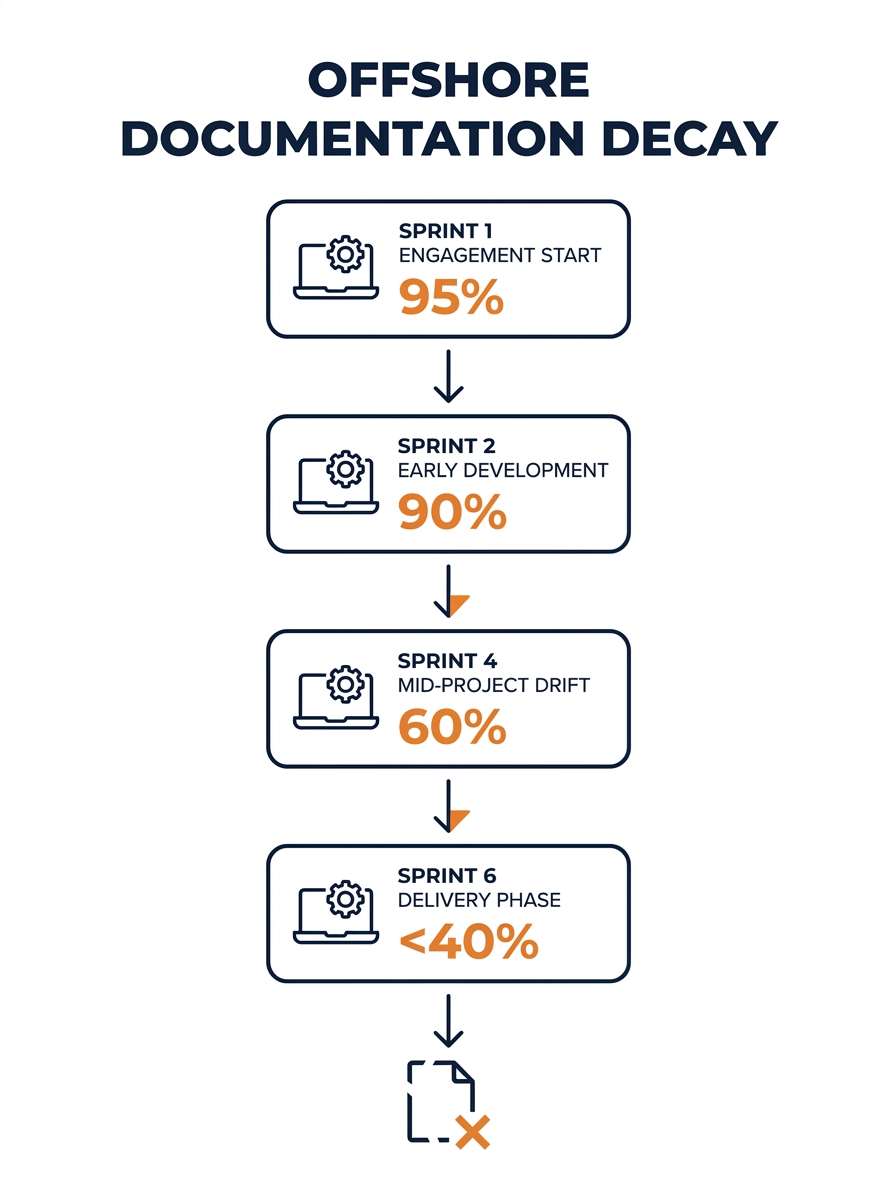
The standard hybrid ramp-up goes like this: an agency or e-commerce brand hires a Philippine development team, spends 2-3 weeks writing specification documents and architecture overviews, uploads everything to Notion or Google Drive, and kicks off the first sprint. By sprint four, 40-60% of that documentation is outdated. Field names have changed. API endpoints have been swapped. The Shopify theme structure has been refactored. Nobody goes back to fix the docs because the original writers are busy shipping features.
According to CISIN’s internal analysis of over 3,000 software projects, a structured knowledge-transfer plan reduces time-to-productivity for new team members by an average of 35%. That number matters enormously for Philippine developer onboarding, where a revolving door of contractors or new hires is common in fast-scaling e-commerce operations. Without a living documentation system, every new developer starts from scratch, reverse-engineering decisions made months ago by people who’ve already moved on.
The research on globally distributed teams confirms this pattern. Knowledge transfer in outsourced software development has been studied since at least the early 2000s across global BPO operations, infrastructure management, and distributed engineering projects. The consistent finding: teams that rely on one-time documentation dumps lose institutional knowledge at a rate that accelerates with each personnel change.
For e-commerce shops running WooCommerce stores with 5,000+ SKUs or multi-region Shopify Plus deployments, this decay pattern creates specific dangers. Custom checkout logic, tax calculation overrides, shipping rule configurations, and payment gateway integrations all carry undocumented edge cases. When the developer who wrote the original integration leaves and the documentation hasn’t kept pace, the replacement developer has to learn by reading raw code, which pushes bug rates up and velocity down.
Defect Rates and the 13-Hour Weekly Tax
Why does documentation decay translate directly to broken e-commerce stores? Because developers working without current documentation make guesses, and guesses produce bugs. Offshore-developed code carries 20-40% higher defect rates than onshore output, with a benchmark target of 1 defect per 1,000 lines of code. Fixing a production bug costs 4x to 15x more than catching it during initial development. On an e-commerce site processing $200,000/month in transactions, a single checkout bug that goes undetected for 72 hours can cost $8,000-$25,000 in lost revenue and recovery labor.
Technical debt, the accumulated cost of shortcuts and undocumented decisions, consumes roughly one-third of engineers’ total working time. That’s 13+ hours per week per developer spent untangling problems that better documentation would have prevented. For a 4-person Philippine dev team billing at $35/hour, that’s $1,820/week in productivity loss, or $7,280/month burned on debt servicing instead of feature development.
Technical debt consumes 13+ hours per week per developer. For a 4-person offshore team at $35/hour, that’s $7,280/month in lost productivity that embedded documentation would largely prevent.
IT Idol Technologies’ best practices guide for offshore team management frames this as a design problem: workflows should be built around async-first communication where documentation clarity reduces ambiguity and rework. ScaleUpAlly’s operational guidance is even more specific, recommending teams provide detailed project documentation including technical specifications, user stories, and design mockups and regularly communicate updates and changes to avoid misunderstandings.
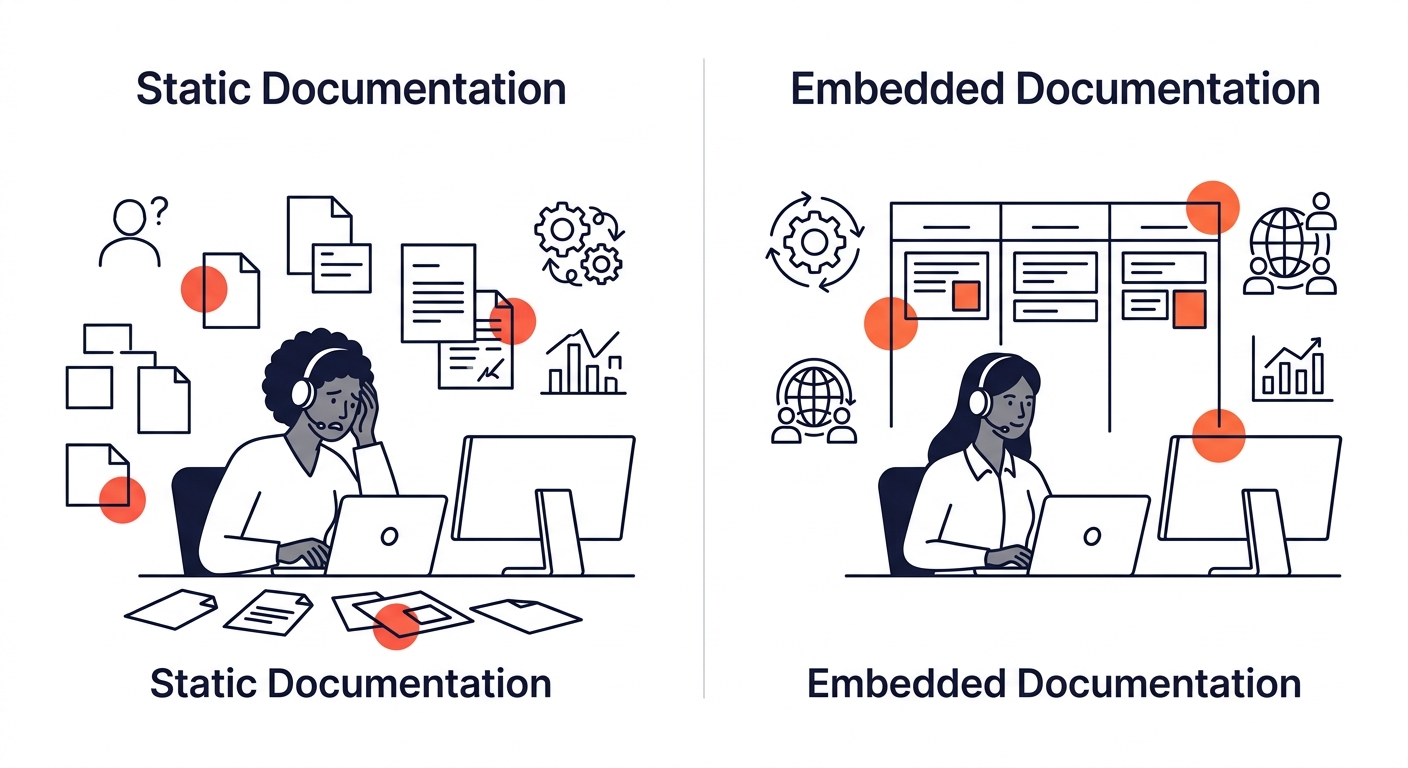
The challenge is that “provide detailed documentation” reads as a one-time instruction. Teams hear it, produce a burst of docs during onboarding, and then stop maintaining them under sprint pressure. This is where the hybrid ramp-up trap springs shut: the documentation that enabled the initial handoff becomes the very thing that undermines ongoing execution because nobody budgeted for its maintenance.
Top-performing teams address this by dedicating 20% of sprint capacity to refactoring and documentation upkeep. That means in a 2-week sprint with 80 available developer-hours, 16 hours go to documentation updates, code cleanup, and debt reduction. E-commerce agencies that skip this allocation to ship features faster end up paying for it in higher defect rates and slower onboarding cycles when team composition changes.
If you’re running white-label WordPress development or building on WooCommerce for agency clients, the documentation gap compounds because you’re maintaining multiple client environments simultaneously, each with its own undocumented quirks.
Platform Migration Risk Management Requires Living Runbooks
E-commerce platform migrations are where the documentation gap becomes an emergency. Moving a store from Magento 2 to Shopify Plus, or from a legacy WordPress/WooCommerce setup to a headless architecture, involves hundreds of data-mapping decisions, redirect rules, and integration configurations. Failed migration phases that aren’t completed as contractually planned lead to severe economic impacts and contractual penalties, according to Prodktr’s risk analysis of data migration projects. And Hyland’s migration risk evaluation notes that training delivered too early gets forgotten by employees by the time new systems deploy to their business unit.
Platform migration risk management requires what I’ll call a Three-Layer Documentation Stack, a framework for evaluating whether your offshore team documentation systems can survive a migration without collapsing:
Layer 1: Sprint-embedded capture. Every sprint includes documentation updates as a required deliverable, not optional. Each pull request must include updated inline comments, updated README sections for any modified module, and an updated changelog entry. CongruentSoft’s guidance to “document key project insights, code, and processes for consistency in any event of team changes” describes the principle, but the mechanism is what matters: documentation tied to the PR review process, enforced by outsourced QA testing checklists that reject PRs without doc updates.
Layer 2: Decision logs. Architecture decisions, recorded within 48 hours of the decision, with context on what alternatives were considered and why they were rejected. For e-commerce migrations, this means recording why a particular Shopify metafield structure was chosen, why a specific payment gateway was selected over alternatives, and what data-mapping compromises were made during product catalog migration.
Layer 3: Migration runbooks. Step-by-step procedures specific to each platform transition, tested through dry runs before production cutover. These runbooks include rollback procedures, data validation scripts, and post-migration QA checklists with specific pass/fail criteria.
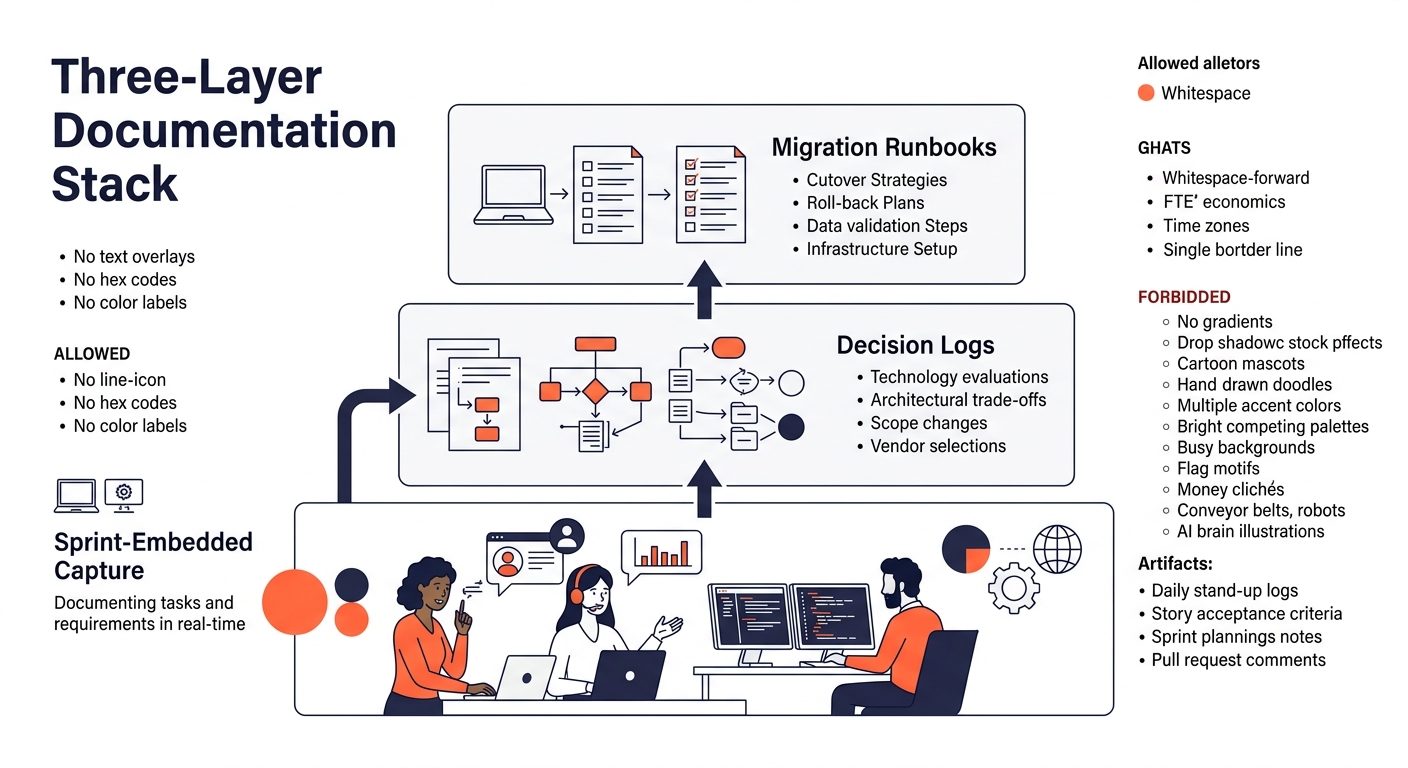
We covered the broader mechanics of how these handoff documents work in our piece on platform migration handoff documentation, but the critical point here is timing. Static documentation created before the migration begins will be wrong by the time the migration reaches its midpoint. The Three-Layer Documentation Stack works because each layer updates continuously throughout the engagement, reducing the 20-40% defect rate premium that offshore code carries when developers work from stale specs.
The Philippines ranks high in English proficiency across global hiring markets, which removes one of the biggest barriers in offshore hiring according to Fronted’s 2026 hiring guide. But English fluency doesn’t solve the documentation problem on its own. A developer who speaks and writes excellent English can still produce zero documentation if the sprint structure doesn’t require it. The barrier is process design, and the trap is assuming that communication skill equals documentation discipline.
Agencies that invest in proactive diagnostic processes before engagement kickoff are better positioned here because they’ve already established the habit of structured, written handoffs between teams. And those running integrated workflow checklists have a natural place to insert documentation gates into existing processes.
Warning: If your Philippine dev team’s onboarding packet is a Google Drive folder that hasn’t been modified since the first sprint, you’re operating on borrowed time. Every undocumented decision becomes a future production incident waiting for a trigger.
The Trap, Examined Again
The hybrid ramp-up model promises a smooth, gradual transition of e-commerce development work to a Philippine team. The promise is real, but the execution fails at a specific, predictable point: the moment when documentation shifts from “something we create” to “something we maintain.” That shift requires dedicated sprint allocation (20% is the benchmark among top teams), PR-level enforcement through QA review, and a named framework like the Three-Layer Documentation Stack that gives both the onshore and offshore sides a shared vocabulary for what “documented” actually means.
The CISIN data showing 35% faster ramp-up with structured knowledge transfer isn’t aspirational. It’s the measured gap between teams that build documentation into their delivery process and teams that treat it as a side task. For e-commerce operations where a checkout bug costs $8,000-$25,000 in a single weekend, where migration delays trigger contractual penalties, and where technical debt eats 13 hours per developer per week, that 35% gap translates directly into dollars saved and revenue protected. The conventional wisdom says hire good developers and they’ll figure it out. The data says give good developers living documentation and they’ll figure it out 35% faster, with 20-40% fewer defects along the way.