
Requirements clarifications that take five minutes in a hallway take 24 to 48 hours over async channels when your dev team sits 12 time zones away. That delay compounds across dozens of open questions during an e-commerce build, and by week six, you’re staring at a checkout flow that doesn’t match what you asked for. The fix for this isn’t more Slack messages or longer email threads. It’s a structured pre-build workshop process that Philippine web development teams have refined over years of running offshore development workshops for US and Australian clients. The mechanism is surprisingly specific, and misunderstanding how it works is exactly why some companies get burned while others ship clean products on schedule.
The Intake Brief That Eliminates Guesswork
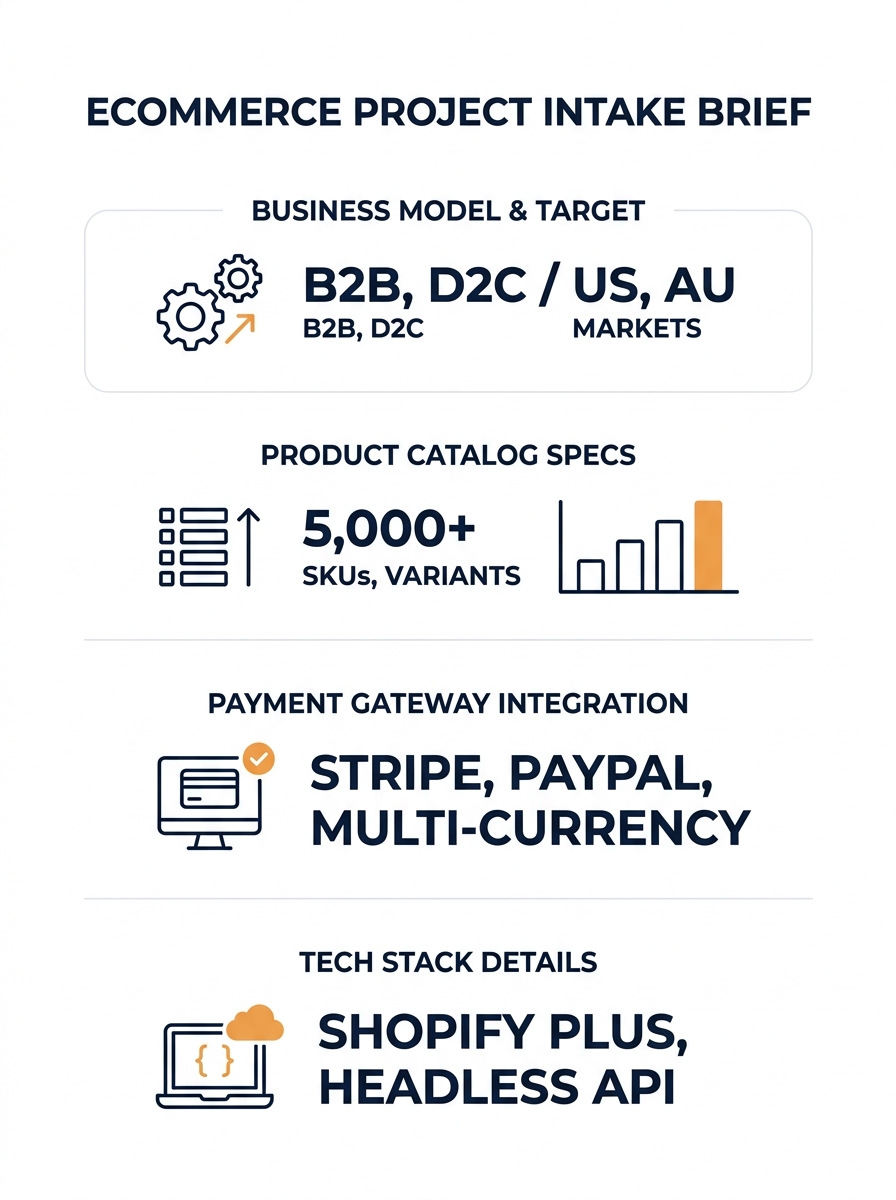
Before any live workshop session, experienced Philippine dev teams send over an intake brief. This is a structured document — usually 15 to 30 questions — designed to surface the business context that developers would normally absorb by sitting near the product team for a few weeks. For an e-commerce project, the brief covers revenue model, product catalog complexity (50 SKUs vs. 50,000), target payment gateways, shipping logic, and existing tech stack.
The brief does two things at once. First, it gives the dev team enough context to prepare intelligent questions rather than generic ones. Second, it forces the client side to articulate decisions they haven’t made yet. You’d be surprised how often a brand comes in wanting “a Shopify-like experience” without having decided whether they’re handling fulfillment in-house or through a 3PL, which changes the entire data architecture.
As one step-by-step web design guide puts it, running a collaborative workshop with marketing leads, sales directors, IT, and senior leadership early on prevents the costly redesigns that happen when someone in leadership surprises the team with a new requirement six weeks into development. The intake brief is how offshore teams make that alignment happen before anyone opens a video call.
Mapping Who Speaks, Who Decides, Who Builds
Cross-functional collaboration outsourcing breaks down the moment you put eight people on a Zoom call and nobody knows who has authority over what. Philippine dev teams handle this by creating a RACI-style role map before the workshop begins. It’s not a formality. It’s the difference between a 90-minute workshop that produces a signed-off feature list and a 90-minute workshop that produces a follow-up meeting.
Here’s the typical breakdown for an e-commerce build:
- Product owner or founder — final sign-off on feature scope and budget tradeoffs
- Marketing lead — inputs on customer journey, conversion funnel priorities, promotional mechanics
- Operations or fulfillment contact — shipping rules, inventory sync requirements, return workflows
- Dev lead (Philippine side) — technical feasibility checks in real time, complexity estimates
- Account manager — facilitates, keeps time, flags misalignment between what’s being asked and what’s been budgeted
That account manager role is crucial. The best offshore shops assign a dedicated AM who knows enough about both business and technical sides to translate between them. If you’re curious about how that works in practice, understanding how account managers customize outsourcing solutions helps explain why this intermediary role prevents so many misfires.
The role map gets shared with everyone 48 hours before the workshop. If the client’s CEO wants to attend but isn’t the decision-maker for UX, the map makes that clear upfront instead of mid-session when the CEO overrules a UX choice the product owner already approved.
The Workshop Session Itself
The live session is where requirements gathering Philippines teams earn their reputation — or don’t. The good ones run workshops in a specific sequence that prevents the sprawl most people associate with offshore projects.
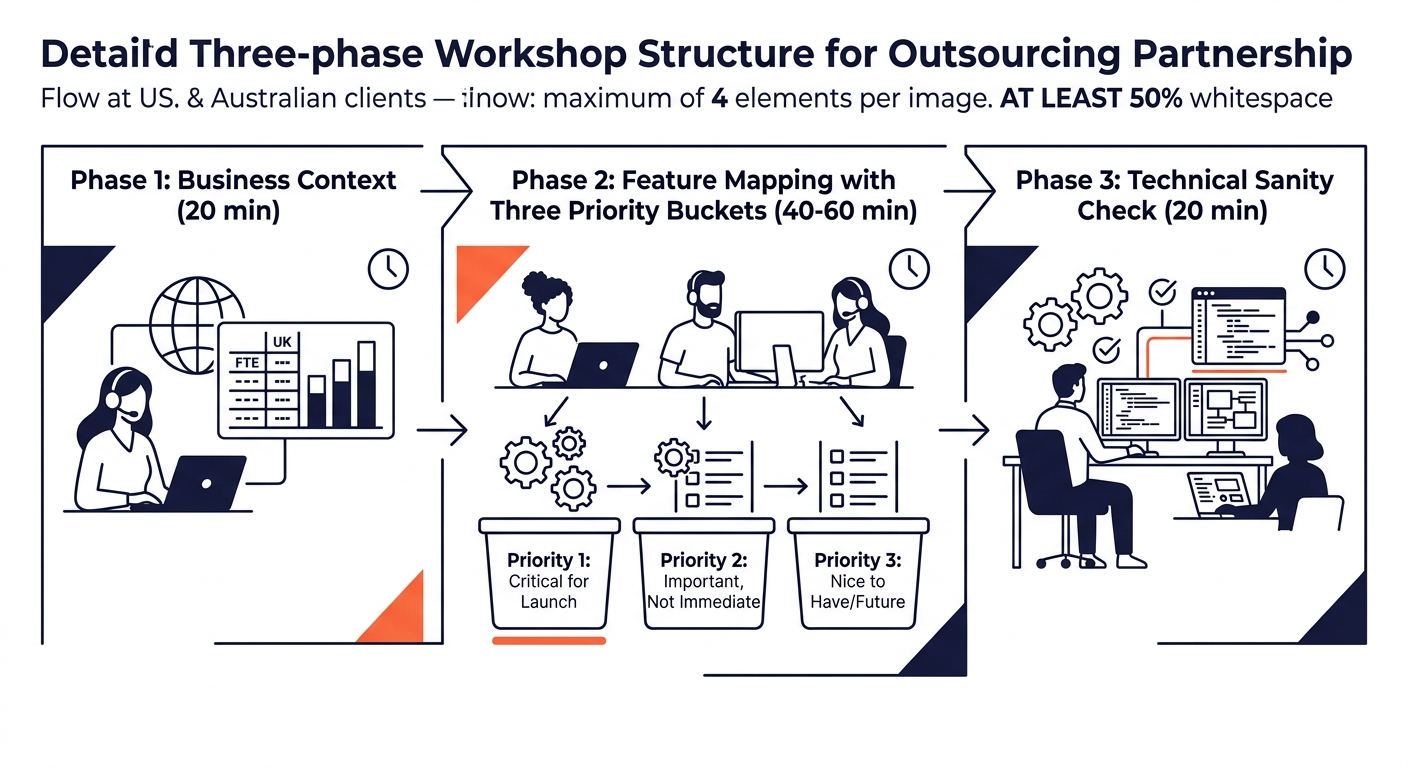
Phase 1: Business Context (20 minutes)
The client side talks. The dev team listens and takes notes. This covers the competitive landscape, the reason for the build or rebuild, revenue targets, and any hard deadlines (a product launch, a holiday sale, a funding milestone). The dev team asks clarifying questions only, no solution proposals yet.
Phase 2: Feature Mapping (40-60 minutes)
This is the core of web development stakeholder management. The team works through each major feature area — product display, search and filtering, cart behavior, checkout, account management, admin dashboard — and for each one, the client describes what they want while the dev lead classifies it into three buckets:
- Launch-critical — the store can’t open without this
- Phase-two — valuable but can ship in a second release
- Nice-to-have — might never get built, and that’s okay
The three-bucket approach prevents the scope creep that kills e-commerce projects. Clients almost always arrive wanting everything at once. The workshop’s job is to help them prioritize without feeling like they’re giving things up permanently.
The workshop’s job is to help clients prioritize without feeling like they’re giving things up permanently.
Phase 3: Technical Sanity Check (20 minutes)
The dev lead walks through any constraints or risks surfaced during the feature mapping. If the client wants real-time inventory sync with a legacy ERP system, this is where the team explains that the integration will take three weeks of the timeline and suggests an alternative (batch sync every 15 minutes, for example). Decisions get made live, documented in a shared Google Doc, and attributed to the person who made them.
The Async Layer Between Sessions
Workshops don’t happen in one sitting. Typical e-commerce builds need two to three sessions spread across a week or two. What happens between sessions matters as much as what happens during them.
Philippine dev teams use a structured async protocol that mirrors best practices for communication cadence: every open question gets logged in a shared tracker with an owner and a deadline. The deadline is almost always 48 hours. Requirements clarifications that drift past 48 hours without a response get escalated to the account manager, who pings the responsible person on the client side directly.
This sounds simple, and it is. But the discipline of tracking every open item with a name and a date attached to it is what separates the messy offshore experiences from the smooth ones. Most communication chaos in offshore projects isn’t caused by language barriers or cultural gaps. It’s caused by unanswered questions accumulating silently until they block development.
The async layer also handles something else: stakeholder changes of heart. Between session one and session two, the marketing lead might realize they actually need a loyalty points system integrated into checkout. The tracker gives that request a place to live, a priority classification, and a cost estimate before it derails the next live session.
Tip: If your offshore team doesn’t maintain a shared decision log with named owners and deadlines for every open item, ask for one before the project starts. It’s the single highest-impact process artifact in any offshore engagement.
The Output Document
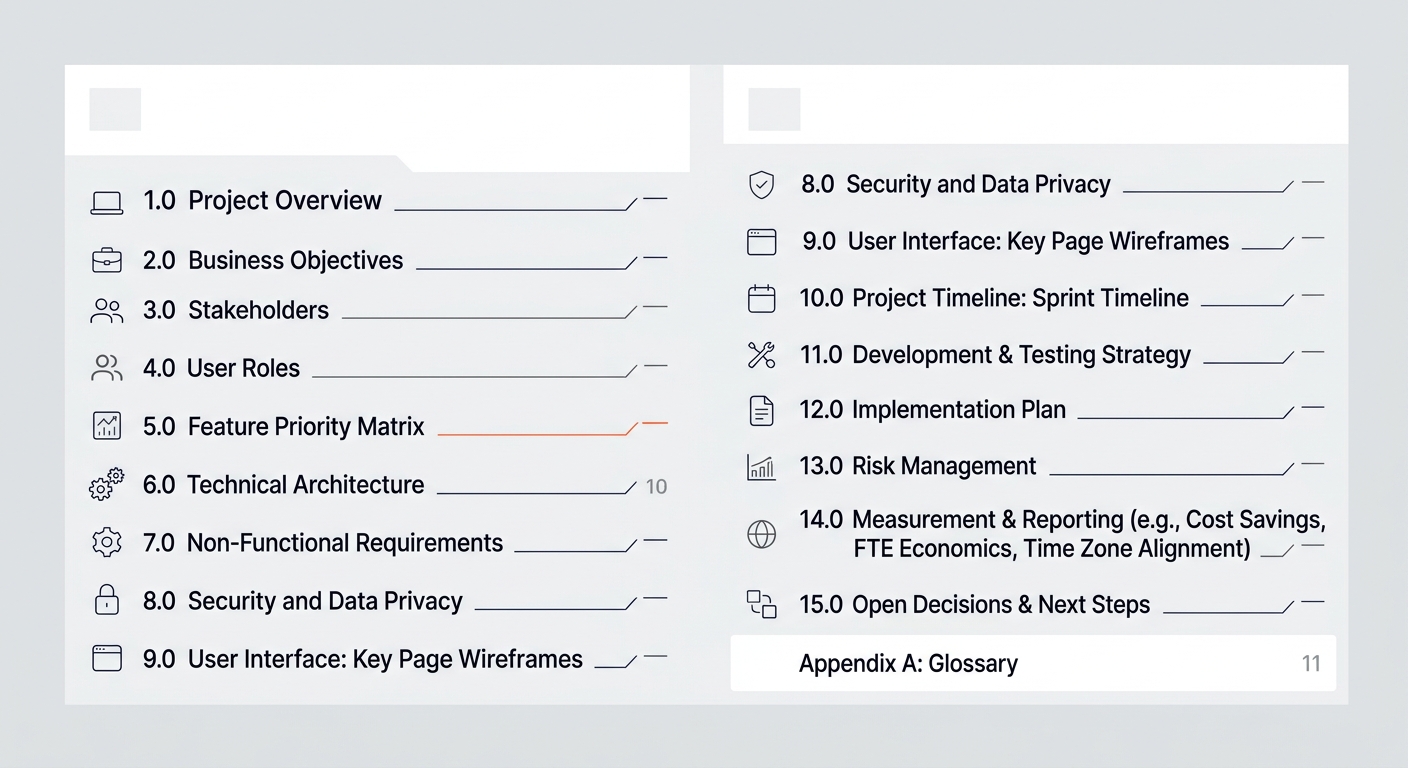
After the final workshop session, the dev team produces a requirements specification document — not a 60-page novel, but a focused document that typically runs 8 to 15 pages for a mid-complexity e-commerce build. It covers:
- Agreed feature list with priority classifications
- Technical architecture overview (platform, hosting, integrations)
- User role definitions (admin, customer, fulfillment staff)
- Wireframe-level page descriptions for key flows
- Timeline estimate broken into sprints
- A list of open decisions with deadlines
Every item in this document traces back to a specific workshop discussion and a named decision-maker. When someone asks “why did we build it this way?” three months later, the answer is in the document.
This spec becomes the contract between client expectations and development execution. Agencies that scale operations with offshore teams often reuse a version of this format across multiple client projects because the consistency reduces onboarding time for new developers joining mid-project.
How This Connects to the Broader Build
The workshop mechanism described here covers web development stakeholder management for the build phase. But e-commerce projects rarely exist in isolation. The same store that needs a checkout flow built also needs product photography, SEO, paid advertising, and email campaigns coordinated around the launch date. Philippine BPO operations increasingly bundle these services, so the workshop findings feed directly into outsourced digital marketing planning. The dev team’s feature timeline tells the marketing team when the blog will be live, when product pages will have structured data, and when the cart abandonment email trigger will be functional.
This cross-functional collaboration outsourcing model works because the workshop produced clear, dated milestones. Without them, the marketing team is guessing when to start running ads, and the dev team is guessing what promotional mechanics to build support for.
Understanding why cross-cultural training reduces conflicts in these environments helps explain another piece of the puzzle: Philippine teams invest in learning how US and Australian stakeholders communicate preferences, give feedback, and signal dissatisfaction. Workshop facilitation isn’t a culturally neutral skill. The way a Melbourne-based founder says “I’m not sure about this approach” means something different than when a Manila-based dev lead says the same phrase. Good teams train for this gap explicitly.
Where the Model Breaks
This workshop mechanism has clear limits, and pretending otherwise would be dishonest.
It breaks when the real decision-maker doesn’t attend. If the CEO delegates workshop attendance to a product manager but then overrules decisions after the spec is signed off, the entire process collapses. The role map and intake brief are designed to prevent this, but they can’t fix organizational dysfunction on the client side.
It breaks on projects with genuinely unclear requirements. Some e-commerce builds are exploratory — the client is testing a new market, a new product category, or a new business model. Workshop-driven requirements gathering assumes you know roughly what you want and need help defining the edges. If you don’t know what you want yet, you need a discovery phase with prototyping, and the workshop format described here isn’t built for that.
It breaks when budget is severely mismatched to ambition. A workshop will surface this mismatch clearly and quickly, which is actually a feature. But it can feel like a failure when the team tells you that your feature list costs $45,000 and your budget is $18,000. The three-bucket priority system helps, but if everything feels launch-critical to the client, the workshop can end in frustration rather than clarity.
And it breaks at scale. A five-person stakeholder group across two organizations is manageable. A twelve-person group with three client departments, an external agency, and a dev team produces workshops that run long, generate competing requirements, and leave the dev lead unsure whose version of the checkout flow is canonical. The mechanism works best when you keep the room small and the authority lines crisp.
These are real constraints. They don’t invalidate the process — they define the conditions under which it performs well and the conditions under which you need something different. Knowing the difference before you sign a contract is worth more than any workshop playbook.