
Async communication adds a minimum of 24 hours to every unresolved design or technical decision in an offshore web development engagement. For e-commerce builds with hard launch deadlines tied to seasonal revenue, those lost days accumulate into weeks of slippage that stakeholders rarely trace back to their own approval workflows.
The 24-Hour Penalty on Every Open Question
Why does a single unanswered Slack message derail an entire sprint? Because offshore developer decision delays don’t operate in isolation. One blocked task cascades into two, then four, then a full sprint’s worth of idle capacity. According to research from Full Scale, “teams that wait for permission on everything will bottleneck your entire development process,” and million-dollar projects have failed because developers sat idle waiting for approvals that sat in someone’s inbox overnight. In an e-commerce context, where a product catalog integration or payment gateway configuration depends on a single stakeholder’s sign-off on data schema, that overnight gap becomes structural.
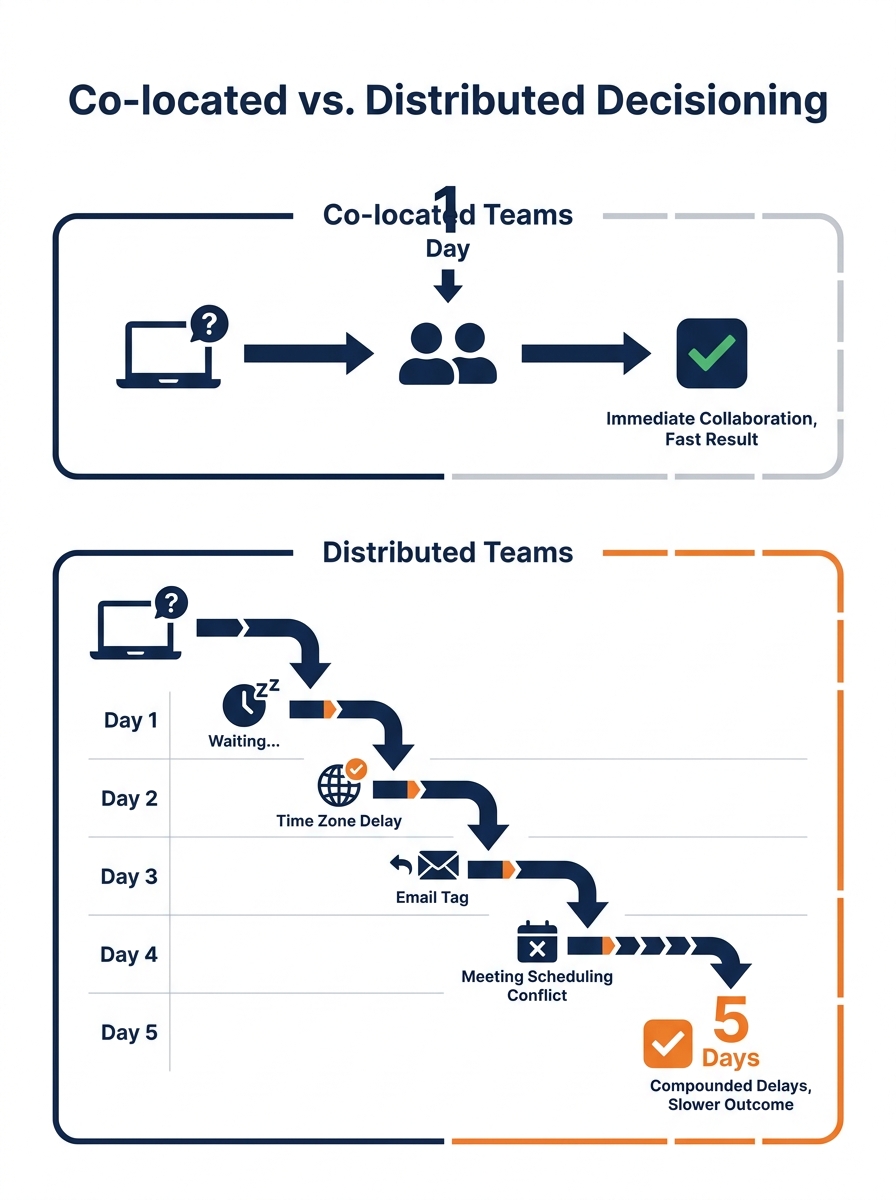
The math here is blunt. If your Philippine development team works Manila hours (GMT+8) and your product owner sits in Chicago (GMT-6), you have roughly 2-3 hours of natural overlap. Every question that doesn’t get resolved during that window waits a full business day. Across a 12-week e-commerce build, research indicates that 28% of project failures trace directly to misaligned expectations and communication breakdowns. That figure doesn’t distinguish between “we had a disagreement about scope” and “nobody answered the question about whether the checkout flow should support guest users.” Both produce the same result: developers building the wrong thing or building nothing at all.
The pattern is recognizable to anyone who’s shipped an e-commerce project with a distributed team. Monday morning in Manila, the front-end developer asks whether the product detail page should pull inventory counts from the ERP in real time or cache them hourly. The product owner in Austin reads the message at 7 PM their time, thinks “I need to check with the warehouse manager,” and doesn’t reply. Tuesday morning in Manila, the developer moves on to a different task. Wednesday, the product owner replies with a partial answer. Thursday, the developer has a follow-up question. By Friday, a decision that should have taken ten minutes has consumed a full work week of calendar time, and the sprint backlog has shifted around it like water around a rock.
Distributed Team Coordination Costs Hide Inside Your Hourly Rate
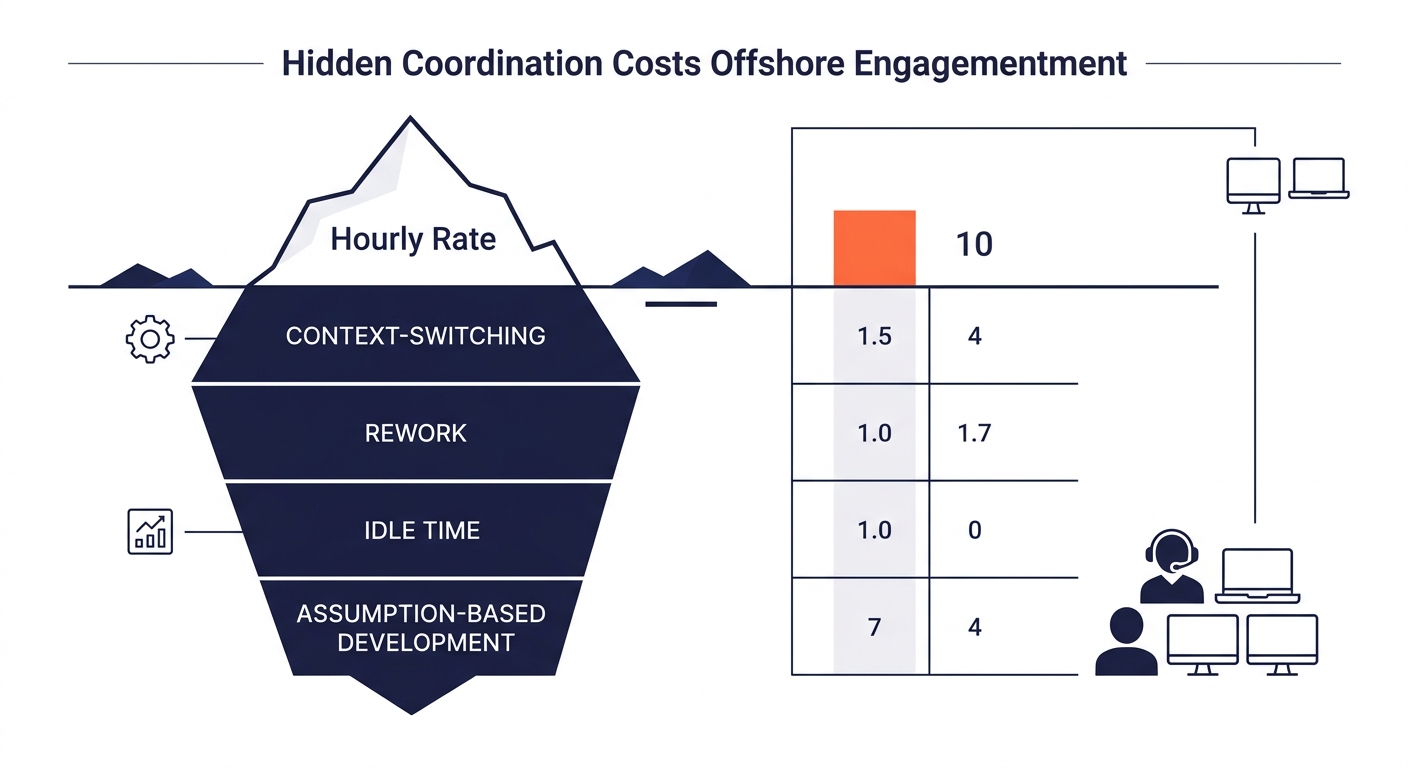
The distributed team coordination costs that kill e-commerce timelines don’t appear on any invoice. Your offshore team bills $30/hour, and you see 40 hours logged per developer per week. What you don’t see is how many of those hours went to context-switching between tasks because the primary assignment was blocked, re-reading ticket threads to reconstruct a decision made across three time zones over four days, or rebuilding work that was done based on assumptions that turned out to be wrong. A study on distributed team productivity found that teams with clear decision-making systems outperform co-located teams by 43%, but the inverse is equally true: distributed teams without those systems underperform by a similar margin because coordination overhead eats their capacity.
For e-commerce projects specifically, the cost compounds because of the interconnected nature of the build. A product page isn’t a standalone deliverable. It connects to the cart, the inventory system, the search index, the promotional pricing engine, the analytics layer, and the checkout flow. When a decision about one component stalls, the developers working on adjacent components face a choice: build against an assumption and risk rework, or move to an unrelated task and lose the mental context they’d built up. Neither option is free. The industry data on this is consistent: 33-37% of projects experience scope creep, and a meaningful share of that creep comes from teams building speculatively around unanswered questions, then discovering the answer invalidates their work.
This is where stakeholder approval workflows offshore diverge sharply from in-house equivalents. When your developer sits fifteen feet from the product owner, a blocked question gets resolved with a tap on the shoulder. The overhead is so low it’s invisible. When your developer sits 6,000 miles away and 14 time zones apart, every question carries a transaction cost. And unlike the hourly rate, that cost scales with the complexity of the project. Simple brochure sites with few interdependencies tolerate async gaps well enough. An e-commerce platform with custom pricing rules, third-party logistics integrations, and real-time inventory sync does not. The teams that struggle most with project timeline management outsourcing are almost always building the most interconnected systems while running the thinnest communication overlap windows.
What a Functional Approval Workflow Looks Like (and Why Most Teams Don’t Build One)
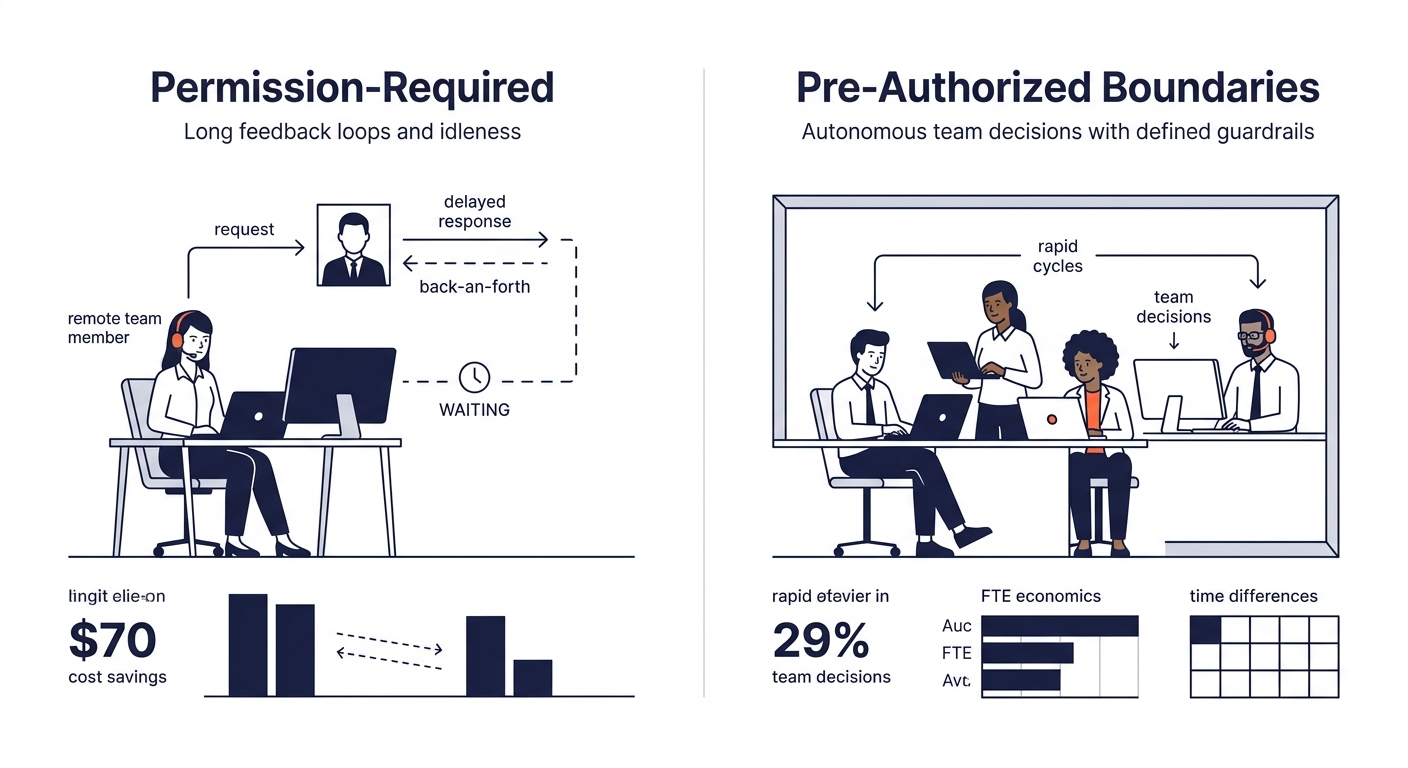
The fix for web development async communication breakdowns isn’t more meetings. It’s pre-authorized decision boundaries. The research from PMI on decision-making within distributed project teams points to a specific structural requirement: distributed teams need both formalized and autonomous approaches to decision-making, with clear lines defining which decisions require stakeholder input and which the development team can make independently. In practice, this means your offshore team should know, before the project starts, that they can choose between two front-end animation approaches without asking, but they cannot change the checkout step sequence without sign-off.
Bestarion’s analysis of IT outsourcing governance puts the point even more sharply: “If stakeholders are not aligned, if priorities shift without governance, or if nobody can approve trade-offs quickly, delivery becomes unstable.” The word “governance” sounds heavy, but it reduces to a simple artifact: a decision matrix that categorizes every foreseeable project decision into “team decides,” “team decides and informs,” and “team proposes and waits for approval.” An e-commerce build has a finite number of decision categories. Product taxonomy structure. Payment provider configuration. Shipping rule logic. Promotional discount mechanics. Return flow UX. Each one can be pre-classified before a single line of code is written.
The reason most teams don’t build this artifact is that it requires the client-side stakeholder to do real work upfront. You can’t create a decision matrix without first aligning internally on priorities, and many SMBs outsourcing e-commerce development haven’t done that alignment. The product owner wants one thing, the marketing director wants another, and the CEO has opinions about the homepage that surface three weeks into the build. When those conflicts play out asynchronously across a 14-hour time zone gap, each disagreement adds days. Winter Design’s research on project delays identifies this pattern clearly: when copy and assets aren’t ready when the design phase begins, the entire timeline shifts, and the downstream development team absorbs the schedule pressure. The same dynamic applies to decisions. If stakeholder alignment isn’t ready when development begins, async communication becomes the bottleneck that absorbs every unresolved internal conflict.
The teams that maintain sprint completion rates above 85% typically enforce 4-6 hours of daily overlap between at least one authorized decision-maker and the development team, keep all decisions logged in a shared space like Confluence or Notion so that no context is lost between sessions, and invest in a prototype gate during weeks 2-3 that validates UX workflows before backend development begins. That prototype gate costs roughly $2,000-$4,800 but prevents $15,000-$30,000 in rework. For e-commerce builds in particular, where performance bottlenecks in distributed teams already create friction during integration testing, eliminating async decision delays from the critical path is the single highest-ROI process investment available. And bringing in outsourced QA testing early, during the prototype validation phase rather than after development is “done,” catches the assumption-based errors that async gaps inevitably produce.
The teams that ship e-commerce projects on time aren’t faster at building. They’re faster at deciding.
The Uncomfortable Part
Everything described above assumes a rational, fixable problem: set up better governance, define decision boundaries, enforce overlap hours, and timelines hold. The uncomfortable reality is that async decision-making delays often persist because the client organization doesn’t actually know what it wants, and the async gap provides a convenient excuse for indecision that would exist regardless of geography. When the product owner takes 48 hours to answer a question about checkout flow, the stated reason is time zones. The actual reason, frequently, is that nobody internally has resolved whether the business wants to optimize for conversion rate or average order value, and that strategic ambiguity filters down into every tactical question the development team asks. The common outsourcing mistakes that cost companies productivity are, in many cases, symptoms of internal strategic confusion rather than vendor-side failures.
This creates an awkward situation for the outsourcing provider. Pointing out that the client’s decision-making is the bottleneck risks the relationship. Absorbing the delays means accepting blame for timeline slippage that originates on the client side. And the data that would prove the pattern, timestamps on every question asked and answered, exists in the project management tool but rarely gets surfaced in retrospectives. The 64-80% of shipped features that end up rarely used represent, in part, the accumulation of decisions made by default rather than by design: the developer assumed, the product owner didn’t correct, the feature shipped, and nobody used it. Async communication didn’t cause the wrong feature to be built. It created the conditions under which building the wrong feature became the path of least resistance. Whether better tools and processes can fix a fundamentally human problem of organizational clarity remains the question that no amount of Jira configuration can answer.