
Slack’s iconic interface — the one that convinced millions of office workers to abandon email threads — wasn’t designed by anyone at Slack. MetaLab, a Canadian design studio with no equity stake in the product, built the UI/UX that launched a $27 billion company. Stewart Butterfield’s team kept product strategy, messaging architecture, and core engineering locked inside their San Francisco office. Everything the user touched visually came from an outside shop. That split is the clearest documented example of a hybrid outsourcing model working at scale, and it offers a blueprint US design agencies can steal from today.
MetaLab Gets the Brief, Butterfield Keeps the Vision
When Slack contracted MetaLab in 2013, the product was still called Tiny Speck internally and had fewer than ten people on payroll. Butterfield knew what he wanted the product to feel like. He had strong opinions about messaging hierarchy, notification patterns, and the emotional tone of the onboarding experience. What he didn’t have was a design team capable of translating those convictions into production-ready screens at startup speed.
So Slack kept the “what” and the “why” in-house. MetaLab owned the “how.” According to an analysis of this arrangement, Slack outsourced UI/UX design but kept product strategy internal, resulting in a product that was both well-designed and aligned with their vision.
This division worked because Butterfield’s team didn’t hand over a vague brief and walk away. They stayed in the loop on every major design decision. The strategy layer — who the user is, what problem we’re solving, how we differentiate from HipChat and IRC — never left the building. The execution layer — color systems, component libraries, interaction patterns, responsive layouts — lived at MetaLab.
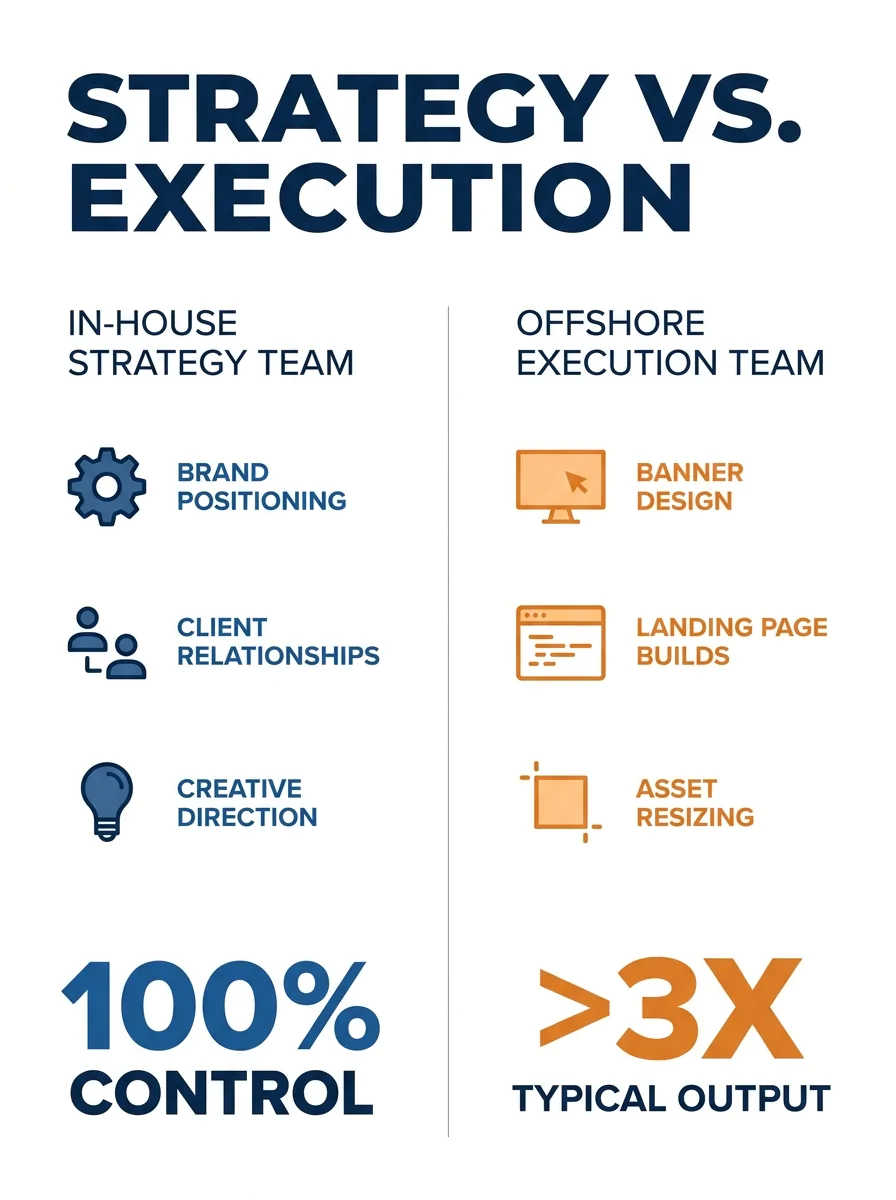
For US design agencies running at 8 to 15 people, this same logic applies. Your creative director, your strategist, your account leads — they hold the client relationship, the brand positioning, the campaign architecture. The production work, the 47 banner variations, the landing page builds, the email template slicing? Those hours eat margin without building strategic value.
Forty-Five Days to a Pixel-Perfect MVP
MetaLab’s engagement with Slack reportedly spanned about six weeks from kickoff to a shippable design system. That timeline matters because it illustrates what offshore execution teams and external studios can do when the strategic guardrails are already set.
Think about what didn’t happen during those 45 days. MetaLab didn’t run user research. They didn’t debate whether Slack should be a consumer product or an enterprise tool. They didn’t question the channel-based messaging architecture. All of those decisions had already been made by Butterfield’s crew. MetaLab’s job was to make those decisions beautiful and usable.
When agencies struggle with outsourced design work, the failure almost always traces back to an ambiguous strategy handoff. The external team gets asked to “design a homepage” without knowing the conversion goal, the audience segment, or the competitive positioning. Then the agency burns revision cycles arguing about things that should have been documented before the first wireframe.
The agencies that succeed with this model do something specific: they create a strategy brief that’s 2-3 pages, covering audience, goals, brand constraints, and success metrics. Then they hand execution to a team that’s paid to produce, not to think about positioning. As one hybrid model analysis notes, the approach works because it combines the strengths of in-house teams with the expertise of external specialists, and the strategy brief is the bridge between those two groups.
This is the same principle behind agencies that use offshore teams to scale their ad operations. The strategic decisions — targeting, messaging, budget allocation — stay with the people who know the client. The build-out and iteration happen where the labor economics make sense.
Where the Handoff Lines Were Drawn
The Slack/MetaLab case reveals something that most hybrid outsourcing discussions gloss over: the handoff protocol between strategy and execution has to be explicit, documented, and non-negotiable.
Slack didn’t give MetaLab access to their product roadmap. MetaLab didn’t attend Slack’s internal strategy meetings. The information flow was deliberately one-directional on strategic matters. MetaLab received briefs, constraints, and feedback. They returned designs, prototypes, and asset packages. The boundary was clean.
The agencies that struggle with outsourcing aren’t the ones who outsource too much. They’re the ones who outsource without deciding what stays in-house first.
For US design agencies adopting this structure, the handoff lines typically fall along these boundaries:
Stays in-house: Client communication, brand strategy, campaign planning, creative direction, approval workflows, digital marketing strategy oversight, pricing decisions, and quality benchmarking.
Goes to the execution team: Production design (social assets, display ads, email templates), front-end development, WordPress builds, QA testing, asset resizing, motion graphics production, and routine content formatting.
Agencies offering white-label WordPress development already operate this way. The client-facing agency owns the relationship and the design direction. The production team builds to spec. Neither side steps on the other’s work.
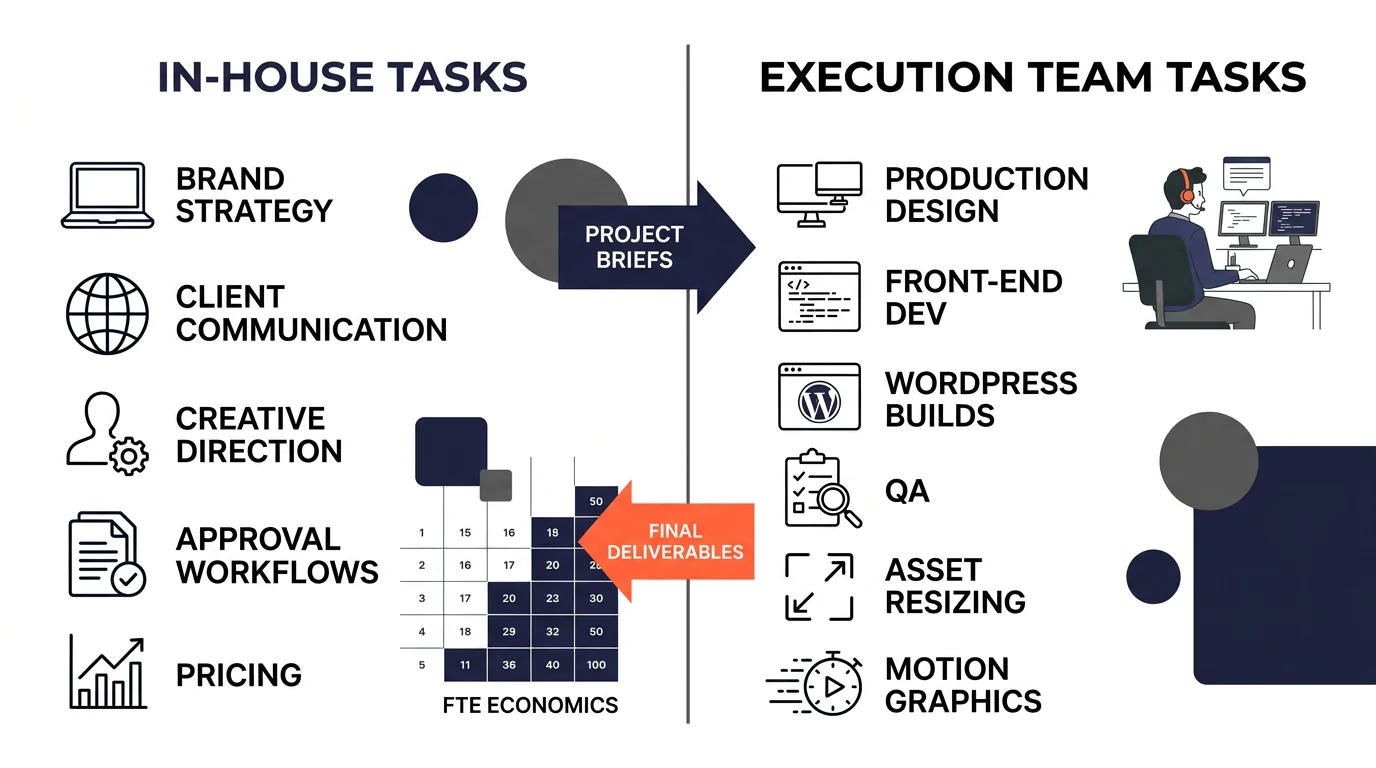
Setting up the project management infrastructure to support this split is where many agencies underestimate the effort. Regular check-ins, shared dashboards, and real-time reporting tools give both sides visibility into progress and quality standards. You can’t manage what you can’t see, and keeping control while outsourcing depends entirely on building those feedback loops before the first task ships.
This is where the speed advantages of offshore execution become tangible. A US-based agency wraps up creative direction at 5 PM Eastern. The Philippine team picks up the production queue at 8 AM Manila time (which is 8 PM Eastern). By the next morning, finished assets are sitting in the review queue. The agency’s creative director reviews, marks up feedback, and the cycle repeats. You’re getting close to 24-hour production throughput with an 8-person operation.
The Economics Behind Slack’s Split
Slack’s early-stage budget constraints made the hybrid model a financial necessity, not a philosophical choice. Hiring a full in-house design team in San Francisco in 2013 would have cost $150,000-$200,000 per senior designer annually, loaded. MetaLab’s engagement, while not publicly priced, almost certainly cost a fraction of what two full-time senior designers would have run over the same period.
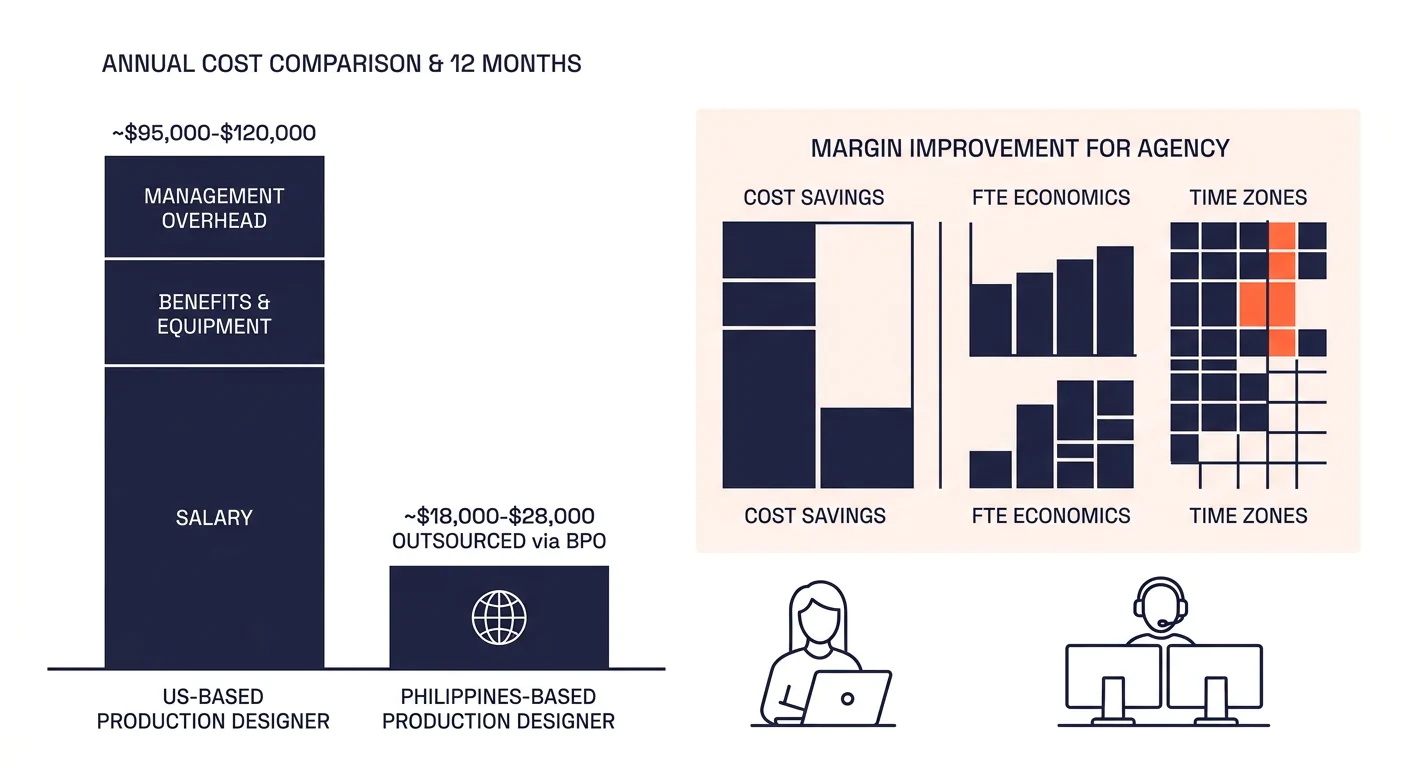
For a US design agency today, the math is similarly compelling. A mid-level production designer in a major US metro costs $75,000-$95,000 in salary alone, before benefits, equipment, and management overhead. A comparably skilled production designer in the Philippines runs $18,000-$28,000 fully loaded through a BPO partner. That’s a 60-70% cost reduction on execution work, which directly improves your project margins.
But the financial case goes deeper than hourly rate arbitrage. When your senior designers spend 40% of their week resizing social assets and building email templates, you’re paying $45/hour for $18/hour work. The hybrid model frees your expensive talent to do the strategic, creative, client-facing work that actually justifies their rate. You’re not cutting costs — you’re reallocating budget from low-value tasks to high-value output.
The agencies that outsource their digital marketing production to the Philippines consistently report the same pattern: margins improve by 15-25 percentage points on production-heavy accounts, and senior staff satisfaction increases because they’re doing more interesting work.
Tip: Run a two-week time audit before restructuring. Have every team member log their hours by task type. You’ll likely find that 30-50% of senior designer hours go to production tasks that don’t require their expertise. That’s your outsourcing scope.
Why This Blueprint Survived Slack’s IPO — And What It Means for 15-Person Agencies
The interesting thing about the Slack case is that the hybrid model didn’t disappear once the company scaled. Slack eventually built a large internal design team, but the organizational principle persisted: strategy stays close to leadership, execution can be distributed. That same principle now shows up across companies like Microsoft, which outsources cybersecurity tasks to specialists rather than hiring low-cost contractors, keeping strategic security decisions internal.
For a 15-person US design agency, the hybrid outsourcing model creates a specific structural advantage. You can take on larger accounts without proportionally increasing headcount. A $30,000/month retainer account that requires heavy production output becomes profitable with a team of three in-house strategists and four offshore production designers, where it might break even with seven US-based full-timers.
The model also reduces hiring risk. Bringing on a full-time US designer is a $100,000+ annual commitment. If a client churns six months in, you’re carrying that cost with no revenue to support it. Offshore execution teams scale down as easily as they scale up. You’re matching your cost structure to your revenue structure, which is how agencies survive client volatility.
The Slack/MetaLab arrangement worked because it respected a boundary that too many agencies blur: strategy is a leadership function, execution is a production function, and confusing the two causes both to suffer. Your clients hire you for your thinking, your taste, your ability to translate business problems into creative solutions. They don’t hire you for your ability to slice a PSD into responsive HTML. Building your agency around that distinction, and staffing accordingly through customized outsourcing arrangements, is how you grow revenue per employee while keeping the work that matters where it belongs.
The agencies getting this right in 2026 don’t talk about outsourcing as a cost play. They describe it as an operating model — one where the strategic brain of the agency stays in Portland or Austin or Brooklyn, and the production muscle operates from Makati or Cebu or Clark. Neither side works without the other, and neither side pretends to do the other’s job.