
Australian agencies are staffing field marketing coordinator roles in the Philippines at roughly one-third the local cost, redirecting the savings into region-specific campaign personalization that domestic teams couldn’t scale alone. Officeworks’ May 28 restructure, which relocated hundreds of roles to Manila and Bengaluru, signals this practice has moved from quietly experimental to publicly defensible.
The Officeworks Effect and What It Reveals About Marketing Operations Offshoring
Officeworks announced on May 28 that it would relocate hundreds of Australian support positions to India and the Philippines, calling it a “difficult” decision tied to a broader cost-cutting restructure. Social media erupted. Consumers on Facebook and Reddit vowed to stop shopping there. But inside Australian marketing agencies, the reaction was a collective shrug. Many of them have been running offshore marketing operations for years, and field marketing outsourcing has grown into one of the fastest-expanding categories within that trend.
The economics are straightforward. According to Satellite Office’s January 2026 analysis, Australian businesses can access up to three Philippines-based team members for the cost of one equivalent local position. AbroadWorks’ April 2026 cost comparison put the broader savings range at 50–80% below domestic hires. These aren’t new numbers, but they’re hitting a market under pressure: Australia faces a documented shortage of over 370,000 digitally skilled workers, and agency margins are being squeezed as clients demand more granular, region-specific campaigns without proportional budget increases.
What’s changed in the past six months is the type of work moving offshore. It’s no longer limited to banner production and social scheduling. Field marketing coordinator roles are now being filled remotely from Manila, Cebu, and Clark. These are the people who execute regional campaigns in close alignment with sales teams, drive pipeline, and manage event logistics across territories. A Channel Life Australia report from May 29 noted that rigid global workflows are leaving Australian marketers with slower publishing, duplicated content, and weaker local relevance across markets. Offshore field marketing coordinators, paradoxically, are helping fix that local relevance gap because they’re dedicated to one region rather than spread across four.
Campaign Personalization at Scale Requires Headcount, Not Algorithms Alone
The personalization conversation in marketing has been dominated by AI tools for two years. And AI does handle parts of it well: automated workflows, dynamic content insertion, A/B testing at speed. But an Everest Group study cited by IBM’s managed marketing services analysis found that offshore managed marketing services centers increased over 50% between 2019 and 2022, with the number of offshore full-time equivalent employees jumping 115%. That growth wasn’t driven by AI adoption. It was driven by the recognition that campaign personalization at scale requires human judgment layered on top of automation. Someone has to understand which message variation works for a construction company in Brisbane versus a fintech startup in Sydney’s CBD, and adjust mid-campaign rather than waiting for the quarterly review.
Australian agencies running field marketing programs across multiple regions are discovering that the bottleneck isn’t creative. It’s operational. A single field marketing coordinator managing events, regional content variations, co-branded partner assets, and local CRM hygiene for three Australian states will cut corners. They have to, because there aren’t enough hours. When agencies outsource that coordination layer rather than strategy, they keep brand-level decisions local while pushing execution to teams with the bandwidth to personalize each touchpoint properly.
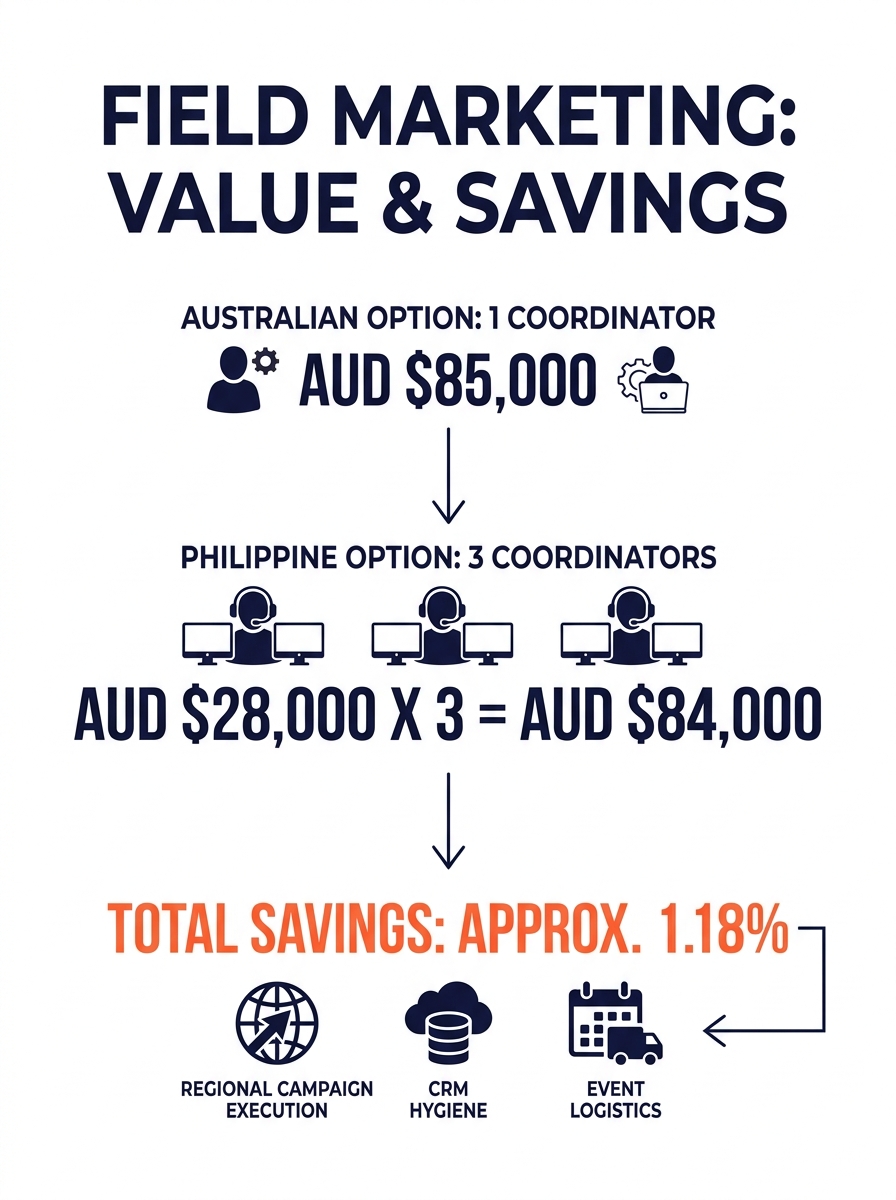
The cost math reinforces the staffing case. ZipRecruiter’s February 2026 data shows remote field marketing roles paying USD $21–$168/hr in the US and Australian markets, depending on seniority. A mid-level field marketing coordinator in Melbourne costs roughly AUD $75,000–$95,000 fully loaded. An offshore equivalent in the Philippines runs AUD $25,000–$35,000. Those savings don’t sit in a finance spreadsheet collecting dust. They fund the additional headcount needed to personalize campaigns that would otherwise ship as one-size-fits-all blasts. Agencies that built offshore teams report faster ramp-up times compared to new local hires, partly because specialized offshore providers maintain bench strength in marketing operations and can deploy trained coordinators within weeks rather than months.
A poorly personalized email that addresses a Melbourne customer with Sydney-specific offers damages brand trust more than a generic blast ever would.
Where Brand Reputation Becomes the Real Risk
This is where field marketing outsourcing intersects with reputation management, and where the conversation gets uncomfortable. Vereigen Media published a report in February 2026 arguing that personalization without trust and data integrity cannot scale effectively, specifically advocating for zero outsourcing policies to maintain quality control. That’s a defensible position for B2B campaigns handling sensitive prospect data. But for Australian agencies running field marketing across retail, hospitality, and professional services verticals, the alternative of understaffed local teams rushing through campaign variations creates its own reputation risk.
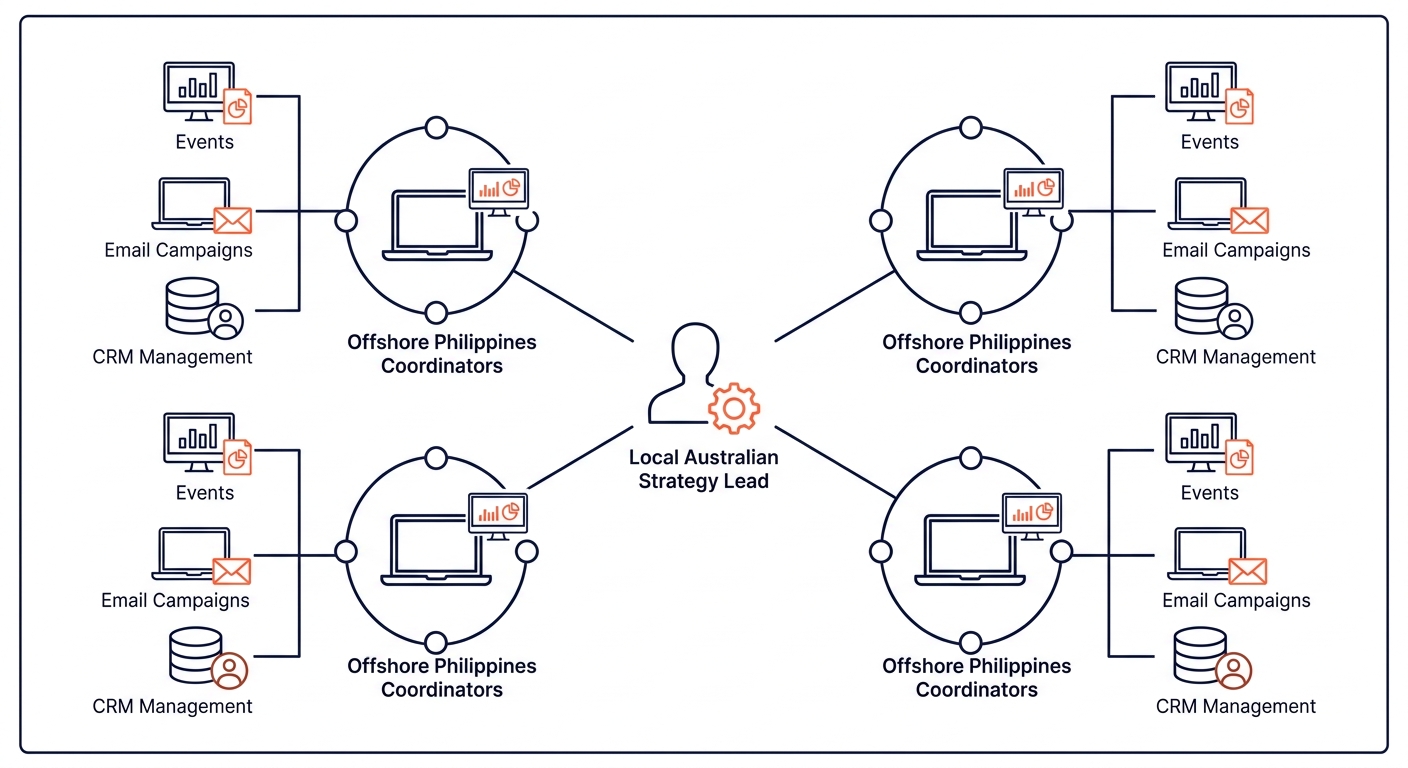
A field event in Perth that ships with Brisbane collateral tells the audience you don’t care enough to get the details right. An SMS campaign with the wrong store address erodes the local credibility you spent six months building. These are reputation management failures, and they happen more often when one coordinator is covering too much territory than when a dedicated offshore team owns each region’s execution. The hybrid model framework that forward-thinking Australian SMEs are adopting, as documented in webcotalent’s April 2026 guide, keeps a lean local lead who sets strategy and owns brand voice while building a scalable offshore team underneath.
Agencies using this model typically keep three functions local: client-facing communication, brand guidelines enforcement, and final sign-off on region-specific messaging. Everything else moves to the offshore coordinator. List segmentation, campaign scheduling, CRM data entry and hygiene, asset localization, post-event lead processing. The risk to brand reputation drops when you assign dedicated people to these tasks rather than expecting a stretched local team to handle them between meetings. A Philippine virtual assistant handling campaign logistics for a single region will catch the mismatch between a Hobart audience and a Gold Coast offer template. An overwhelmed local coordinator splitting attention across both regions probably won’t.
AI tools add another layer of protection. Offshore teams running campaign personalization are using automated reporting and bid optimization that saves 10–15 hours monthly per client, according to agency operators using the hybrid model. Those reclaimed hours go directly into the manual quality checks that protect brand reputation: reviewing localized copy for tone, confirming that regional partner logos are current, validating that personalization tokens render correctly across email clients before anything goes live.

The Question This Model Hasn’t Answered Yet
The Officeworks backlash illustrates a tension that Australian agencies can’t fully resolve: the public perception of offshoring clashes with the operational reality that makes better marketing possible. When Officeworks’ customers vowed boycotts, they weren’t evaluating whether offshore teams would deliver better service. They were reacting to the idea of Australian jobs disappearing. Agencies running field marketing outsourcing at scale face the same reputational exposure, especially when their clients operate in communities where “local” matters as a brand value.
The economic pressure is real and growing. Australian agency owners dealing with the same payroll compression affecting businesses globally aren’t making philosophical choices about where work should live. They’re looking at a $95,000 local coordinator who can personalize campaigns for two regions versus three $30,000 offshore coordinators who can personalize for six. The performance answer is obvious. For agencies tracking KPI frameworks that measure offshore team ROI, the output metrics look strong: more campaign variations shipped, faster regional turnaround, fewer personalization errors per thousand sends.
But the input question remains politically charged in a way that performance data doesn’t resolve. Who does this work, and where? Australian agencies betting on marketing operations offshoring are building operationally superior systems for campaign personalization. Whether they can tell that story publicly, without triggering the backlash Officeworks absorbed this week, is the reputation management challenge sitting underneath all the efficiency gains. The agencies that figure out how to be transparent about their model while demonstrating that offshore coordination produces better local outcomes will own this category. The ones that hide the arrangement and hope nobody asks are building a different kind of brand risk entirely.