
The order you outsource marketing services shapes your brand’s search footprint faster than any single campaign. Delegate SEO before paid ads, and organic visibility compounds while you build the rest of the stack. Reverse that sequence, and you spend months repairing reputation gaps that didn’t need to exist.
The logic here is straightforward. Your online reputation is, functionally, whatever Google returns when someone searches your company name, your founder’s name, or the problem you solve. The 93% of companies reporting improved results from external marketing support got the sequencing right. The remainder outsourced aggressively but started with the wrong discipline, and their brand’s digital presence showed the damage.
This matters more in 2026 than it did two years ago. Deloitte’s 2025 global outsourcing data showed that 42% of businesses outsource marketing to access talent they can’t recruit internally, with the industry shifting toward building new capabilities and improving customer experience rather than cutting costs. The question is no longer whether to outsource. The question is what goes first, what waits six months, and why the gap between those decisions protects (or wrecks) your reputation online.
SEO Goes First Because Search Is Your Reputation
Search engine optimization is the base layer of the delegation stack for one reason: it determines what people find before they ever speak to you. A prospect Googling your brand and finding thin, unoptimized pages, competitor comparison posts ranking above your own site, or worse, unanswered negative reviews on page one, has already formed an opinion. That opinion is your reputation, and no amount of paid advertising overrides it.
When you outsource SEO early, you accomplish two things simultaneously. You secure branded search results with pages you control, and you start building topical authority that compounds over months. The compounding element is critical. SEO assets generate organic traffic without ongoing ad costs, and they stick with your brand even as platforms and algorithms shift. A Philippine SEO team working 8-12 hours ahead of a US-based client can execute technical audits, content optimization, and link-building outreach on a daily cycle that most in-house generalists can’t match.
The cost math reinforces this priority. Philippine marketing services sequencing typically puts SEO at $800-$2,000 per month for a dedicated specialist, compared to $5,000-$8,000 for an equivalent US-based hire. At that rate differential, you’re buying 5-6 months of foundational work before a US hire even finishes onboarding. Companies deciding whether to outsource SEO or PPC first should weigh this: PPC stops delivering the moment you stop paying, while SEO keeps working.
If your brand is in the middle of a site redesign or platform swap, the timing becomes even more urgent. Teams that understand how to preserve traffic during complex platform overhauls can protect months of accumulated search equity that would otherwise vanish overnight.
Content Fills the Gaps SEO Exposes
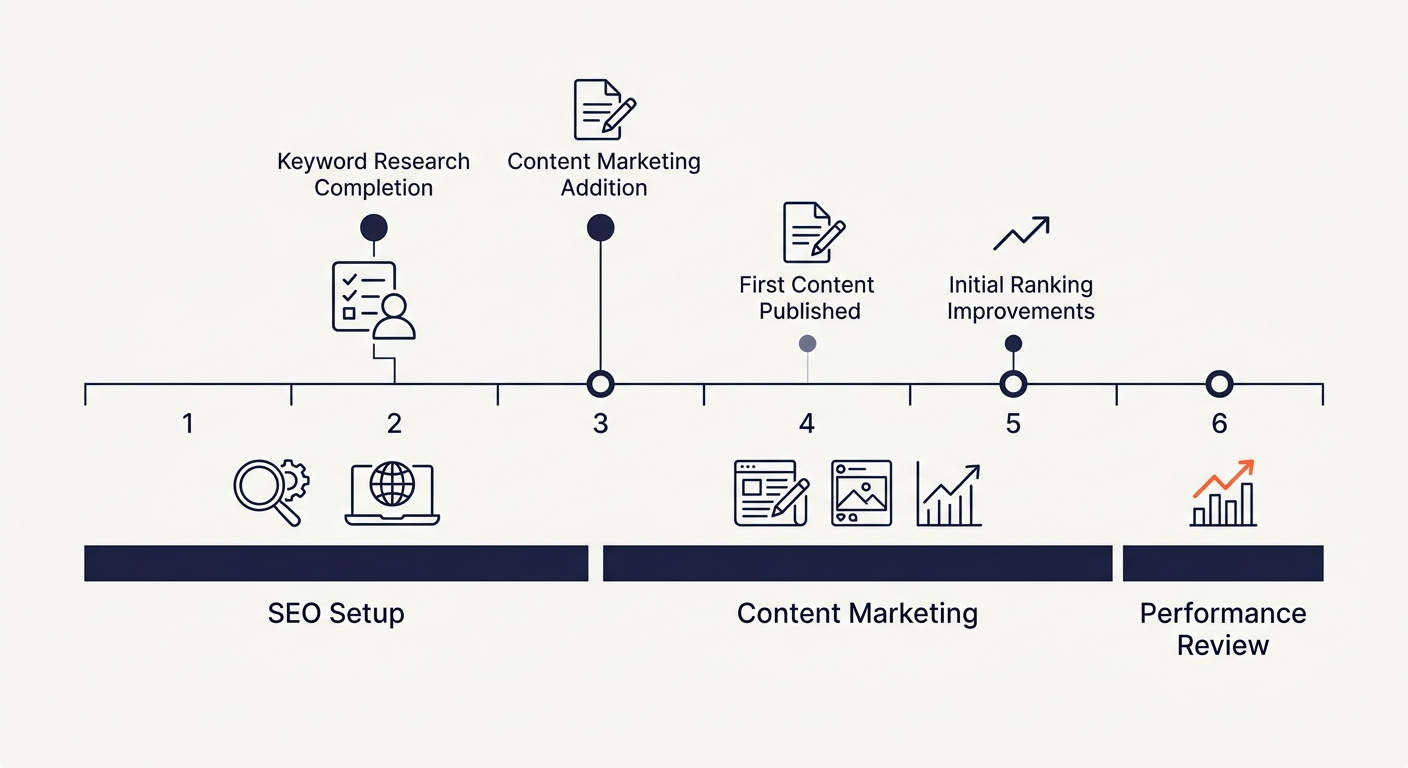
Once your SEO foundation is in place, the gaps become obvious. Technical optimization tells you which keywords to target, but without content, there’s nothing to rank. This is where content marketing enters the delegation stack, typically 60-90 days after SEO work begins, once keyword research and site architecture are established.
Content outsourcing at this stage serves a direct reputation function. Blog posts, case studies, and resource pages give you control over the narrative Google surfaces about your brand. A company with 40 indexed pages of high-quality content occupies more real estate in search results than a competitor with 8 pages and a bigger ad budget. That real estate is your digital reputation, and it’s defensible in ways paid placements aren’t.
The sequencing discipline here matters because content created without SEO guidance tends to be disconnected from search intent. Teams that outsource marketing strategy alongside execution avoid the common failure mode where a content team produces 20 blog posts that rank for nothing because nobody researched what the audience actually searches for. Content follows SEO because SEO provides the map.
For businesses running four or more content formats (blog, email, social, video scripts), a Philippine virtual assistant handling editorial coordination, publishing schedules, and asset tracking can recover 10-15 hours per week for the US-side marketing lead. That reclaimed time goes directly into reviewing content quality and strategic direction instead of managing Trello boards.
The Paid Advertising Decision
PPC and paid social enter the stack third, and the timing is deliberate. Paid advertising without an organic foundation creates a dependency loop: you pay for every click, and when those visitors land on an unoptimized site with thin content, conversion rates stay low while costs climb. The 33% of businesses that Deloitte identified as prioritizing quality and performance over cost savings understand this sequence intuitively.
The right moment to outsource PPC is when your SEO and content layers are generating enough organic traffic to establish a conversion baseline. At that point, paid campaigns have two functions: accelerating growth in proven keyword categories, and testing new markets before committing organic resources. Google Ads and Meta Ads platforms require daily monitoring, bid management, and creative rotation. These are high-volume, process-heavy tasks that fit outsourcing economics perfectly.
A dedicated PPC analyst in the Philippines typically runs $1,200-$2,500 per month, versus $6,000-$9,000 for a US-based specialist. The savings are real, but the bigger advantage is coverage. Philippine teams operating in the GMT+8 time zone can monitor campaigns during US nighttime hours, catching budget overruns or ad disapprovals that a 9-to-5 US team wouldn’t see until the next morning. With AI tools reshaping Google Ads management, the analyst’s role has shifted toward strategic oversight and creative testing rather than manual bid adjustments.
Paid advertising without an organic foundation creates a dependency loop: you pay for every click, and when visitors land on an unoptimized site with thin content, conversion rates stay low while costs climb.
The digital marketing delegation order between SEO and PPC generates genuine debate in practitioner communities. Experienced marketers consistently note that SEO builds assets with compounding returns, while PPC delivers immediate revenue but requires continuous spend. For reputation management specifically, SEO wins the priority argument because organic results carry more credibility with searchers than paid placements. A 2026 brand with strong organic rankings signals authority in ways a top-of-page ad placement cannot replicate.
Social Channels and Review Management Come Later
Social media management and online review monitoring are the fourth layer, and many businesses make the mistake of outsourcing them first. The instinct makes sense. Social media feels urgent because it’s visible, public, and unpredictable. A negative tweet or a one-star Google review triggers an emotional response that makes delegation feel imperative.
But outsourcing social media before you’ve built search visibility and content infrastructure means you’re managing conversations without a destination. Every social post, every review response, every brand mention should drive people back to a website that ranks well, loads fast, and presents a credible brand narrative. Without that foundation, social media management becomes reputation defense instead of reputation building.
When social does enter the outsourced stack, the work splits into two categories. Proactive content (scheduled posts, community engagement, influencer coordination) is high-volume and process-driven. Reactive monitoring (review responses, brand mention tracking, crisis flagging) requires judgment and brand voice consistency. The first category outsources cleanly. The second category works best with clear escalation protocols, where the offshore team handles routine responses and flags anything sensitive to a US-side decision maker.
Companies that built quality-focused dashboards for outsourced marketing teams report faster response times and fewer missed brand mentions because the tracking infrastructure exists before the social team starts work. Trying to build tracking and manage social simultaneously is how reputation incidents slip through.
Where the Stack Stands Now
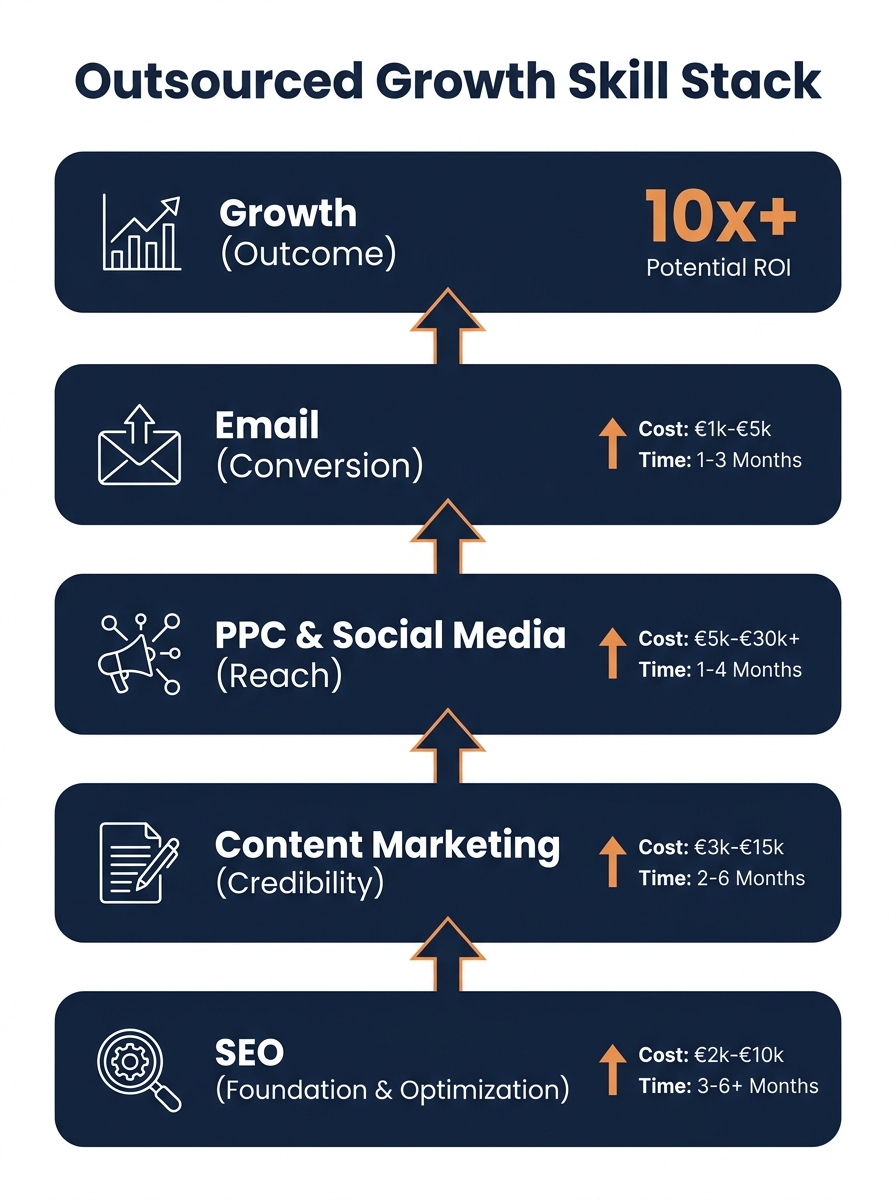
The marketing outsourcing priorities sequence that works in practice follows a consistent pattern: SEO first (months 1-3 as primary focus), content marketing second (layering in during months 2-4), paid advertising third (entering at months 4-6 once organic baselines exist), and social media plus review management fourth (months 5-7, with proactive and reactive work split into separate workflows). Email marketing and retention campaigns typically arrive last, running on the content and audience data the previous layers generated.
Sixty-six percent of US companies now delegate at least one department externally, and the companies reporting a 30% increase in brand visibility and 50% rise in inbound leads tend to be the ones that followed a deliberate sequence rather than outsourcing everything at once. The Philippine marketing services market has matured enough that you can hire individual specialists for each layer rather than engaging a full-service agency, which gives you granular control over which function scales and when.
The reputation management angle ties all of this together. Your brand’s online reputation is the sum of what appears when someone searches for you, reads about you, or encounters your content. Each layer of the outsourced marketing stack controls a different piece of that sum. SEO controls findability. Content controls narrative. Paid ads control visibility in competitive spaces. Social media controls real-time perception. Get the sequence right, and each layer reinforces the ones below it. Scramble the order, and you’ll spend the next quarter untangling the mess instead of growing. The stack works because it builds in the order your audience actually encounters your brand, from search result to website to social proof to ongoing relationship. That encounter sequence is the one that matters, and choosing which tasks stay in-house versus offshore becomes a much clearer decision once you’ve mapped it.