
Bryan Catanzaro, Nvidia’s VP of Applied Deep Learning, told reporters this week that “the cost of compute is far beyond the costs of the employees” AI is supposed to replace. That quote landed two days before Alphabet, Amazon, Microsoft, and Meta collectively confirmed $725 billion in planned AI infrastructure spending for 2026, a 77% jump over the prior year.
The gap between those two facts is where every SMB owner weighing AI vs human virtual assistants should be paying close attention right now.
The Q1 Earnings Reveal: $725 Billion Chasing Capacity, Not Your Inbox
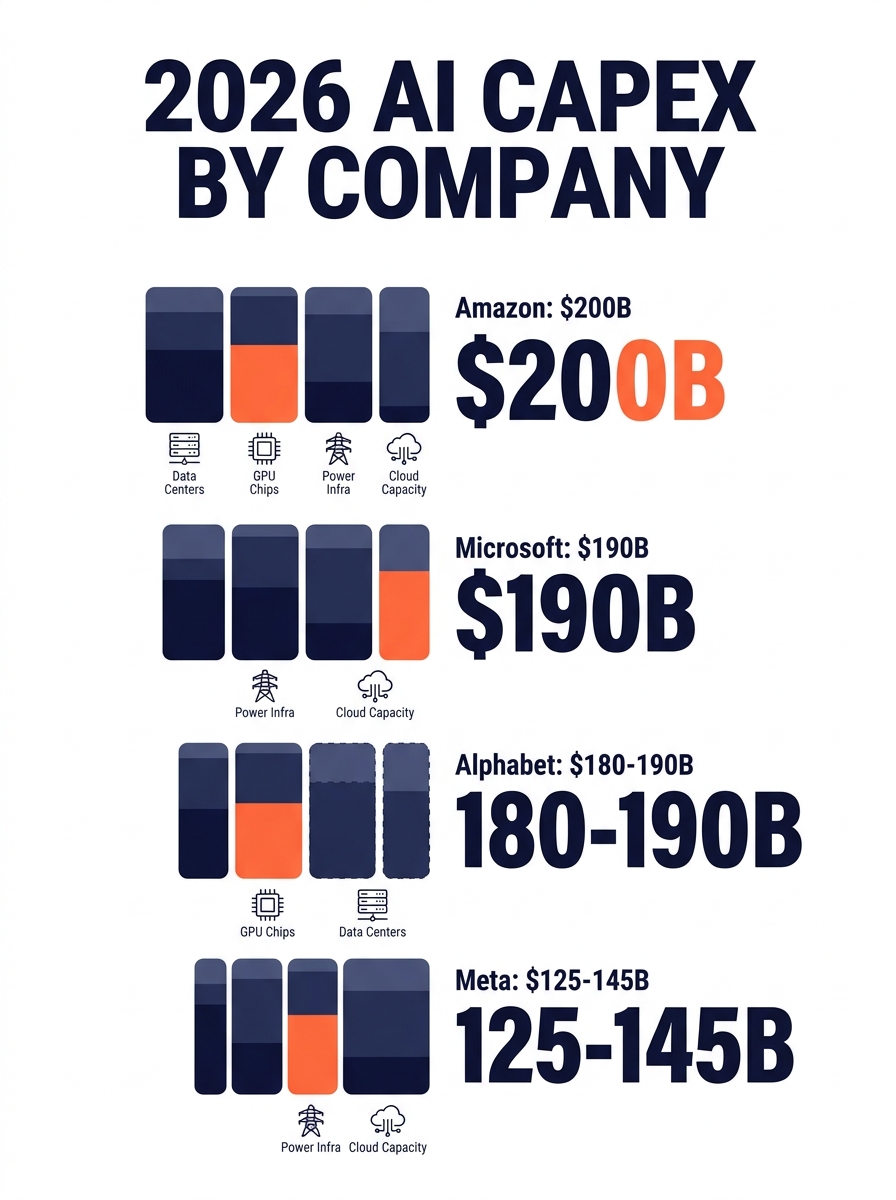
The numbers from last week’s earnings calls are staggering once you line them up. Amazon spent $43 billion in Q1 alone and is holding to a $200 billion annual capex plan. Microsoft raised its guidance to $190 billion—$35 billion more than analysts expected—with its CFO attributing $25 billion of the increase to rising memory chip prices. Meta bumped its range to $125–$145 billion. Alphabet landed at $180–$190 billion, buoyed by Google Cloud’s 63% year-over-year revenue surge, the best growth figure among all the hyperscalers.
Wall Street’s reaction told you everything. Only Alphabet’s stock went up, roughly 7%. Meta dropped about 10%. Microsoft fell 3%. Amazon slid approximately 1%. Investors are asking the same question you should be: where does this money actually go, and who benefits from it?
The answer, for now: data centers, GPUs, power infrastructure, and cloud capacity. The spending is building rails for enterprise-scale AI—training large models, running inference at massive scale for Fortune 500 clients, and competing for cloud market share. Almost none of it is designed to replace your $12/hour VA who manages your CRM and schedules your client calls.
Nvidia’s Own VP Breaks the Cost Spell
Catanzaro’s admission deserves more context than the headlines gave it. He wasn’t arguing against AI adoption. He was pointing out that running AI inference—the actual compute cost of having an AI system answer a customer email, process an invoice, or draft a social media post—currently costs more per unit of work than paying a person to do it.
This tracks with what Microsoft’s CFO Amy Hood said during their earnings call: even with $190 billion in capex, Microsoft expects to remain capacity constrained through the rest of 2026. Demand for AI compute is outstripping supply, which means prices stay high for the businesses trying to run on it.
For an SMB running a 10-person marketing agency or a 15-employee ecommerce brand, the 2026 AI spending trends look like this: the big players are building infrastructure that will eventually make AI cheaper and more accessible. But “eventually” isn’t a budget line item. Right now, a U.S.-based virtual assistant runs $3,000 to $7,000 per month for part-time to full-time support. An offshore VA from the Philippines costs between $1,500 and $2,500 per month full-time. And the AI tools capable of fully replacing either one? They require subscriptions, integration work, prompt engineering hours, and ongoing oversight that most SMBs underestimate by a wide margin.
The business automation ROI numbers floating around in marketing content—250% ROI on dashboard automation, $45K in annual savings per employee—come from specific, narrow implementations. McKinsey’s 2025 analysis found dashboard automation delivers strong returns for businesses under 50 employees, but that’s automating a single reporting workflow. It doesn’t mean the AI handled your client’s angry phone call or caught a duplicate payment in your vendor invoices.
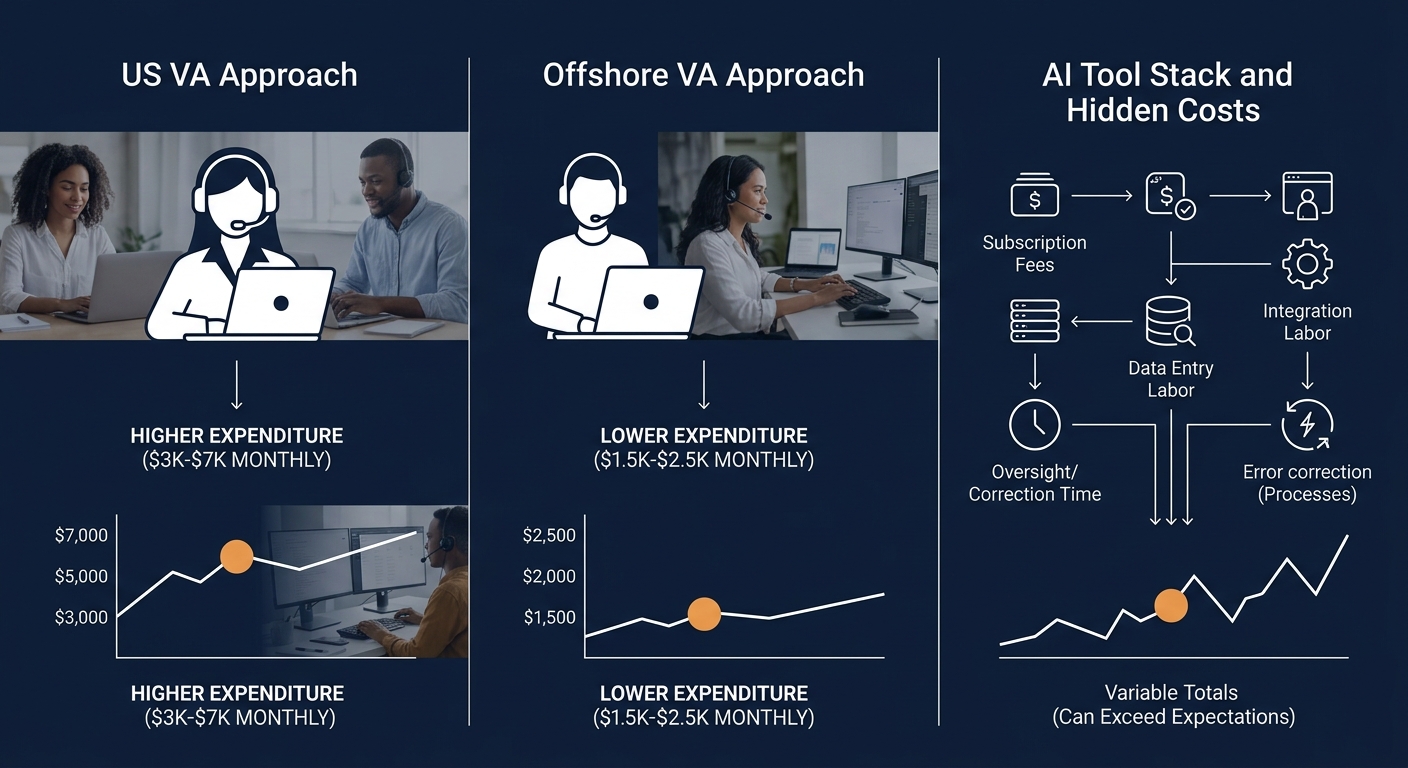
The $725 billion is building infrastructure for Fortune 500 companies, not replacing your $1,800/month offshore VA who knows your clients by name.
The Hybrid That’s Actually Working: AI-Equipped Human VAs
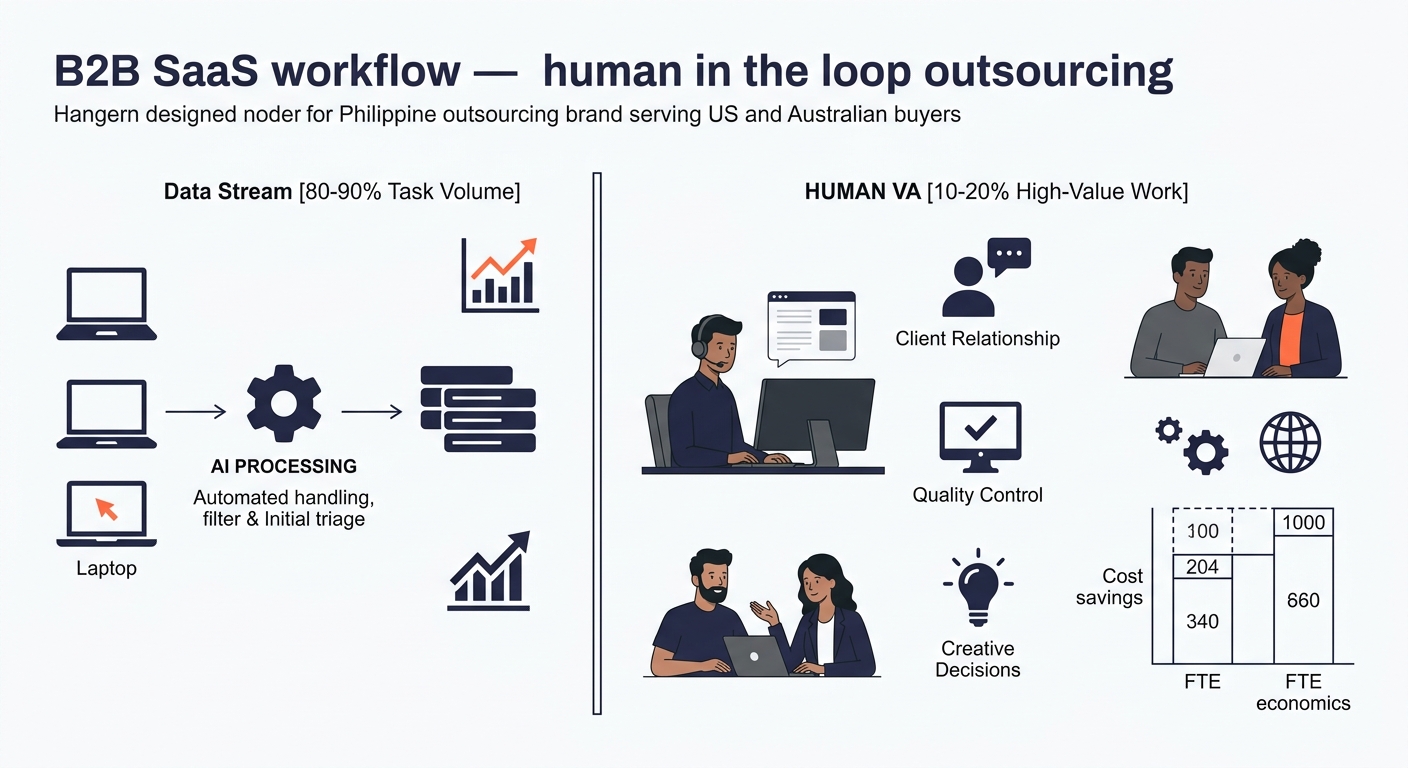
Here’s where the offshore VA vs automation debate gets genuinely interesting. The real product of all this AI infrastructure spending, at least for SMBs, isn’t a robot that replaces your assistant. It’s a human assistant who uses AI tools to produce two to three times the output they delivered eighteen months ago.
Data from Q1 2026 shows that over 40% of virtual assistants now use AI tools daily: ChatGPT for content drafting and email templates, Zapier and Make for workflow automation, Canva AI for design tasks, Notion AI for project coordination. AI-proficient VAs command $10–$15/hour compared to $5–$8 for basic admin VAs, but the productivity difference justifies the premium several times over.
Consider what this looks like in real operations. A Philippine-based VA handling outsourced bookkeeping used to spend 6–8 hours per week on invoice reconciliation and basic reporting. With AI-powered extraction tools handling the initial data pull, that same VA now finishes in 2–3 hours and uses the freed-up time for exception handling, vendor communication, and financial flagging that no AI tool performs reliably on its own.
The same pattern holds across functions. An offshore data entry team processing forms and contracts uses AI extraction to cut manual entry time by 40%, then redirects human attention to validation and edge cases where accuracy matters most. A virtual executive assistant equipped with scheduling AI and email triage tools can manage three or four executives’ calendars instead of one, because the routine logistics are resolved before the VA even opens the task.
This is where 67% of AI-adopting SMBs are seeing 20%+ revenue growth. They’re augmenting their people, not swapping them out. The companies trying full automation on customer support, data processing, or marketing execution keep hitting the wall Catanzaro described: compute costs compound, error rates demand human cleanup, and customer experience deteriorates in ways that are invisible until churn shows up in quarterly numbers.
We covered a similar cost-structure analysis when an AI platform mapped its breakpoints against traditional outsourced support for ecommerce operations. The pattern held there too: AI wins on speed for simple, repetitive queries, but total cost of ownership tips toward humans or human-AI hybrids once you factor in edge cases, training data maintenance, and escalation paths.
The Accidental Subsidy Big Tech Created for Offshore Teams
Big Tech’s massive spending creates an unexpected dynamic for smaller businesses. The hyperscalers are competing furiously to build AI capacity, which drives down the marginal cost of the AI tools your VAs use every day. GPT-4 API calls cost a fraction of what they did in 2024. Image generation is effectively free at SMB volumes. Workflow automation platforms are racing to add AI features to justify price increases that, on a per-seat basis, still run $20–$50/month.
So the $725 billion in infrastructure spending is subsidizing your offshore VA’s productivity toolkit. You don’t need to build your own AI infrastructure. You don’t need to train models. You don’t need to buy GPUs. You need people who know how to use the tools that all of this spending makes cheaper every quarter.
The Philippine BPO sector, which already accounts for a major share of global digital marketing outsourcing, is adapting fast. Teams that understand AI-powered architecture and development patterns are becoming a genuine differentiator for agencies and SMBs that hire them. The VAs who invested in learning prompt engineering, automation workflows, and AI-assisted content production throughout 2025 are now the ones commanding premium rates and delivering measurably higher output.
Tip: When evaluating offshore VA vs automation, ask your provider which AI tools their team already uses daily and how they measure the resulting productivity lift. A VA team that can’t name specific tools and workflows is behind the curve for 2026.
After the Spending Surge Settles
The $725 billion will eventually translate into cheaper, more capable AI services for everyone. Memory chip prices will stabilize. Data center capacity will catch up with demand. Inference costs will drop. When that happens—likely 18 to 24 months from now—the economics of full AI automation will shift for certain narrow, well-defined task categories.
But the lesson from this week’s earnings calls is that we’re in the infrastructure-building phase, not the cheap-deployment phase. Nvidia’s own VP said the math doesn’t work yet for replacing workers with AI. Wall Street punished three out of four hyperscalers for spending too aggressively with returns still uncertain.
For an SMB spending $2,000 a month on an AI-proficient offshore VA who handles customer support triage, CRM updates, content scheduling, and basic bookkeeping, the value proposition is both concrete and immediate. You’re getting a human who exercises judgment, manages relationships, and adapts to your business context while using $725 billion worth of someone else’s R&D investment to do all of it faster than was possible even a year ago.
The companies that will struggle are the ones waiting for AI to get cheap enough to go fully automated, while their competitors already ship work with human teams that use today’s AI tools to operate at twice the throughput. That gap compounds every quarter, because the tools keep getting better—for the humans who know how to use them.