
Dedicated Philippine marketing teams outperform both US in-house generalists and agency retainers on multi-channel campaign ROI when brands run four or more simultaneous channels. Offshore FTE economics let you staff every channel with a focused specialist instead of stretching one person across six platforms.
TL;DR: Three team models compete for multi-channel marketing execution in 2026: in-house generalists, US agency retainers, and dedicated Philippine squads. The Philippine model wins on coverage depth per dollar, the agency wins on strategic sophistication, and in-house wins on speed-to-decision. Your channel count and budget determine which fits.
Snap’s India MD told The Hindu BusinessLine this week that impressions and views on social media ads are no longer sufficient. Attention itself is the metric brands should track. Anisha Iyer, CEO of OMD India and a Cannes Lions 2026 Media juror, reinforced that point days earlier: “The strongest media ideas are deceptively simple,” she told Exchange4media, arguing that complexity is often mistaken for craft.
The operational implication hits immediately. Improvado’s 2026 multi-channel marketing guide reports that 79% of top-performing companies use AI to orchestrate cross-channel campaigns, yet 58% of marketers still say their biggest challenge is aligning messaging across platforms. Multi-channel ROI runs 2× higher than single-channel campaigns on average, so the payoff for solving this coordination problem is real. Gartner predicts traditional search engine volume will drop 25% by 2026 as AI chatbots take share, which means the channels you need to cover keep multiplying while the attention available on each one shrinks.
Customer attention fragmentation is accelerating across APAC, too. Homegrown retail media super apps like Grab, Lazada, and Tokopedia are supplanting traditional search-led discovery, adding yet more platforms that demand daily management. Three team structures handle this pressure differently. Here’s how they compare.
In-House Generalists Run Fast and Run Shallow
A US-based generalist marketing hire costs $65,000–$95,000 annually for a mid-level role. You get someone who sits in your time zone, knows your brand intimately, and can make creative calls in minutes. For single-channel or two-channel businesses, this model works fine.
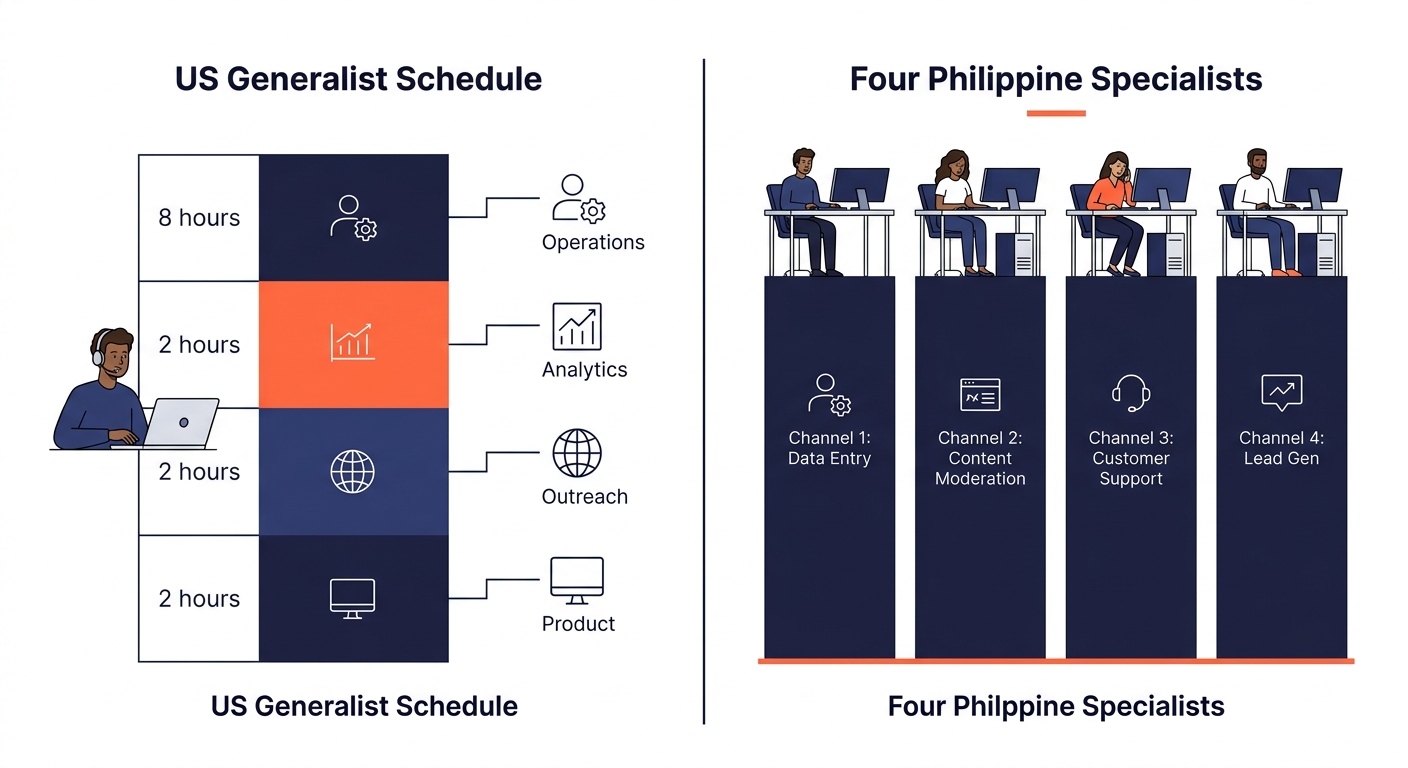
The trouble starts at channel three. A single generalist managing Google Ads, Meta campaigns, email sequences, and organic social is splitting their working week into 10-hour blocks per channel. That’s roughly 2 hours per day per platform, assuming zero meetings and no reporting overhead. In the attention economy of digital marketing in 2026, where platform algorithms reward daily consistency and fast response to trending formats, 2 hours per channel isn’t enough to run competitive campaigns on any single platform.
You also lose specialization. PPC bid management on Google Ads requires a different skill set than writing email nurture sequences or editing short-form video for TikTok. The generalist covers all of them at a B-minus level. When we wrote about which digital marketing tasks to keep in-house versus offshore, the core finding was that strategy and brand voice should stay close to the founder, but execution benefits from specialists.
Where this model fits: Businesses running 1–2 channels with under $5,000/month in ad spend. The generalist can give those channels real attention.
Where it breaks: Anything above 3 channels or $10,000/month in combined spend. You’re paying $75,000+ for shallow coverage that underperforms specialist management on every individual platform.
The US Agency Retainer: Deep Expertise, Divided Attention
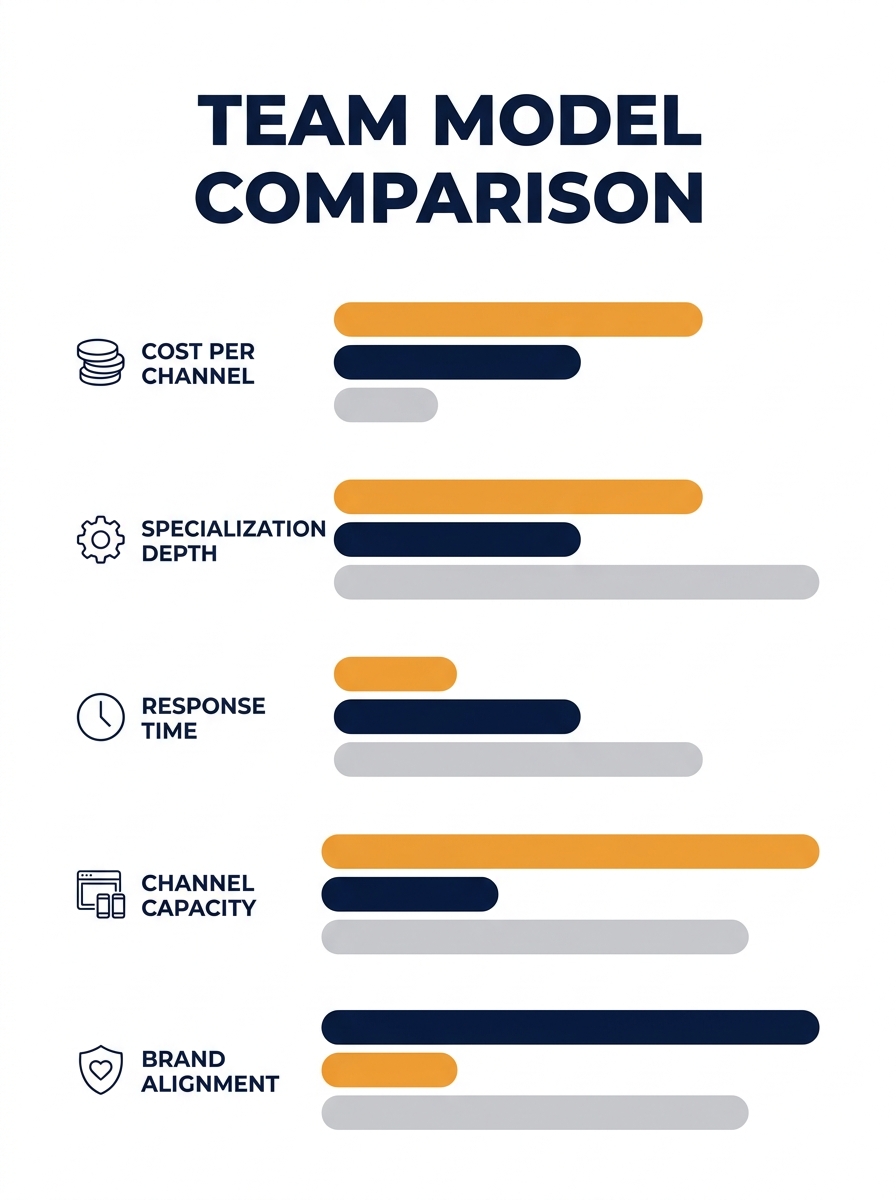
Agency retainers typically run $5,000–$15,000/month for mid-tier US firms managing 3–5 channels. You get access to specialists in paid search, social, content, and analytics, all under one roof. The strategic thinking is usually strong. Agencies live and die by client results, so they invest in training and tooling.
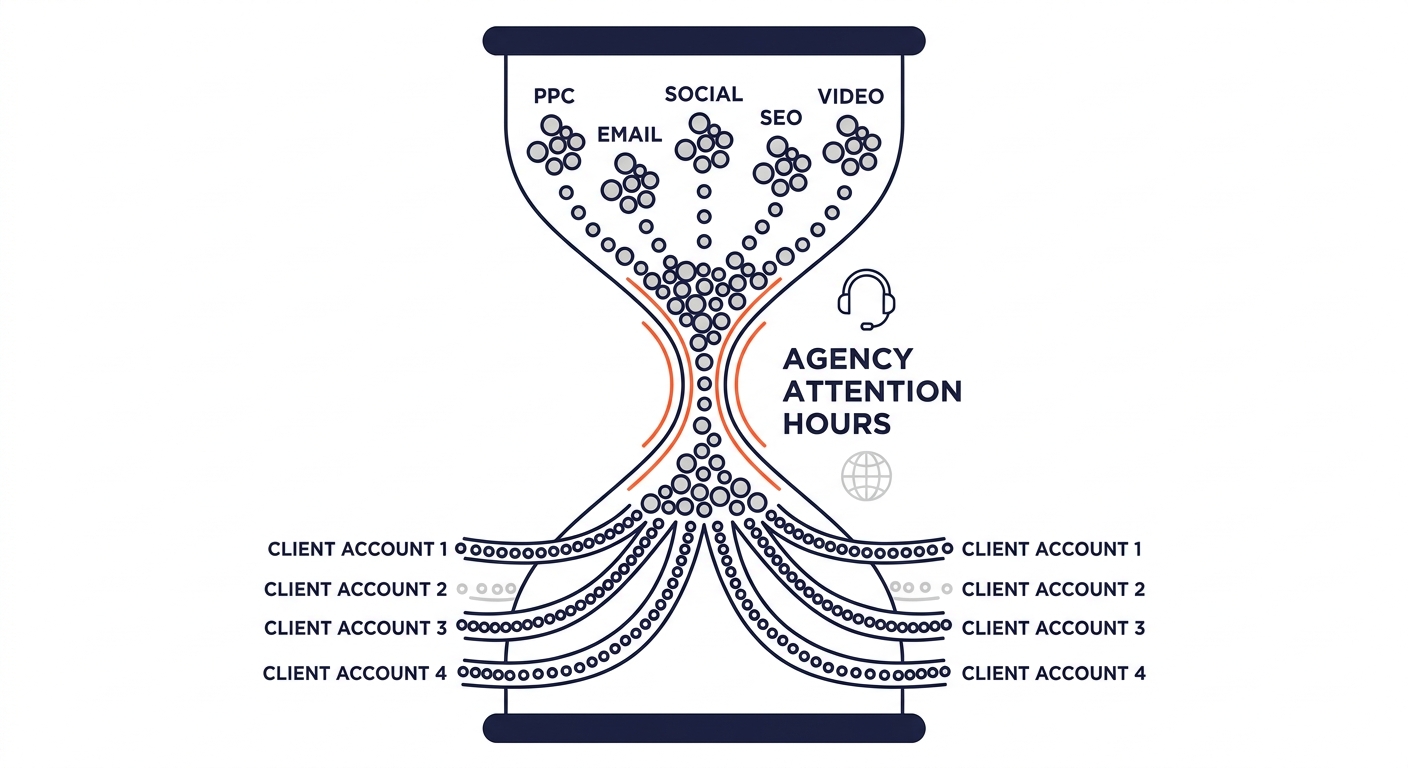
But your account shares those specialists with 8–15 other clients. A senior PPC manager at a mid-tier agency handles 6–10 accounts simultaneously. Your campaigns get reviewed 2–3 times per week, not daily. When a Meta ad set starts underperforming on a Tuesday afternoon, the adjustment might not happen until Thursday’s scheduled account review.
The attention economy punishes that lag. Platforms like Meta and Google Ads use real-time auction dynamics that reward accounts with frequent optimization touchpoints. A campaign optimized daily outperforms a campaign optimized twice weekly by a measurable margin across click-through rates, cost-per-acquisition, and quality score. And the math gets worse as you add channels: each additional platform dilutes the agency team’s per-client hours unless you’re willing to increase the retainer.
There’s a reporting overhead cost, too. Agencies spend 15–25% of billable hours building client-facing reports and sitting in status calls. That time doesn’t improve campaign performance. It reassures you that someone’s watching. If you’ve seen how Philippine teams now handle the strategy-execution split for US agencies, the pattern is clear: agencies increasingly use offshore execution teams themselves, then mark up the hours to you.
Where this model fits: Businesses that need senior strategic guidance and can afford $8,000+/month. The agency excels when you’re entering new markets, repositioning a brand, or running complex attribution across high-spend accounts.
Where it breaks: Accounts that need daily hands-on execution across 4+ channels. The retainer buys you strategic access, but the daily work gets queued behind other clients.
Dedicated Philippine Teams Cover Every Channel at FTE Economics
A dedicated Philippine digital marketing specialist costs $1,200–$2,200/month, depending on experience level and channel focus. For the price of one US generalist at $75,000/year, you can staff 3–4 dedicated specialists who each own a single channel full-time. That’s the core economic argument, and it’s why outsourced digital marketing ROI numbers look dramatically different at scale.
Why does this model specifically address customer attention fragmentation? Because each person focuses on one platform for 8 hours a day. Your Google Ads specialist isn’t also writing email copy. Your social media manager isn’t splitting time with SEO reporting. The daily optimization cadence that platforms reward is baked into the staffing model rather than fought against.
The talent pipeline supports this depth. Digital Marketing Recruiters (DMR), a Philippine-focused staffing firm, notes that outsourced specialists become an integrated part of your team, filling roles from PPC management to content production to analytics. Firms like Flatworld Solutions and Eastvantage have built specialized PPC and analytics practices that run continuous optimization cycles based on real-time performance data.
For the price of one US generalist at $75,000/year, you can staff 3–4 dedicated Philippine specialists who each own a single channel full-time.
Time zone offset is the main tradeoff. Philippine teams (GMT+8) overlap with US Pacific hours for roughly 3–4 hours in the morning and with Australian Eastern for 2–3 hours in the afternoon. Campaigns run 24/7, so overnight optimization by a Philippine team means your ads and content get adjusted while US competitors’ accounts sit idle. But real-time collaboration requires async discipline. We’ve covered how adapted Scrum and Kanban frameworks solve cross-timezone coordination, and the playbook is well-established for marketing workflows.
Ramp-up time is the second tradeoff. A dedicated offshore team needs 30–60 days to absorb your brand voice, audience segments, and campaign history. In-house hires know the brand on day one. Agencies bring institutional knowledge of your vertical. The Philippine team needs structured onboarding: brand guides, competitor briefs, access to historical performance data. Teams that skip this step struggle for months. Those that invest in it often outpace new full-time hires within 90 days.
The AI-automation shift hitting Philippine teams this year makes this model even more compelling. With 79% of top performers using AI for multi-channel marketing execution orchestration, the daily specialist work is increasingly about interpreting AI recommendations and making judgment calls rather than manual bid adjustments. Filipino digital marketers trained on Gemini-powered Google Ads, Meta Advantage+, and AI-driven content tools bring that fluency across every account they manage.
Where this model fits: Businesses running 4+ channels with $10,000+ monthly ad spend that need daily optimization across every platform. The economics only improve as you add channels.
Where it breaks: Businesses with under $3,000/month in total marketing spend. The onboarding investment and management overhead don’t pay off at small scale.
The Numbers, Side by Side
| Factor | In-House Generalist | US Agency Retainer | Dedicated Philippine Team |
|---|---|---|---|
| Annual cost (4 channels) | $75,000–$95,000 | $60,000–$180,000 | $57,600–$105,600 |
| Specialists per channel | 0.25 (one person, four channels) | 0.5–1 (shared across 8–15 clients) | 1 (dedicated) |
| Daily optimization | Unlikely above 2 channels | 2–3× weekly | Daily per channel |
| Brand alignment | High from day one | Medium | Medium (improves after 30–60 days) |
| Ramp-up time | Immediate | 2–4 weeks | 30–60 days |
| US time zone overlap | Full | Full | 3–4 hours |
| Strategic sophistication | Limited to one hire’s experience | Strong | Varies; stronger with senior hires |
Tip: If you’re spending more than $10,000/month across 4+ channels and your current team optimizes campaigns fewer than 5 days a week, you’re leaving measurable ROI on the table. Multi-channel campaigns deliver 2× the ROI of single-channel efforts on average, but only when each channel gets enough daily attention to compete in platform auctions.
How To Choose Between These Three
The answer depends on three variables: your monthly channel count, your combined ad spend, and how much external strategic direction you actually need.
Pick the in-house generalist if you run 1–2 channels with modest spend and want someone embedded in every meeting. This person is your brand’s voice. Don’t also make them your media buyer, email strategist, and video editor.
Pick the US agency retainer if you need senior strategic guidance, you’re entering a new market, or your campaigns involve complex multi-touch attribution that benefits from agency-level tooling. Budget $8,000–$15,000/month and hold the agency accountable to optimization frequency, not monthly slide decks.
Pick the dedicated Philippine team if you’re running 4+ channels and your current setup can’t give each platform daily attention. The cost savings are real: $18,000–$38,000/year less than an equivalent agency retainer for the same channel count, based on the figures above. And the dedicated-specialist structure directly addresses attention fragmentation by ensuring no channel runs on autopilot.
Many SMBs and agencies end up combining models. A US-based marketing director handles strategy and brand voice. A Philippine team of 3–4 specialists handles daily execution across paid search, social, email, and content. The in-house person reviews performance weekly and adjusts direction. That hybrid setup puts the right kind of attention on the right kind of work, which matters more than ever when attention is the scarcest resource both your team and your customers can offer.