
Alhena, a San Francisco-based AI customer support platform, released a cost framework on April 30 comparing AI agent economics to traditional BPO arrangements for ecommerce brands, according to a company blog post. The analysis breaks down hidden costs in outsourced support contracts and presents case studies from brands running hybrid AI-human models.
The framework arrives as ecommerce operators face a practical decision: whether to route rising support volumes to offshore contact centers or to AI platforms that promise near-zero marginal costs per conversation. Alhena’s analysis targets brands handling 5,000 to 50,000 monthly customer inquiries—the volume range where BPO contracts start showing cost strain but in-house teams remain impractical.
BPO Cost Structure Breaks Down Beyond Per-Ticket Pricing
Traditional outsourcing quotes typically land around $6 per resolved ticket, the Alhena post states. For a brand managing 50,000 monthly inquiries, that translates to $300,000 in monthly support spend. But the company highlights three cost layers that fall outside initial BPO proposals.
Onboarding and retraining cycles recur constantly, Alhena notes, because offshore BPO attrition regularly exceeds 30% annually. Each product launch or policy update requires fresh training rounds for replacement agents. Quality assurance overhead remains an internal expense—someone on the client side still samples tickets, reviews calibration calls, and manages disputes. Brand control risk persists because outsourced agents juggle multiple client accounts simultaneously, creating inconsistency in tone and resolution quality.
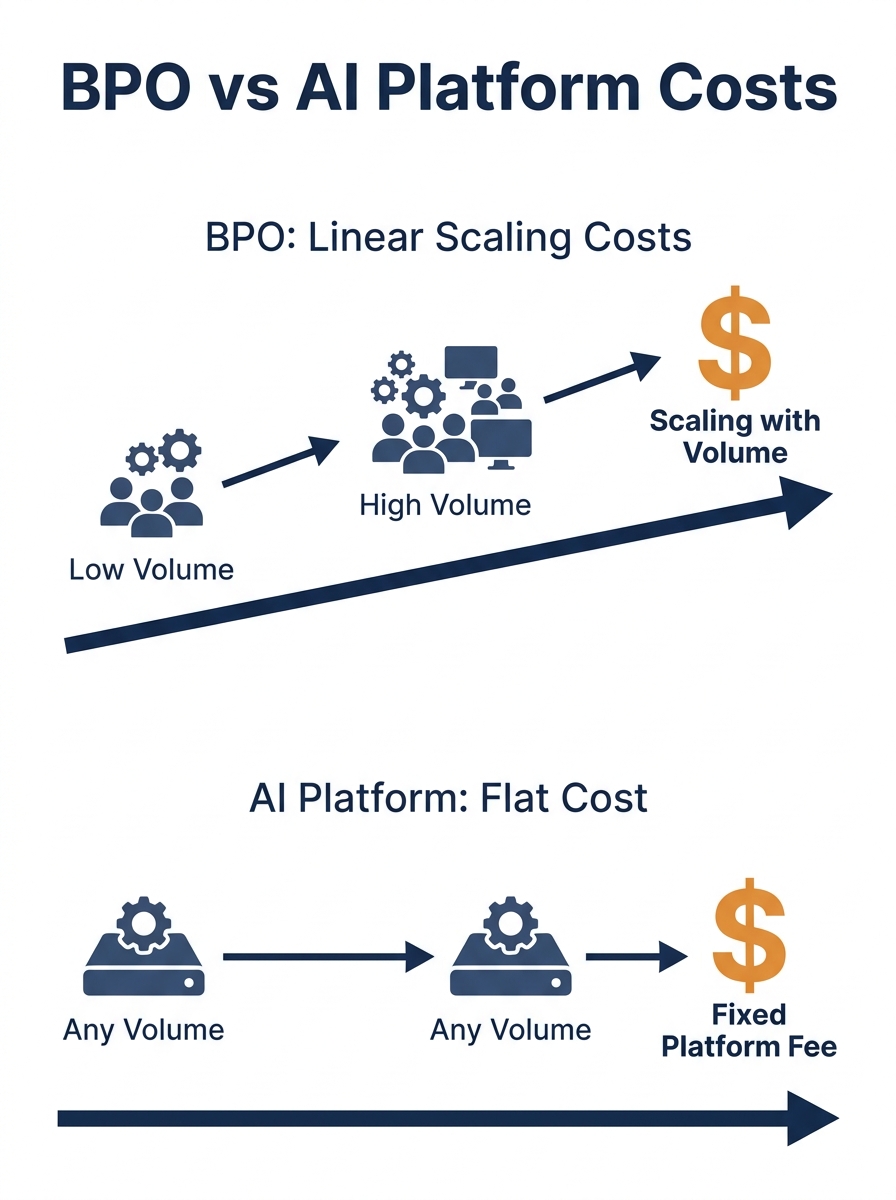
None of these expenses appear in the per-ticket rate, according to the analysis. The accumulated cost gap between quoted price and actual operational spend widens each quarter.
Case Studies Show 63% to 86% Deflection Rates With Satisfaction Above 84%
Alhena cites three client deployments where AI handled majority-tier-one volume. Manawa, an ecommerce brand, achieved 80% AI resolution, leaving only 10,000 of 50,000 monthly tickets for human agents, the post states. Crocus recorded an 86% deflection rate while maintaining 84% customer satisfaction scores. Puffy hit 63% automated resolution with 90% CSAT, according to the company.
The math shifts when AI resolves 80% of 50,000 tickets. Only 10,000 reach human agents, cutting the $300,000 BPO bill to $60,000 for human handling plus a flat AI platform fee. Alhena’s platform covers order tracking, returns, product inquiries, and recommendations end-to-end across web chat, email, WhatsApp, Instagram DMs, and voice from a single agent configuration, the company states.
The containment rate depends on knowledge base quality and product data setup, the analysis notes. Platforms that ground responses in verified data rather than generating answers from scratch close deflection gaps faster, according to Alhena.
Hybrid Model Routes Complexity to Humans With Full Context
The recommended approach in the framework is not binary. Alhena positions AI as tier-one coverage with smart escalation to existing helpdesks like Zendesk, Gorgias, Freshdesk, or Intercom. High-volume, low-complexity tickets—order tracking, FAQ responses, return status—go to AI first. Medium-complexity inquiries like product recommendations or troubleshooting flow to AI with human fallback. High-stakes, low-volume cases route directly to human agents.
When escalation occurs, the AI passes full conversation context to the human agent, eliminating cold handoffs. Alhena’s Agent Assist tool drafts responses for human agents using the same knowledge base, the company states. The agent reviews, edits if needed, and sends.
This structure addresses communication barriers that plague offshore outsourcing arrangements, according to the post. AI agents deliver 24/7 coverage with no shift handoffs, handle multilingual responses at consistent quality, and apply brand voice tuned once across all channels. Time zone gaps and cultural mismatches disappear structurally, Alhena argues.
For agencies and SMBs already running outsourcing operations, the hybrid model fits existing workflows. AI handles repetitive volume while human agents—whether in-house or offshore—focus on edge cases and complex problem-solving where judgment matters.
Reading Between the Lines
Alhena’s cost framework is vendor analysis, not neutral research, but the underlying math checks out. BPO providers do charge per ticket or per seat, which creates linear cost scaling. AI platforms do charge mostly fixed fees with near-zero marginal costs per conversation. The breakpoint where AI becomes cheaper than outsourcing depends on volume, complexity mix, and how well the AI is configured—but for brands pushing 20,000+ monthly tickets, the cost curve difference is real.
The hidden message for US and Australian ecommerce operators: the question isn’t “outsource or automate” anymore. It’s “what goes to AI first, what goes to humans second, and how do I route between them without losing CSAT?” Brands running Shopify, WooCommerce, or BigCommerce stores with offshore support teams can layer AI on top of existing BPO contracts to cut ticket volume before it hits the outsourced queue. The BPO relationship stays in place for escalations, compliance-sensitive cases, and anything requiring human judgment. You’re not replacing virtual assistant services—you’re filtering what reaches them.
The risk sits in setup cost and knowledge base work. If your product catalog, policies, and FAQs live in scattered docs and tribal knowledge, AI won’t deflect much. The containment rates Alhena cites—63% to 86%—assume clean data and workflow design up front. That’s where account managers and implementation support matter, whether you’re working with an AI vendor or a BPO that’s starting to bundle AI tools into service contracts.