
The global BPO industry will derive 50% of revenue from technology margins rather than labor billing by 2028, according to a June 19 analysis published by Anyreach, an enterprise AI solutions provider. The projected shift represents a structural break from the labor-arbitrage model that has generated approximately 95% of the industry’s $280 billion annual revenue for two decades, the analysis states.
TL;DR: Anyreach predicts half of BPO revenue will come from AI platform fees, outcome-based pricing, and managed AI services by 2028, driven by labor margin compression and 60-80% gross margins on technology services versus 15-25% on human labor.
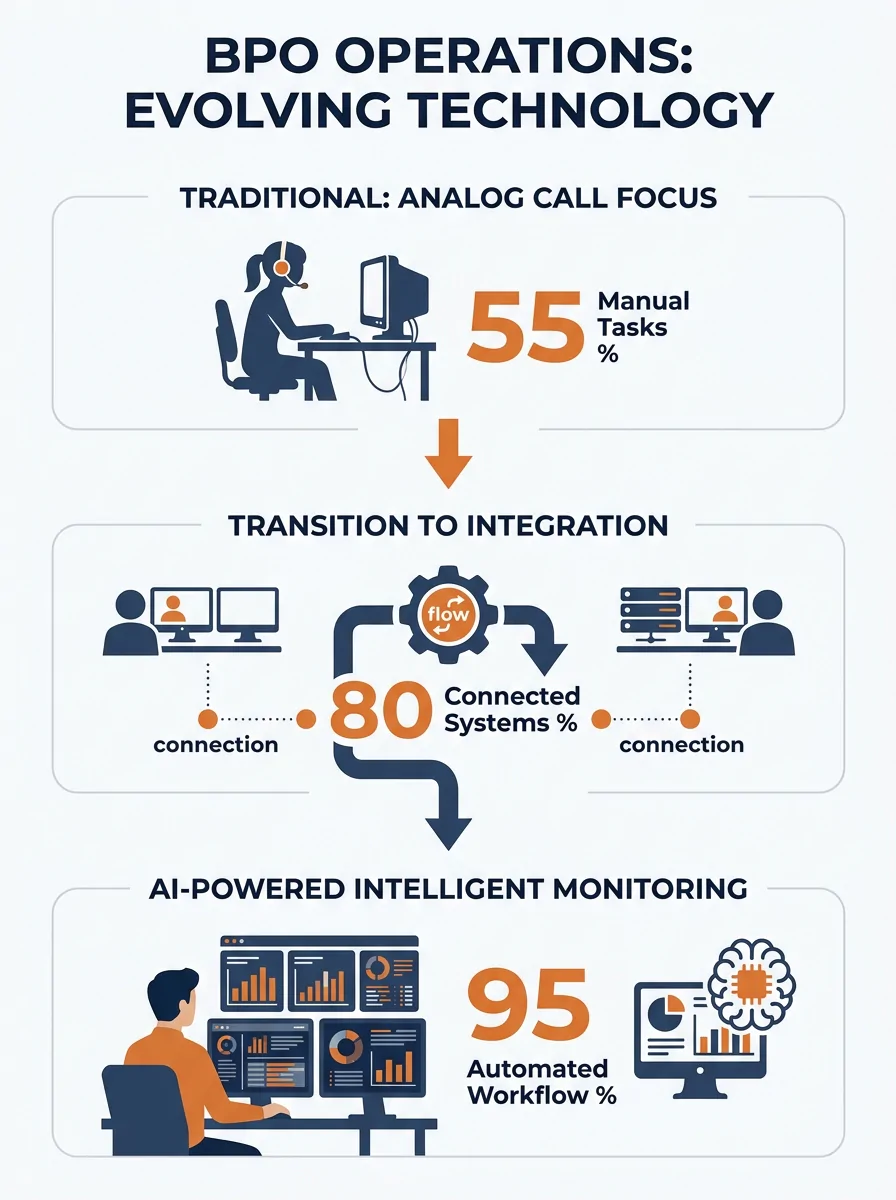
The analysis identifies three structural forces driving the revenue mix transformation: accelerating labor margin compression, AI-created technology revenue opportunities that carry margins four to five times higher than human labor, and evolutionary pressure favoring BPOs that integrate technology into their revenue models.
Labor Margin Compression Forces Revenue Model Shift
BPO labor margins have compressed from approximately 25% gross five years ago to 18-20% today, according to the Anyreach analysis. The firm projects margins will reach 12-15% for commodity work within five years as client rates face downward pressure from AI alternatives while agent costs rise 4-8% annually across major delivery markets including the Philippines, India, Colombia, and South Africa.
The analysis notes that at 12% gross margin, the business model cannot support corporate overhead, technology investment, and growth. Client rates are declining as enterprise buyers recognize AI can handle routine interactions at a fraction of human agent costs, the analysis states. Simultaneously, wage inflation, benefits costs, and expanding worker protection regulations increase agent costs from both directions.
AI Creates High-Margin Technology Revenue Stream
AI agent deployment creates a technology revenue opportunity that generates 60-80% gross margins compared to the 15-25% margins from human labor, according to the analysis. When a BPO deploys an AI agent handling 40% of a client’s call volume, the AI agent functions as a product rather than operational infrastructure, the analysis argues.
The economics show AI agents cost BPOs $0.06-$0.15 per minute to operate while clients pay $0.30-$0.60 per minute or equivalent outcome-based rates, the analysis states. This contrasts with pre-AI technology stacks—telephony, CRM, workforce management—which were cost centers that BPOs did not bill separately.
Technology revenue sources include AI platform fees, outcome-based pricing spreads, technology licensing to clients, and managed AI services, according to the analysis. These services scale without proportional cost increases, unlike human labor billing.
Surviving BPOs Will Adopt Hybrid Revenue Models
BPOs that maintain 95% labor-revenue models will face continuous margin compression until the business becomes unviable, while BPOs shifting 30-50% of revenue to technology margins will achieve blended margin structures supporting investment and competitive pricing, the analysis predicts. Market selection will favor the shifted model, the analysis argues.
Clients will prefer BPOs offering AI-augmented services due to superior economics and broader capabilities, according to the analysis. Investors will favor BPOs with technology revenue because margins are higher and growth is more scalable. Talent will prefer BPOs investing in technology because work is more engaging and career paths are more durable, the analysis states.
The analysis draws parallels to manufacturing and logistics companies that integrated technology into revenue models. AI-powered assistants meeting Philippine human teams represent the hybrid model’s practical application, with technology handling routine tasks while human specialists manage complex customer needs.
The shift affects how SMBs and agencies evaluate offshore providers. AI-native web development teams already demonstrate technology-enabled differentiation, using tools like Cursor, Claude, and Aider to ship faster than traditional development shops.
Agencies Implications
The revenue model shift creates a new evaluation framework for SMBs and agencies selecting offshore partners. Providers that still bill exclusively by labor hour signal they have not invested in technology infrastructure that will define competitive delivery in 2028. Agencies running $3-30K monthly offshore budgets should ask prospective BPO partners what percentage of their current revenue comes from technology services versus labor billing—the answer reveals whether the provider is positioned for the projected industry transformation or defending a compressing margin structure.
The 60-80% gross margin spread between technology services and human labor also affects team stability and career development for offshore hires. BPOs generating higher margins from technology revenue can invest more in training, tools, and compensation for the human specialists who work alongside AI systems. Agencies building long-term offshore teams should evaluate whether their provider’s revenue model supports sustained investment in the people handling complex client work rather than optimizing for the lowest possible labor cost per seat.