
Every communication breakdown in an outsourced web project produces technical debt that Google’s ranking algorithm will find before your users do.
That’s the part of outsourcing economics nobody tracks. The industry conversation fixates on hourly rates, sprint velocity, time-zone overlap. But the real financial exposure sits in what happens after a miscommunicated build finally ships, when Google’s crawlers index a site full of performance problems, redundant code, and mobile UX issues that trace directly back to unclear requirements and skipped acceptance criteria.
The conventional framing treats communication failures as project management problems: delays, budget overruns, scope creep. They are all of those things. But they’re also SEO problems, because Google’s Core Web Vitals and page experience signals punish exactly the kind of shortcuts that rework cycles produce. And those ranking penalties compound long after the invoices are paid.
Here are three pieces of evidence.
Misaligned Requirements Ship as Technical Debt Google Can Measure
Industry data attributes a 28% failure rate in outsourced projects to misaligned expectations, with the root cause overwhelmingly being communication breakdowns. What does “misaligned expectations” look like in practice? An offshore team builds a feature set that technically works but doesn’t match the client’s intent. The client requests changes. The offshore team patches instead of refactoring. Patches accumulate. The codebase gets heavier, slower, and more fragile.
Google measures the result. Largest Contentful Paint (LCP), First Input Delay (FID), Cumulative Layout Shift (CLS) — these Core Web Vitals directly reflect code quality. A page that loads in 1.8 seconds before three rounds of rework might load in 4.2 seconds after, because rushed patches add unoptimized assets, duplicate API calls, and layout-shifting DOM elements that nobody had time to clean up.
AlterSquare’s analysis of communication costs in outsourced development documents a case where an outsourced team developed a web application with an exposed password reset endpoint, the direct result of misunderstood requirements. That kind of security flaw shows up in site health audits. Google’s systems increasingly downrank sites with known security vulnerabilities, particularly after the helpful content and site reputation updates tightened quality signals across the board.
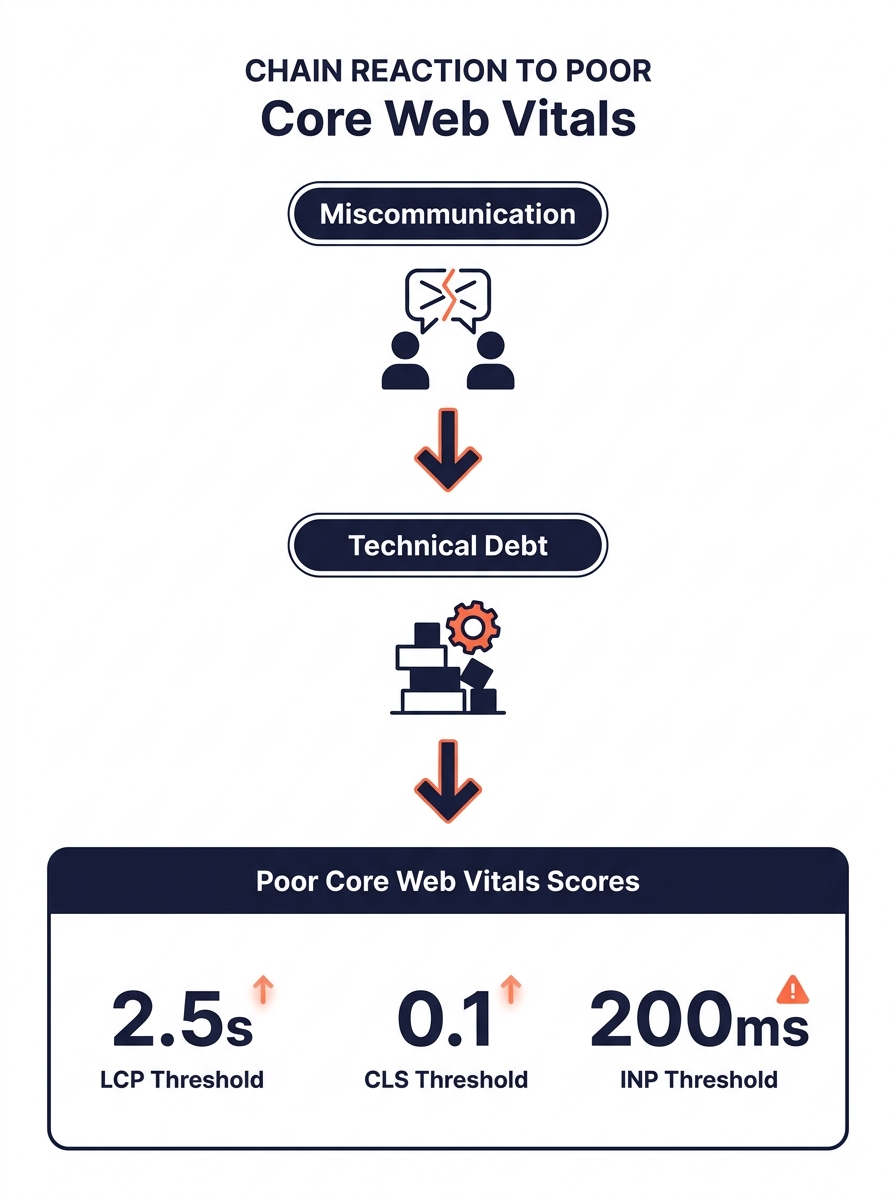
The pattern is consistent: when web development outsourcing communication breaks down between client and offshore team, the resulting rework doesn’t add just weeks to the timeline. It degrades the build quality in ways that are directly measurable by Google’s ranking infrastructure.
The Compounding Math of Delayed Launches and Lost Indexing Windows
The $50K estimate for communication-driven project delays comes from direct costs: additional developer hours, extended project management overhead, sometimes contractual penalties. But it ignores the opportunity cost of delayed organic visibility.
A site that was supposed to launch in March but ships in June because of three rounds of miscommunication-driven rework has lost three months of indexing time. For a business generating $20K–$40K per month in organic revenue from its web presence, that delay represents $60K–$120K in foregone traffic value, before you even count the direct project overruns.
The numbers behind this are well-documented. Research on hidden outsourcing costs confirms that communication breakdowns slow feedback cycles, leading to rework that adds 10–20% to project budgets. Separately, Statista data shows 50% of outsourced projects fail to meet client expectations, with 30% of those failures directly linked to communication problems. And 62% of outsourced IT projects exceed their budgets, with 56% of those overruns traced to miscommunication.
When teams building Philippine-based web projects handle stakeholder alignment properly, they avoid the worst of these compounding delays. But the default for first-time outsourcing clients who haven’t established offshore development documentation standards is a feedback loop where ambiguity creates rework, rework creates delays, and delays create pressure to ship a suboptimal build.
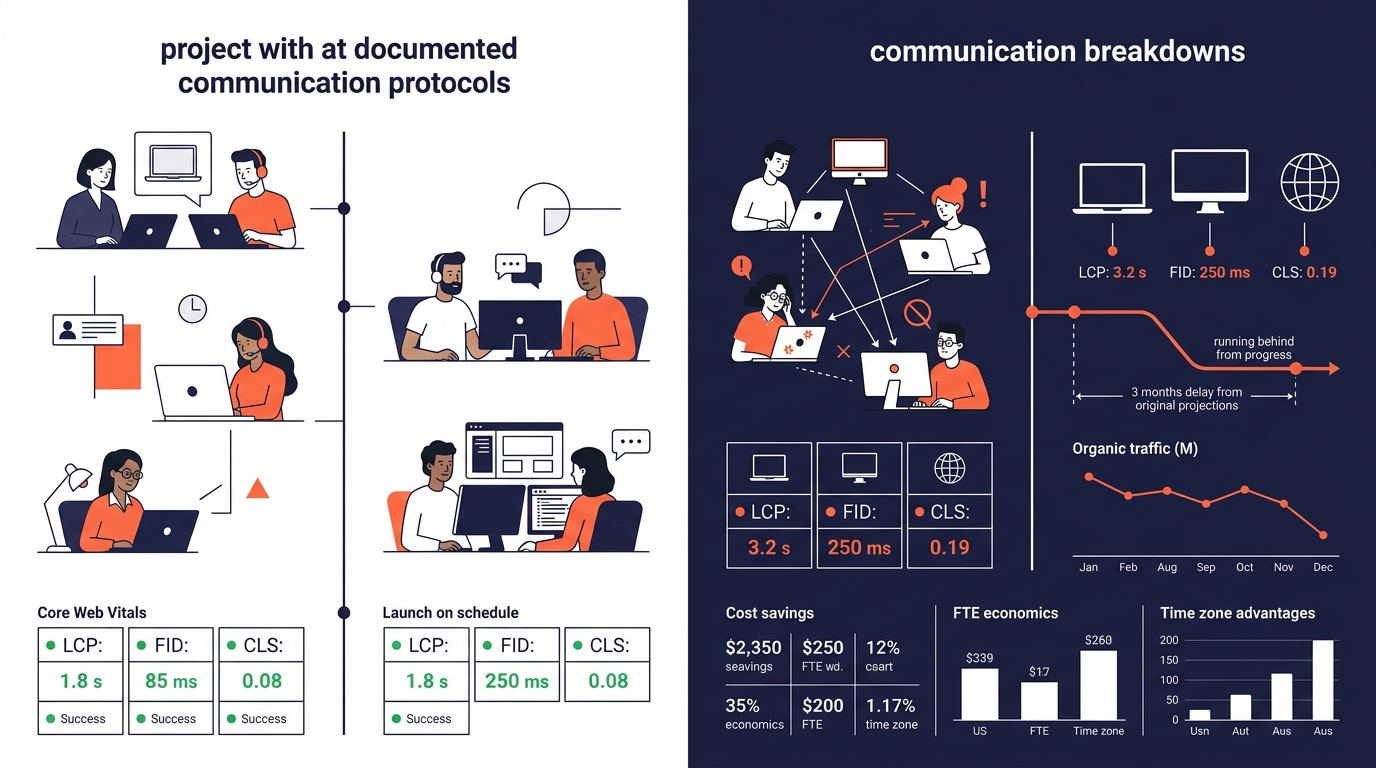
That pressure is where the Google penalty risk escalates. Teams under deadline pressure skip performance optimization. They ship without proper mobile testing. They deploy with render-blocking resources that tank page speed scores. Every one of those shortcuts shows up in search rankings within weeks.
The $50K estimate for communication-driven project delays ignores the opportunity cost of delayed organic visibility and the ranking damage from a rushed, patched-together launch.
The Documentation Standards and Communication Protocols That Break the Cycle
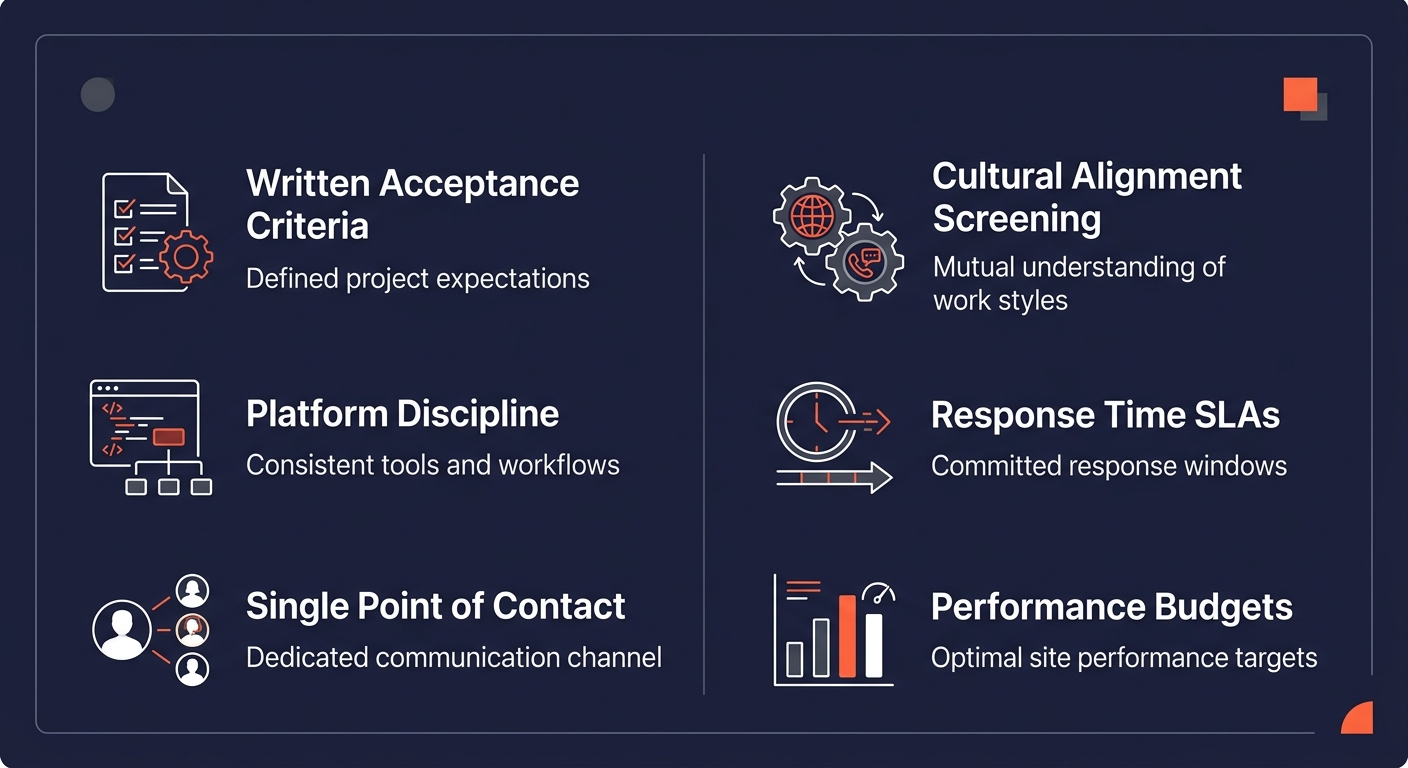
The fix isn’t complicated, but it requires discipline that many outsourcing relationships lack at the outset. Here’s a project communication checklist built from what actually prevents these failures:
Written Acceptance Criteria for Every Sprint
As MindK’s outsourcing guide puts it, “losing context across time zones is the bigger threat” than poor English. Written acceptance criteria tied to what “done” actually means for each deliverable eliminates the single largest source of rework. If a task doesn’t have written acceptance criteria, it shouldn’t enter a sprint. This applies equally whether you’re building a marketing site, a SaaS dashboard, or working with a dedicated mobile app team on a companion product.
Platform Discipline
Decide which platform is used for what: Slack or Teams for quick questions, email for formal approvals, Zoom for weekly syncs. This sounds basic, but in practice most outsourcing relationships drift toward a chaotic mix of channels where critical decisions get buried in Slack threads that nobody can find two weeks later. The rule: if it affects scope, timeline, or budget, it goes in writing in the project management tool. Nowhere else counts.
A Single Point of Contact on Each Side
Dual points of contact prevent the “game of telephone” effect where requirements mutate as they pass through multiple people. This becomes especially important when outsourced QA testing runs parallel to development, because QA teams need the same requirements context that developers do. Without a single point of contact on each side, QA often tests against outdated specs while developers build against verbal clarifications the QA team never received.
Cultural Alignment Screening During Hiring
Outsourcing cultural alignment matters because it determines how your offshore team handles ambiguity. DistantJob’s hiring research identifies four signals to screen for: documentation habits, performance in paid trials, self-managing work style, and writing quality. Teams that default to asking clarifying questions when something is unclear produce dramatically fewer rework cycles than teams that default to guessing and building in silence.
This connects to broader cross-cultural training practices that reduce conflicts in distributed teams. Philippine development teams tend to score well on these dimensions because the BPO industry has decades of experience calibrating communication styles for US and Australian clients. But even strong cultural fit deteriorates without the structural protocols to support it.
Response Time SLAs
Target under four hours for message acknowledgment during overlapping business hours. Philippine teams working with US clients on Pacific time typically overlap from 8 AM to noon Manila time (5 PM to 9 PM Pacific). That four-hour window is where all synchronous communication should happen. Everything else should be async, documented, and non-blocking. When you’re working with outsourced IT services across multiple time zones, these SLAs prevent the single-day feedback delays that compound into weeks of wasted sprint capacity.
Performance Budgets Written Into the Spec
This is the Google-specific piece most project communication checklists miss entirely. If your spec doesn’t include target Core Web Vitals scores (LCP under 2.5 seconds, CLS under 0.1, Interaction to Next Paint under 200ms), your offshore team has no reason to optimize for them. And when rework pressure hits, performance is the first thing that gets sacrificed. Written performance budgets, reviewed in every sprint demo, prevent the technical debt accumulation that tanks search rankings post-launch.
When you’re keeping strategy in-house while outsourcing execution, these documentation standards become the connective tissue between your SEO strategy and your offshore team’s daily work. Without them, the two operate in parallel universes, and Google’s algorithm adjudicates the gap.
Tip: If you’re evaluating an offshore web development partner, ask them to show you a sample sprint ticket with acceptance criteria and performance targets. How they respond tells you more about communication quality than any portfolio review.
The Claim, Revisited
The web development outsourcing communication problem is universally framed as a project management risk. It is one. But every project management failure that adds weeks of rework and thousands in unplanned costs also produces a build that Google’s ranking systems evaluate less favorably. Slow pages, broken mobile experiences, security flaws from misunderstood requirements, delayed launches that forfeit months of organic indexing: these are communication costs that show up in Search Console, not in the project invoice.
The organizations that avoid these outcomes aren’t necessarily spending more on their offshore teams. They’re spending differently, front-loading investment in documentation, acceptance criteria, and platform discipline rather than paying for rework on the back end. A four-week structured onboarding process for an offshore development team costs roughly $3K–$5K in billable time. The communication-driven project delays it prevents routinely run ten times that amount, and the organic traffic it protects is worth more still.
The checklist above covers the minimum viable protocol. The principle behind it is simpler: in distributed web development, what isn’t documented doesn’t exist, and what doesn’t exist will eventually surface as a problem that Google can measure and your users can feel.