
Cross-cultural training reduces team conflicts by addressing misunderstandings caused by differences in communication styles, values, and expectations. Here’s why it works:
- Improves Communication: Teams learn to interpret different communication styles, such as direct vs. indirect feedback, and avoid misinterpreting body language or silence.
- Reduces Bias: Training helps identify and minimize unconscious biases that lead to assumptions and stereotypes.
- Enhances Conflict Resolution: Teams adopt techniques like active listening and mediation, which respect diverse perspectives and improve collaboration.
- Boosts Performance: Studies show a 30% improvement in team efficiency and a 40% drop in miscommunication incidents when companies implement such training.
Real-world examples, like Siemens and Marriott, highlight measurable outcomes such as better team engagement, increased productivity, and stronger collaboration. For outsourcing teams, strategies like establishing shared guidelines and clear communication practices further reduce misunderstandings and improve workflows.
Key Stats:
- 70% of international business conflicts stem from cultural misunderstandings.
- Teams with cultural diversity in leadership are 36% more likely to achieve higher profitability.
- Cross-cultural training can lead to a 50% reduction in conflict resolution time.
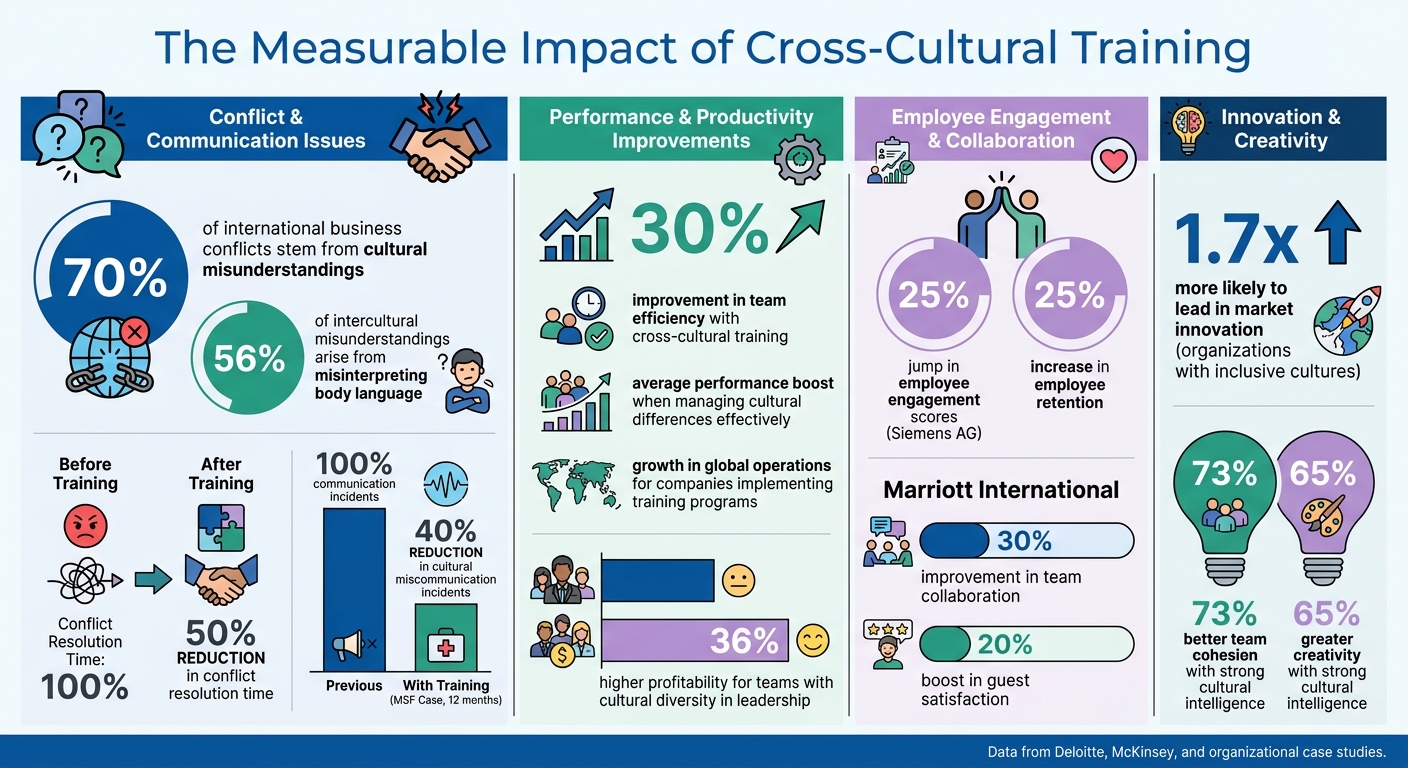
Cross-Cultural Training Impact: Key Statistics on Team Performance and Conflict Reduction
Research Findings on Training and Conflict Reduction
What Deloitte Studies Show

Cross-cultural training isn’t just a theoretical concept – it’s backed by data that shows its real-world impact on team performance. According to Deloitte, organizations with inclusive cultures are 1.7 times more likely to lead in innovation within their market. This success stems from how such training reshapes team behavior. By learning to anticipate cultural differences, team members become more self-aware, act with greater flexibility, and rely less on assumptions.
Take Siemens AG, for example. Their cross-cultural training initiative led to a 25% jump in employee engagement scores. Similarly, Marriott International saw impressive results: a 30% improvement in team collaboration and a 20% boost in guest satisfaction after implementing cultural awareness training. These examples highlight how cultural training directly enhances team dynamics and performance.
Data on Cross-Cultural Competence and Team Performance
A large-scale meta-analysis of 108 studies involving 10,632 teams sheds light on the effects of cultural diversity on performance. The findings describe cultural diversity as a "double-edged sword." While it can create challenges like task conflicts and reduced social integration, it also offers rewards such as increased creativity and greater team satisfaction.
The deciding factor? How teams handle cultural differences. Studies show that effectively managing these differences can lead to an average performance boost of 30%. For instance, Médecins Sans Frontières (Doctors Without Borders) implemented a framework to evaluate the success of their training programs. Within just 12 months, they achieved a 40% reduction in cultural miscommunication incidents. This demonstrates how focusing on cultural competence can turn potential conflicts into opportunities for growth and success.
sbb-itb-5665bbf
How Cross-Cultural Training Prevents Team Conflicts
Better Communication Across Different Styles
Misunderstandings in communication are a common source of friction in diverse teams. Cross-cultural training helps bridge this gap by teaching team members to recognize and adapt to different communication styles. For instance, high-context cultures like Japan or Arab nations rely heavily on tone and context to convey meaning, whereas low-context cultures like Germany or the U.S. favor direct and explicit communication. Without this understanding, a German colleague’s straightforward feedback might come across as overly blunt to a Japanese teammate. Similarly, a Thai employee’s silence in a meeting may be misinterpreted by a Finnish colleague as disengagement, rather than a gesture of respect.
Training also focuses on decoding nonverbal cues, which are often a major source of confusion. Studies show that 56% of intercultural misunderstandings arise from misinterpreting body language or other nonverbal signals. By equipping teams with these skills, cross-cultural training helps reduce these missteps significantly.
Reducing Biases and Stereotypes
Improving communication is just the beginning – cross-cultural training also addresses unconscious biases that can fuel misunderstandings. A key concept introduced in training is the "Cultural Iceberg", which encourages employees to look beyond surface-level traits like clothing or accents and instead focus on deeper values and decision-making processes. This mindset shift helps team members seek clarification rather than jumping to conclusions about others’ intentions.
Tools like implicit bias assessments further help employees uncover and address their subconscious prejudices. As Learnit explains:
"Learners begin to shift from assuming intent to seeking clarity, avoiding unnecessary conflicts."
The impact of this training is clear. Organizations that invest in cross-cultural training report up to a 40% drop in misunderstandings related to cultural differences and a 30% boost in team performance.
Conflict Management Techniques That Work Across Cultures
With better communication and fewer biases, teams are better equipped to handle conflicts effectively. Resolving disputes in multicultural environments requires flexibility and respect for cultural differences. Cross-cultural training teaches techniques like active listening and empathy, which help team members understand and navigate diverse perspectives.
Rather than defaulting to direct confrontation, which is common in Western cultures, training introduces culturally adaptive methods like mediation. These approaches respect social norms and help teams establish shared guidelines for communication, timelines, and conflict resolution. This is crucial, as 70% of conflicts in multicultural teams stem from differences in values and communication styles.
The results are impressive: organizations see a 25% increase in employee retention and a 50% reduction in the time spent resolving conflicts. These strategies not only improve team dynamics but also lead to measurable benefits for global teams, particularly in outsourcing environments where cultural alignment is key to success.
Cross-Cultural Training in Outsourcing: 365Outsource‘s Methods

Managing Cultural Differences in Outsourcing Teams
Outsourcing teams often encounter challenges rooted in cultural differences. 365Outsource, operating out of the Philippines, tackles this by fostering a "third culture" – a shared identity that brings together team members from diverse backgrounds. Instead of expecting one culture to dominate, this approach highlights mutual strengths and commonalities.
The training focuses on real-world outsourcing scenarios where cultural nuances impact daily operations. For instance, Filipino virtual assistants may hesitate to challenge a U.S. client’s decisions – not because they agree, but out of respect for hierarchy. These sessions help both sides identify such patterns and adapt, creating workflows that respect varying approaches to authority and decision-making.
"Most teams discover that colleagues they found ‘difficult’ were simply operating from different cultural frameworks. Understanding this can transform frustration into newfound appreciation."
This emphasis on a shared cultural foundation also enhances communication with clients, making interactions smoother and more productive.
Working Smoothly with Global Clients
Clear communication is a cornerstone of 365Outsource’s strategy for global collaboration. Staff undergo training to minimize the use of colloquialisms and jargon, ensuring clarity across cultural boundaries. For example, instead of saying "let’s circle back" or "low-hanging fruit", teams are encouraged to use straightforward language tailored to international audiences.
The program also promotes asynchronous collaboration through tools like Microsoft Teams and Slack, making it easier for team members in different time zones to contribute equally. Meeting times are rotated to ensure no group consistently bears the burden of early or late calls. Teams maintain shared documents written in simple terms to record project updates and decisions, providing a reliable reference when misunderstandings occur.
"Communication is at the root of most cultural issues in a global organization and is a natural place to start."
Results Clients Can Measure
The impact of cross-cultural training is tangible. These methods lead to measurable improvements, such as reduced conflicts and streamlined workflows. Companies that implement such programs report 30% growth in their global operations. A 2020 McKinsey report also found that organizations promoting inclusive behavior through training outperform their competitors financially.
For 365Outsource clients, the benefits include quicker decision-making and higher project success rates. With fewer cultural misunderstandings, teams spend less time resolving conflicts and more time delivering results. These efforts also improve morale and retention by ensuring staff feel valued and understood, which helps clients avoid the high costs of recruitment and onboarding. Perhaps most importantly, diverse teams trained in cultural understanding can leverage their varied perspectives to develop more creative solutions.
Conclusion: Better Teams Through Cross-Cultural Training
Cross-cultural training addresses one of the biggest causes of team conflicts: misunderstandings rooted in cultural differences. These misunderstandings are behind 70% of international business disputes. By teaching teams to move away from assuming intent and instead focus on seeking clarity, these programs help stop conflicts before they even begin. Studies show that such training can increase productivity by 30% and reduce miscommunication by 50%.
From a financial perspective, the advantages are clear. Leadership teams in the top quartile for cultural diversity outperform others by 36%. Additionally, teams with strong cultural intelligence demonstrate 73% better cohesion and 65% greater creativity. These improvements lead to quicker decisions, better employee retention, and stronger relationships with clients.
A great example of this in action is 365Outsource, which has successfully implemented these strategies. Using a "third culture" approach, the company provides tailored training for outsourcing scenarios and establishes clear communication practices. They rotate meeting schedules, use straightforward language, and rely on shared documentation to ensure smooth collaboration between their Filipino team members and U.S. clients. The results? Fewer conflicts and faster project delivery.
"Cross-cultural training isn’t a one-off workshop you tick off a list. It’s a living capability that matures whenever a teammate pauses to clarify intent." – Courtney Ritchie, Executive Learning Professional, Learnit
Courtney Ritchie’s insight echoes what global players like Siemens and Accenture have proven time and again, and what 365Outsource demonstrates every day: cultural competence is no longer optional – it is the foundation for building high-performing teams. When teams learn to turn cultural differences into strengths, they don’t just avoid problems – they excel.
FAQs
What should cross-cultural training include?
Cross-cultural training is all about preparing individuals to navigate and work effectively in diverse environments. It focuses on three main areas:
- Understanding cultural differences: Employees learn to identify and respect varying cultural norms, behaviors, and traditions. This helps reduce misinterpretations and fosters mutual respect.
- Effective communication styles: Training emphasizes how to adapt communication methods to bridge language barriers and understand subtle nuances, ensuring clear and respectful interactions.
- Managing cultural conflicts: Participants explore strategies to handle disagreements rooted in cultural differences. This includes learning conflict management styles and leadership approaches that encourage inclusivity and collaboration.
By equipping teams with these skills, cross-cultural training reduces misunderstandings and helps create a workplace where diverse perspectives thrive.
How long does it take to see fewer team conflicts?
It often takes months of consistent cross-cultural training to see a noticeable drop in team conflicts. Research indicates that developing cultural fluency and strong communication skills is a gradual process that demands continuous effort and practice.
How can cross-cultural training work in remote outsourcing teams?
Cross-cultural training plays a key role in helping remote outsourcing teams work more effectively together. By focusing on better communication, deeper understanding, and smoother collaboration, it bridges gaps between culturally diverse team members. This type of training emphasizes respect for cultural differences, which helps reduce misunderstandings and potential conflicts.
The training often covers areas like understanding cultural values, handling conflicts constructively, and building a sense of unity within the team. Beyond that, mentorship programs and activities designed to increase cultural awareness can strengthen trust and mutual respect. These efforts ensure that digital communication remains clear, respectful, and productive – critical elements for creating strong, globally connected teams.