
Virtual assistant hiring should prioritize documented procedures over candidate charisma, according to a fraud-prevention guide published June 7 by bootstrap founder Violetta Bonenkamp on blog.mean.ceo. The 2026-edition framework argues that weak operating systems—not bad hires—drive most VA failures, and recommends founders write standard operating procedures for recurring tasks before opening contractor searches.
TL;DR: Bonenkamp’s guide shifts VA hiring emphasis from screening profiles to documenting workflows first, citing rising identity fraud in remote hiring and the operational risk of building roles around individual people rather than repeatable systems.
Why Process-First Hiring Matters Now
The guide arrives as fraud in contingent workforce hiring accelerates. Bonenkamp cites Staffing Industry Analysts data showing more than half of surveyed organizations experienced identity-related fraud when hiring remote contractors. CNET separately warned that employment scams increasingly target founders and small teams, using fake job arrangements to harvest banking details and access credentials.
Bonenkamp, a European founder who has built remote teams across borders, argues founders typically misdiagnose hiring failures. “Without SOPs, you cannot tell whether you hired the wrong person or created the wrong role,” the guide states. The framework positions documentation as fraud insurance: written procedures limit the damage from account misuse, contractor disappearance, or skill misrepresentation because the business operation exists independently of any individual.
The recommendation contrasts with retention-focused hiring strategies that emphasize candidate fit and long-term engagement, instead treating early-stage delegation as a systems-design problem where trust is earned through demonstrated output rather than assumed during interviews.
The Five-SOP Baseline Before Posting a Job
Bonenkamp’s framework requires founders to document five to ten recurring tasks before evaluating any candidate. Recommended starter workflows include inbox triage protocols, calendar coordination rules, CRM cleanup checklists, lead research templates, and data-entry quality standards. Each SOP should specify tool access, decision thresholds, output format, and escalation triggers.
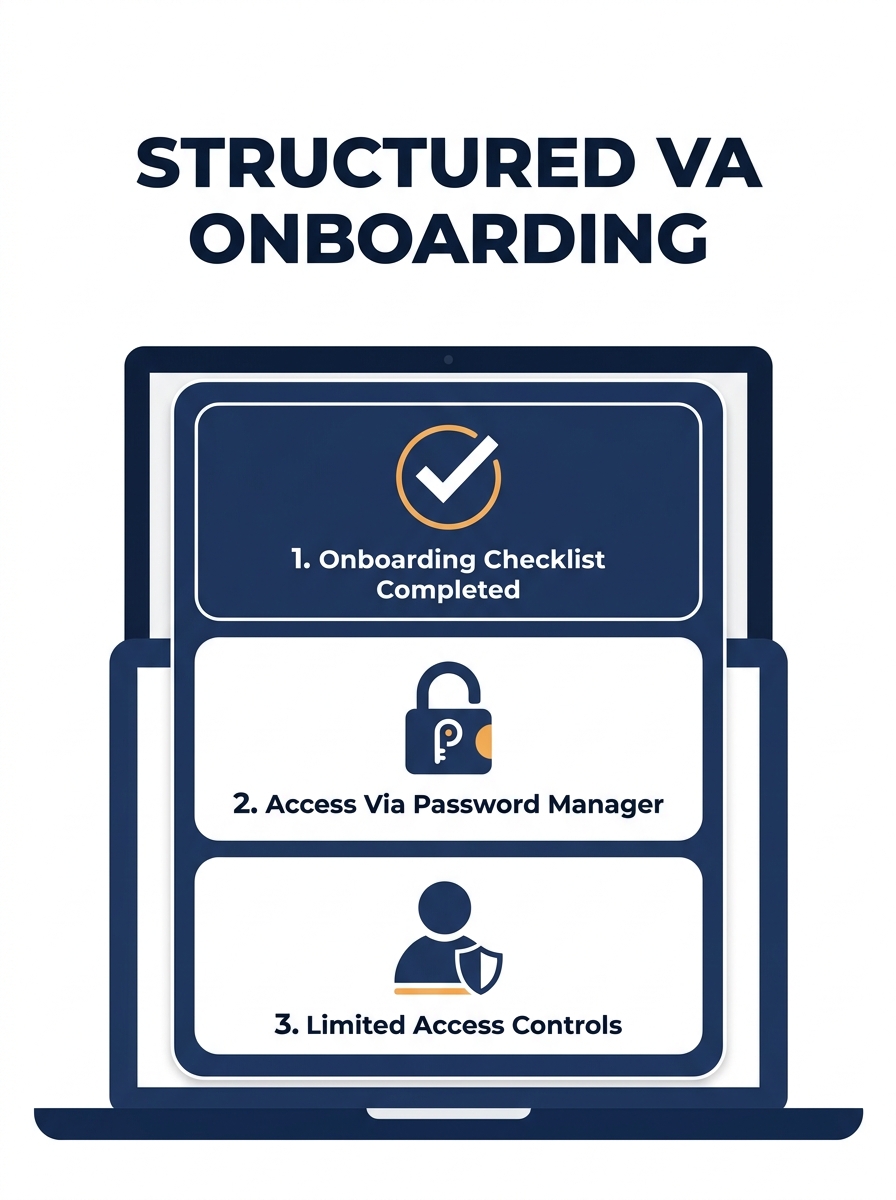
The guide recommends founders delegate low-risk work first—research, scheduling, list hygiene, social media queuing—while retaining control of banking, payroll, legal correspondence, and full inbox access until a VA completes 30 days of supervised output. Role-based accounts, two-factor authentication, shared password vaults, and daily review cycles contain early mistakes or fraud attempts within narrow boundaries.
Paid test tasks replace personality-driven interviews under the framework. Bonenkamp advises founders to design 90-minute assignments based on actual workflows, pay $25-50 per test, and evaluate judgment quality and instruction-following accuracy rather than profile polish or communication style. The testing layer filters fake profiles, offshore subcontracting, and weak reading comprehension before passwords or customer data enter the relationship.
Access Control as Fraud Mitigation
The guide treats access management as a first-line defense. Bonenkamp recommends role-specific logins over shared credentials, 30-day permission reviews, and tool-native activity logs to track file access and workflow changes. Startups should assume any new remote hire could misuse admin privileges, vanish mid-project, or operate under a falsified identity—making narrow, auditable permissions the baseline rather than an edge-case precaution.
For founders evaluating offshore virtual assistant options across real estate, healthcare coordination, e-commerce operations, or client success, the SOP-first model applies regardless of task complexity or contractor geography. The framework shifts hiring risk from “did I pick the right person” to “did I design a role that protects my business regardless of who fills it.”
Performance measurement frameworks typically layer on top of SOP infrastructure, tracking output quality and cycle time once baseline procedures stabilize.
Reading Between the Lines
Bonenkamp’s guide quietly reframes a high-stakes founder decision—who to trust with operational access—as an engineering problem with documented inputs, observable outputs, and known failure modes. That shift matters because the $19.6 billion IT virtual assistant market is growing faster than fraud-prevention tooling or founder education on access hygiene. Most small teams still hire on gut feel, skip test tasks to save $40, and grant admin-level permissions during onboarding week.
The SOP-first methodology won’t eliminate hiring risk, but it does change the failure scenario. A bad hire working inside documented workflows burns days, not months. A disappeared contractor leaves behind instructions the next person can execute. A fraudster with narrow tool permissions can’t drain accounts or exfiltrate customer lists. The operating use VA hiring promises—founder time bought back at $8-25/hour offshore rates—only compounds if the system outlasts any individual.
For budget-constrained SMBs and agencies running $3-30K/month operations, the implication is straightforward: delay hiring until you finish the documentation work. Founders who skip that step typically re-hire three times in six months. Those who build SOPs first hire once and scale the role through iterative procedure updates rather than candidate replacement.