
Hireplicity, a Philippines-based offshore development provider, published a hiring guide on June 13 detailing engagement models and pricing for AI-augmented offshore developers in 2026, according to the company’s blog post. A fully-loaded senior Philippine developer costs $6,000–$7,500 per month—including statutory benefits, AI tooling, and management overhead—compared to $180,000–$210,000 annually for a US equivalent, the guide reports.
TL;DR: Hireplicity’s June 13 guide covers three engagement models for hiring AI-augmented Philippine developers, with cost comparisons showing 40–70% savings versus US hiring and 35–55% faster delivery than traditional offshore teams.
The guide addresses a decision point US and Australian SMBs face when scaling technical capacity: which engagement model—staff augmentation, Employer of Record (EOR), or Build-Operate-Transfer (BOT)—fits their compliance posture, IP ownership requirements, and AI tool procurement approach. Hireplicity positions model selection as the first decision, ahead of rate negotiation.
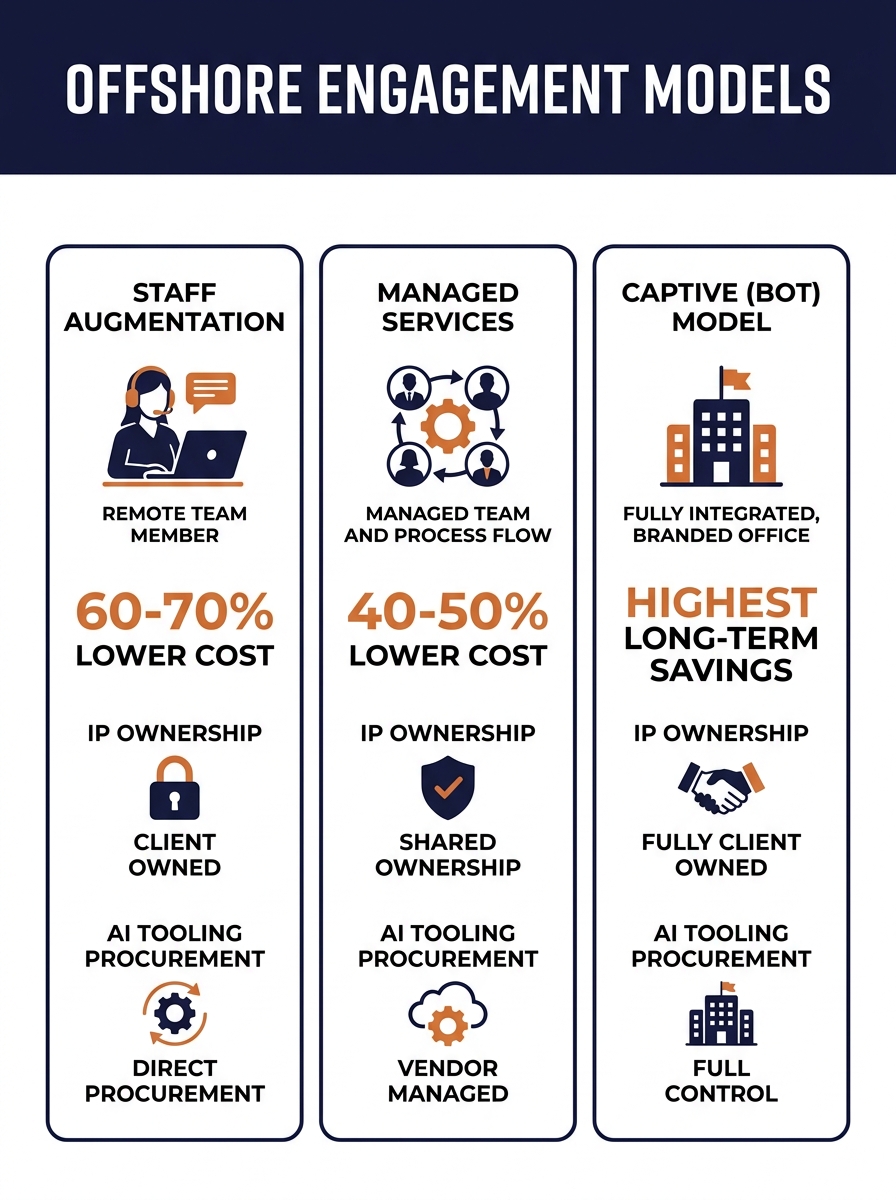
Three Engagement Models With Different IP and Tooling Trade-Offs
Staff augmentation places offshore web developers directly into a client’s existing team under the client’s day-to-day direction. The client controls AI tool licensing, sprint planning, and intellectual property. The offshore partner handles sourcing and HR administration. Hireplicity’s guide positions this model for growth-stage companies with existing technical leadership who need AI-fluent capacity without vendor-side management overhead.
Employer of Record (EOR) arrangements use a third-party entity that legally employs offshore developers in the Philippines on the client’s behalf. The EOR handles payroll, statutory compliance, and mandatory benefits—adding approximately 22% overhead to base salaries—while the client retains operational control. EOR providers charge $150–$250 per employee per month for compliance administration, according to the guide. AI tooling can be procured by either the client or the EOR’s managed services layer.
Build-Operate-Transfer (BOT) involves the offshore partner building and operating a Philippine entity for the client, then transferring ownership once the team stabilizes. The guide notes BOT carries the highest upfront setup cost but delivers the lowest per-seat long-term cost for companies planning 20+ developer teams. AI tool procurement shifts to the client’s Philippine entity once the transfer completes.
AI Augmentation Drives 35–55% Faster Delivery, Company Data Shows
AI-augmented offshore development embeds AI coding tools—Cursor, GitHub Copilot, Claude Code—into distributed engineering workflows, with senior developers directing and validating AI-generated output. The guide defines a three-tier structure: AI handles boilerplate and repetitive code generation at Tier 1, mid-to-senior engineers validate and correct output at Tier 2, and senior architects focus on system design at Tier 3.
Companies using AI-augmented Philippine teams report delivery velocity 35–55% faster than traditional offshore models and 40–60% fewer production incidents, Hireplicity’s guide states. A five-person AI-augmented team costs $30,000–$37,500 monthly but delivers output equivalent to an 8–10 person traditional offshore team priced at $18,000–$25,000, yielding 20–35% lower total cost of ownership per feature over six months.
The guide cites the Stack Overflow Developer Survey 2026, which found 51% of code pushed to GitHub is AI-generated or substantially AI-assisted. Deloitte projects AI will drive 30–35% productivity gains across the full software development lifecycle, according to the guide. Hireplicity’s research found current tool proficiency matters less than “Adaptability Quotient”—an engineer’s demonstrated ability to learn and switch AI tools as the ecosystem evolves.
A comparison table in the guide shows AI-augmented teams reduce rework rates from 15–30% in traditional models to 5–10%, attributed to multi-tier validation processes. The guide recommends smaller, more senior, AI-fluent teams over larger headcount-heavy ones for both output quality and total cost of ownership.
Compliance and IP Ownership Tied to Engagement Model Choice
EOR arrangements require attention to Philippine statutory requirements, the guide notes. The Philippines’ Social Security System (SSS), PhilHealth, and Pag-IBIG contributions add mandatory overhead, and the 13th-month pay requirement represents 8.33% of annual compensation. The guide states EOR access to CREATE MORE Act (Republic Act 12066) tax incentives isn’t automatic and depends on how the EOR structures employment.
For intellectual property, staff augmentation and EOR models keep IP with the client by default. BOT transfers IP ownership once the Philippine entity is handed over. The guide positions IP residency as a model-selection criterion for venture-backed companies with investor agreements that restrict offshore IP ownership.
AI tool licensing costs vary by model. Under staff augmentation, clients typically manage enterprise licenses for Cursor or GitHub Copilot directly. EOR providers may offer managed AI tooling as an add-on service with transparent pass-through pricing. BOT structures eventually place AI tool procurement with the client’s Philippine entity, which can access regional pricing tiers unavailable to US-domiciled buyers.
Why This Matters Now
US and Australian SMBs running on $3,000–$30,000 monthly budgets face a structural cost problem: senior technical talent priced at $180,000–$210,000 annually consumes the entire operational budget, leaving no room for marketing, product iteration, or customer acquisition. The 40–70% cost arbitrage on AI-native web development outsourcing creates room to staff both technical and growth functions without US or Australian headcount cost.
The engagement model choice matters more in 2026 than in prior offshore cycles because AI tool procurement and IP ownership no longer default to simple work-for-hire arrangements. A staff augmentation contract that leaves AI tooling undefined creates licensing gaps. An EOR setup that doesn’t address CREATE MORE Act eligibility leaves 20–30% tax savings on the table. Hireplicity’s guide positions model selection as the gate decision before rate negotiation—a reversal of how most SMBs historically approached offshore hiring.
The 35–55% faster delivery claim ties directly to Philippine teams’ access to multiple AI development frameworks and the Adaptability Quotient metric Hireplicity uses to vet engineers. For SMBs that budget 12–16 weeks for an MVP, a 35% velocity gain compresses timelines to 8–10 weeks, which changes runway math and go-to-market sequencing. The guide’s explicit positioning of model choice ahead of pricing is a structural shift in how offshore capacity gets framed for budget-constrained buyers.