
Hireplicity, a California-based software development firm operating Cebu teams since 2008, published pricing on June 23 that pegs fully-loaded AI-augmented senior Philippine developers at $6,000–$7,500 per month versus U.S. annual equivalents of $180,000–$210,000, claiming 40–70% cost savings based on the company’s managed team data, according to a press release from Outsource Accelerator.
TL;DR: Hireplicity’s 2026 pricing guide documents what one Cebu-based vendor is quoting U.S. buyers for AI-augmented Philippine engineering teams, $30,000–$37,500/month for five-person teams versus roughly $1 million in equivalent U.S. annual cost.
The pricing guide represents a vendor sales document rather than an independent benchmark, but the cost structure tracks ranges the Philippine engineering market has shown consistently since 2024 and frames what U.S. buyers are being quoted mid-2026 for teams trained on AI-assisted development workflows.
Five-Person Team Pricing Sits Above Traditional Offshore Rates
A five-person AI-augmented team at Hireplicity runs $30,000–$37,500 monthly against roughly $1 million in equivalent U.S. annual cost, the company stated. The monthly rate positions AI-augmented teams above traditional offshore pricing, $18,000–$25,000 monthly for a comparable five-person team, and claims the productivity premium justifies the cost difference.
Hireplicity attributes the pricing to a three-layer vetting framework covering tool proficiency, code review judgment, and what the company terms an “Adaptability Quotient” measuring an engineer’s capacity to learn evolving AI tools. The framework is positioned as the differentiating variable between productive and unproductive offshore AI-augmented teams.
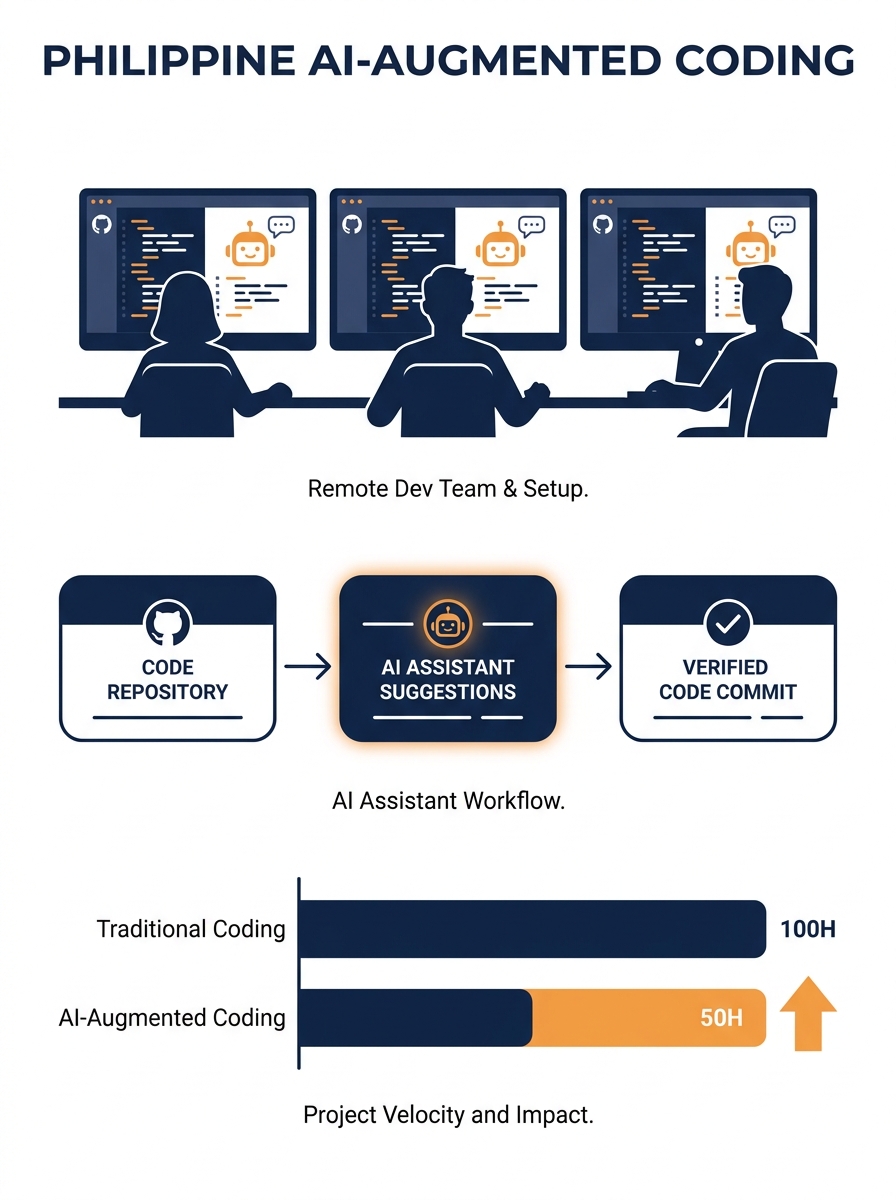
“[AI-augmented Philippine teams] ship 35–55% faster and require smaller headcounts for the same functional output,” Hireplicity stated in the guide, citing company-measured managed team data. The productivity claim includes 40–60% fewer production incidents compared to non-AI-augmented offshore alternatives.
Third-Party Data Frames Market Context; Vendor Claims Reflect Managed Environment
The Stack Overflow Developer Survey 2026 finds 51% of code pushed to GitHub is now AI-generated or substantially AI-assisted, the baseline Hireplicity frames its Philippine team pricing against. The company positions AI fluency as the differentiating offshore capability in 2026.
Deloitte projects 30–35% productivity gains across the full software development lifecycle from AI integration. Hireplicity’s 35–55% delivery speed claim tracks the third-party figure closely, though the company’s numbers reflect its specific managed team environment rather than industry-wide measurement.
The Philippines’ CREATE MORE Act (Republic Act 12066) adds structural advantages independent of any single vendor’s performance claims. The legislation provides 4–7 year corporate tax holidays, a 5% special tax rate thereafter, VAT and duty exemptions, and legal provision for up to 50% remote work for registered IT-BPM firms.
The pricing guide documents what one Cebu-based vendor is actively telling the market and what productivity assumptions U.S. buyers are being asked to accept alongside the cost figures. Hireplicity’s guide is a vendor-measured data set, not a Gartner, IDC, or HFS benchmark, but the cost structure appears internally consistent with AI-augmented offshore developer hiring ranges documented across the Philippine market since early 2025.
Adaptability Quotient Positioned as AI-Era Hiring Variable
The guide introduces “Adaptability Quotient”, an engineer’s capacity to learn evolving AI tools, as the differentiator between Philippine engineering teams that benefit from AI augmentation and those that do not, Hireplicity stated. The metric represents a vendor-specific vetting criterion rather than an industry-standard measure.
Tool proficiency and code review judgment round out the three-layer framework. Hireplicity positions the vetting as the structural variable explaining why some offshore teams deliver the claimed 35–55% speed improvements while others do not.
For U.S. companies evaluating AI-native web development outsourcing strategies, the guide documents a 2026 market where AI-augmented pricing sits above traditional offshore rates but claims output-per-dollar economics approaching U.S.-based engineering. The vendor-measured data lacks independent verification but tracks directionally with the productivity claims other offshore dev agencies have published since AI coding assistants reached 50%+ GitHub penetration in late 2025.
What This Means for US
Agencies and SMBs running on $3,000–$30,000/month development budgets are being quoted AI-augmented Philippine teams at price points that sit mid-range between traditional offshore rates and U.S. in-house engineering. A five-person team at $30,000–$37,500/month represents 60–75% of a single U.S. senior developer’s annual cost stretched across twelve months, not a perfect cost comparison but a structural advantage for agencies needing multi-framework capability without six-figure U.S. hires.
The 35–55% delivery speed claim, if it holds under production conditions, matters more than the raw labor arbitrage. Faster delivery at 40% savings competes differently than slower delivery at 70% savings. Agencies evaluating offshore dev partnerships should demand vendor-measured case studies showing actual sprint velocity and incident rates rather than accepting top-line cost percentages at face value.
Hireplicity’s “Adaptability Quotient” metric, regardless of whether the specific term gains traction, signals what the offshore dev market is converging on: vetting for AI tool fluency rather than raw coding skill alone. U.S. buyers shopping Philippine teams in 2026 should verify that candidate screening includes live AI-assisted coding tests, not just algorithm challenges built for the pre-Copilot era.