
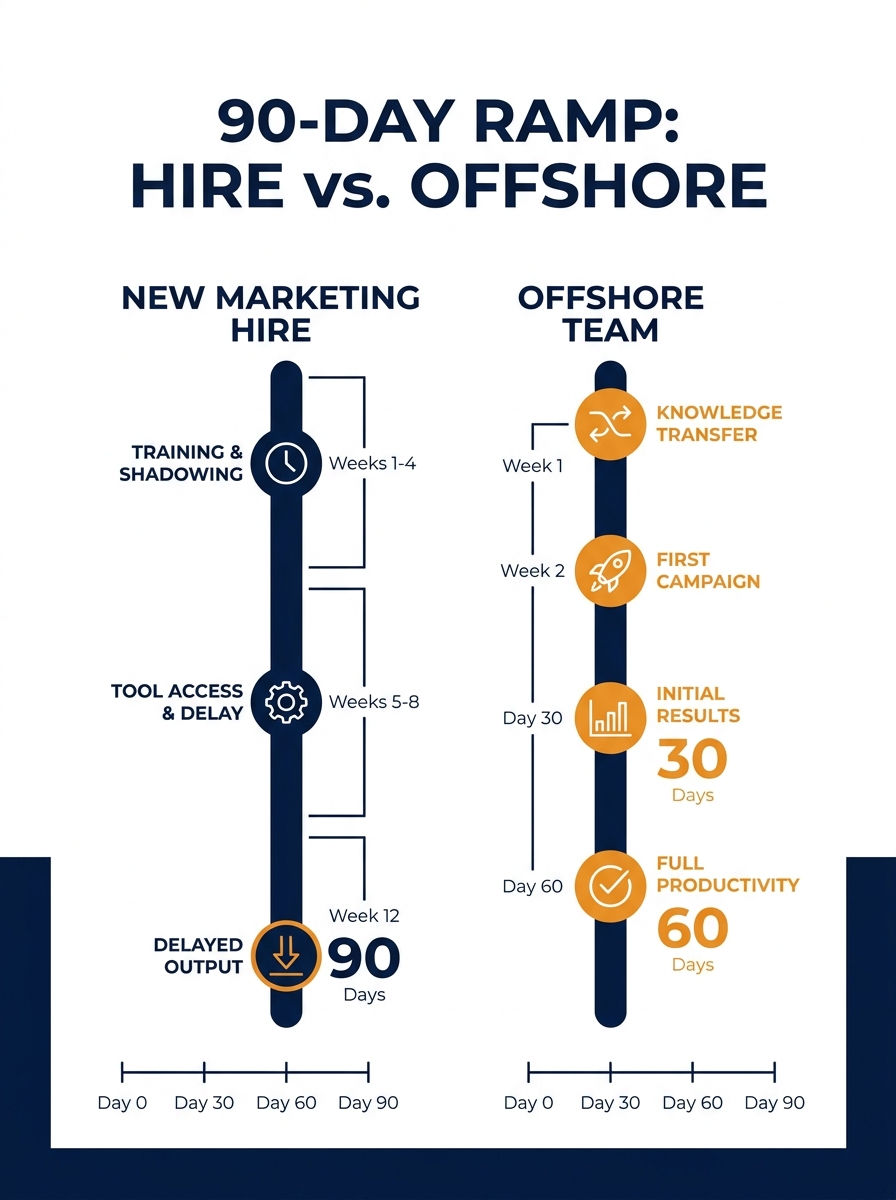
The calendar invite reads “Brand Guidelines Deep Dive — 2 hours,” and it’s one of fourteen onboarding sessions scheduled for a new marketing hire’s first two weeks. Analytics platform walkthrough, CRM permissions setup, campaign naming conventions review, content approval workflow training, stakeholder introduction rounds. According to a complete breakdown of onboarding expenses, marketing roles fall between $4,000 and $10,000 to bring up to speed, covering brand guidelines, campaign tools, analytics platforms, and content processes. Full productivity typically requires three to six months. An offshore digital marketing team with existing process discipline can show initial campaign improvements within 30 to 45 days. The distance between those two timelines is where the real money goes.
Here are six rules for thinking clearly about full-time vs outsourced marketing productivity and for avoiding the onboarding trap that drains your first quarter.
Measure onboarding cost in lost weeks, not training dollars
That $4,000 to $10,000 line item for marketing team onboarding costs gets all the attention in budget conversations. But it’s the wrong number to fixate on. The more damaging cost is opportunity cost: the campaigns that don’t run, the ad spend that sits unoptimized, the content calendar that slips because your new hire is still learning where the shared drive lives.
A new full-time marketing coordinator spends weeks absorbing tribal knowledge. Which Slack channels matter, who approves creative, how the attribution model actually works versus how it’s documented. Every organization has a gap between its written processes and its real ones, and bridging that gap eats the first 30 to 45 days of almost any hire’s tenure.
Offshore teams organized around a specific function, say PPC management or content production, come pre-loaded with the operational muscle memory for that function. They’ve already run hundreds of campaigns across dozens of clients. The onboarding they need is narrower: your brand voice, your target audience specifics, your reporting cadence. That’s a week of knowledge transfer, not a quarter of it. This is a core reason Philippine PPC specialists consistently beat in-house teams on early ROI.
Demand campaign output by day 30
The standard expectation for a new full-time marketing hire is that they’ll “shadow” for a few weeks, “ramp up” over the next month, and “start contributing meaningfully” somewhere around day 60 to 90. That’s a generous timeline that most hiring managers accept because they’ve internalized it as normal. It doesn’t have to be normal.
According to OffshorePH’s research on offshore teams and campaign conversion, most businesses see initial improvements within 30 to 45 days of offshore team onboarding, with significant conversion rate improvements appearing within 60 to 90 days as teams complete their learning curve and implement optimization strategies. The time-to-value offshore marketing model compresses the learning curve because the team already knows the tools and the general playbook. What they’re learning is your specific version of it.
If your new hire or your new team can’t point to a live campaign, a published content batch, or a measurable test by day 30, something is wrong with the onboarding structure, not the person. This is equally true for offshore and in-house hires, but offshore teams organized around output tend to hit this benchmark more reliably because output is literally what they’re contracted for. There’s no ambiguity about whether they’re “still getting settled.”
Stop front-loading training and spread it across live work
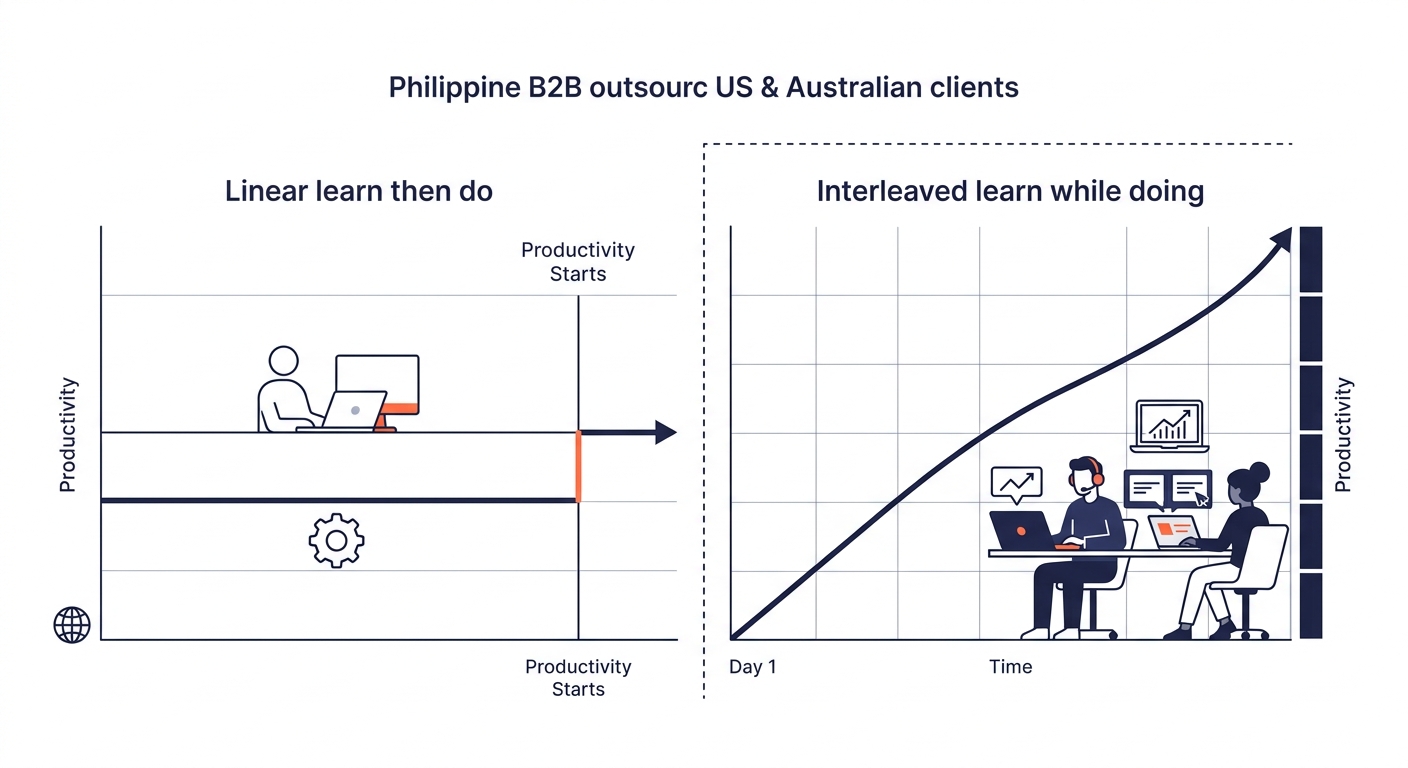
The classic onboarding playbook stacks all the learning at the front. Week one: company history, mission, values. Week two: tool training. Week three: process documentation review. Week four: maybe, finally, some supervised work on an actual campaign.
This is backward. Staff training overhead compounds when you batch it because retention of information drops sharply when there’s no immediate application. A marketer who learns your Google Ads account structure on Tuesday and doesn’t touch the account until the following Thursday has already forgotten half of what was covered.
The better model interleaves learning and doing from day one. Assign a real but low-risk task immediately. Let the new person or team run a small campaign, draft a content brief, or audit a landing page while they’re still absorbing the broader context. They’ll ask more targeted questions. They’ll retain more. And you’ll see evidence of competence (or problems) much faster.
A marketer who learns your Google Ads account structure on Tuesday and doesn’t touch the account until the following Thursday has already forgotten half of what was covered.
Konnect.ph’s week-by-week offshore implementation guide recommends exactly this structure, showing how well-organized offshore teams can reach full productivity by day 60 when onboarding is woven into active project work. Companies that avoid the most common outsourcing mistakes tend to build this interleaved model from the start rather than defaulting to the classroom-then-work sequence.
Define what “good” looks like before anyone starts
Here’s a pattern that kills onboarding speed regardless of whether you’re hiring in-house or offshore: the new person arrives, and nobody has written down what success actually means for their role in week one, month one, or quarter one. They get a job description that lists responsibilities but no measurable targets tied to a timeline.
As Kriszta Grenyo, COO at Suff Digital, puts it, the real question is whether every person on your team knows exactly what success looks like for their role this week, this month, and this quarter. If the answer is no, that’s where the work begins. Productivity rarely fixes itself without someone first fixing the clarity behind it.
Offshore teams have a structural advantage here because the engagement itself forces specificity. When you’re paying a monthly rate for a defined scope of work, you tend to articulate deliverables clearly upfront. You write the SLA. You specify the KPIs. You define the reporting rhythm. That same rigor rarely gets applied to a full-time hire because the relationship feels more open-ended. “They’ll figure it out” is a sentence that gets spoken about employees and almost never about contractors. The irony is that the employee needs the clarity even more, because they don’t have a project manager on the vendor side making sure the work stays on track.
Track utilization rate weekly, not quarterly
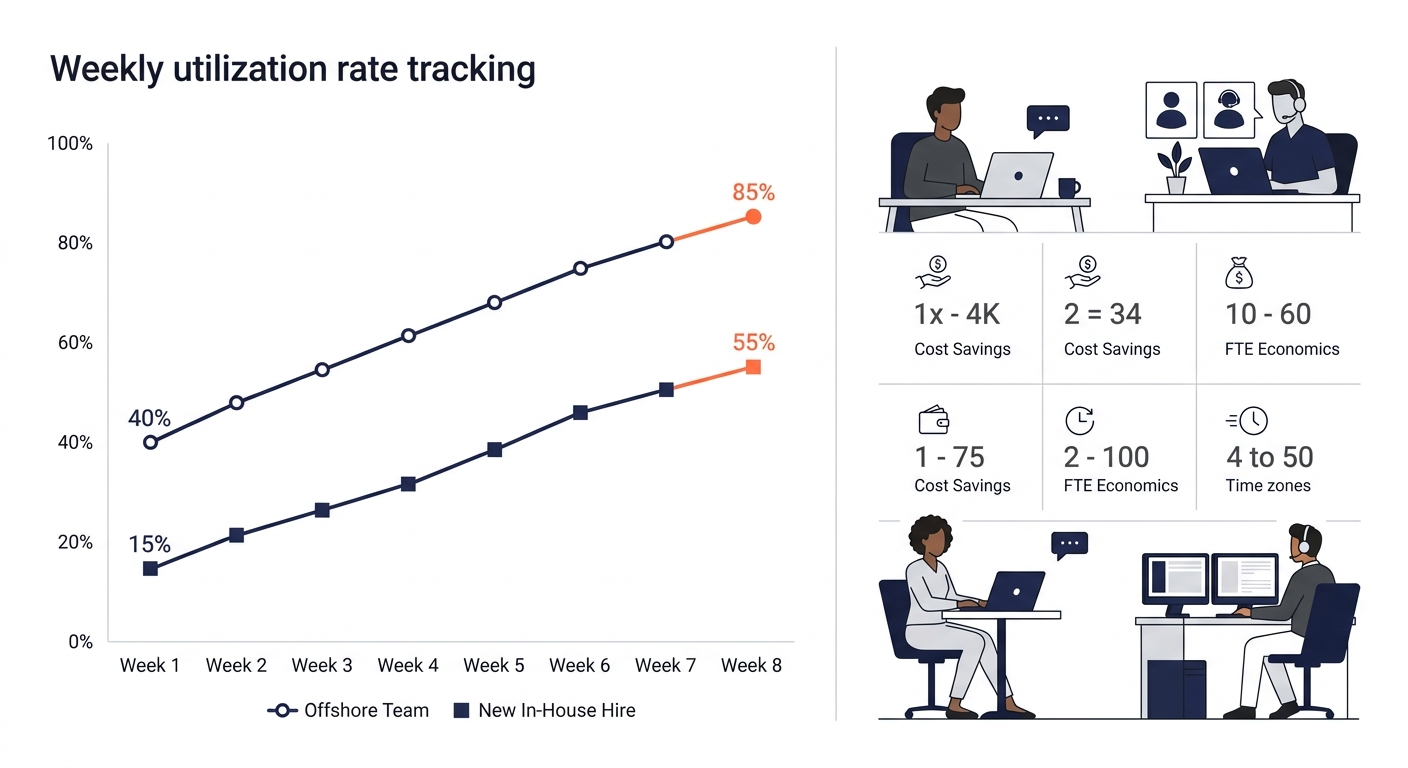
Utilization rate measures how much of a team member’s available time goes to productive work versus meetings, waiting on approvals, searching for assets, or sitting idle because a dependency is blocked. For in-house hires during onboarding, this number is brutal. Weeks of training, orientation lunches, IT setup delays, and “when you get a chance, read through this wiki” assignments push utilization well below 50% for the first month.
Offshore teams measured on utilization from the start tend to hit productive thresholds faster because the measurement itself changes behavior. When your digital marketing team is built for speed, there’s an incentive to remove blockers aggressively, to pre-provision tool access before day one, and to keep meetings short and actionable. Weekly utilization tracking surfaces problems in five days instead of letting them fester for a full quarter.
Tip: Pre-provision every tool, credential, and shared folder before the new hire or team’s first day. Each day spent waiting on IT access is a day of zero utilization that you’re still paying for.
Training ROI research from D2L illustrates how tricky it is to isolate onboarding’s actual impact. In one example, a team measured a 12% improvement in productivity metrics post-training, but 3% of that improvement came from new processes implemented simultaneously. The isolated benefit was 9%, worth approximately $180,000 in increased output. That kind of granularity is only possible when you’re tracking weekly, not waiting for a quarterly business review to notice someone’s underperforming.
Let the first hire onboard the second
When you’re scaling a marketing function with offshore talent, resist the urge to bring on five people at once. Adding team members in batches of one or two every 60 to 90 days lets your first hire become the institutional knowledge carrier for the next one. They’ve already learned your brand quirks, your approval bottlenecks, and your reporting preferences. They can transfer that context far more efficiently than you can, because they learned it recently and remember which parts were confusing.
This self-reinforcing loop reduces your staff training overhead per person over time. The first hire costs the most in management attention. The second costs less. By the fourth or fifth, you have an offshore team that essentially onboards itself, with your involvement limited to strategic direction and quality checks. Agencies that have figured out how to scale operations with offshore teams consistently describe this staggered approach as the single biggest factor in sustainable growth.
And for teams working across content, paid media, and web development simultaneously, the same principle applies. Your content production team builds velocity the same way: each successive team member ramps faster because the context is already alive inside the group, not locked in a documentation folder nobody reads.
When These Rules Break Down
These principles assume you’re outsourcing execution, not strategy. If the role requires deep institutional knowledge, relationships with internal stakeholders across departments, or the authority to set direction rather than follow it, an offshore team won’t close the gap in 90 days or 900. A VP of Marketing who needs to understand your board’s risk tolerance and your CEO’s communication style can’t be replaced by a well-structured offshore engagement.
The rules also weaken when your brand is genuinely unusual. If your voice, audience, or competitive landscape requires months of immersion to understand at a gut level, the offshore speed advantage shrinks. Niche B2B verticals with tiny addressable markets and complex buyer committees fall into this category more often than broad consumer plays.
But for the execution layer, where campaigns need to launch, content needs to ship, ads need optimization, and reports need to go out on schedule, the math is pretty clear. A structured offshore team producing real output by week four will outperform a full-time hire who’s still memorizing your Slack channel conventions. The onboarding trap isn’t that hiring takes too long. The trap is accepting “three to six months to full productivity” as inevitable when it doesn’t have to be.