
TeamSeven, a Pakistan-based offshore development agency, published a practical guide on June 15 addressing New York startups and businesses evaluating offshore software development, according to the company’s blog post. The guide benchmarks a six-month custom software project requiring three developers at $400,000–$750,000 when contracted through a mid-size New York agency, compared to $168,000–$240,000 for equivalent offshore capacity.
TL;DR: A Pakistan-based agency’s June 15 guide for New York startups details cost structures showing $400K–$750K local development expenses versus $168K–$240K offshore, revealing competitive benchmarks for US businesses evaluating offshore alternatives.
The publication provides cost-per-role breakdowns and addresses operational constraints U.S. startups encounter when evaluating offshore development partnerships, particularly time zone coordination and quality assurance for teams operating outside North American hours.
The Cost Structure Breakdown
The guide presents hourly rates for Pakistan-based development capacity: senior full-stack developers at $35–$55/hour, senior mobile developers at $35–$55/hour, QA engineers at $25–$40/hour, and UI/UX designers at $30–$50/hour, according to TeamSeven’s published rates.
For a typical SaaS MVP requiring backend, frontend, and QA engineering capacity, TeamSeven cites a blended team rate of approximately $35–$50/hour. A six-month engagement at 40 hours per week across three developers totals $168,000–$240,000, the guide states.
The cost comparison targets New York specifically, where the guide reports senior full-stack developers command $140,000–$200,000 in annual salary before benefits and overhead. “Add employer taxes, benefits, and overhead, and the fully-loaded cost of a single senior engineer exceeds $250,000 annually,” the guide states. For a startup requiring three engineers, the fully-loaded annual cost reaches $750,000 “before a single line of production code is written.”
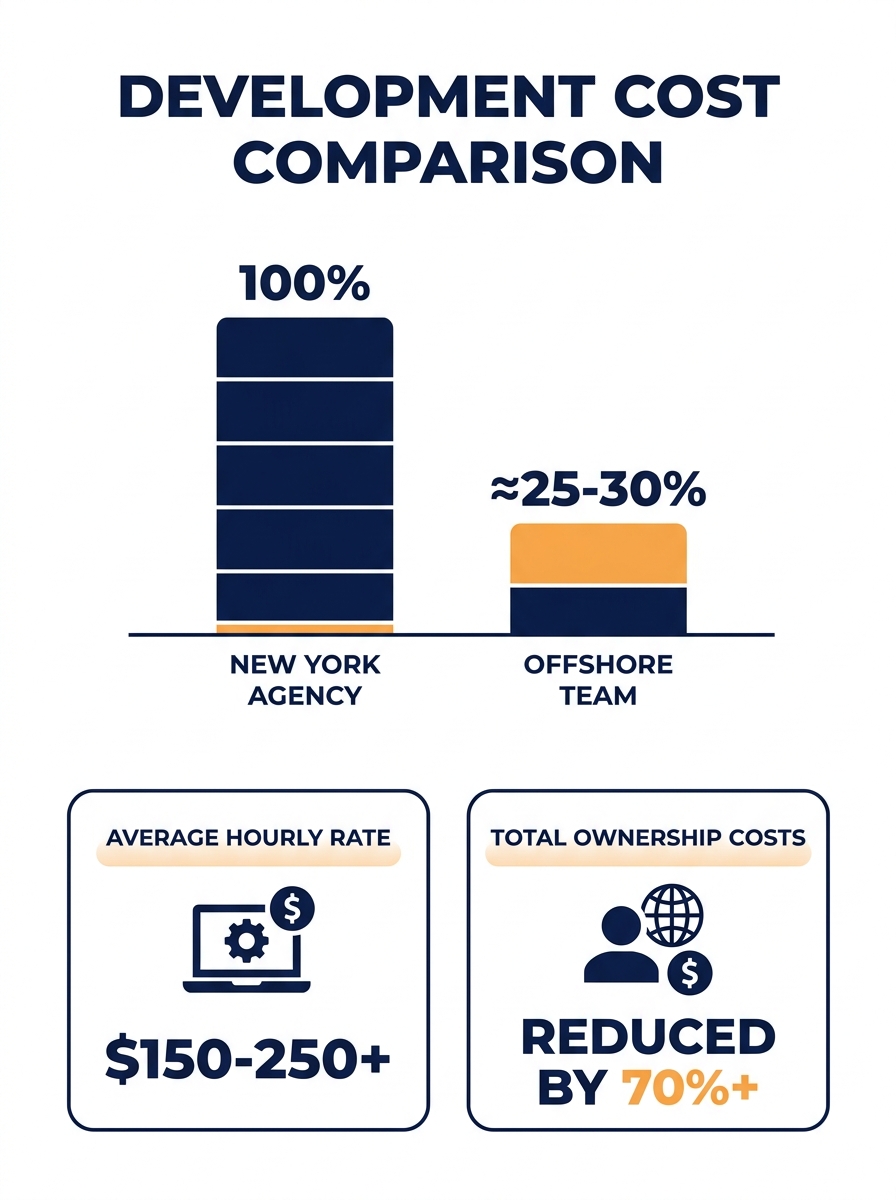
New York software development agencies charge $150–$250/hour for senior developer time, according to the guide’s market assessment. Mid-market agencies deliver six-month custom software projects at the $400,000–$750,000 range.
Time Zone Coordination and Async Protocols
Pakistan operates 9–10 hours ahead of New York EST/EDT, creating zero direct overlap during standard business hours, the guide acknowledges. TeamSeven positions this constraint as manageable through asynchronous communication structures: sprint planning conducted via weekly or biweekly synchronous video calls, daily standups delivered asynchronously as end-of-day progress reports that arrive before the client’s workday begins.
“You wake up to progress reports, questions answered, and completed work ready for review,” the guide states.
For urgent communication, TeamSeven proposes 7 a.m. EST calls corresponding to 4 p.m. Pakistan time as boundary-zone scheduling. The guide emphasizes “front-loaded clarity”, investing in detailed sprint briefs, thorough user stories, and complete design review before development starts, as the discipline that compensates for asynchronous coordination.
“The time zone gap is most painful when requirements are unclear and developers need to ask questions constantly,” according to the guide. Over-communication protocols including Loom video walkthroughs, detailed Slack updates, and maintained project boards reduce dependency on synchronous availability.
The guide claims most New York clients report the time zone becoming “background noise” after the first sprint, with initial sprint cycles establishing the communication rhythm for subsequent development phases.
Engagement Scope Recommendations
The guide categorizes work types by offshore suitability. Well-suited projects include greenfield product development, well-specified feature modules with clear acceptance criteria, backend API development, mobile app work for iOS and Android, QA and testing automation, and long-running engagements with consistent teams.
Less-suited projects include real-time product design and strategy, highly iterative discovery-phase work requiring constant back-and-forth, and projects where technical debt or legacy code require deep context about the original implementation, according to TeamSeven’s assessment.
The guide targets two New York business categories: early-stage startups building initial products without local agency budgets or full-time engineering payroll, and growth-stage companies scaling engineering capacity faster than New York’s 3–4 month senior developer hiring timelines allow. TeamSeven states offshore agencies can deploy dedicated development teams in 2–4 weeks.
The Takeaway
The TeamSeven guide establishes Pakistan as a direct competitor to Philippine offshore development for U.S. startups, at cost structures nearly identical to Philippine web development and digital marketing outsourcing. The $35–$55/hour senior developer rates TeamSeven cites mirror Philippine agency pricing for equivalent roles. The 9–10 hour time difference Pakistan presents to New York clients is steeper than the Philippine 12–13 hour gap to U.S. East Coast, creating a coordination disadvantage for Pakistani providers.
For U.S. and Australian agencies and SMBs evaluating offshore capacity, the guide’s $400K–$750K New York benchmark validates the cost-arbitrage case for offshore development broadly, but the Pakistan positioning highlights that buyers face multiple offshore markets competing on similar economics. Philippine providers retain advantages in English-language proficiency, cultural alignment with Western business practices, and time zone overlap with Australian clients (1–3 hour difference vs Pakistan’s 3.5–5 hour gap).
The guide’s emphasis on asynchronous communication protocols and “front-loaded clarity” applies equally to Philippine offshore engagements. The operational discipline TeamSeven describes, detailed sprint briefs, thorough design review, maintained project boards, represents baseline expectations for any offshore development partnership operating across significant time differences, not competitive differentiation.