
Philippine call center revenue reached $42 billion in 2026 while employing 1.97 million specialists, even as agentic AI systems began autonomously resolving up to 80% of routine tier-one customer interactions, according to industry data reported by Inquirer.net. The industry now faces what executives describe as a structural divide between Fortune 500 enterprises deploying proprietary AI stacks and small-to-mid-sized businesses navigating a three-to-five-year AI maturity gap.
The split creates what John Maczynski, CEO of PITON-Global and former global EVP at the world’s largest call center outsourcing provider, calls a “data moat” problem. Fortune 500 clients achieve 70% cost-of-ownership reductions by grounding AI systems in a decade of structured voice-to-text logs and mapped customer journeys across millions of interactions. SMEs typically operate with fragmented or unstructured data silos, making comparable AI deployment timelines stretch three to five years before systems achieve viability without generating what Maczynski described as “a 25% error rate that destroys customer lifetime value.”
The Philippine BPO sector contributed 8.5% to the country’s GDP in 2026 and holds approximately 16% of the global outsourcing market share, according to the OECD Economic Survey of the Philippines 2026. The Philippines ranked 28th globally and second in Asia in the 2025 EF English Proficiency Index, maintaining “High Proficiency” status with a score of 569 out of 800. Industry projections target $59 billion in revenue and 2.5 million specialists by 2028.
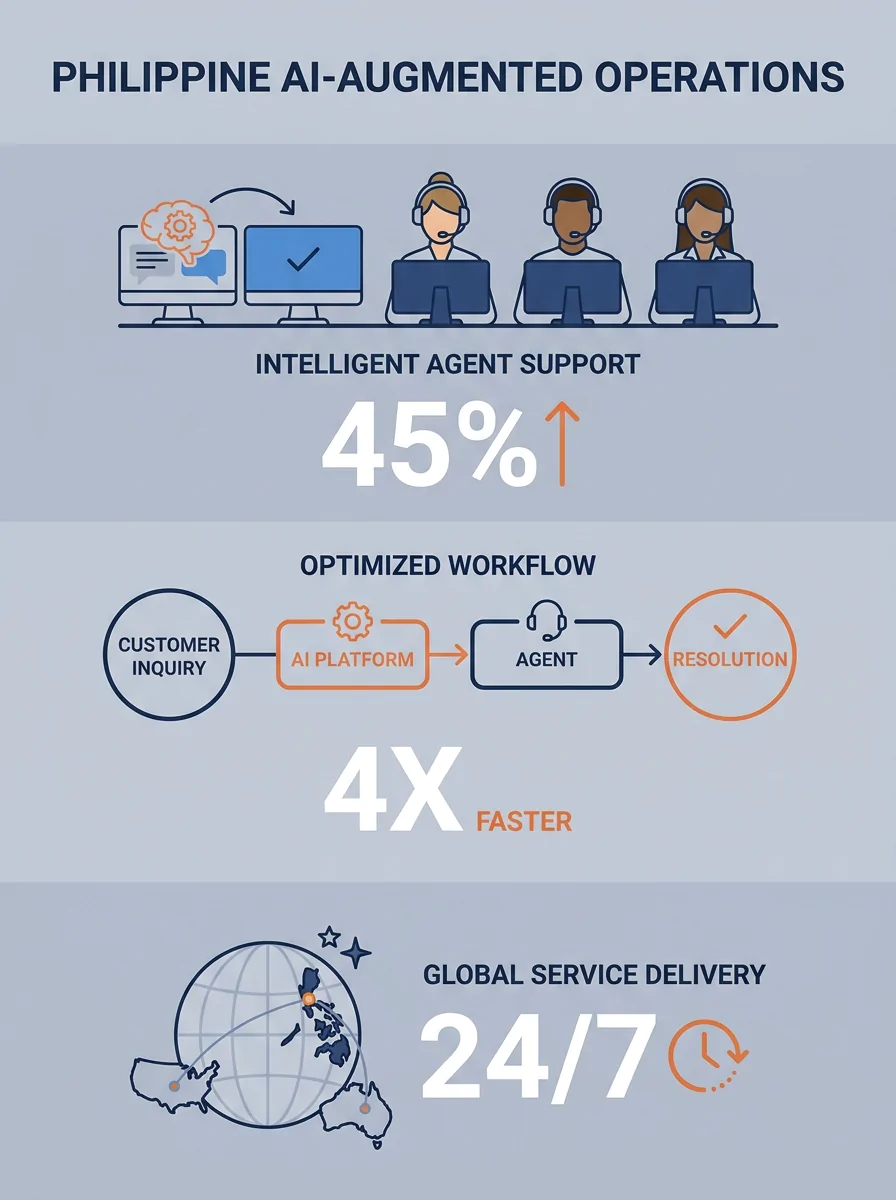
The Intelligence Arbitrage Model Replaces Labor Cost Savings
The evolution from traditional “agent plus script plus CRM” operations to what industry executives call “AI pilot” roles marks what Maczynski termed the most significant strategic shift in the sector’s 25-year history. First-contact resolution rates for AI-augmented Philippine agents now reach 85% to 92%, compared to 65% to 72% for traditional outsourcing operations, the industry data showed.
Labor costs in the Philippines remain 50% to 70% lower than equivalent US, UK, or Australian hires, but the value proposition has shifted from headcount arbitrage to what executives describe as “intelligence arbitrage” — Filipino specialists governing autonomous AI systems rather than executing scripted call flows. Over 700,000 college graduates enter the Philippine job market annually, many specializing in IT, communications, finance, and healthcare.
The CREATE MORE Act passed in 2025, combined with Department of Information and Communications Technology 5G infrastructure investment and PEZA tax incentives, maintains the Philippines as what the report described as “one of the most BPO-friendly regulatory environments on Earth.” The country’s 120 million citizens include over 100 million who speak conversational English, a talent pipeline no competing destination can match over the next decade, according to the industry analysis.
Data Governance Becomes Core Contract Negotiation Point
BPO contract negotiations in 2026 increasingly center on data rights governance rather than service-level agreements, Maczynski said. Enterprise clients with structured historical data can ground AI systems that autonomously handle routine queries while human agents manage complex exceptions. SMEs without that data infrastructure face what the report characterized as being “sold capabilities that don’t yet exist by contact centers still learning how to build them.”
The compliance architecture gap compounds the challenge. Fortune 500 enterprises typically maintain HITRUST certification and established data frameworks. SMEs entering the market require three to five years of data hygiene work before AI systems achieve comparable performance, the industry data indicated.
Agentic AI deployment timelines vary significantly based on client data readiness. Enterprises with decade-long voice-to-text archives and mapped customer journey data across millions of interactions can deploy systems that achieve 80% autonomous resolution rates within six to twelve months. SMEs starting with fragmented data face substantially longer development cycles before systems match that performance threshold.
The shift toward AI-powered outsourcing versus traditional human virtual assistants reflects broader changes in how US and Australian agencies structure their offshore partnerships, particularly around which capabilities remain in-house and which move to Philippine teams equipped with AI tooling.
Agencies Implications
Digital agencies and SMBs evaluating Philippine BPO partnerships in 2026 face a binary choice disguised as a spectrum of vendor options. The data moat separating enterprise-grade AI deployment from SME-accessible capabilities means most sub-$30K monthly accounts cannot access the autonomous resolution rates that Fortune 500 clients achieve. Agencies should audit their own data infrastructure — specifically, whether they have structured historical customer interaction logs spanning multiple years — before evaluating vendor AI claims.
The three-to-five-year timeline for SMEs to build data foundations sufficient for agentic AI deployment suggests a phased approach: begin with AI-augmented human teams (the “AI pilot” model delivering 85-92% first-contact resolution) while simultaneously building the grounding data infrastructure that unlocks full autonomous capabilities. Vendors selling immediate 70% cost reductions through AI to clients without structured historical data are, according to the industry analysis, selling systems that will generate error rates high enough to damage customer lifetime value rather than optimize it.
Contract negotiations should prioritize data rights governance over traditional SLA metrics. The value in 2026 Philippine outsourcing partnerships lies not in headcount cost arbitrage but in accessing teams trained to govern AI systems — a capability that requires vendor transparency about which AI features depend on client data maturity versus which operate on vendor-owned models and datasets.