
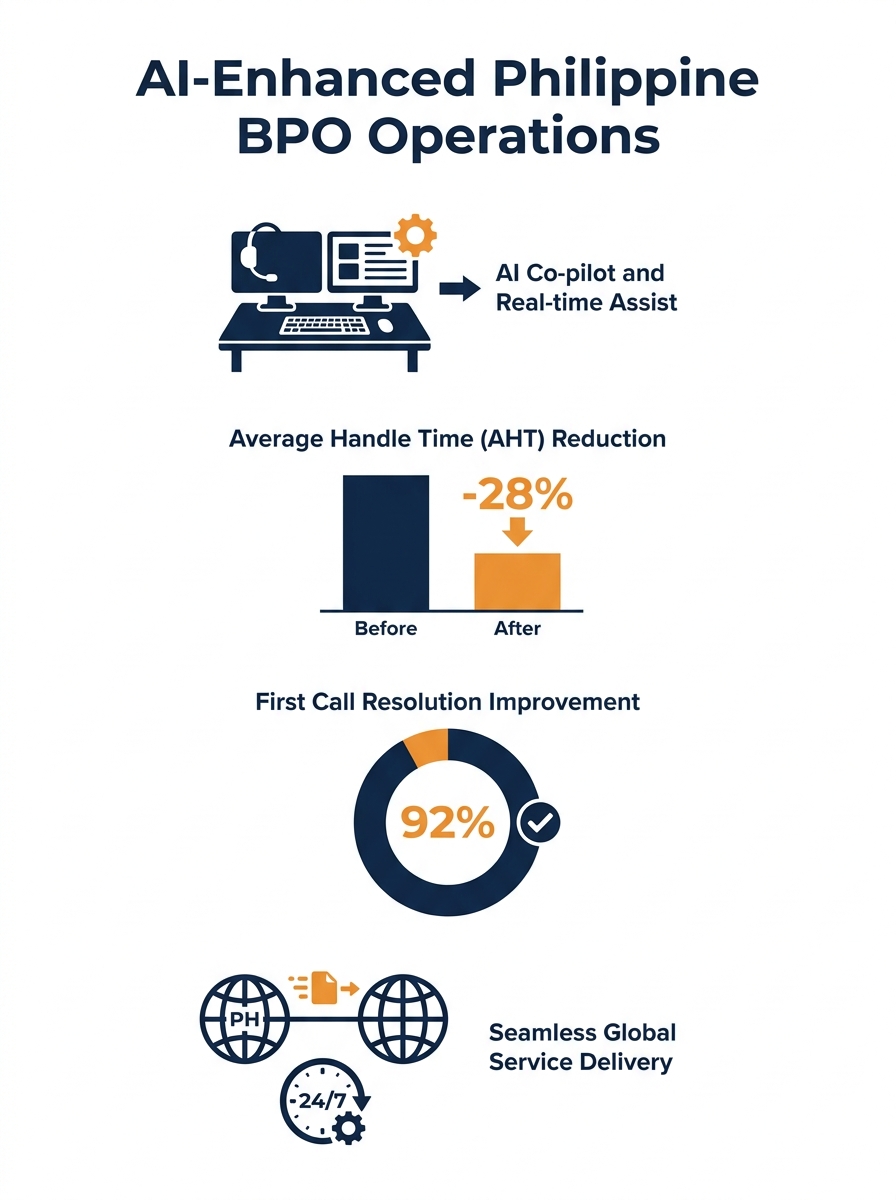
Philippine BPO providers are abandoning hourly billing models in favor of outcome-based pricing, driven by agentic AI deployments that resolve customer interactions in minutes rather than the 18-minute average handle time for human agents, according to BusinessWorld Online.
The pricing shift addresses what industry executives describe as a structural conflict: when vendors bill by the hour, AI-driven efficiency improvements that reduce resolution time directly reduce vendor revenue. Under outcome-based contracts, Philippine call centers charge per resolved ticket, retained subscriber, or verified transaction rather than per seat-hour.
“The billable hour was never a neutral pricing mechanism,” John Maczynski, CEO of PITON-Global and former global EVP at a major contact center outsourcing provider, said in the report. “In 2026, when AI can deliver 10x the throughput per headcount at a fraction of the cost, paying by the hour is not just inefficient — it is a structural guarantee that your vendor will never fully invest in the technology you need them to run.”
Cost Structure Breaks Down
At standard Philippine BPO rates of $12-16 per hour with an 18-minute average handle time, a human customer support representative costs $3.60 to $4.80 per resolved interaction under hourly contracts. The same interaction resolved by an AI agent supervised by a Filipino AI pilot costs $0.50 to $1.50 — a 65% to 88% reduction that clients cannot capture under hourly billing, the report shows.
The arithmetic creates what the report calls an “efficiency paradox”: AI agents that resolve service requests in 120 seconds versus 20 minutes for human agents generate 10x less revenue for vendors billing by time. Outcome-based pricing eliminates the disincentive by tying vendor revenue to resolution volume rather than hours logged.
Legislative Infrastructure Enables Shift
The CREATE MORE Act’s 100% power expense deduction for high-compute AI infrastructure reduces the total cost of running GPU-heavy agentic AI clusters in the Philippines by an estimated 30% to 40% versus equivalent US or European facilities, according to the report. The subsidy funds the compute layer required for autonomous customer service agents, real-time processing, and multi-modal interaction analysis.
GPU workloads that remain prohibitively expensive at Western operating rates become financially viable in Philippine facilities under the legislative framework. The report describes this as an “architectural advantage” rather than a marginal pricing benefit, positioning Philippine operations to offer outcome-based pricing at quality and scale levels that onshore facilities cannot match on cost structure alone.
Case Study: 180-Day Transition
A global e-commerce platform paying $14 per hour for Philippine call center support restructured its outsourcing contract from per-FTE hourly billing to outcome-based pricing through PITON-Global, according to a case study included in the report. The platform processed 1.2 million monthly contacts, with 67% classified as tier-1 queries suitable for agentic AI resolution.
The transition followed a phased structure: hybrid hourly and performance billing in months one and two, per-resolution billing from month three, and a value-share arrangement from month six. At the 180-day mark, tier-1 resolution rates improved while the platform captured cost reductions previously absorbed by the vendor under hourly billing, the report shows.
The model applies to operations where resolution volume is measurable and AI can handle a significant percentage of incoming contacts without human intervention. For roles requiring judgment, relationship management, or complex problem-solving — such as a virtual executive assistant handling C-suite scheduling and stakeholder coordination — hourly or monthly retainer structures remain standard.
Vendor Incentives Realign
Under outcome-based contracts, vendors gain revenue by increasing resolution throughput rather than extending handle time or maintaining staffing levels above operational requirements. The model requires vendors to invest in AI infrastructure and training for Filipino AI pilots who supervise autonomous agent fleets.
One Filipino AI pilot can govern up to 10 autonomous agents simultaneously in production environments, the report notes. The supervisor role shifts from handling customer interactions directly to monitoring agent performance, escalating edge cases, and refining AI behavior based on outcome data.
The pricing shift mirrors broader changes in the Philippine call centers sector as agentic AI splits the industry into firms investing in autonomous systems versus those maintaining traditional labor arbitrage models. Firms that delayed AI deployment while billing hourly now face clients demanding outcome-based contracts that expose productivity gaps the hourly model previously concealed.
Agencies Implications
For US and Australian SMBs and digital agencies evaluating Philippine BPO partnerships in 2026, the shift to outcome-based pricing creates a concrete negotiating point and a vendor capability filter. If a prospective call center partner insists on hourly billing for high-volume, repeatable support work — tier-1 customer service, order processing, basic technical troubleshooting — the pricing model itself signals underinvestment in AI infrastructure. The client pays for that underinvestment every month through inflated per-resolution costs that outcome-based contracts would expose.
Agencies managing support operations for ecommerce clients or SaaS platforms should request outcome-based pricing proposals alongside traditional hourly quotes. The gap between the two structures — often 60% to 80% on a per-resolution basis — reveals whether the vendor is running production-grade agentic AI or positioning manual labor with AI window dressing. For operations processing thousands of monthly interactions, that gap translates to $5,000 to $15,000 in monthly savings at typical SMB volumes.
The outcome-based model does not apply universally. For specialized roles requiring judgment and relationship continuity — campaign strategists, account managers, a law firm virtual assistant managing complex case coordination — monthly retainers or hourly billing remain appropriate. But for repeatable, measurable workflows where AI can resolve 60% to 80% of volume, outcome-based pricing shifts financial risk from client to vendor and aligns incentives around efficiency rather than seat occupancy. Agencies that avoid common outsourcing mistakes typically anchor vendor selection on pricing model alignment before evaluating individual proposals.