
Salary comparisons between Philippine and US digital marketing teams miss the largest variable in the outsourcing cost comparison: output velocity per dollar spent. A three-person Philippine marketing pod costs $9,600–$21,600 annually while a single US in-house marketer runs $69,000–$115,000 in base salary before benefits, tools, or ramp-up waste enter the equation.
TL;DR: The true cost of hiring a US in-house marketing team exceeds $200,000 annually when you add benefits, software, and ramp-up. A Philippine team covering the same scope runs $8,000–$20,500 loaded. But digital marketing ROI depends on output velocity per dollar, not the cost gap alone—communication overhead and rework can flatten returns if you don’t structure the engagement around deliverables.
The Salary Line Item Everyone Gets Right
A mid-level digital marketing specialist in the US earns between $69,000 and $115,000 per year depending on metro area and channel specialty. The Philippine equivalent, with comparable platform certifications and campaign experience, earns $3,200–$7,200 annually. Every outsourcing provider’s sales page leads with this comparison, and the numbers hold up. Penbrothers reports that companies save roughly 65% on digital marketing costs when moving execution roles offshore.
The problem is that salary is the only line item where the math is simple. Everything after this gets muddier, and it’s where most outsourcing cost comparison exercises fall apart.
Loaded Cost: Where the US Number Doubles
When you hire a US marketer at $90,000 base, you’re also paying employer-side FICA (7.65%), health insurance ($7,000–$14,000 per employee annually for employer contributions), 401(k) matching (typically 3–6% of salary), PTO accrual, workers’ comp insurance, and office overhead or remote stipends. According to Blue Sparq Marketing’s analysis, maintaining an in-house marketing team runs over $200,000 annually when you factor in salaries, benefits, and software costs.
The loaded cost multiplier for a US knowledge worker typically lands between 1.25x and 1.4x base salary. So your $90,000 marketer actually costs $112,500–$126,000 before they touch a single ad account.
Philippine providers bundle differently. Offshore teams dramatically reduce overhead because providers package most expenses into a single monthly rate—office space, hardware, internet, statutory benefits (SSS, PhilHealth, Pag-IBIG), and 13th-month pay are folded into the billing. Your loaded cost for a Philippine digital marketer sits between $5,500 and $12,000 annually, all-in.
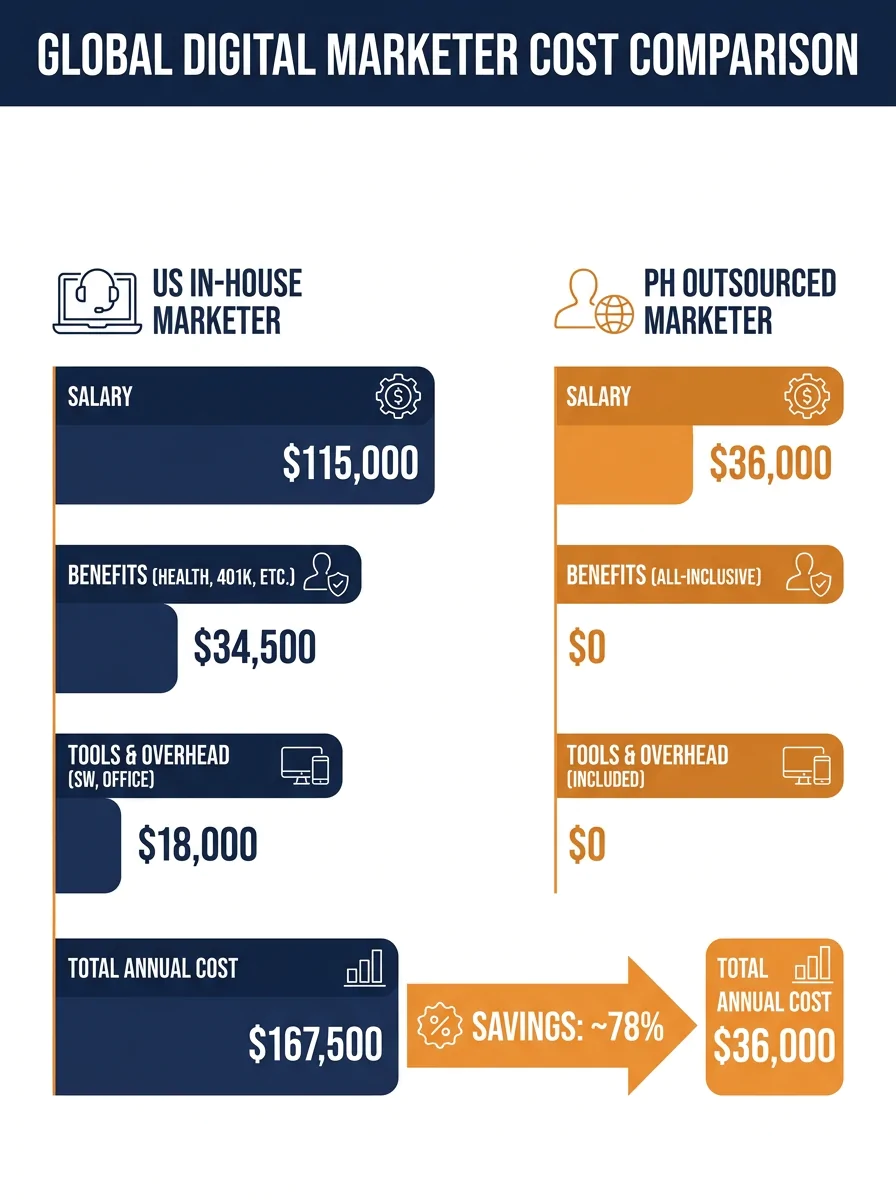
| Cost Component | US In-House (Annual) | Philippine Outsourced (Annual) |
|---|---|---|
| Base salary | $69,000–$115,000 | $3,200–$7,200 |
| Benefits & taxes | $18,000–$32,000 | Bundled by provider |
| Software & tools | $6,000–$14,400 | $1,200–$3,600 (shared licenses) |
| Office/equipment | $4,000–$8,000 | Bundled by provider |
| Ramp-up waste (first 90 days) | $4,000–$8,000 in ad spend | $1,000–$2,500 |
| Total loaded cost | $101,000–$177,400 | $8,000–$20,500 |
The Tooling Tax
Digital marketing runs on paid software. SEMrush or Ahrefs costs $130–$450 per month. A Google Ads management platform adds $100–$300. Email platforms, social scheduling tools, analytics suites, landing page builders, heatmapping software—the stack adds up to $6,000–$14,400 per year per marketer.
Philippine teams often share enterprise licenses across the pod, which drops your per-seat cost. More importantly, experienced offshore teams already know the tools. You’re not paying for someone to learn Screaming Frog during their first month. If you’re thinking about which marketing services to delegate first, the tool-heavy execution tasks (technical SEO audits, PPC bid management, reporting automation) deliver the fastest arbitrage because the tooling cost differential compounds on top of the salary gap.
Ramp-Up Waste and the Learning Curve
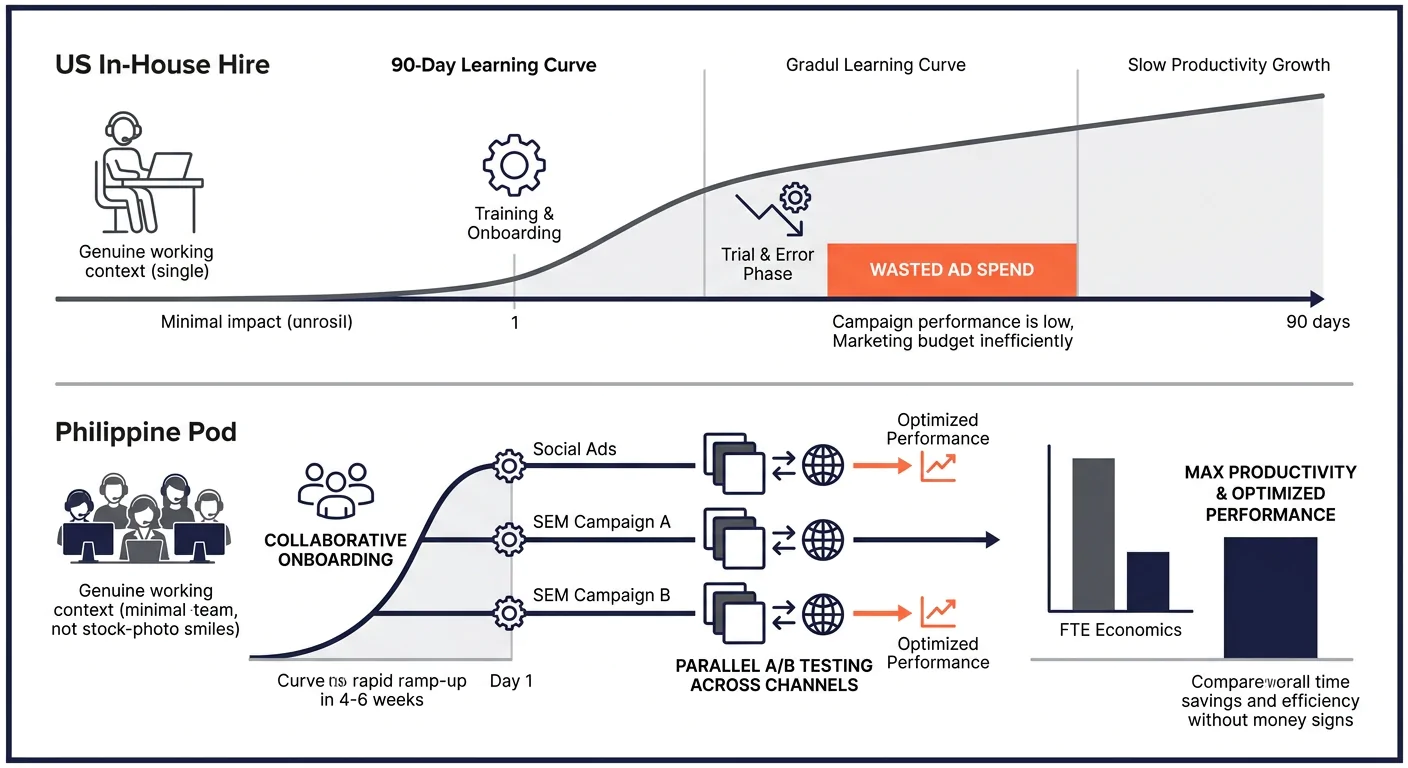
This is the cost line that almost never appears in Philippines outsourcing economics spreadsheets. When you hire a US digital marketer, they spend their first 60–90 days learning your brand voice, your audience segments, your existing campaign structure, and your reporting cadence. During that window, they’re making sub-optimal decisions on live ad budgets.
Experienced Philippine teams working in pod structures compress this ramp-up to 4–6 weeks through rapid A/B testing and established onboarding frameworks. The difference matters in dollar terms: a US hire managing $10,000/month in ad spend during a three-month learning curve can burn $4,000–$8,000 in wasted budget through poor targeting, wrong bid strategies, and creative misalignment. An offshore pod with a structured onboarding playbook—ideally one built around written procedures rather than tribal knowledge—cuts that waste because you’re getting three specialists instead of one generalist feeling their way through unfamiliar channels.
Output Velocity: The Variable That Determines Digital Marketing ROI
Why does the savings percentage vary so wildly from one company to the next? Because the cost gap is predictable while the productivity gap is not. As Programming Insider’s ROI comparison for offshore vs. in-house teams points out, ROI can flatten if communication overhead or rework increases. The key variable is the velocity of output per dollar spent.
I’d frame this as the Output-Per-Dollar Velocity Model, and it has three components:
- Deliverable throughput — how many campaign iterations, content pieces, or optimizations a team ships per week
- Rework rate — what percentage of deliverables need revision before they go live
- Decision latency — how long it takes for a deliverable to move from draft to approved
A three-person Philippine pod (one SEO specialist, one paid media manager, one content marketer) typically produces 2–3x the deliverable volume of a single US generalist at 15–25% of the loaded cost. But if your approval process takes five days because of timezone gaps, and 40% of deliverables need rework because the brief was unclear, that throughput advantage evaporates.
ROI flattens when communication overhead or rework increases. The key variable is the velocity of output per dollar spent.
Companies that succeed with Philippine digital marketing outsourcing invest heavily in async communication infrastructure. The OECD’s 2026 economic survey of the Philippines notes that average annual labor productivity growth has held around 2% since 2011, with the BPO sector consistently outperforming that national average. Philippine marketing teams working for US clients have been operating in cross-timezone environments for over a decade. The habits and infrastructure exist. The bottleneck is almost always on the client side.
Companies that keep strategy decisions in-house while offshoring execution tend to see the highest output velocity because the decision-making authority stays in one timezone while the production capacity scales offshore. The Philippines’ BPO sector operates at 40% greater cost-effectiveness than onshore alternatives according to ZipDo’s industry analysis, but that 40% figure only materializes when the workflow structure supports it.
The Continuity Risk Nobody Prices In
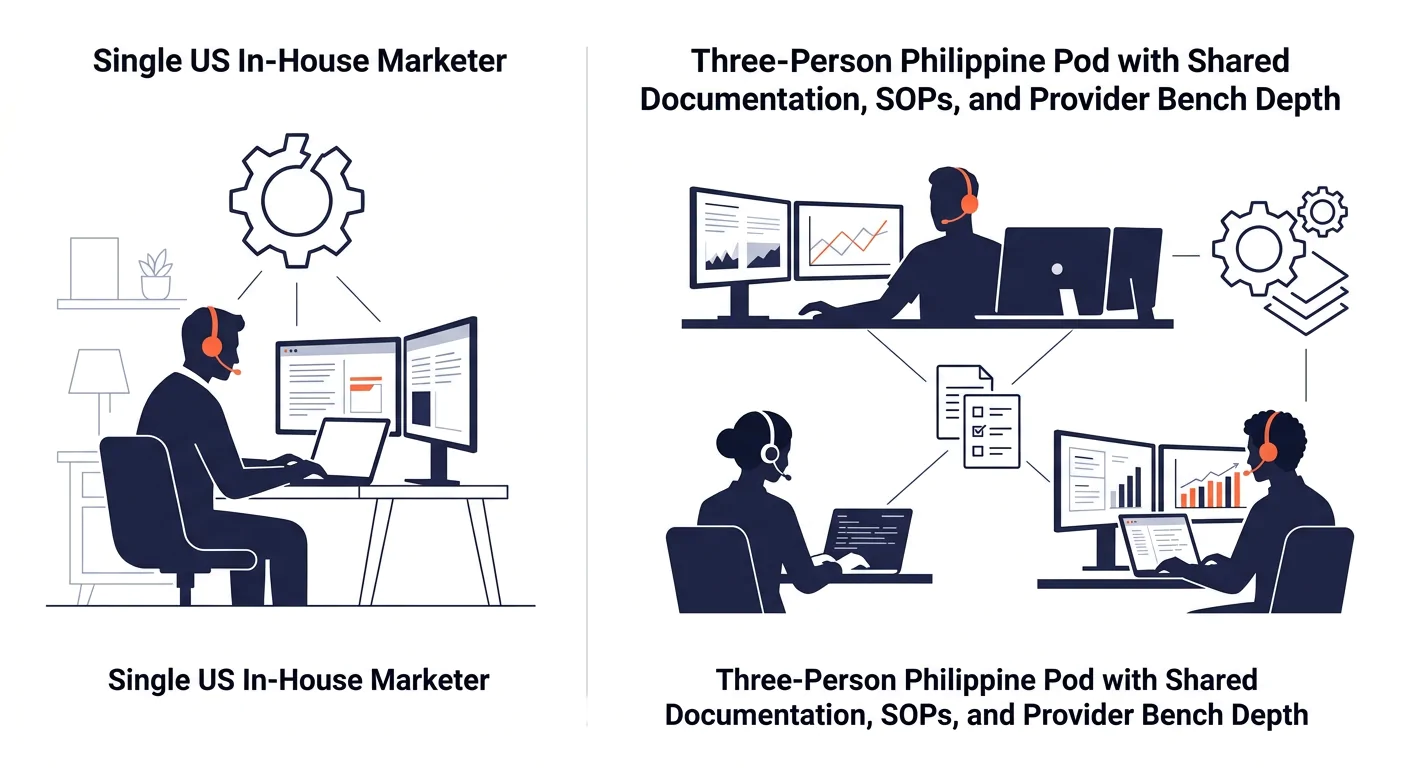
One underappreciated factor in the offshore vs. in-house calculation is what e-commerce consultants call the “Bus Factor.” If your entire digital marketing operation lives in the head of one internal hire, and that person leaves, you’re starting from zero. US marketing roles carry a median tenure of about 2.5 years, and replacing a departed marketer costs 50–200% of their annual salary in recruiting fees, onboarding time, and lost momentum.
Philippine teams structured as pods carry lower continuity risk because knowledge is distributed across multiple people and documented in shared SOPs. The provider maintains bench depth. When one team member transitions out, the remaining pod members keep campaigns running while the replacement ramps up. You lose a week of velocity, not a quarter.
This connects to how you manage other outsourced functions, too. Teams running outsourced IT services alongside marketing pods benefit from standardized documentation practices that reduce single-point-of-failure risk across departments. And if your marketing team depends on outsourced WordPress development for landing pages and site updates, having both functions with Philippine providers creates workflow efficiencies that a split US/offshore model doesn’t deliver.
Where the Model Breaks
The 50–70% savings and 2–3x ROI figures are real, but they come with conditions that plenty of companies ignore until the engagement is already struggling.
High-context brand work suffers offshore. If your marketing depends on deep cultural fluency with US regional markets—think local real estate, healthcare marketing with regulatory nuance, or hyper-local restaurant chains—a Philippine team will need significantly more guidance and review cycles. The cost savings narrow as oversight hours climb.
Founder-led brands with undefined processes burn through providers. When there’s no documented brand guide, no campaign brief template, no approval workflow, and every decision requires a Slack thread with the CEO, no amount of cost arbitrage makes the engagement work. The AI-augmented strategy-execution split that Philippine teams increasingly operate under assumes the strategy side has something concrete to hand off.
Compliance-heavy industries add real overhead. Financial services, healthcare, and anything touching EU consumer data require additional training, access controls, and audit procedures. These costs are manageable—and we’ve covered how Philippine teams navigate GDPR and privacy regulations—but they add 10–20% to the base engagement cost and shouldn’t be ignored during planning.
Warning: If your marketing operation has no documented processes, brand guidelines, or approval workflows, outsourcing will amplify the chaos rather than reduce costs. Fix the process gap before you offshore the work.
The digital marketing ROI equation for Philippine outsourcing resolves to something like this: take the loaded cost differential (typically 5–8x), subtract communication overhead (10–25% of the savings), subtract rework caused by poor briefing (0–30% depending on your process maturity), and subtract compliance costs if applicable. For a well-organized US SMB or agency, the net result lands between 2x and 3x ROI on marketing spend compared to a fully in-house team. For a company with no processes and unclear expectations, the result is an expensive lesson in why cost arbitrage alone doesn’t build a marketing function. The mechanism works, but only when the inputs are clean.