
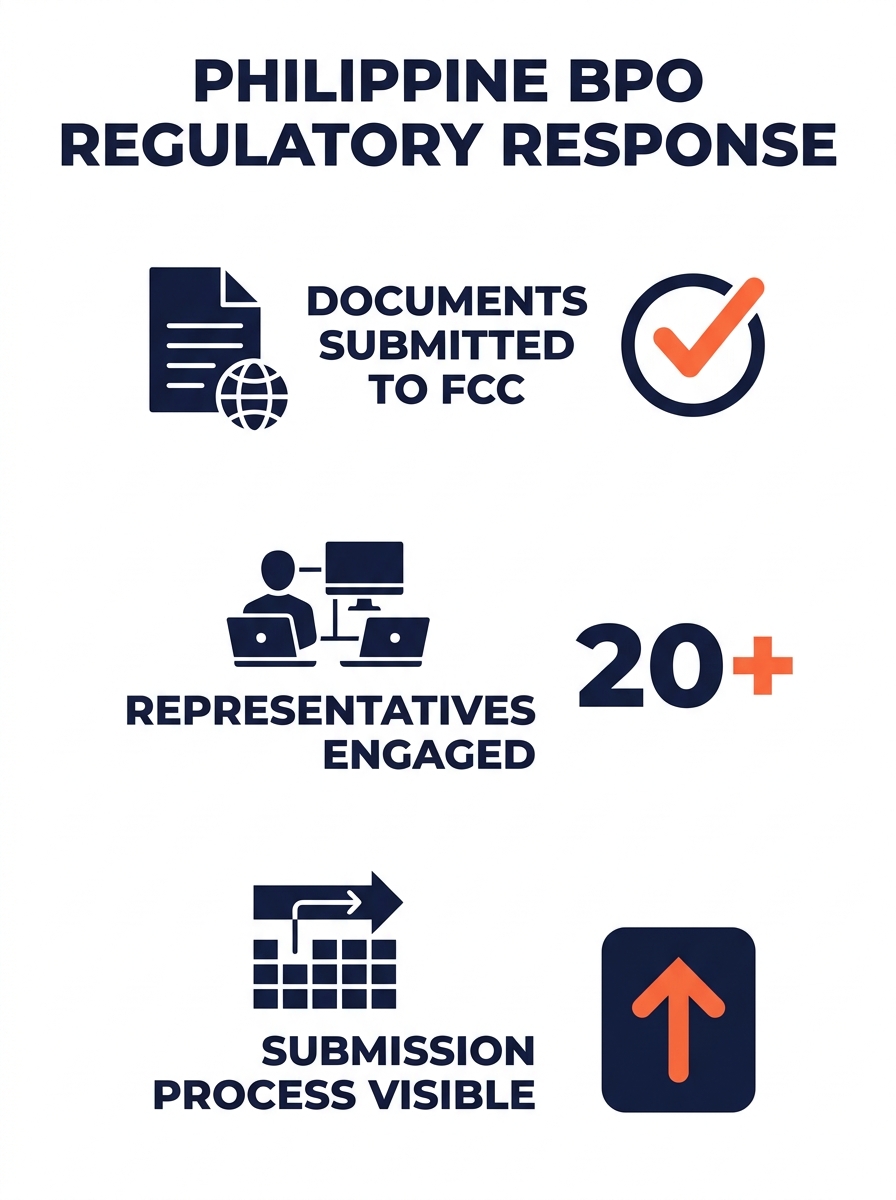
Philippine government agencies and industry groups submitted formal objections to US Federal Communications Commission proposals that would restrict overseas customer-service outsourcing, defending a sector that generated $40 billion in 2025 revenue and employs millions, according to a June 27 Manila Bulletin report.
TL;DR: The Board of Investments, Department of Information and Communications Technology, Philippine Economic Zone Authority, and industry associations argued to the FCC that training, technology, and management—not geographic location—determine customer service quality, warning forced onshoring could raise costs for American consumers.
The joint submission challenges the FCC’s core assumption that call center location drives fraud risk and service quality. The IT and Business Process Association of the Philippines, American Chamber of Commerce of the Philippines, and US-ASEAN Business Council presented evidence that Philippine firms already operate under contractual obligations, internationally recognized security standards, and strict performance metrics that meet or exceed US regulatory requirements.
FCC Proposals Target Consumer Protection, Data Security
The FCC proposals aim to strengthen consumer protection against fraud, improve customer service standards, and safeguard sensitive information in outsourced operations. The commission has not publicly specified whether the rules would mandate disclosure of call center locations, impose licensing requirements on offshore providers, or create penalties for companies using overseas customer-service teams.
Philippine IT-BPM firms serving American clients currently comply with contractual obligations on data privacy and cybersecurity while meeting regulatory requirements imposed by US clients. The industry already operates under Philippine data privacy laws and international security certifications, the submission noted.
Industry Groups Warn of Cost Pass-Through to US Consumers
Forcing companies to shift call center operations back to the United States could raise operating costs that would be passed on to American consumers through higher prices or reduced service availability, the industry groups argued in their FCC submission. Offshore operations provide round-the-clock customer support, manage demand surges, and maintain global competitiveness for US companies that depend on outsourced IT services and customer-facing teams.
The Philippine IT-BPM sector ranks as the country’s top source of dollar earnings after overseas Filipino worker remittances. Last year’s $40 billion revenue figure represents growth across metro Manila and provincial growth centers where the industry has expanded beyond traditional hubs.
Government Response Emphasizes Compliance Record
The Board of Investments, Department of Information and Communications Technology, and Philippine Economic Zone Authority coordinated the government response. The agencies presented operational evidence showing decades of regulatory compliance and mutual benefit for Philippine and American businesses, rather than requesting special treatment.
The submission emphasized that Philippine firms meet data privacy standards, maintain cybersecurity protocols, and track performance metrics that US clients impose. The industry groups challenged the geographic assumption underlying the FCC proposals, arguing that training quality, technology infrastructure, management systems, and accountability frameworks determine service outcomes regardless of location.
Context and Outlook
US regulatory pressure on offshore outsourcing represents a structural risk for the 1.3 million-employee Philippine BPO sector and the US and Australian SMBs that depend on it for cost-effective scaling. The FCC proposals surface amid broader protectionist pressure in American labor markets, though the commission has framed its concerns around consumer protection rather than domestic job preservation. For agencies and ecommerce operators running on $3,000–$30,000 monthly budgets, compliance frameworks that Philippine outsourced teams navigate already include GDPR, ICO, and US state privacy laws—regulatory complexity that mirrors the data-handling requirements the FCC proposes to address.
The Philippine government’s emphasis on innovation, security standards, and workforce upskilling signals recognition that labor-cost advantages alone won’t sustain the sector’s competitive position. Technology margins are already reshaping BPO revenue models, with AI capabilities and automation playing larger roles in how offshore teams deliver value. The outcome of the FCC review will test whether operational evidence and compliance records outweigh political pressure to reshore customer-facing work—a precedent that extends beyond call centers to the full spectrum of digital marketing, web development, and virtual assistant services that Philippine teams provide to Western clients.
Whether the FCC adopts location-based restrictions or accepts performance-based compliance frameworks will determine whether SMBs face higher offshore vendor costs, reduced service availability, or business-as-usual access to Philippine teams that have anchored their operational scaling strategies since the sector’s growth began two decades ago.