
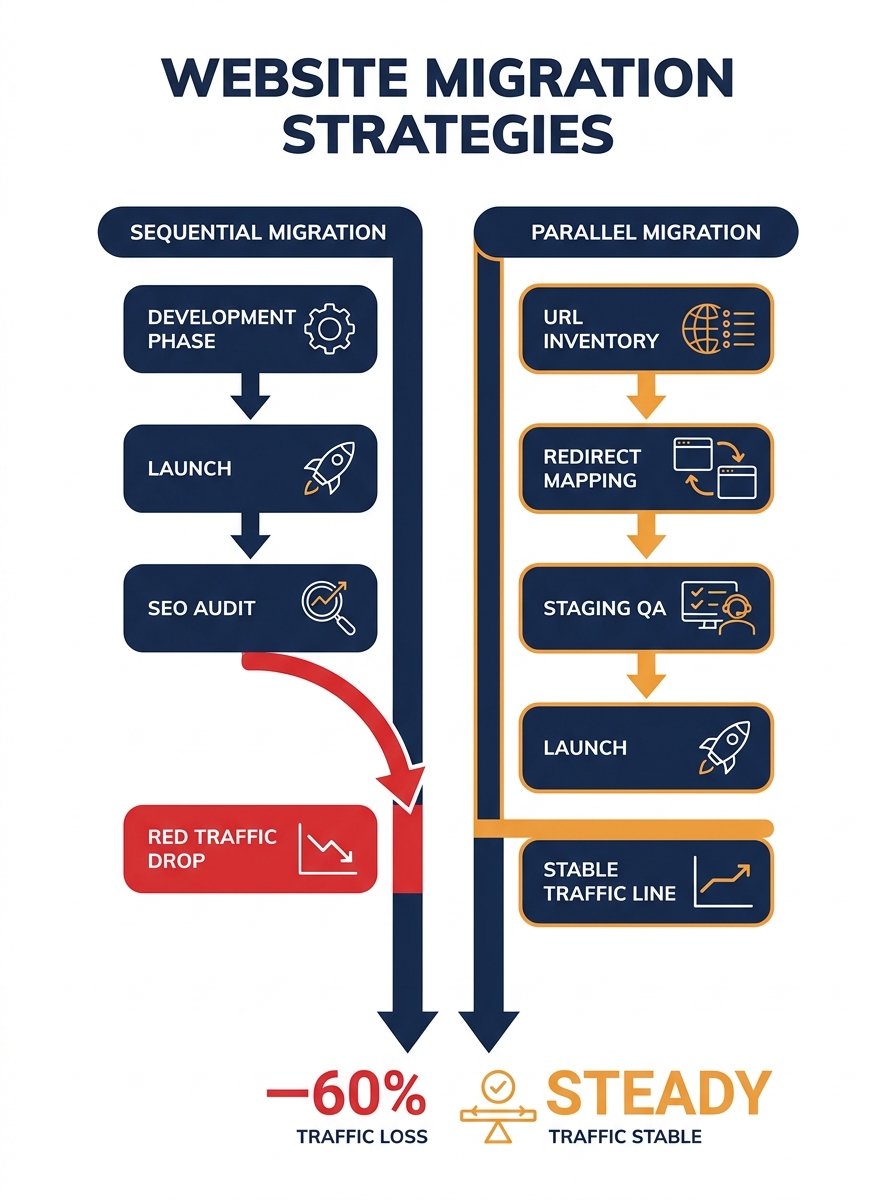
Platform migrations destroy organic traffic when development and SEO teams work sequentially — redesign first, fix rankings later. Philippine SEO teams that execute migrations without significant traffic loss run both workstreams in parallel, with redirect mapping, content triage, and technical validation happening inside the development sprint cycle, not after launch.
TL;DR: Traffic loss during platform migrations is a coordination failure, not a technical inevitability. The mechanism that prevents it is parallel execution: SEO audit, redirect mapping, and content triage embedded directly in the dev timeline, with a 90-day post-launch monitoring window to catch regression.
The Coordination Problem That Causes 90% of Migration Failures
Nine out of ten website migrations damage SEO, according to a 2026 analysis by Numen Technology. The cause is almost always the same: the development team ships a redesigned site, then the SEO team scrambles to fix broken URLs, missing metadata, and lost internal links after the fact. By the time Google re-crawls the new architecture, weeks of ranking damage have already accumulated.
The mechanism that prevents this looks deceptively simple. SEO practitioners join the project at sprint zero — the same week wireframes and information architecture decisions begin. Every URL change, every template modification, every content restructure gets flagged in a shared redirect and content map that both developers and SEO specialists maintain simultaneously. When Philippine development and SEO coordination works, it works because the SEO team isn’t a downstream reviewer. They’re embedded in the build process.
This model maps closely to how offshore project management at scale functions: initial analysis and architecture decisions happen collaboratively, then execution distributes across the team. The larger the migration, the more critical the coordination layer between onsite stakeholders and the offshore execution team.
Building the URL Inventory Before Anything Moves
The first component of the mechanism is a full crawl inventory of the existing site. Philippine SEO teams use tools like Screaming Frog and Semrush Site Audit to crawl every indexed URL — including orphaned pages, legacy landing pages, and URLs not visible in the main navigation. According to Semrush’s migration checklist, teams should also pull twelve months of Google Search Console data to establish performance baselines for organic traffic, conversion rates, and engagement metrics.
Why twelve months? Because seasonality hides inside shorter windows. A page that looks low-traffic in a three-month sample may drive 40% of its annual conversions during a specific quarter. Cutting or redirecting that page without the full picture creates invisible damage you won’t notice for months.
The output of this audit is a master spreadsheet — every URL paired with its organic traffic, backlink count, target keywords, and SERP rankings. Each URL gets a priority tier:
- Tier 1 — pages with significant organic traffic, strong backlink profiles, or conversion value. These URLs don’t change unless absolutely required. As one 2026 redesign guide puts it: “Identify URLs that rank well for a specific keyword, log them, and don’t update unless absolutely required.”
- Tier 2 — pages with moderate traffic or some backlinks. These get one-to-one 301 redirects if the URL structure changes.
- Tier 3 — thin content under 300 words with no traffic, duplicate pages, discontinued product pages, and anything with zero sessions in twelve months. These are candidates for consolidation, removal, or redirect to a relevant parent page.
This three-tier priority model is where platform migration SEO either holds or collapses. Teams that treat every URL equally waste redirect budgets on pages that don’t matter and miss the 50 pages that drive 80% of organic revenue.
If you’re weighing the economics of building this audit capability internally versus deciding when outsourcing makes more financial sense, the calculus often tips toward an experienced offshore SEO team for migrations specifically — it’s a high-skill, temporary spike in workload that doesn’t justify a permanent hire.
The Three-Tier Redirect Map
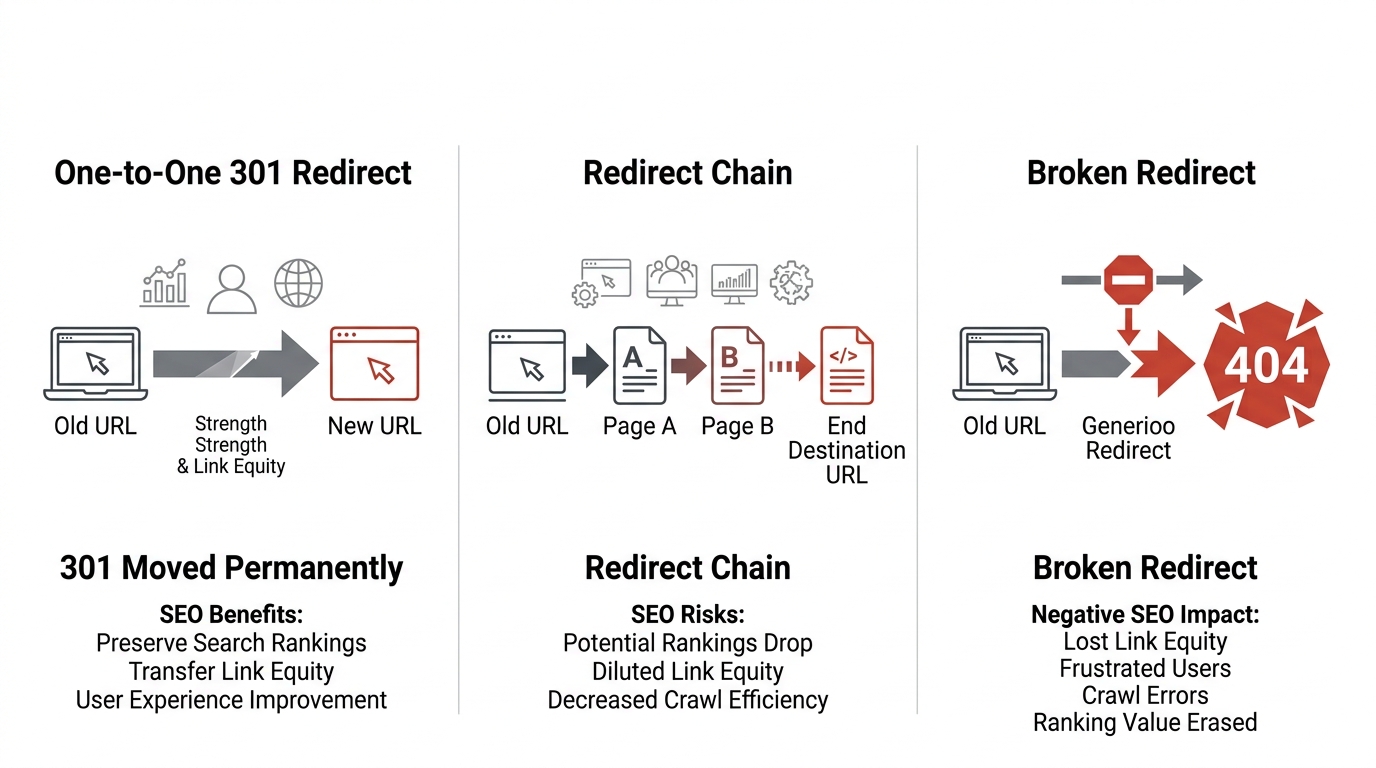
Google passes approximately 98–99% of PageRank through 301 redirects, but only when the redirect destination is semantically relevant and the redirect stays in place long enough for Google to process it. Removing redirects after a month of apparent stability — a common mistake — can trigger delayed traffic losses because search engines continue processing URL changes over several months.
The redirect map is a living document, not a one-time deliverable. Philippine SEO teams working on website redesign traffic retention typically build it in a shared Google Sheet or Airtable base with columns for old URL, new URL, redirect type, priority tier, backlink count, and validation status. Developers pull from this map directly when configuring server-level redirects or WordPress plugins like Redirection and All-in-One SEO.
For migrations at scale — sites with 5,000+ URLs — the map also tracks redirect chains. If Page A redirects to Page B, and the redesign moves Page B to Page C, you now have a chain (A → B → C) that dilutes link equity and slows crawl processing. The SEO team’s job is to flatten every chain to a single hop: A → C and B → C.
Warning: Redirect chains are the silent killer of migration SEO. Each additional hop bleeds PageRank and adds crawl latency. Audit for chains weekly during the build phase, not once at launch.
Teams managing WordPress-to-WordPress migrations or WordPress-to-custom-stack moves often find that outsourced WordPress development paired with a dedicated SEO specialist cuts the redirect validation time in half, because the developer understands the CMS’s URL generation rules natively.
Content Triage Before the First Line of Code Ships
The Search Engine Land redesign checklist frames this step as: “Inventory all existing content and identify high-performing pages to keep, re-optimize, merge, remove, or redirect.” That’s the right idea, but the execution detail matters.
Content triage during a migration serves two functions. It prevents link equity from evaporating into 404 pages. And it creates the opportunity to consolidate thin, overlapping content into stronger pages — something that actually improves post-migration rankings. Sites that migrate 1:1, preserving every piece of low-quality content, often see worse results than sites that thoughtfully consolidate.
Philippine SEO teams handling this work create a content and keyword map: every page URL, its target keyword, the SERP intent it serves (informational, transactional, navigational), and the action (keep, merge, redirect, remove). Pages tagged for merging get combined into a single stronger piece, with the lower-performing URL 301-redirecting to the surviving page.
This is also where offshore technical SEO execution earns its cost back. A senior in-house marketer can make the keep/merge/remove decisions in a few hours. But executing the merge — rewriting content, updating internal links, setting up redirects, validating metadata — takes 40–60 hours for a mid-size site. That’s work Philippine content and SEO teams handle at a fraction of the cost of a US-based agency.
Why QA and SEO Must Share the Staging Environment
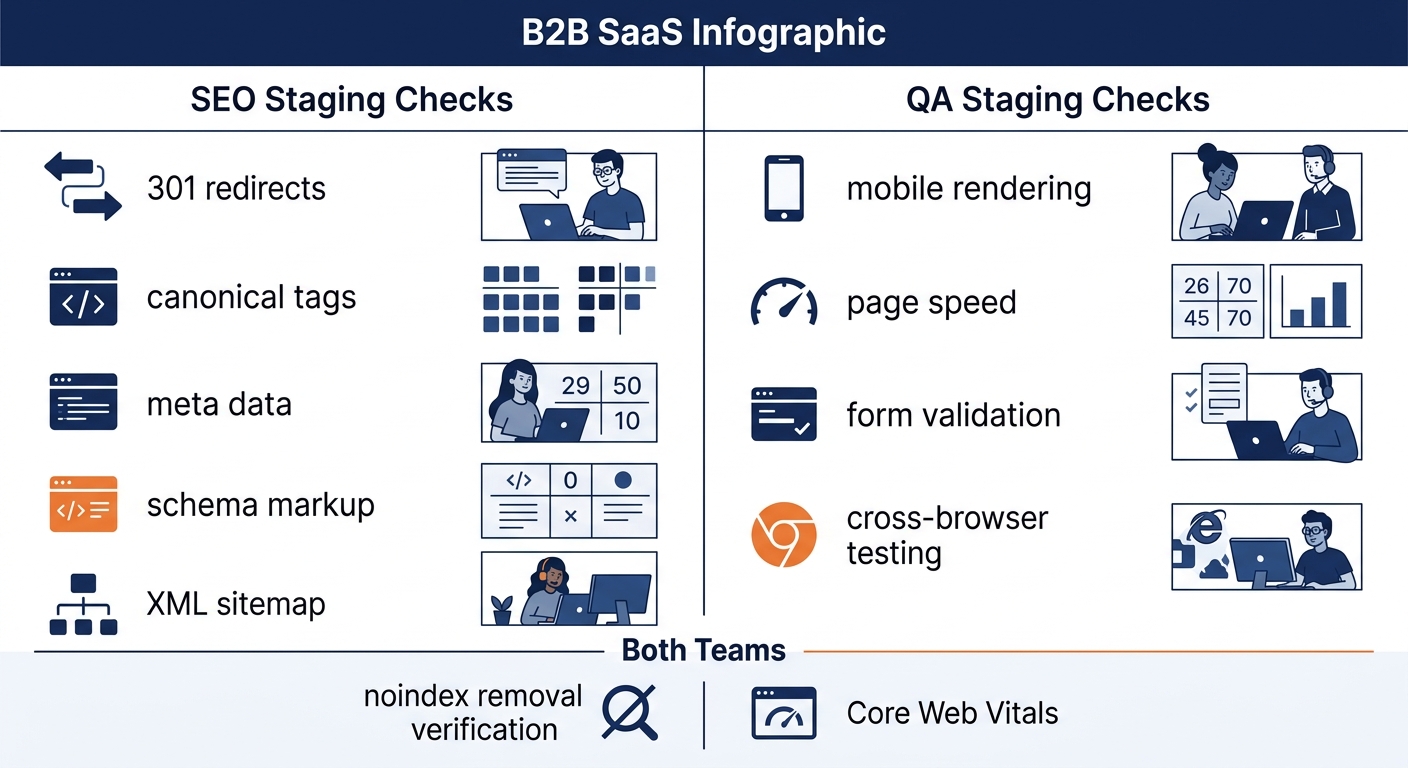
Staging validation is where the mechanism either proves itself or silently fails. The staging site is a pre-launch copy of the redesigned site, and both QA engineers and SEO specialists need access simultaneously — not sequentially.
The SEO team validates on staging: every 301 redirect fires correctly, canonical tags point to the right URLs, meta titles and descriptions survived the template change, structured data (schema markup) renders in Google’s Rich Results Test, robots.txt isn’t blocking critical directories, and the XML sitemap reflects the new URL structure.
The QA team validates on staging: cross-browser rendering, form submissions, checkout flows, load times, and mobile responsiveness. With 62.5% of global web traffic coming from mobile devices, Core Web Vitals regressions introduced by heavy JavaScript frameworks or unoptimized images can wipe out ranking gains even when every redirect is perfect.
A redirect map with 100% accuracy still loses traffic if the redesigned pages load two seconds slower on mobile.
This is where outsourced QA testing and SEO review overlap. An offshore QA team that also understands performance metrics can catch the speed regressions that pure-functionality testing misses. The most common staging mistake? Launching with a noindex meta tag still in place from the staging environment configuration — an error that tells Google to drop every page from its index.
The 90-Day Post-Launch Monitoring Window
Launching the redesigned site is the midpoint of the migration, not the end. Philippine SEO teams tracking website redesign traffic retention treat the 90 days after launch as a structured monitoring phase with distinct checkpoints.
Week 1 requires daily checks in Google Search Console. The team watches for crawl errors, new 404 pages, indexing anomalies, and redirect failures. Any 404 on a Tier 1 page gets fixed within 24–48 hours. Filipino teams working US or Australian hours typically schedule these checks at the start of their shift (8 AM Manila / 8 PM EST), giving the US-side stakeholders a morning status report in their inbox.
Weeks 2–4 shift to weekly reviews. Some ranking volatility during this period is normal — Google is re-crawling and reassessing the new site architecture. The team compares current traffic to the pre-migration baseline, flagging any page that’s dropped more than 20% from its historical average.
Months 2–3 are where the picture stabilizes. Traffic should land within 85–95% of pre-migration levels and be trending upward. Sites that followed a structured migration process averaging a 19% traffic increase over six months, according to data compiled by Numen Technology. Wise, the financial services company formerly known as Transferwise, saw organic visits drop from over 32 million to 13 million monthly after its migration — but recovered and eventually grew to over 205 million visits with sustained post-migration optimization.
That recovery timeline illustrates an important point: short-term dips are normal even with perfect execution. The mechanism’s job is to make those dips shallow and recoverable, not to eliminate them entirely.
Where the Model Breaks
This parallel-execution model has real limits. It breaks down in three predictable scenarios.
Scope changes mid-migration. If the redesign scope expands after the redirect map and content triage are complete — new sections added, URL patterns changed, navigation restructured — the SEO workstream has to restart portions of its audit. Philippine teams that define project scope tightly upfront avoid this, but client-side scope creep remains the single most common cause of migration SEO failure.
Platform changes that alter rendering. Moving from a server-rendered CMS like WordPress to a JavaScript-heavy framework like Next.js or a single-page application changes how Google crawls and indexes content. The redirect map can be perfect, but if Googlebot can’t render the new pages due to client-side rendering issues, rankings drop anyway. This specific failure mode requires a developer who understands both the framework and Google’s rendering pipeline — a skill set that’s increasingly common in Philippine dev shops but still uncommon in generalist agencies.
No post-launch budget. Some clients treat launch day as the project’s finish line. They cancel the offshore SEO engagement, stop monitoring Search Console, and only notice traffic loss when revenue drops 60 days later. The 90-day monitoring window isn’t optional overhead. It’s the mechanism’s error-correction loop. Without it, even a well-executed migration can silently degrade as Google encounters edge cases the pre-launch audit missed.
The teams that execute platform migration SEO reliably treat the migration as a 120-day engagement: 30 days of pre-launch audit and mapping, plus 90 days of post-launch monitoring and correction. Anything shorter is cutting the mechanism off before it can self-correct, and that’s where the traffic loss everyone fears actually comes from.