
Google Ads accounts with monthly budgets between $3,000 and $15,000 sit in an awkward middle ground. Too small for a US agency to give real attention, too complex for a marketing generalist to run well between their other twelve responsibilities. This is the budget range where outsourced paid search specialists in the Philippines consistently produce better digital marketing ROI than a single in-house hire, and the gap compounds month over month because of how PPC campaign optimization actually works in practice.
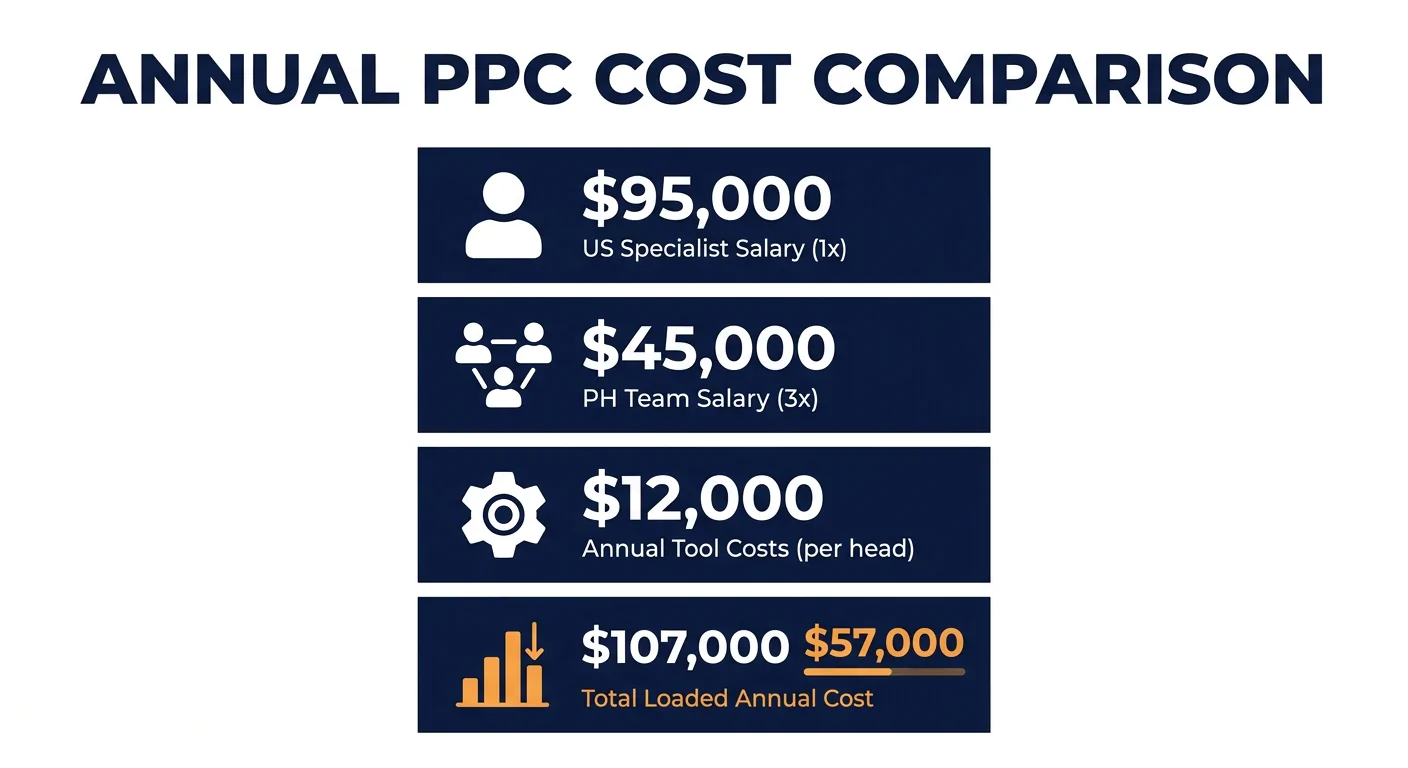
A mid-level US PPC specialist costs $69,000 to $115,000 annually with benefits, plus another $6,000 to $14,400 for platform tools. A fully loaded Philippine specialist costs $9,600 to $21,600 per year. For the price of one domestic hire, you deploy a three-person team that splits responsibilities across strategy, copy testing, and landing page work. But the cost difference alone doesn’t explain the performance difference. The rules below do. They come from watching what separates accounts that hit 200–300% ROAS from the ones burning cash at 1.5:1 returns.
Split strategy from execution before anything else
You own the business knowledge. You know which leads convert to revenue, which product lines have margin, and which geographies matter. Your outsourced team owns platform execution, testing velocity, and bid management. Mixing these two functions inside one person’s head is where most small-business PPC efforts go sideways.
The separation sounds obvious, but it’s the single most skipped step. When a business owner or marketing director also manages the Google Ads account, strategic decisions (which campaigns to fund, which audiences to pursue) get contaminated by tactical noise (this keyword’s Quality Score dropped, that ad group needs new copy). The result is reactive management where every session in the platform becomes firefighting instead of building.
Philippine PPC agencies that perform well enforce this split structurally. You provide a brief on business goals, margins, and customer profiles. They translate that into campaign architecture, keyword strategy, and testing plans. As we’ve written about in the context of keeping strategy in-house while outsourcing execution, this hybrid model works because each side plays to its actual strengths. When strategy and execution blur together, both suffer.
Staff three roles, not one generalist
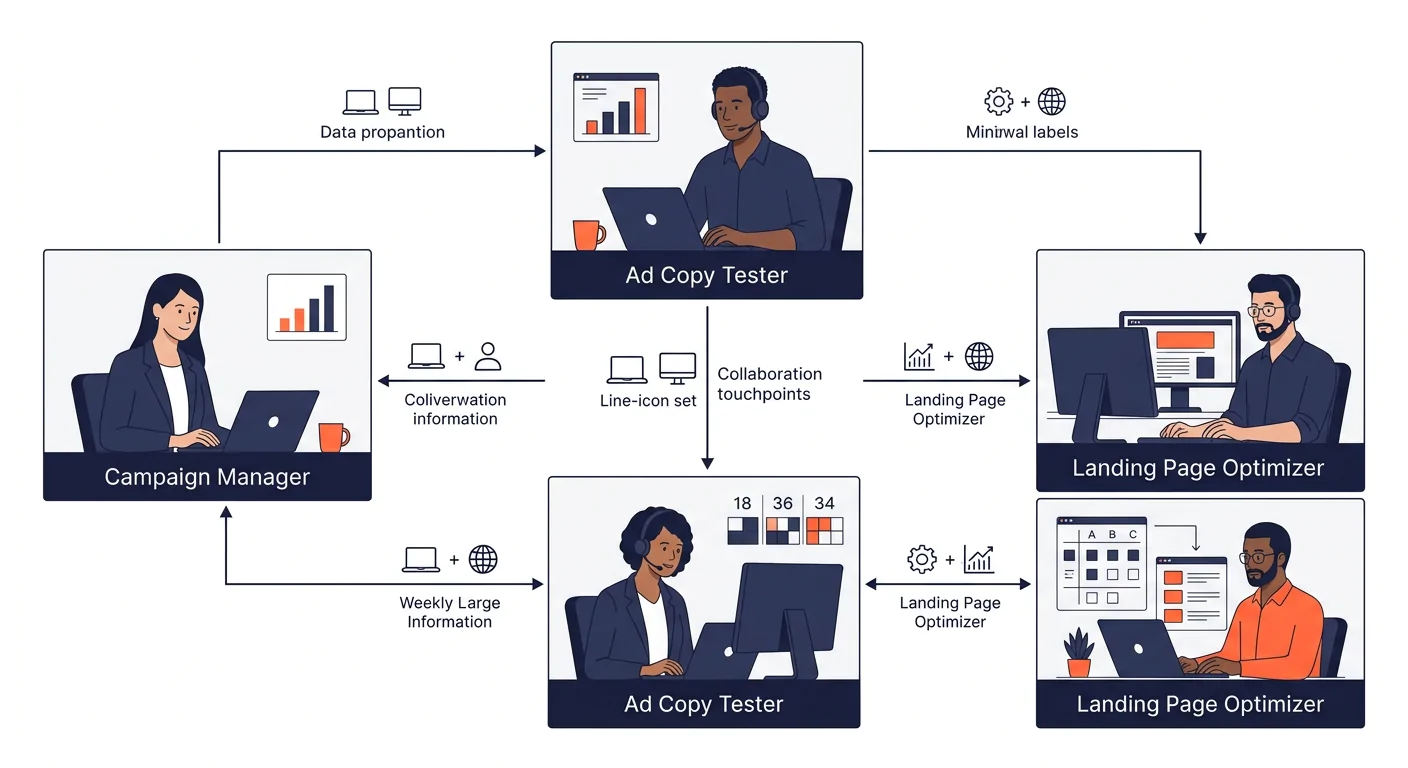
Small and mid-sized businesses often hire a single generalist who spends 8 to 12 hours per week on PPC. That person is also running email campaigns, updating the website, maybe managing social. Contrast that with a dedicated Philippine team investing 40+ collective hours weekly across three distinct functions: campaign management, ad copy and creative testing, and landing page optimization.
The math on testing velocity is stark. An experienced three-person team can run two to three A/B tests per week across ad copy, landing pages, and bidding strategies. A solo in-house marketer typically manages one per week, and often less when other priorities crowd in. This speed difference means offshore teams reach optimal campaign settings in four to six weeks versus three to four months for in-house generalists. According to DesignRush’s outsourced PPC strategy guide, outsourcing PPC is generally more advantageous than doing it in-house precisely because of this structural capacity gap.
Three people also means three sets of eyes catching problems. A negative keyword that one person misses gets flagged by another during review. Pattern recognition accelerates when you have specialists who’ve collectively worked across 200+ accounts rather than one person learning everything from scratch on your single account.
Run tests faster than your competitor adjusts
Speed is a structural advantage in paid search, and it’s one area where Philippine PPC agencies consistently outperform in-house setups. Every week you delay an A/B test is a week you’re paying for underperforming ads. If you’re spending $5,000 per month on ad budget and your ads convert at 2% instead of the 4% that proper testing would reveal, you’re leaving roughly half your potential conversions on the table.
The ramp-up period matters enormously here. According to benchmarking data, if a new in-house hire takes three months to reach baseline competence while managing $5,000 per month in ad spend, the performance gap can result in $4,000 to $8,000 in wasted budget. Experienced offshore teams avoid that waste because they’ve already seen the patterns. They know which ad copy structures work for service businesses versus e-commerce. They know which bidding strategies to start with for accounts that have thin conversion data. We broke down the actual ROI math on first campaigns in a previous analysis, and the numbers are consistent: outsourcing can reduce costs by 60-70% compared to Western markets, and the savings compound with the performance gap during ramp-up.
Your competitors are running tests too. The team that iterates fastest wins the auction economics.
Demand weekly search term reviews, not monthly reports
Monthly reporting is where PPC accounts go to die slowly. By the time you see a monthly report showing that 30% of your budget went to irrelevant search terms, you’ve already spent that money. Negative keyword refinement needs to happen weekly, ideally within a 15 to 20 minute check-in where your team walks through the actual search queries triggering your ads.
The best operating rhythm looks like this: weekly check-ins for search term reviews and negative keywords, monthly audits of two to three hours covering audience targeting and ad creative testing, and quarterly strategic reviews of four to six hours where you reassess campaign structure against business goals. Philippine teams that manage multiple clients institutionalize this rhythm because they’ve learned the hard way that accounts without weekly hygiene bleed money quietly.
Negative keyword refinement needs to happen weekly. Monthly reporting is where PPC accounts go to die slowly.
This is also where the time-zone overlap question comes up. Philippine teams working US business hours can push search term updates and bid adjustments while your ads are actively running, rather than making changes overnight and hoping the next day’s data validates them. As we’ve covered regarding offshore team speed advantages in digital marketing, the ability to iterate during peak traffic hours produces measurably better outcomes than batch-processing changes.
Treat landing pages as campaign assets, not dev tickets
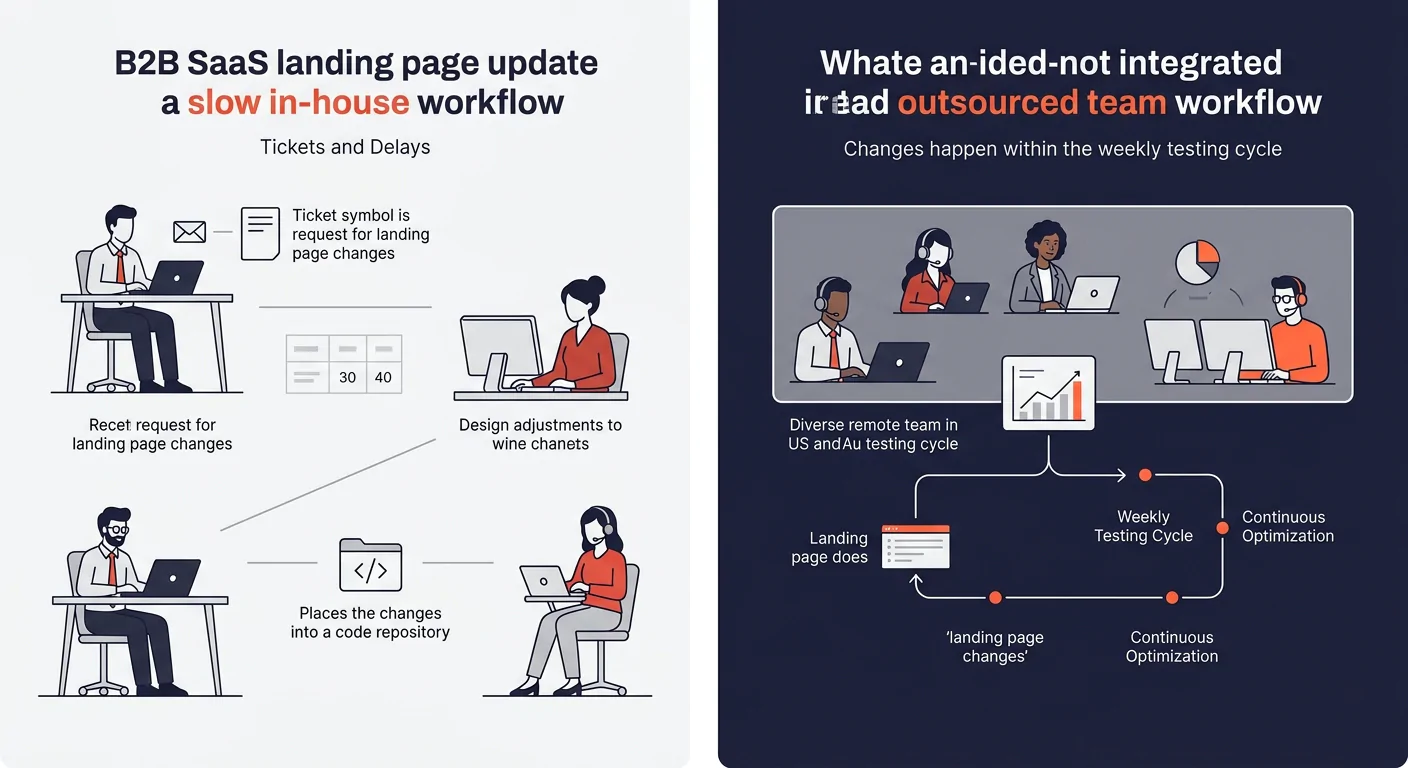
Here’s where in-house setups break down most visibly. Your in-house PPC person identifies that a landing page needs a different headline, a stronger CTA, or a faster load time. They submit a ticket to the dev team. That ticket sits in a backlog for two weeks. Meanwhile, Google’s Quality Score algorithm has already penalized the landing page relevance signal, driving up your cost per click.
Dedicated offshore teams integrate conversion rate optimization into their standard workflows. Landing page changes aren’t tickets that wait in queue. They’re part of the weekly testing cycle. Reports from Philippine PPC agencies on Clutch consistently cite this integration as a differentiator: clients see improved lead generation because copy, ads, and landing pages move together rather than in separate workflows with different priorities.
Optimized landing pages can double conversion rates and cut cost per acquisition in half. That’s the kind of improvement that makes every other optimization downstream more effective, because a campaign pointing at a high-converting page gets better data faster, which feeds better bidding decisions, which lowers costs further.
Never let automated bidding run unsupervised
Google’s automated bidding strategies (Target CPA, Maximize Conversions, Target ROAS) can outperform manual bidding when you have sufficient conversion data, generally 15 to 30 conversions per month. But automation multiplies whatever you feed it. Good campaign structure, clean conversion tracking, and proper audience segmentation produce great automated results. Sloppy inputs produce expensive automated mistakes.
As iVirtual’s analysis of in-house versus outsourced PPC puts it, accessing the latest strategies and maintaining a relentless focus on measurable ROI is where specialist agencies consistently yield better results. The human judgment layer matters because automated bidding can’t tell you that your lead quality dropped even though volume went up. It can’t flag that a competitor started bidding aggressively on your brand terms and you should respond with a brand campaign rather than letting Smart Bidding chase those clicks at inflated prices.
Philippine teams provide that supervision layer at a cost that makes it viable for smaller budgets. A $5,000 per month ad spend account can’t justify a $90,000 per year US specialist to watch the algorithms. But a $1,200 per month specialist in the Philippines who’s managing your account alongside nine others? That math works, and the oversight prevents the kind of runaway spend that unsupervised automation produces.
Warning: Automated bidding without human oversight is one of the fastest ways to burn through ad budget. Always pair automation with weekly manual review of search terms, lead quality, and bid adjustments.
When These Rules Break Down
These rules assume your monthly ad spend is between $3,000 and $25,000, you’re running search and display campaigns on Google and Bing, and your business has enough transaction volume to generate meaningful conversion data. If you fall outside those parameters, adjust accordingly.
If your spend exceeds $50,000 per month, you likely need a hybrid model with both a senior in-house strategist and an outsourced execution team. At that scale, the strategic decisions carry enough financial weight that you want someone in your building who lives inside your P&L.
If your spend is under $2,000 per month, even outsourced management may not be cost-effective. The management fee as a percentage of spend gets too high to justify, and you might be better served by a one-time campaign setup with quarterly optimization reviews rather than ongoing management.
And if you’re in a highly regulated industry (healthcare, finance, legal), your outsourced team needs specific compliance training. The savings from outsourcing digital marketing to the Philippines remain real, but you’ll need to invest more upfront in compliance documentation and review workflows. Skip that step and the regulatory risk eats the cost savings.
The core principle behind all seven rules stays the same regardless of scale: PPC campaign optimization rewards specialization, speed, and disciplined weekly attention. The question is whether you build that capacity internally at US labor rates or access it through a Philippine team at a fraction of the cost. For the vast majority of SMBs spending $3,000 to $15,000 per month on paid search, the outsourced model produces better results faster, and the performance data across hundreds of accounts backs that up.