
Content production bottlenecks live in the approval loop, the asset handoff, the brand-voice drift that accumulates between draft three and draft seven when a team pushes forty blog posts a week across six client accounts. The writing itself takes hours. The coordination around it takes days. Agencies and SMBs that frame this as a “quality versus velocity” problem are usually diagnosing the wrong thing entirely. The real constraint is process architecture, and that’s exactly where offshore creative teams in the Philippines have built a structural advantage that’s difficult to replicate with domestic freelance networks or AI-only pipelines.
The argument that you can scale content velocity only by sacrificing editorial standards comes from teams that never separated the two variables in the first place. When your writer is also your proofreader, your SEO analyst, and your project manager, quality and speed are obviously at odds. They share the same person’s calendar. But when you break content production into discrete roles with clearly defined handoff points, the trade-off dissolves. You can run faster because different people handle different stages in parallel, and each stage has its own quality gate. Philippine content teams that serve U.S. and Australian agencies have been operating this way for years, and the economics make it possible at price points domestic markets can’t touch.
Why the Binary Keeps Getting Repeated
The quality-versus-velocity framing persists because most agencies experience content scaling as a staffing problem. They hire one senior writer at $65–$85 per hour, load that person with strategic and executional responsibilities, and watch output plateau at twelve to fifteen polished pieces per month. Increasing speed means lowering standards, because one person can only work so many hours. This is a real constraint, but it’s a constraint of the staffing model, not of content production itself.
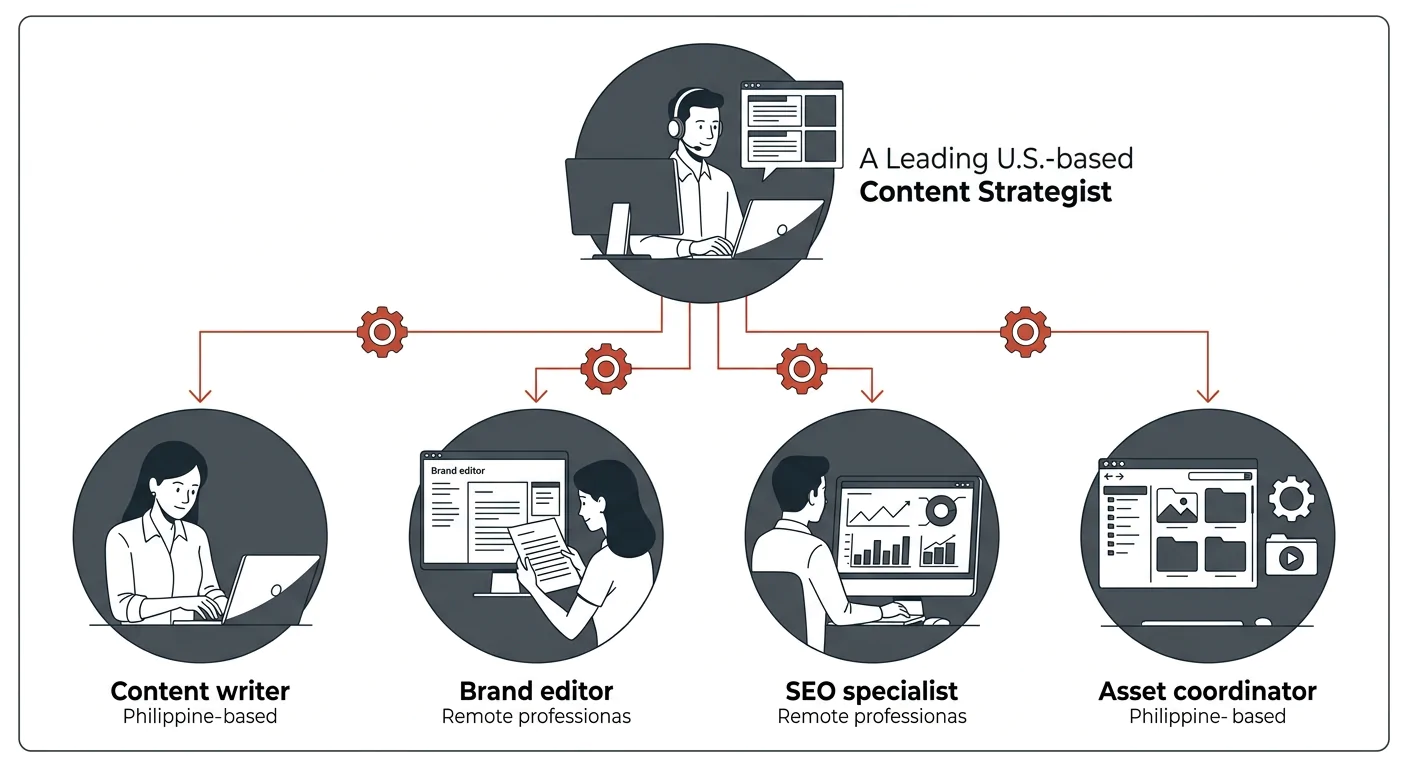
Compare that to how a dedicated content team in the Philippines typically structures the same workflow. A content strategist maps topics and briefs. A writer produces first drafts from those briefs. A separate editor reviews for brand voice, accuracy, and readability. An SEO specialist checks keyword integration, internal linking structure, and metadata. Monthly retainers for this kind of end-to-end social and content management run between $300 and $1,000, with per-project bundles often landing in the $50 to $150 range. At those rates, the parallelized model becomes economically viable for five-person agencies that would never staff four domestic content roles.
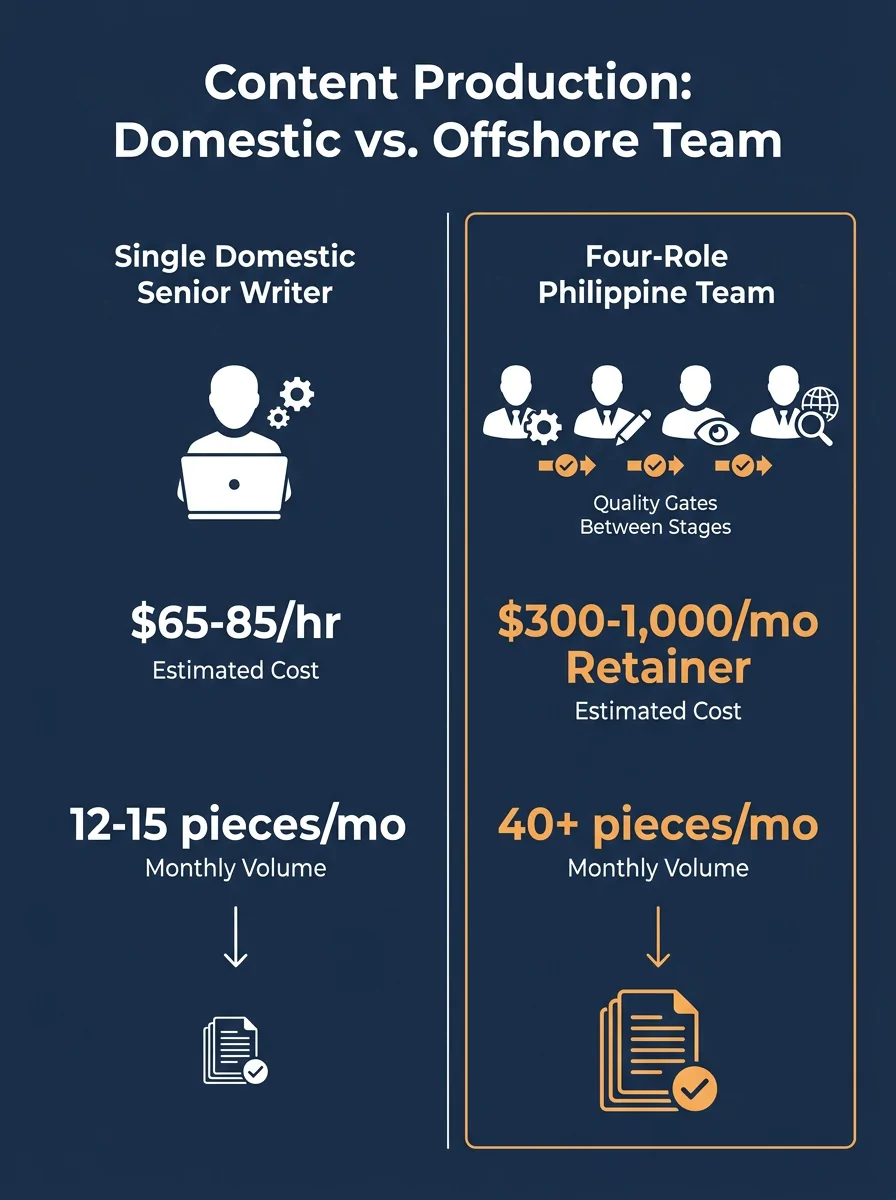
The underlying math here explains why content production outsourcing has grown steadily even as AI writing tools have matured. AI accelerates the draft stage, sometimes dramatically. But draft acceleration only helps if the rest of your pipeline can absorb higher throughput without breaking. An AI-generated draft still needs brand-voice editing, fact verification, SEO alignment, and visual asset pairing. If one person handles all of that, you’ve moved the bottleneck from writing to editing, and your effective output barely changes.
Building the Process Layer That Makes Speed Safe
The agencies that scale marketing asset production successfully through Philippine teams all share a common trait: they invest heavily in documentation before they invest in headcount. Style guides, tone-of-voice references, audience personas, keyword strategy documents, and templated briefs form the foundation. As research from Yoast’s content scaling framework puts it, breaking the process into small tasks with checklists for researching, writing, and editing ensures nothing gets dropped when volume increases.
This documentation layer serves a dual purpose. It accelerates onboarding when you add writers or editors to the team, and it creates an objective standard against which any piece of content can be evaluated. Brand-voice drift, the silent killer of scaled content operations, happens when editorial judgment is implicit and lives inside one person’s head. When that judgment is codified into a fifteen-page style guide with annotated examples of what “on-brand” looks like versus what “close but off” looks like, any competent editor can enforce it. Filipino editors, with their early English-language education and deep exposure to American media, tend to absorb these guides quickly and apply them with a consistency that surprises agencies accustomed to managing freelance pools.
Brand-voice drift, the silent killer of scaled content operations, happens when editorial judgment is implicit and lives inside one person’s head.
The quality control at scale challenge also has a tooling dimension. The best offshore content teams layer Grammarly or Hemingway for mechanical quality, Surfer SEO or Clearscope for keyword and topical coverage, and Copyscape for originality checks. Each tool handles a different quality dimension, and together they create a system where a senior editor’s time goes toward the nuanced judgment calls rather than catching typos or thin keyword integration. If you’re evaluating how to structure outsourced digital marketing operations more broadly, this same principle of separating mechanical checks from human judgment applies across PPC, email, and social workflows too.
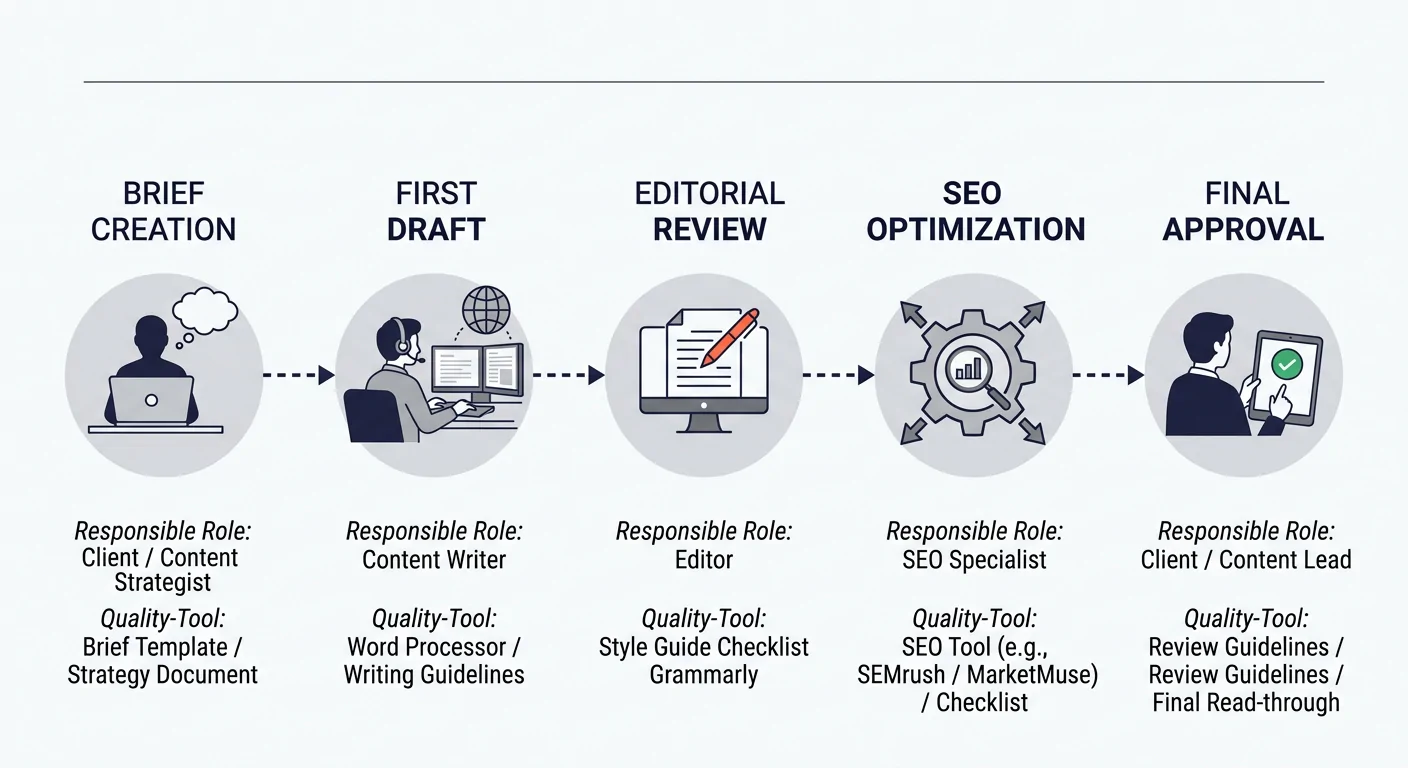
The teams that struggle with content velocity in the Philippines almost always share a different trait: they skipped the documentation step and expected the offshore team to reverse-engineer brand standards from a handful of sample posts. That approach works fine at five pieces per month. It collapses at forty. Scope definition matters as much in content production as it does in web development projects, where unclear requirements routinely double timelines and budgets.
Where AI Fits Into the Philippine Content Stack
A Forbes Council post from April 2026 captured the current consensus well: AI is helping teams scale thoughtful content, not replace it. AI handles research synthesis, outline structuring, and draft acceleration, while final perspective, voice, and editorial judgment stay human. This is exactly how the most productive Philippine content teams operate today. Writers use AI to cut research time from ninety minutes to twenty. Editors use AI-powered readability scoring to flag dense passages. But no one ships an AI draft without a human editor reviewing it against the brand style guide, because the drift pattern in unedited AI output is predictable and cumulative across a content calendar.
The 62% of organizations that have moved beyond early-stage AI adoption in their content management systems, according to Bynder’s 2026 State of DAM report, are seeing gains primarily in asset management and distribution rather than in writing itself. Automated transcription, multilingual captioning, and reuse recommendation engines reduce the operational overhead around content once it’s produced. For Philippine teams managing content calendars across multiple client accounts, these tools eliminate hours of manual tagging and reformatting work each week. The productivity gain is real, but it lives downstream of the editorial process rather than inside it.
The hybrid model where strategy stays in-house while execution ships offshore works particularly well for content. Your U.S.-based content strategist defines the editorial calendar, identifies target keywords, and sets the messaging framework. Your Philippine team produces the assets within that framework. Quality stays high because the strategic decisions that shape brand voice are made by someone with direct client access, while the executional volume is handled by a team whose rates allow you to staff four roles where you could previously afford one. Companies that have explored speed testing in their marketing workflows already understand this dynamic. Velocity gains come from parallel execution, not from asking individuals to work faster.
The tension point in AI-assisted offshore content production is originality. Search engines in 2026 increasingly distinguish between content that synthesizes genuine expertise and content that recombines existing web material. The Philippine teams that deliver strong SEO results over twelve-month horizons are the ones where writers bring subject-matter familiarity to their drafts, not where AI generates everything from a keyword prompt. Original data, specific examples, and practitioner-level detail are what separate content that ranks from content that sits on page four. An offshore team can produce that kind of content consistently, but only if the brief includes real source material and the writer has enough domain knowledge to work with it critically.
What Remains Genuinely Hard
Scaling content production through Philippine offshore teams solves the throughput problem and, with proper systems, maintains editorial quality at volumes that would overwhelm a domestic freelance model. But several challenges resist easy solutions. Client-specific voice adaptation during the first thirty days of an engagement remains slow, even with strong documentation. Some brands have voices so idiosyncratic that no style guide fully captures them, and the feedback loops required to dial in tone take weeks of iteration that can feel inefficient to agencies accustomed to hiring senior writers who “just get it” from day one.
There’s also the coordination overhead that comes with any distributed team. Regular check-ins, Slack threads, and shared project boards add management time that partially offsets the cost savings. For accounts producing fewer than fifteen pieces per month, that overhead can make the per-piece economics less attractive than a single skilled freelancer. The model works best at scale, which means agencies need to commit enough volume to justify the process infrastructure. And as the quality assurance guide on this site covers in detail, the systems you build for maintaining standards require ongoing maintenance themselves. Style guides go stale. Tools change their scoring algorithms. Editorial calibration drifts if you don’t run regular audits.
The agencies getting the best results from content production outsourcing have accepted these realities and built them into their operating cadence. They run monthly brand-voice calibration sessions. They update style guides quarterly. They treat the process documentation as a living product rather than a one-time setup artifact. The quality-versus-velocity problem, it turns out, was always a process-design problem. Philippine teams happened to be the most cost-effective way to staff the solution, and AI happened to arrive at the right time to accelerate the parts of the workflow where human judgment wasn’t the bottleneck. Whether that combination continues to hold its current advantage depends less on the talent market in Manila or Cebu and more on whether the agencies using these teams keep investing in the systems that make the model work.