
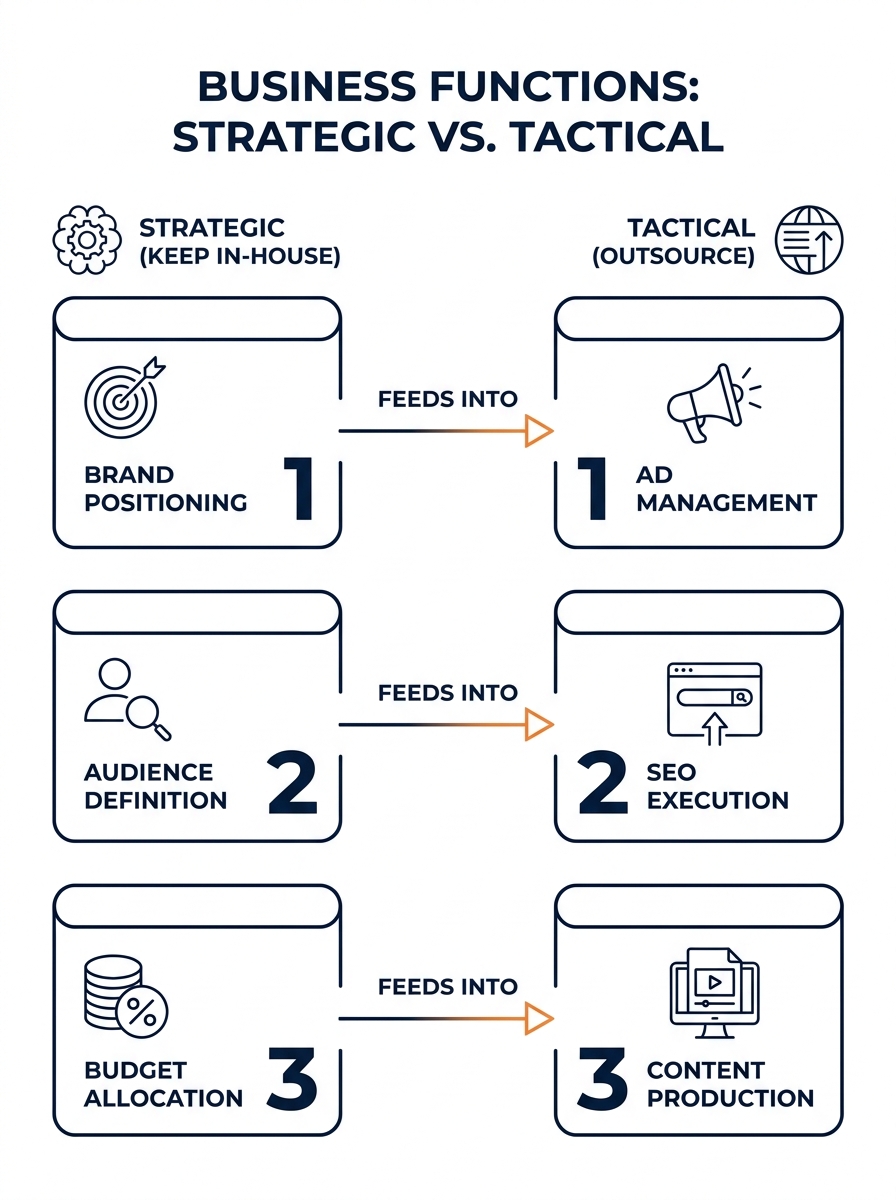
The line between strategic and tactical marketing determines which work you keep and which work you hand off. Strategic work — brand positioning, audience definition, budget allocation — requires institutional knowledge that doesn’t transfer well. Tactical execution — ad builds, keyword research, content production — transfers cleanly to an offshore team when the strategy behind it is already locked.
TL;DR: Keep work that defines *who* you’re targeting and *why*. Outsource work that answers *how* and *how often*. The dividing line isn’t importance — tactical SEO execution is critical — it’s how much company-specific context the task requires to do well.
Research backs the split: marketers with a documented strategy are 313% more likely to report success, while Deloitte’s 2025 global outsourcing data showed that 42% of businesses outsource marketing specifically to access talent they can’t recruit internally. The six rules below give you a marketing delegation framework for drawing that line in practice.
Own the “why” — outsource the “how”
Strategic marketing defines who you’re talking to, why they should care, and how you plan to earn their attention. Tactical marketing is the day-to-day execution of specific actions — the email sequences, the ad creative rotations, the on-page SEO fixes — that carry out those strategic decisions. The first category requires deep knowledge of your product, your margin structure, and your competitive position. The second category requires deep knowledge of platforms, algorithms, and production workflows.
That difference is where the marketing delegation framework gets its teeth. When you outsource digital marketing strategy itself — your positioning, your ideal customer profile, your channel priorities — you’re asking someone who doesn’t live inside your business to make decisions that shape everything downstream. The results are predictable: campaigns that look polished but speak to the wrong audience, or content that ranks well for keywords your actual buyers never search.
But when you outsource the execution layer — the Google Ads campaign builds, the technical SEO audits, the social media content calendar — you’re handing off work that has clear inputs (your strategy brief) and measurable outputs (traffic, conversions, cost per acquisition). That’s where an offshore marketing team can operate at full speed without needing to understand your board dynamics or your founder’s vision for the brand.
Never delegate the customer definition
Your ideal customer profile is the single most consequential marketing decision you make. Everything else — keyword targeting, ad copy angles, content topics, landing page structure — flows from it. And it changes based on conversations you’re having with sales, product feedback loops, and competitive moves that an external team simply doesn’t see in real time.
This is where the in-house vs offshore marketing tasks distinction gets concrete. Your offshore SEO team can build a keyword map with 500 targets, cluster them by intent, and prioritize by search volume and difficulty. They do that well. But the decision about which customer segment those keywords should serve? That’s yours. If you’re a B2B SaaS company deciding whether to go upmarket into enterprise or double down on SMB, that call reshapes the entire keyword strategy. No external team should be making it for you.
HubSpot’s guidance on outsourcing marketing reinforces this: keep activity in-house when your current marketing technology is generating excellent ROI and you have a trained, experienced workforce with the capacity to handle long-term campaign work. The customer definition is the foundation of that ROI, and it’s built from institutional knowledge that’s expensive to transfer and impossible to fully replicate outside your walls.
Treat campaign execution as a manufacturing problem
Once strategy is set, the execution work follows repeatable patterns. A Google Ads campaign needs keyword research, ad group structure, bid strategy selection, ad copy variations, landing page alignment, and ongoing optimization. A monthly SEO sprint needs technical audits, content briefs, link prospecting, and on-page updates. These are production workflows with defined quality standards and measurable turnaround times.
That’s exactly the kind of work where outsourced PPC management and offshore SEO services deliver 40-60% cost savings without quality degradation — because you’re measuring output against clear specs, not asking for strategic judgment. Philippine marketing teams working 8-13 hours ahead of US offices can complete a full day’s production work before you open your laptop. Teams that run on live performance dashboards close the visibility gap that used to make offshore execution feel like a black box.
The decision about which customer segment to target is yours. The 47 tasks required to execute against that decision are not.
The manufacturing framing also clarifies where to set quality gates. You don’t need to review every meta description or every ad variation. You need to review the brief that generated them and the performance data that came back. The rest is process, and process scales better when it’s not competing for your attention with strategic questions about where the business is headed next quarter.
Measure strategic fit by decision frequency
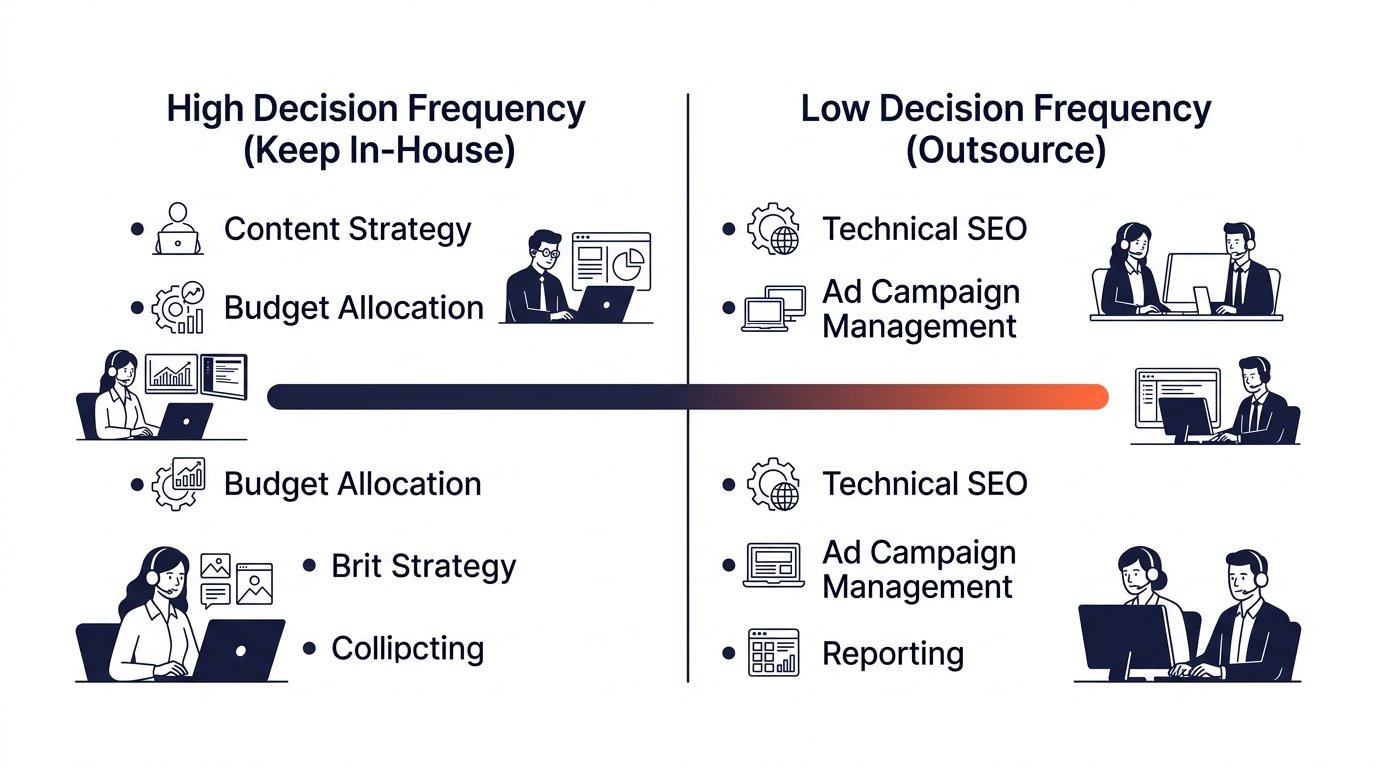
Why does this distinction feel blurry in practice? Because plenty of marketing tasks contain both strategic and tactical elements, and most teams never separate them. A practical test cuts through the ambiguity: how often does this task require a decision that depends on information only you have? If the answer is “every time,” it stays in-house. If the answer is “once at setup, then rarely,” it’s a prime candidate for delegation.
Consider the difference between two SEO activities. Content strategy — which topics to cover, which angles to take, which products to feature — requires business context every cycle. You need to know what’s launching next quarter, what the sales team is struggling to close, what competitors just published. That’s a high-decision-frequency task. Keep it close.
Technical SEO execution — site speed fixes, schema markup, crawl error resolution, redirect mapping — requires business context at the briefing stage. After that, the work is governed by Google’s documentation and platform best practices. Decision frequency drops to near zero. Send it offshore. This is the same logic behind the outsourced marketing skill stack, where tasks are sequenced by how much company-specific context they consume.
| Task | Decision Frequency | Context Dependency | Recommendation |
|---|---|---|---|
| Brand positioning | Every quarter | High (internal) | Keep in-house |
| Content strategy | Every sprint | High (market + internal) | Keep in-house |
| Content production | Once per brief | Low (brief-driven) | Outsource |
| Technical SEO audits | Once per engagement | Low (platform-driven) | Outsource |
| PPC campaign builds | Once per campaign | Medium (brief + platform) | Outsource |
| Budget allocation | Every month | High (financial) | Keep in-house |
| Reporting and dashboards | Once at setup | Low (data-driven) | Outsource |
Keep budget authority within arm’s reach
Budget decisions are strategic decisions wearing a financial costume. When you decide to shift $5,000 from Facebook to Google, you’re making a channel strategy call. When you decide to increase spend by 30% ahead of a product launch, you’re making a growth bet. These decisions need to sit with someone who understands your cash position, your runway, your unit economics, and your risk tolerance.
The operational execution of that budget — building the campaigns, managing the bids, optimizing the creative — is tactical. Your offshore PPC team doesn’t need to know your runway. They need to know your target CPA, your daily budget cap, and your conversion goals. The line is clean.
Where companies get into trouble is when they hand off both the budget authority and the execution to the same external team. The incentives misalign immediately. An external team managing your ad spend has a structural incentive to recommend more spend, because more spend means more management fees or, at minimum, more work to justify their retainer. As WebFX notes, in-house marketing gives you full control at higher fixed costs, while agency marketing provides flexible expertise at lower variable costs. The trick is combining both: keep the allocation decision in-house, push the execution offshore, and you maintain control without micromanaging every bid adjustment.
Warning: If your outsourced team is recommending budget increases without tying them to specific, measurable performance targets, you’ve accidentally delegated strategy along with execution. Pull the budget conversation back in-house.
Outsource the skill you’d need to retrain every six months
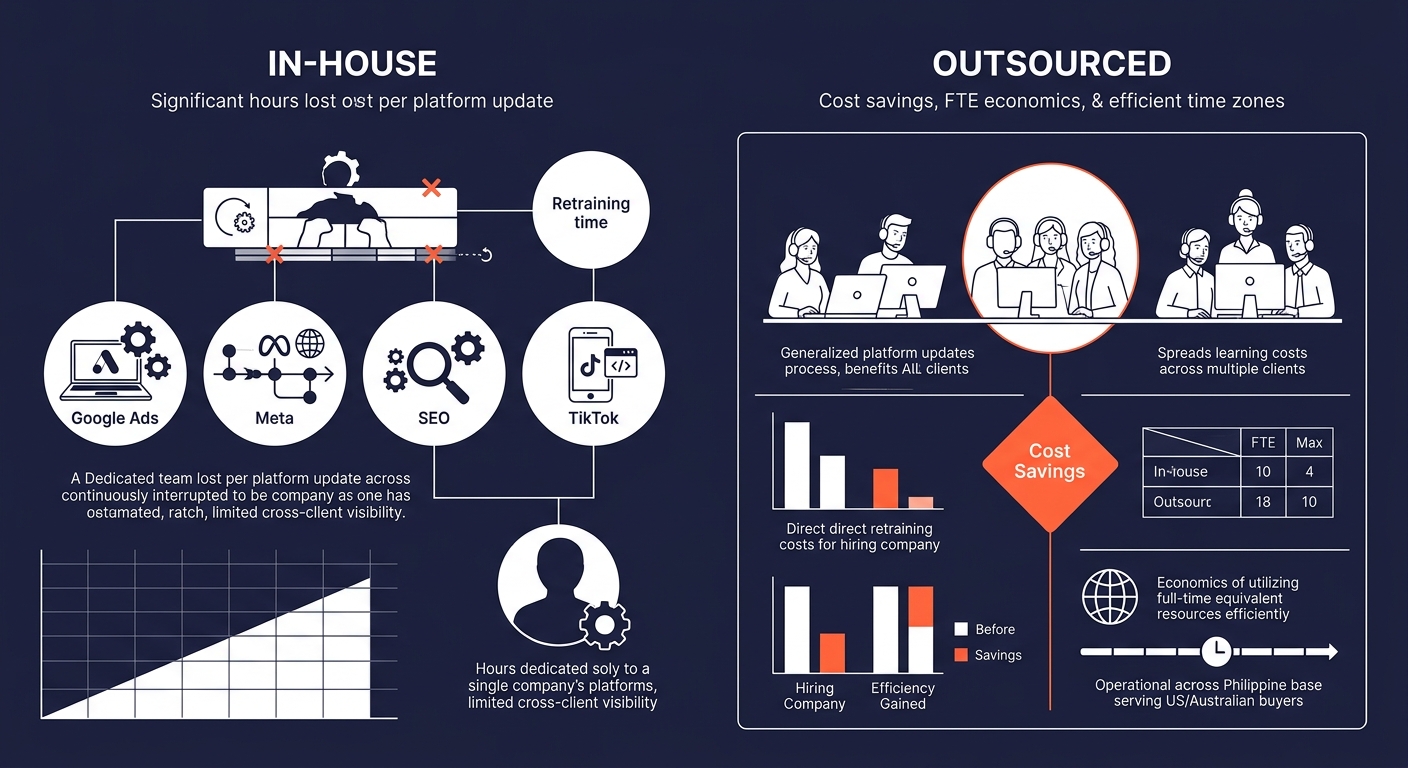
Google’s algorithm updates alone forced Philippine SEO teams to adapt faster than most in-house generalists across 2025 and into 2026. Platform-specific expertise — Google Ads bidding strategies, Facebook’s auction mechanics, TikTok’s algorithm preferences, Core Web Vitals requirements — changes so fast that keeping a single in-house person current across all channels is functionally impossible.
This is the strongest economic argument for tactical vs strategic outsourcing. A dedicated offshore SEO team has five or ten specialists who spend their entire week inside one platform. They see pattern changes across dozens of client accounts. They catch algorithm shifts within days, not weeks. Your in-house marketing manager, splitting time between strategy, stakeholder meetings, and vendor management, will always be 30-60 days behind on platform-specific knowledge. And in digital marketing, 30 days of outdated tactics can burn through a meaningful portion of your quarterly budget before anyone notices the performance dip.
The retraining cost is real and measurable. Sending one person to upskill on a major platform change costs 20-40 hours of productive time. Multiply that by three or four platforms, and you’ve burned a month of capacity every six months on skills maintenance alone. An offshore team absorbs that cost across its client base, and you pay for the output, not the learning curve. As hibu’s outsourcing guide puts it, your time is better spent on the tasks where you know your business and trade best, while a digital marketing partner handles the platform-specific execution.
When These Rules Break Down
Every framework has failure modes, and this one has two worth naming.
The first: your company is so early-stage that the person doing the strategic thinking is also the person running every campaign. You can’t separate the layers because you only have one layer. In that situation, outsource the tasks that consume the most time while delivering the least strategic input — usually reporting, basic content production, and ad campaign setup. The framework still applies; you’re working at a smaller scale, and the order in which you delegate matters more than ever.
The second failure mode is more interesting: your offshore team has worked with you long enough that they’ve absorbed significant institutional context. After 12-18 months, a dedicated Philippine marketing team that’s been on your account understands your customer segments, your competitive landscape, and your brand voice well enough to take on some strategic advisory work. The hybrid outsourcing playbook accounts for this evolution. The line between strategic and tactical isn’t fixed. It shifts as trust and context accumulate between your team and theirs.
The framework’s purpose is to give you a clean starting position. Own the why. Outsource the how. Measure each task by decision frequency and retraining cost. Then let the line move as your relationship with your offshore team matures. The companies that get this wrong are the ones who never drew the line at all — they either delegate everything and lose control of their positioning, or delegate nothing and burn out trying to master six platforms simultaneously. Drawing the line, even imperfectly, is how you build a marketing operation that scales without losing its strategic center of gravity.