
Architecture firms treat their websites like award submission portfolios, dense with rendering galleries and BIM methodology language aimed at other architects. The real buyers, commercial developers and institutional clients, find nothing written for them. The failure starts with disconnected tools and mismatched talent, not missing budget.
TL;DR: Architecture firm digital marketing breaks down at two root causes: a fragmented tech stack where CRM, email, website, and social tools don’t share data, and a talent model that assigns marketing duties to design professionals instead of trained marketers. Fix the infrastructure and the staffing model first, or every campaign you run will underperform.
The six rules below address the structural problems that sink architecture firm digital marketing before a single campaign launches. They apply whether you’re a 12-person studio or a 200-person multi-office practice. And they’re ordered deliberately: infrastructure first, talent second, execution third.
Audit your disconnected tools before you add another platform
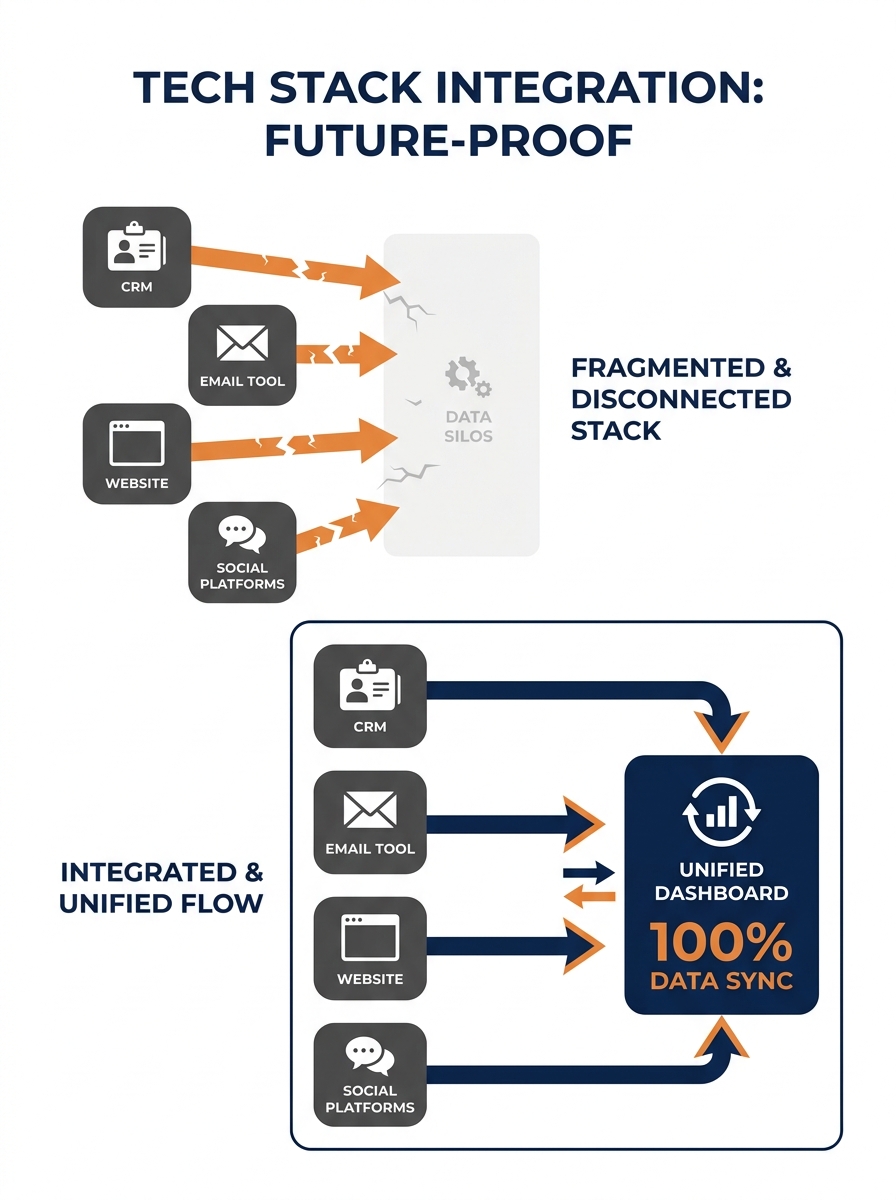
Most architecture firms make technology decisions in silos. The managing partner buys a CRM. The marketing coordinator signs up for Mailchimp. Someone in business development starts a HubSpot trial. The website runs on Squarespace or a custom WordPress build with no analytics integration. The result: four or five platforms, none of them talking to each other, and zero visibility into which marketing activity actually generated the RFP.
According to Built Environment Marketing’s 2026 guide to architecture firm strategies, the core challenge is getting “the foundations and basics right and being strategic about how you communicate your value and to the right audience.” That strategic foundation requires a single data pipeline where website visits, email opens, LinkedIn engagement, and proposal submissions all connect. Without it, you’re guessing which channels produce revenue and which just produce busywork.
Before you evaluate any new marketing tool, map the data flow across your existing stack. Where does a lead enter your system? Where does the data stop moving? Where are you duplicating effort? If you can’t answer those three questions in under five minutes, your tech stack needs surgery before it needs expansion. The 2026 trend toward composable MarTech stacks, stitching best-in-class tools together via APIs, makes integration easier than it was even two years ago, but only if someone on your team understands the architecture.
Write for the person signing the check, not the design jury
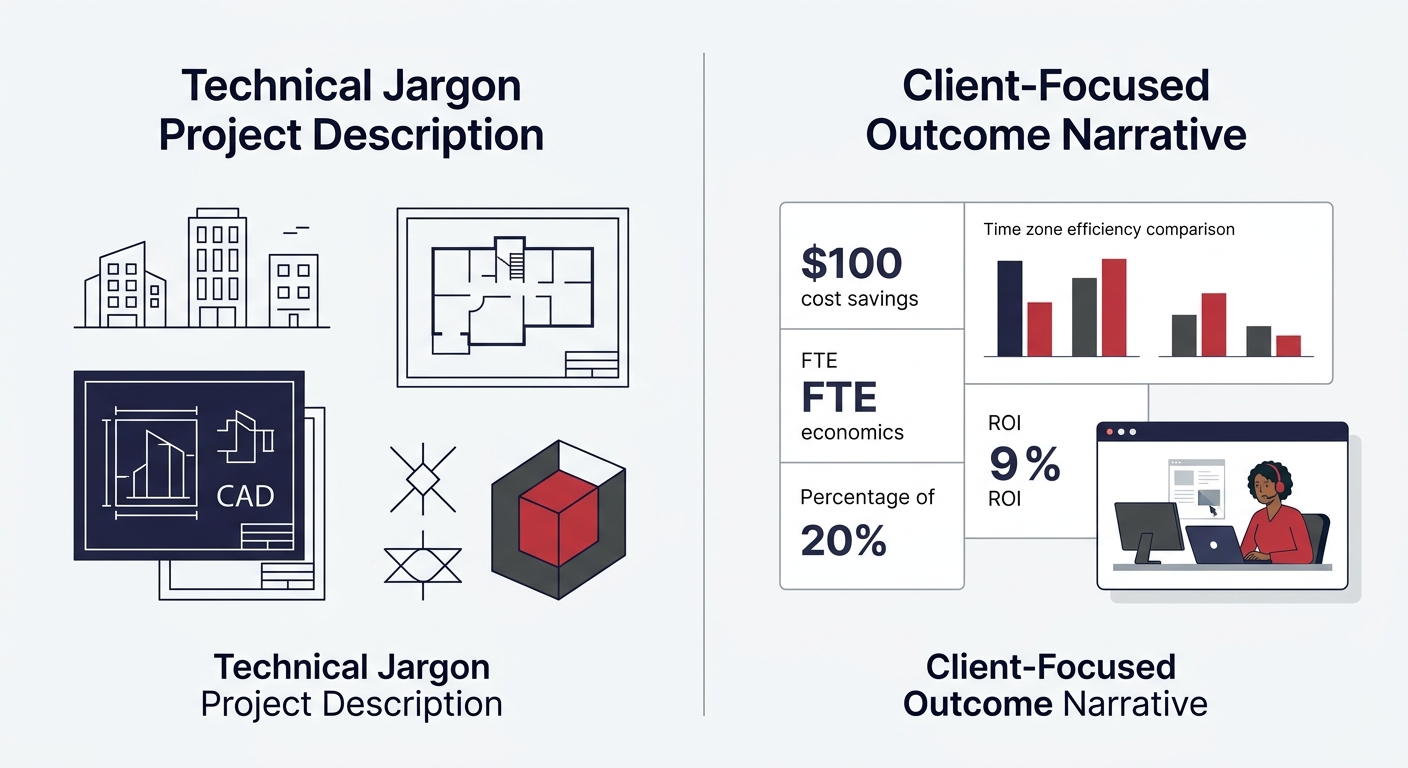
The single most common B2B content mistake architecture firms make is writing for architects. Project pages describe “BIM and Lean methodologies” and “parametric facade systems” when the commercial developer reading the page wants to know three things: will it be on budget, will it be on time, and will it help them lease the space faster.
Targeting B2B clients effectively requires creating buyer personas for each client type, whether that’s an SMB, corporate entity, developer, project management firm, or institutional buyer. Each persona cares about different outcomes. A hospital system evaluating architects for a new wing cares about patient flow optimization and regulatory compliance timelines. A retail developer cares about foot traffic projections and tenant attraction. Your content should describe those outcomes in their language, not yours.
This is where B2B content for architects goes wrong at the structural level. Firms produce gorgeous case studies that win design awards and generate zero inbound leads. The fix is straightforward: for every piece of content, identify the buyer it targets and write the headline, the first paragraph, and the call to action in their vocabulary. Technical depth can live deeper in the piece for the project managers who vet shortlists, but the entry point belongs to the decision-maker who controls the budget.
Staff your marketing function with marketers, not architects who post on Instagram
The talent cliff in the AEC industry is well documented: fewer people are entering the field, the effects of post-pandemic attrition persist, and senior leaders are retiring with decades of institutional knowledge. But the marketing talent gap is even more acute because architecture firms rarely hire dedicated marketing professionals in the first place.
The typical pattern looks like this: a junior architect or office manager gets handed the Instagram account, the LinkedIn page, and the email newsletter alongside their actual job responsibilities. They post project photos on a sporadic schedule, write captions that read like internal memos, and have no training in conversion optimization, paid media, or analytics. The firm then concludes that digital marketing doesn’t work for their industry.
Digital marketing works fine for architecture firms. What doesn’t work is treating it as a side task for people trained in design rather than demand generation. If your marketing budget can’t support a full-time senior marketer at $85,000–$120,000 per year in a US metro, you need to rethink the staffing model entirely. Firms that have explored outsourcing digital marketing strategy alongside execution consistently report faster time-to-results because they’re working with people who already know how to run campaigns, interpret analytics data, and build lead-nurturing sequences that convert over long timelines.
Treat your CRM as the command center, not a digital Rolodex
Architecture firms have sales cycles that stretch 6 to 12 months for commercial projects, sometimes longer for institutional work. That timeline demands a CRM system tracking every touchpoint across the entire relationship, from first website visit to signed contract. What most firms actually have is a contact list dressed up in software.
Warning: If your CRM can’t show you which marketing channel generated a specific RFP opportunity, every dollar you spend on traffic is money you can’t learn from. Fix attribution tracking before investing in any new marketing channel.
When your CRM functions as a passive contact database instead of an active pipeline management tool, you lose visibility into where prospects stall, which content they engage with, and when to follow up. A firm pursuing 15 active opportunities with no pipeline scoring or automated follow-up sequences will inevitably let warm leads go cold while partners chase the two or three deals they happen to remember.
Integrate your CRM with your email platform, your website analytics, and your proposal tracking. When a commercial developer visits your healthcare portfolio page three times in two weeks, your business development lead should get an alert that same day, not discover the missed opportunity six months later when the project has already been awarded. And if you’re running paid search campaigns to generate traffic, that spend produces no return without a CRM that captures and scores the resulting leads.
Match your content cadence to a 6-to-12-month sales cycle
B2B content for architects needs to account for a timeline that looks nothing like SaaS or e-commerce. When your average deal takes 6 to 12 months to close, a burst of blog posts in January that stops by March accomplishes nothing measurable. The firms that generate consistent inbound leads publish on a predictable schedule, typically 2 to 4 pieces of high-quality content per month, sustained over 12 or more months without interruption.
That cadence is hard to maintain with a one-person marketing department. It’s one reason firms are building content production operations with offshore teams that can handle writing, graphic design, email distribution, and social promotion while the in-house team focuses on strategy and client relationships. A dedicated offshore marketing specialist in the Philippines costs $1,200 to $2,200 per month fully loaded, compared to $7,000 to $10,000 per month for a US-based marketing coordinator with benefits. That 70% cost difference buys you consistency, which is the variable that matters most in long-cycle B2B marketing.
Every architecture firm says they need better marketing. What they actually need is a sustained content operation that speaks the buyer’s language across a 6-to-12-month sales cycle, staffed by people who won’t burn out after three months.
LinkedIn matters disproportionately for architecture firm digital marketing in the B2B space. Commercial developers, project managers, and institutional buyers are active on that platform, and firms posting thought-leadership content 3 to 5 times per week see measurably higher engagement than those posting project photos once a month. Instagram and Facebook serve a different purpose: building brand awareness with residential clients and recruiting design talent. Conflating the two audiences on a single content calendar produces generic posts that resonate with nobody.
Build your AEC outsourcing strategy around skill gaps, not cost alone
AEC firms around the world are struggling to hire skilled workers, and that shortage extends well beyond architects and engineers into the marketing, analytics, and digital production roles that support business development. These positions are equally hard to fill, especially at the salary levels mid-size firms can realistically offer.
An effective AEC outsourcing strategy for marketing starts with mapping your specific skill gaps against available talent. You might have a strong brand strategist in-house but no one who can execute PPC campaigns, build landing pages, or manage email automation workflows. Or you might have technical SEO needs that surface only during your annual website redesign cycle. The strategy-execution split that’s reshaped agency outsourcing works well here: keep strategic direction with your senior team and move repeatable execution tasks to offshore marketing teams for design firms that already have the technical skills in place.
Offshore marketing teams for design firms work best when the scope is clearly defined and KPIs are established from day one. Track cost per qualified lead, proposal-to-close ratio attributed to marketing-sourced opportunities, and organic traffic growth segmented by target service page. These metrics keep everyone accountable and prevent the common failure mode where an outsourced team produces volume without relevance.
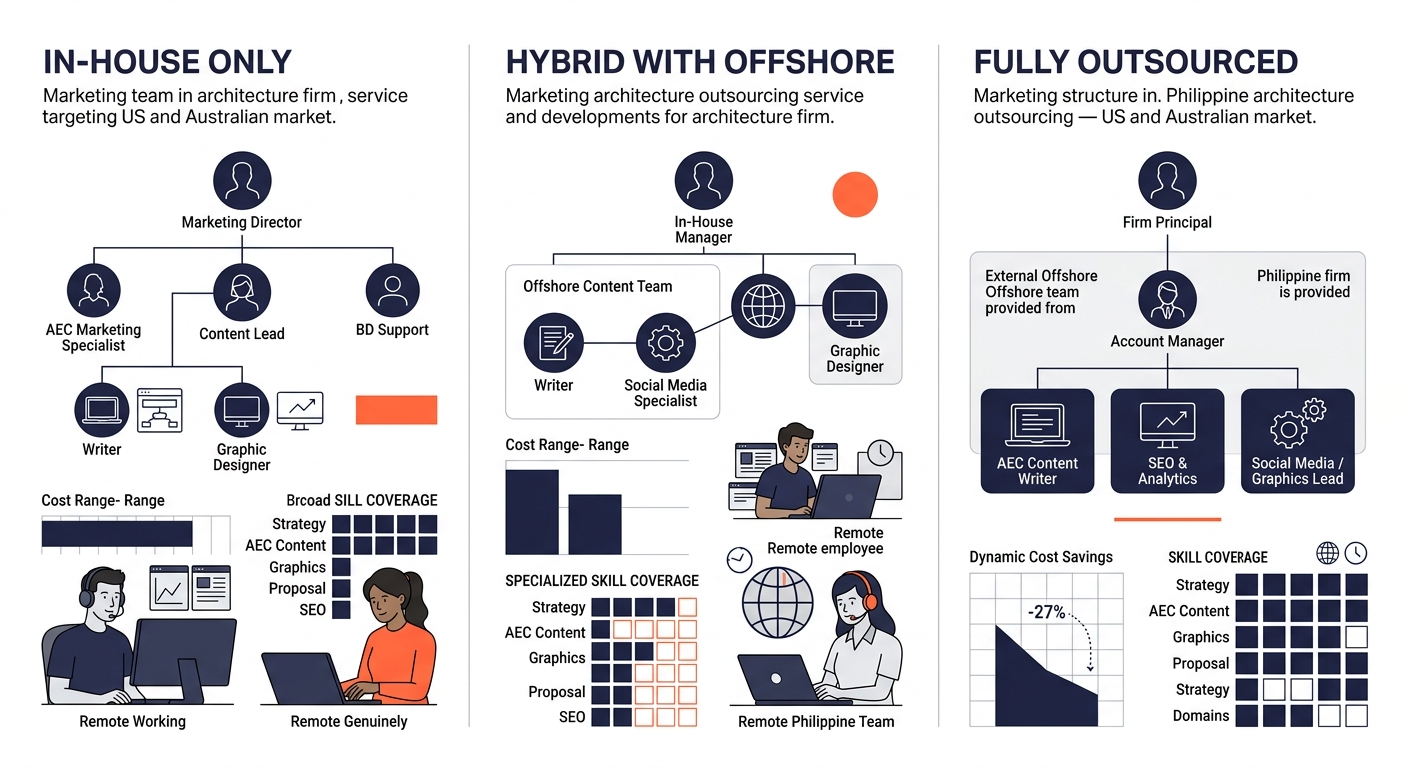
| Staffing Model | Monthly Cost (USD) | Time to Full Output | Skill Coverage | Strategic Control |
|---|---|---|---|---|
| Full in-house (US metro) | $12,000–$25,000 | 60–90 days | Depends on hire quality | High |
| Hybrid: in-house strategy + offshore execution | $4,000–$8,000 | 30–45 days | Broad (specialists available) | High |
| Fully outsourced to AEC marketing agency | $5,000–$15,000 | 14–30 days | Broad but less customized | Medium |
When These Rules Break
These six principles assume your firm has enough project volume and revenue to justify sustained marketing investment. A three-person studio billing $400,000 annually won’t benefit from a CRM overhaul or an offshore content team. For firms at that scale, the highest-ROI move is still personal networking, strategic partnerships with developers and contractors, and one well-maintained portfolio website with clear calls to action on every page.
The rules also assume your firm actually wants to grow through inbound channels. Some architecture practices thrive entirely on referrals and repeat clients, and there’s nothing wrong with that model. If 90% of your work comes from three long-standing developer relationships, your marketing investment should protect and deepen those relationships rather than chase new ones you aren’t staffed to serve.
But for the mid-size firm billing $2M to $20M that keeps losing RFPs to competitors with better online visibility, the diagnosis is almost always the same: fragmented tools that don’t share data, talented designers assigned to marketing work they weren’t trained for, and content that speaks to the profession instead of the buyer. Fixing those three structural problems will do more for your pipeline over the next 12 months than any individual campaign, platform, or hire you could make this quarter.