
Fourteen hours separate New York from Manila. A creative brief sent at 4 PM Eastern arrives in a Philippine marketing team’s inbox at 6 AM the next day. If that brief contains one ambiguous line about brand tone, the clarifying question arrives back when the US side has gone home. The answer returns another business day later. One unclear sentence just cost 48 hours of dead project time.
This pattern has a name worth quantifying: the async decision tax. It’s the cumulative hours lost each month to decisions that stall in the gap between time zones, unclear briefs, and approval queues nobody owns. For a typical SMB running 8-12 marketing deliverables per month through a Philippine BPO team, that tax runs 20-30 hours of idle team capacity per month, based on timeline audits across our client accounts. The six rules below eliminate most of it.
TL;DR: Outsourced marketing timelines slip because decisions stall in the time-zone gap, not because the offshore team is slow. Treating every pending approval as inventory with a measurable daily cost, and applying preset 24-hour decision windows, eliminates 20+ hours of dead time per month for most SMB-to-Philippine-team workflows.
Align internally before you brief externally
The single fastest way to blow up an outsourced marketing timeline is to send a brief that reflects unresolved internal disagreements. Your product owner wants the landing page to emphasize feature specs. Your marketing director wants social proof above the fold. Your CEO has opinions about the hero image that won’t surface until week three of the build. When those conflicts play out asynchronously across a 14-hour time zone gap, each round of “actually, let’s change direction” burns 2-3 business days.
We documented this dynamic in detail when looking at async decision-making in web dev outsourcing, and the marketing version is identical in structure. A brief that goes out with internal disagreements baked in generates 3-5 rounds of revision that could have been 1 round if stakeholders had resolved their conflict in a 30-minute internal meeting first.
When this rule applies: Every project involving more than one internal stakeholder with approval authority. So, almost every project.
When it breaks: Solo founders making all creative decisions themselves can skip the alignment step entirely. If you’re the only approver, your problem is different. You need the next rule instead.
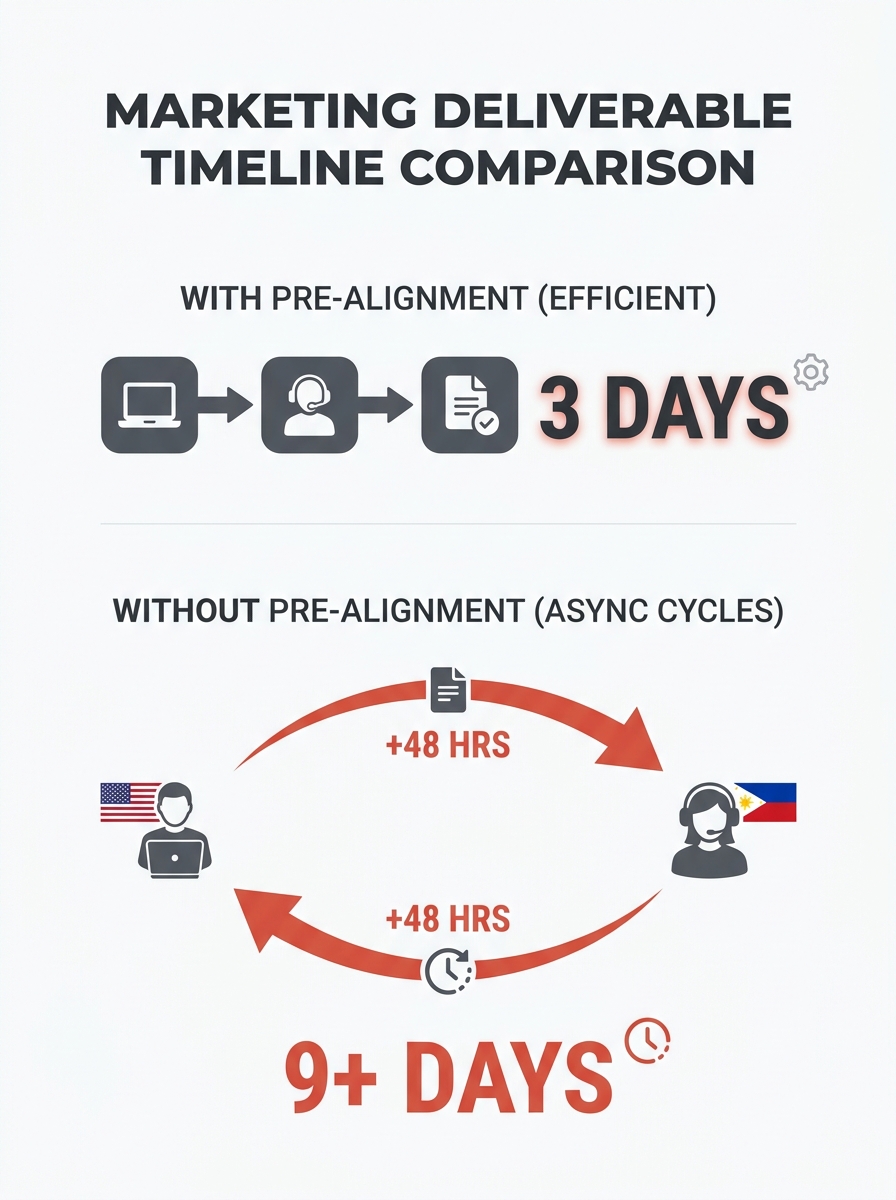
Set every approval to a 24-hour window, not “when you get to it”
Open-ended approval timelines are the largest single source of cross-timezone project delays in outsourced marketing. A Moxo guide on marketing approval workflows recommends setting explicit escalation paths: if the assigned reviewer hasn’t acted within 48 hours, the system notifies the next stakeholder or manager automatically. Teams without escalation paths see approval times of 72-96 hours for routine creative assets. Teams with them average 18-24 hours.
The fix is mechanical. Every deliverable that leaves the Philippine team’s hands gets a 24-hour approval clock attached to it. When that clock expires without feedback, the project manager escalates to the next person in the chain. No judgment, no awkwardness. The clock is the rule.
For a team producing 10 marketing assets per month, shaving 48 hours off average approval time per asset recovers roughly 20 hours of previously idle team capacity. That number is where the “20+ hours/month” claim in this article’s headline comes from. And those are hours you’re already paying for through your retainer or FTE agreement, which makes the true ROI of Philippine outsourcing look far worse than it should.
When this rule applies: Any recurring deliverable type where the approval process has historically exceeded 24 hours. Blog drafts, ad creatives, email sequences, landing page mockups.
When it breaks: Legal review and compliance approvals genuinely require longer windows. If your team handles work touching GDPR or privacy regulations, the review window should be 48-72 hours, and you should account for that in the project timeline from day one.
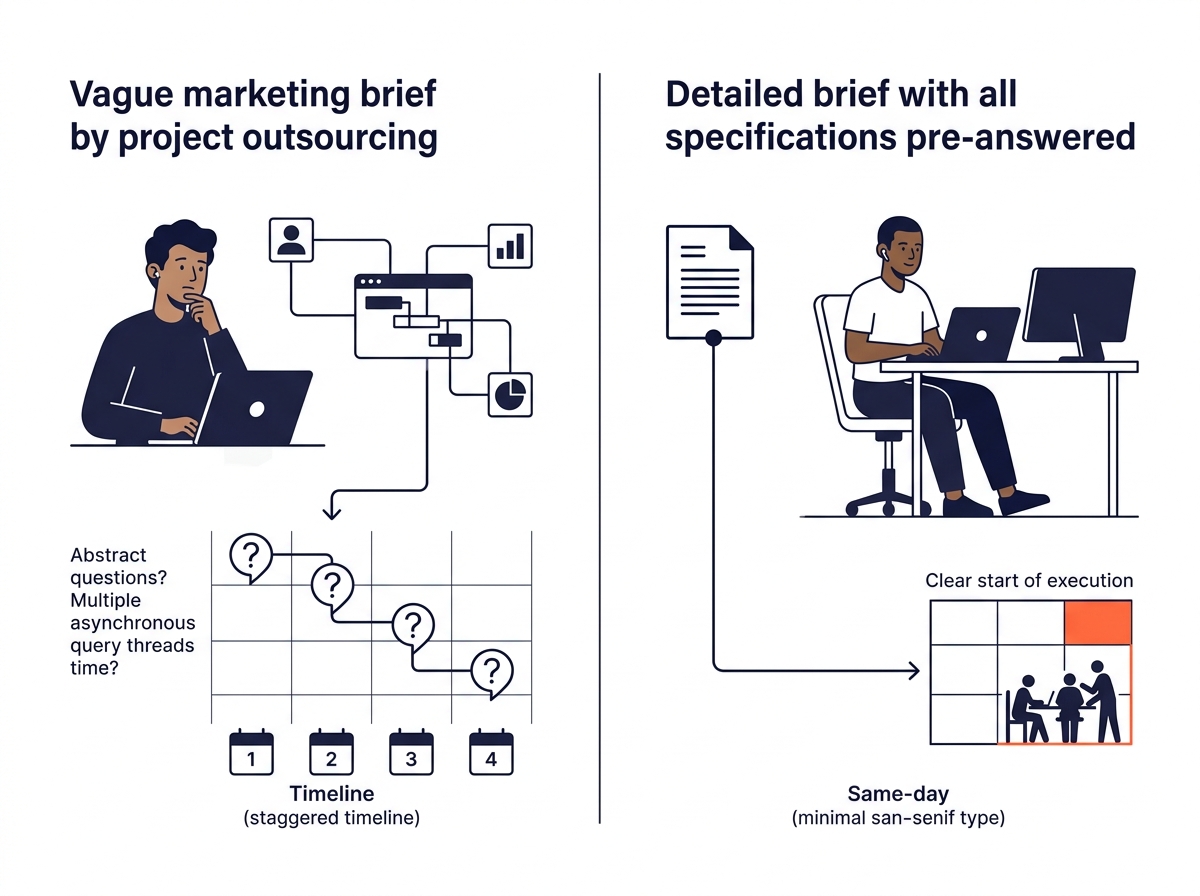
Write the brief as if your team can’t ask follow-up questions
This is the highest-ROI habit change for anyone managing outsourced marketing. A brief that generates zero clarifying questions from your Philippine team doesn’t mean the team is uncritical. It means you did your job. Storyteq’s research on marketing approval workflows across distributed teams identified four recurring bottlenecks: “communication silos, version control confusion, progress tracking difficulties, and compliance verification issues.” The first two are almost entirely brief-quality problems.
A brief that says “write a blog post about our new feature” will generate 3-5 questions: target audience, tone, word count, keyword focus, CTA destination, internal links to include. Each question-and-answer cycle costs 12-24 hours in a cross-timezone setup. A brief that specifies all six parameters upfront costs you 15 minutes of extra writing time and saves 2-3 calendar days of async back-and-forth per deliverable.
Tip: Before sending any brief, read it and list every question a competent person would need answered to start working. If you find more than one unanswered question, add the answers to the brief. The framework we’ve used when [building offshore digital marketing teams](/blog/offshore-digital-marketing-team-framework) treats brief completeness as the number-one predictor of on-time delivery.
When this rule applies: Always. Every deliverable type benefits from this discipline.
When it breaks: Genuinely exploratory work like brand discovery sessions or competitive audits can’t be fully specified in advance. For those, use the next rule.
Bundle decisions into 2-3 scheduled sync windows per week
The instinct to go fully async when working with a team 14 hours ahead is understandable but counterproductive for marketing work, which involves subjective judgment calls about tone, creative direction, and brand fit. Those calls resolve in 5 minutes on a live call and 72 hours in a Slack thread.
Best practices from Pumble’s research on working across time zones support the principle: shared calendars showing availability, combined with preset meeting slots, reduce coordination overhead significantly compared to ad-hoc scheduling. Their core recommendation is to reserve synchronous meetings for decisions that can’t be resolved through a document, email, or memo, and keep everything else async.
For most US-to-Philippines marketing workflows, the overlap window falls between 7-10 AM Eastern (7-10 PM Manila). Two or three 30-minute syncs per week inside that window, with a standing agenda that clears the decision queue, will eliminate most of the async decision-making outsourcing friction that causes outsourced marketing timeline slippage. Teams using adapted Kanban and Scrum frameworks for async coordination report the same finding: scheduled sync points beat ad-hoc communication by a wide margin on every timeline metric.
When this rule applies: Any engagement producing 5 or more deliverables per month where subjective creative decisions are involved.
When it breaks: Purely execution-heavy work like data entry, report formatting, or templated email sends rarely needs live syncs. Keep those fully async and save your sync windows for the judgment-heavy items.
Treat the approval queue like inventory and measure its daily cost
Here’s where most teams fail at the management layer. They track deliverable completion dates but never measure how long items sit in the approval queue waiting for a decision. That queue is the async decision tax made visible, and it belongs on a dashboard.
We recommend a metric called Decision Queue Hours (DQH): the total number of hours all deliverables spent waiting for client-side decisions in a given month. To calculate it, tag every deliverable with a “submitted for review” timestamp and a “feedback received” timestamp. Sum the deltas across all deliverables. For a quality-first outsourced marketing dashboard, DQH belongs on the main screen, right next to throughput and revision rate.
A typical DQH for a new outsourced marketing engagement is 80-120 hours per month across all deliverables combined. After applying these rules consistently for 60-90 days, teams bring that number below 40 hours. The difference represents recovered team capacity you’re already paying for through your retainer.
The approval queue is the async decision tax made visible. Measure it in hours, attach a dollar figure, and most teams change their behavior within 30 days.
When this rule applies: Any engagement where you’re paying for dedicated team hours on a retainer or FTE basis.
When it breaks: Pure project-based engagements with fixed delivery dates and milestone payments shift the queue cost to the outsourcing partner. Delivery dates still slip, but the financial incentive runs differently.
Assign one person as the decision bottleneck and make that assignment explicit
Outsourced marketing timeline slippage often traces back to a structural ambiguity: nobody on the client side has documented authority to approve deliverables. The Philippine team sends a blog draft, and it circulates between 3-4 people internally for 5-7 days before consolidated feedback comes back. Then the feedback contradicts itself because two reviewers had different visions for the piece.
The fix is naming one person as the primary approver for each deliverable type. Blog content goes to the content director. Ad creative goes to the marketing manager. Landing pages go to whoever owns conversion rate. That person gets the 24-hour window from rule two. If they’re unavailable, a named backup takes over automatically. The Indeed guide on preventing project slippage reinforces this: “additional time in the schedule can help prevent slippage” for global teams, but the structural fix is clarifying who holds decision authority and ensuring they act within a defined window.
When this rule applies: Any team with more than one person who considers themselves an approver.
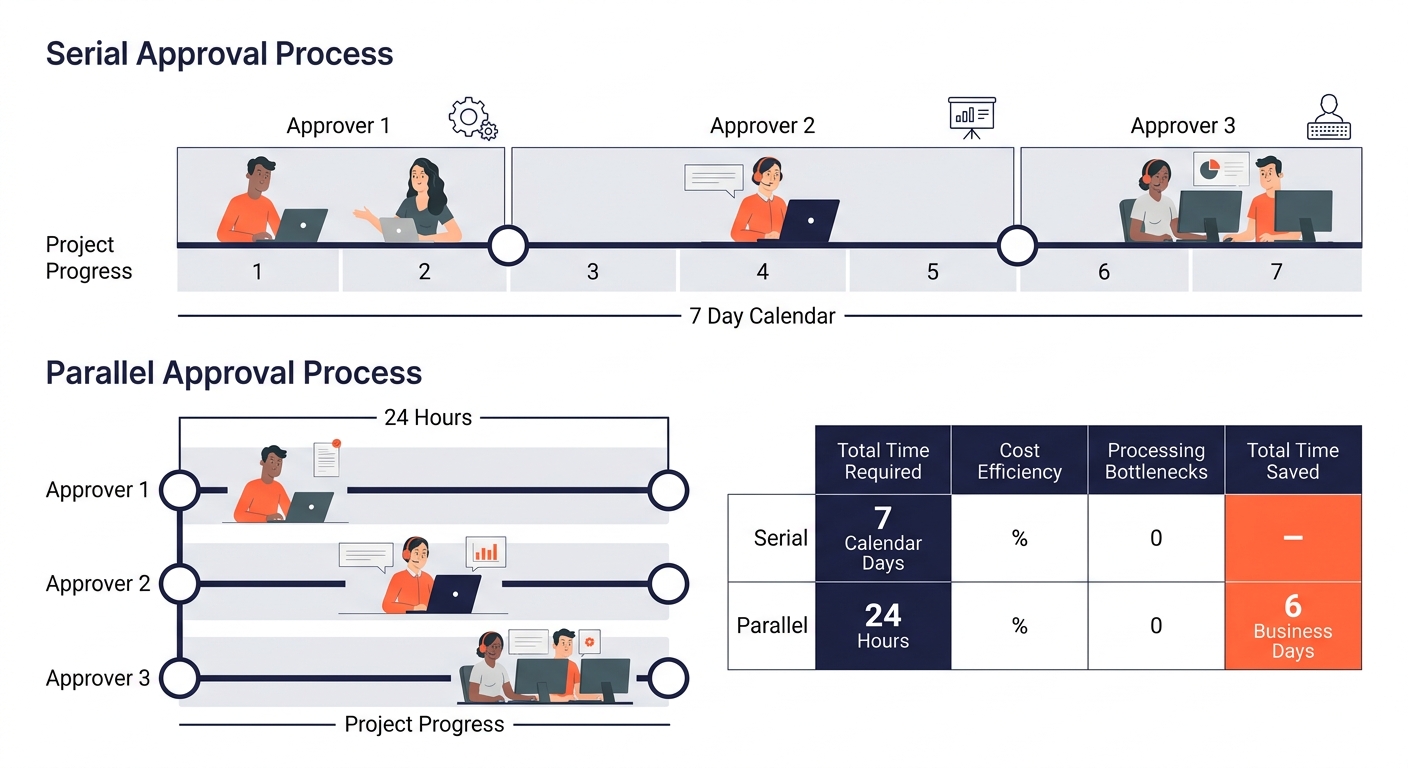
When it breaks: Regulated industries where multi-stakeholder sign-off is legally required. In those cases, run the approvals in parallel (everyone reviews simultaneously within the same 24-hour window) rather than in series (one reviewer after another, each adding their own 48-hour delay).
When These Rules Break
Philippine BPO communication friction doesn’t always originate in the decision queue. Sometimes the team lacks context about your market, your brand voice, or your competitive landscape. No amount of process optimization compensates for a team that doesn’t understand why they’re building what they’re building.
If you’ve applied all six rules and deliverables still miss timelines consistently, the problem has shifted from process to context. That requires a different intervention: deeper onboarding, recorded walkthroughs of your brand guidelines, shared competitive analysis documents, and quarterly strategy syncs where the offshore team participates in planning rather than executing plans they had no hand in shaping. The question of what to keep in-house versus offshore becomes relevant here, because some decisions should never cross the time-zone gap at all.
The async decision tax is real and measurable. But the decision to keep paying it, to let approvals pile up and briefs go out half-finished, is always a choice your side of the time zone is making. Start tracking DQH this month, enforce the 24-hour approval window, and watch the number drop. The recovered hours were always sitting in your pipeline, waiting in a queue for someone on your team to notice them.