
Campaign failures between US clients and Philippine digital marketing teams trace to system misalignment at specific, diagnosable layers, not talent gaps or time-zone friction. The mechanism has four components: data access, task handoff protocols, decision timing, and feedback loops. Each layer breaks in predictable, fixable ways.
TL;DR: Outsourced team workflow alignment depends on four layers working together: shared data access, structured handoff protocols, decision-timing rules, and closed feedback loops. Fix them in order. Skipping the data layer makes every other layer unreliable, and a June 2026 Boomi/Omdia study found that fragmented data foundations are the primary reason APAC teams fail to operationalize new tools.
The Four-Layer Integration Stack
Philippine digital marketing integration fails when teams treat it as a single problem. It isn’t. A June 2026 study by Boomi and Omdia found that organizations across APAC are adopting AI and automation tools faster than they’re restructuring the workflows underneath them, leading to widespread tool adoption alongside limited operational integration. That gap between tool access and workflow structure is where campaigns stall.
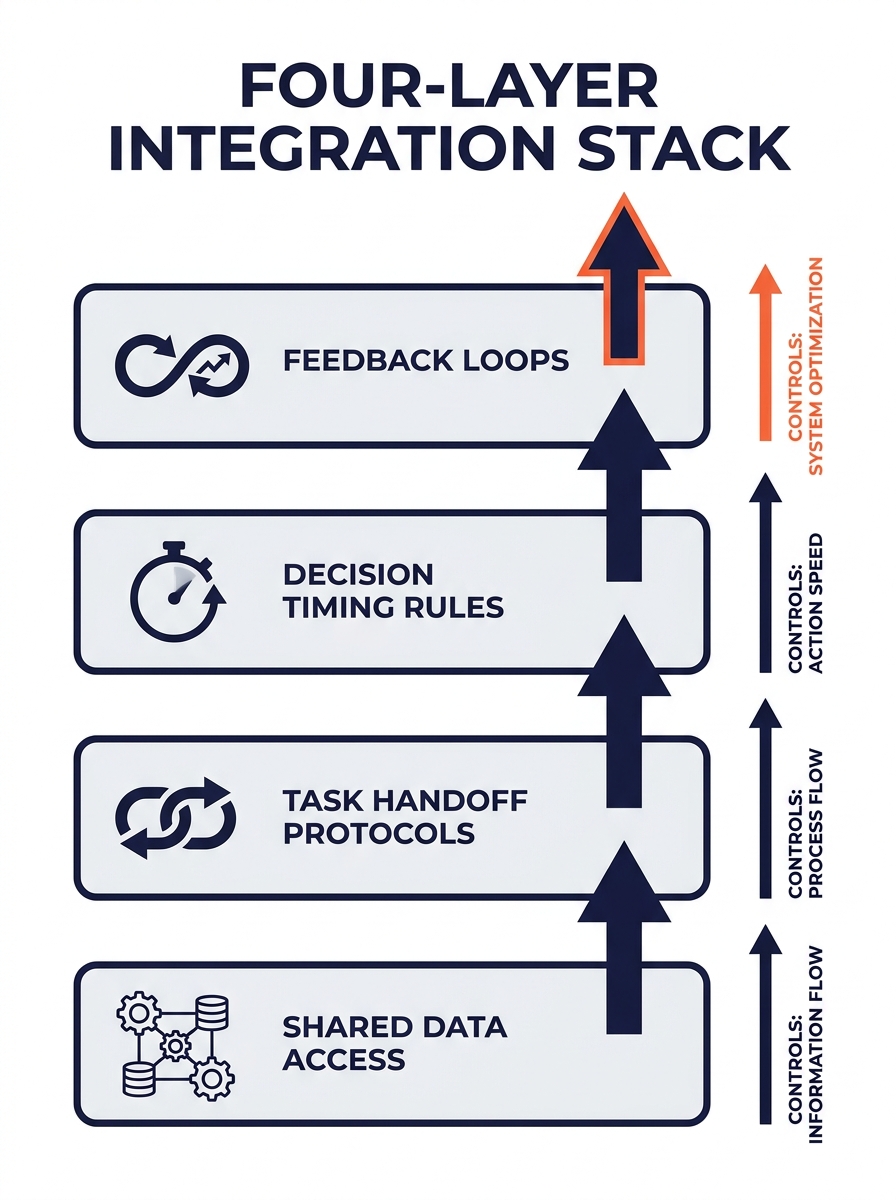
The framework I use to diagnose these failures has four layers, each dependent on the one below it. I call it the Four-Layer Integration Stack: shared data access, task handoff protocols, decision timing rules, and feedback loops. If you’re building a BPO system integration checklist, these four layers are the checklist.
Each layer serves a different function. The data layer determines what your offshore team can see. The handoff layer determines how work moves between people. The timing layer determines who can approve what, and when. And the feedback layer determines whether results actually change future behavior. Skip any one of them, and campaign velocity through process design drops to near zero.
Shared Data Access Is the Foundation
The single most common failure point is data access. According to Improvado’s 2026 analysis, implementing a centralized data warehouse (tools like Snowflake or BigQuery) as a single source of truth allows offshore teams to operate on live, analysis-ready data instead of relying on stale weekly PDF exports. Without this, your Philippine team is making decisions based on information that’s 3 to 7 days old.
Here’s what this looks like in practice. Monday.com’s 2026 marketing workflow research lays out a concrete timeline: Day 1, the workflow automatically pulls data from all marketing platforms. Days 2 through 4, a marketing analyst reviews data and identifies significant changes. Day 5, findings go to the leadership team with specific recommendations. That 5-day cycle works when data flows automatically. It collapses into a 10-to-15-day cycle when someone has to manually export CSVs, email them to Manila, and wait for a Slack reply asking which columns matter.
You need your offshore team looking at the same dashboards you are, in real time. This means granting direct access to Google Analytics, Meta Ads Manager, SEMrush, or whatever platforms you’re running. If compliance concerns make you hesitant, tools like Databox or Whatagraph let you create read-only shared dashboards without giving full admin credentials.
Tip: When your Philippine team can pull live performance data on their own, they stop waiting for you to send reports and start flagging problems before your morning coffee. Building a [quality-first dashboard for your outsourced team](/blog/pipeline-clarity-dashboard-outsourced-marketing) is the single highest-ROI integration step.
Even routine tasks like outsourced data entry become bottlenecks when the team doing the work can’t verify what they’re entering against a live source of truth. Data access isn’t a perk you extend to offshore teams. It’s the infrastructure everything else sits on.
Task Handoffs Need Structure, Not Good Intentions
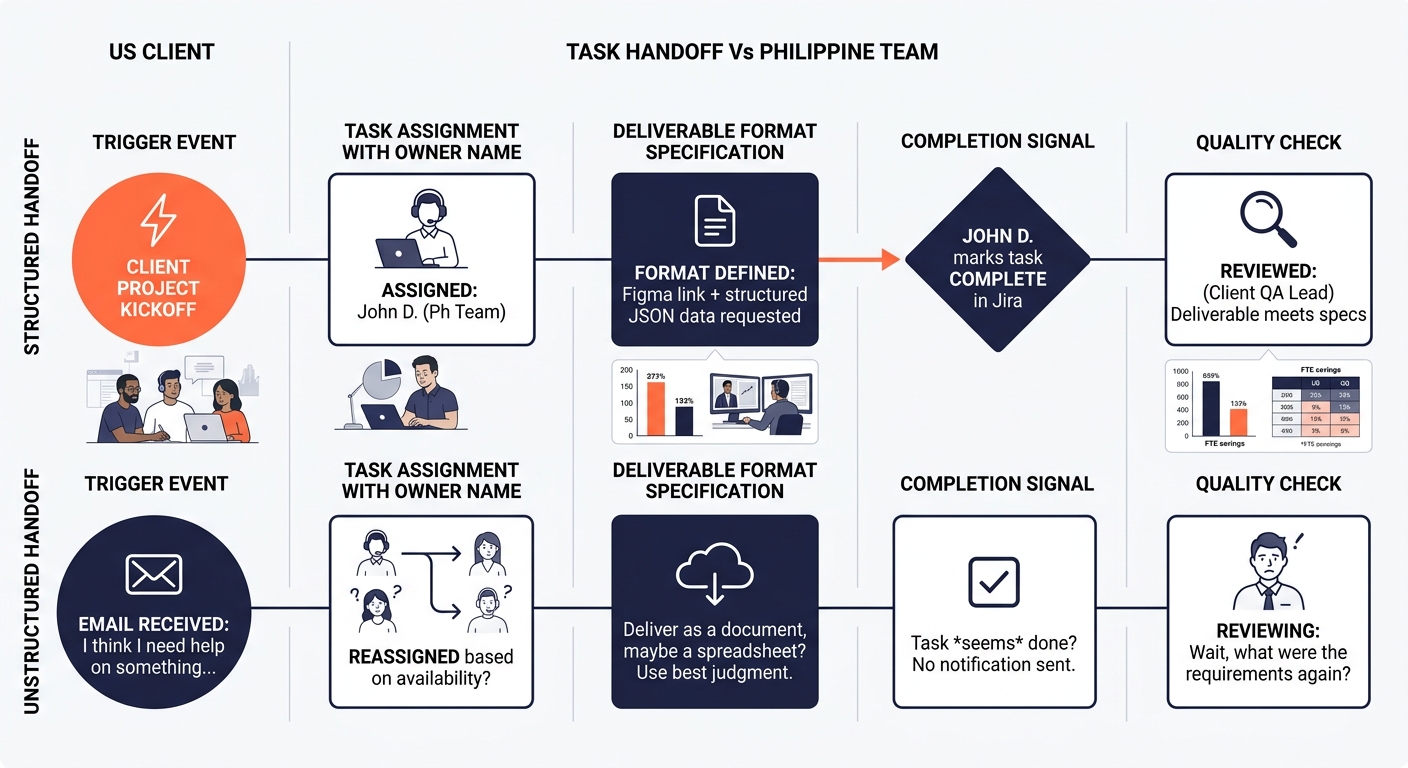
Why do handoffs between US clients and Philippine teams break down so consistently? Because most teams rely on informal channels instead of structured protocols. A message in Slack, a forwarded email, a verbal instruction during a Zoom call. None of these create a traceable, repeatable workflow.
Manifestly’s marketing workflow system addresses this directly by formalizing recurring processes so that assignments are clear and everyone knows the what, how, who, and when of every important task. The principle is straightforward: every recurring task needs a defined trigger, a named owner, a deliverable format, and a completion signal.
Stackmatix’s analysis of offshore marketing onboarding recommends a structured Five-Field Intake Framework that takes 2 to 4 weeks to complete, covering knowledge transfer, tool access provisioning, baseline audits, and initial strategy alignment across 4 sequential stages. Skipping this process costs months of correction. If your Philippine marketing partner didn’t receive a structured intake process covering brand context, audience personas, platform rules, and async communication protocols, your handoff layer is already broken.
Modular systems help here. Knak’s research on enterprise email campaign orchestration shows that teams using pre-coded, tested components (headers, product grids, CTAs) can assemble campaigns without breaking underlying code. The same principle applies to broader marketing workflows: build modular task templates your Philippine team can execute without needing to reinvent the process for each campaign. When your content calendar, ad creative briefs, and reporting templates follow a consistent format, handoff errors drop dramatically.
Decision Timing Determines Campaign Velocity
Every campaign has decision gates: approve this creative, increase this budget, pause this underperforming ad set. When those gates sit exclusively with the US-based client, you’ve built a 12-to-16-hour bottleneck into every decision cycle. Your Philippine team finishes work at the end of their day, submits it for approval, and waits until the next morning (their time) to hear back.
The math is simple. A campaign that requires 4 approval cycles with a 16-hour delay on each cycle loses 64 hours, or nearly 3 full business days, before it goes live. Multiply that across 6 to 8 campaigns per month, and you’re looking at 15 to 20 lost business days of execution time per quarter. We’ve written before about how the async decision tax drains 20-plus hours monthly from outsourced projects. The fix isn’t working more hours. It’s restructuring who can approve what.
A campaign requiring 4 approval cycles with 16-hour delays loses 64 hours before it goes live. The fix isn’t working more hours. It’s restructuring who can approve what.
Build a Decision Authority Matrix with three tiers:
- Tier 1 (Philippine team decides): Routine optimizations, bid adjustments under $50/day, A/B test variants within approved brand guidelines, scheduling posts from an approved content calendar
- Tier 2 (Philippine team recommends, US approves within 4 hours): New creative concepts, budget shifts above $50/day, campaign pauses based on performance thresholds
- Tier 3 (US decides): Brand positioning changes, new channel launches, contract or vendor commitments, budget increases above 20% of monthly spend
When your offshore team has Tier 1 autonomy, campaigns move during Philippine business hours without waiting for US input. That alone can cut your average campaign launch time from 9 days to 3 or 4.
An offshore executive assistant can manage the traffic between tiers, routing Tier 2 decisions to the right approver and tracking response times against your 4-hour SLA. This kind of coordination work is where dedicated VAs earn back their cost within the first month.
The Feedback Loop That Most Teams Skip
The first three layers handle getting campaigns out the door. The feedback loop handles whether you get better over time. And this is where most outsourced team workflow alignment programs quietly fall apart.
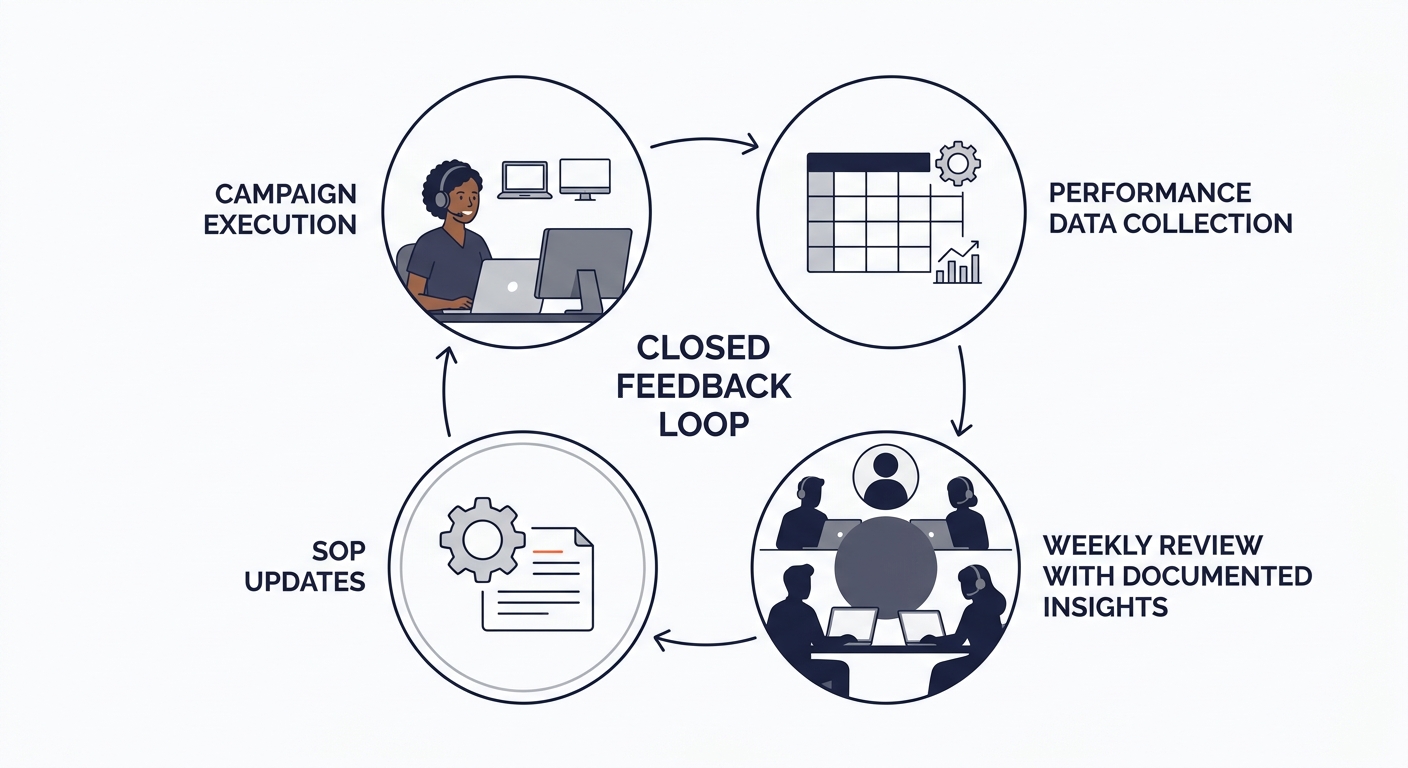
A closed feedback loop requires three things: a regular review cadence, a structured format for capturing what worked and what didn’t, and a mechanism for those findings to change future workflows. Weekly performance reviews where someone presents numbers and everyone nods don’t count. The output of every review needs to produce at least one documented process change.
Velocity Growth’s outsourced growth model makes this explicit: centralized reporting and visualizations give leadership teams full transparency to iterate rapidly across channels, campaigns, targets, and results. The key word is “iterate.” Reporting without iteration is just surveillance.
| Feedback Component | What It Looks Like When Working | What It Looks Like When Broken |
|---|---|---|
| Review cadence | Weekly 30-min syncs with pre-filled dashboard | Monthly calls where the team scrambles to pull numbers |
| Capture format | Shared doc with columns: insight, evidence, proposed change | Verbal discussion, no written record |
| Process change mechanism | Updated SOPs within 48 hours of review | Same playbook runs for 6+ months unchanged |
| Accountability | Named owner for each change, due date attached | “We should try that” with no follow-up |
The n8n community maintains over 3,158 marketing automation workflow templates, many designed to automate exactly this kind of feedback capture. When your Philippine team’s CRM data, ad platform metrics, and project management status all feed into one automated report, the review meeting becomes about decisions, not data assembly.
Where the Model Breaks
The Four-Layer Integration Stack assumes something that isn’t always true: that both sides want the same level of operational transparency. Some US clients prefer to keep their Philippine team at arm’s length, treating them as task executors rather than integrated team members. If that’s your operating model, this stack won’t work. You’ll build the data access layer, and nobody on the offshore side will feel empowered to act on what they see.
The model also struggles with rapid team turnover. Stackmatix’s 2-to-4-week onboarding timeline assumes the people you train are the people who run the campaigns. When a key team member leaves after 6 weeks, the handoff protocols and decision authority matrix need to be re-taught from scratch. Written SOPs reduce but don’t eliminate this cost.
And there’s a compliance dimension. As we’ve outlined in our BPO compliance guide, Philippine BPO teams handling payments must implement PCI DSS controls, and those in healthcare must align with HIPAA and HITECH standards. Your data access layer can’t grant blanket dashboard access if certain fields contain protected information. The integration stack needs a compliance filter between Layer 1 and Layer 2, and building that filter adds 1 to 2 weeks to your setup timeline.
None of these limitations make the model useless. They make it honest about where your investment in outsourced team workflow alignment will face friction, and where you’ll need to spend extra time getting the layers right before you can expect campaign velocity through process design to pay off.