
Every dollar spent fixing a production bug in a shipped web application costs between 4x and 15x what the same fix would have cost during initial development. Philippine dev teams that build maintainability into the architecture from sprint one understand this arithmetic cold, and it’s why they treat production support headcount as a failure metric rather than a scaling strategy.
TL;DR: Scaling production support by adding headcount fails because defect density compounds faster than teams can hire. Philippine web dev teams avoid this trap by enforcing modular architecture, dedicating 20% of sprint capacity to refactoring, and running CI/CD pipelines that catch defects before deployment. The result: lower total cost of ownership and applications that don’t demand a growing army of support engineers.
The Defect Density Problem That Breaks Support Budgets
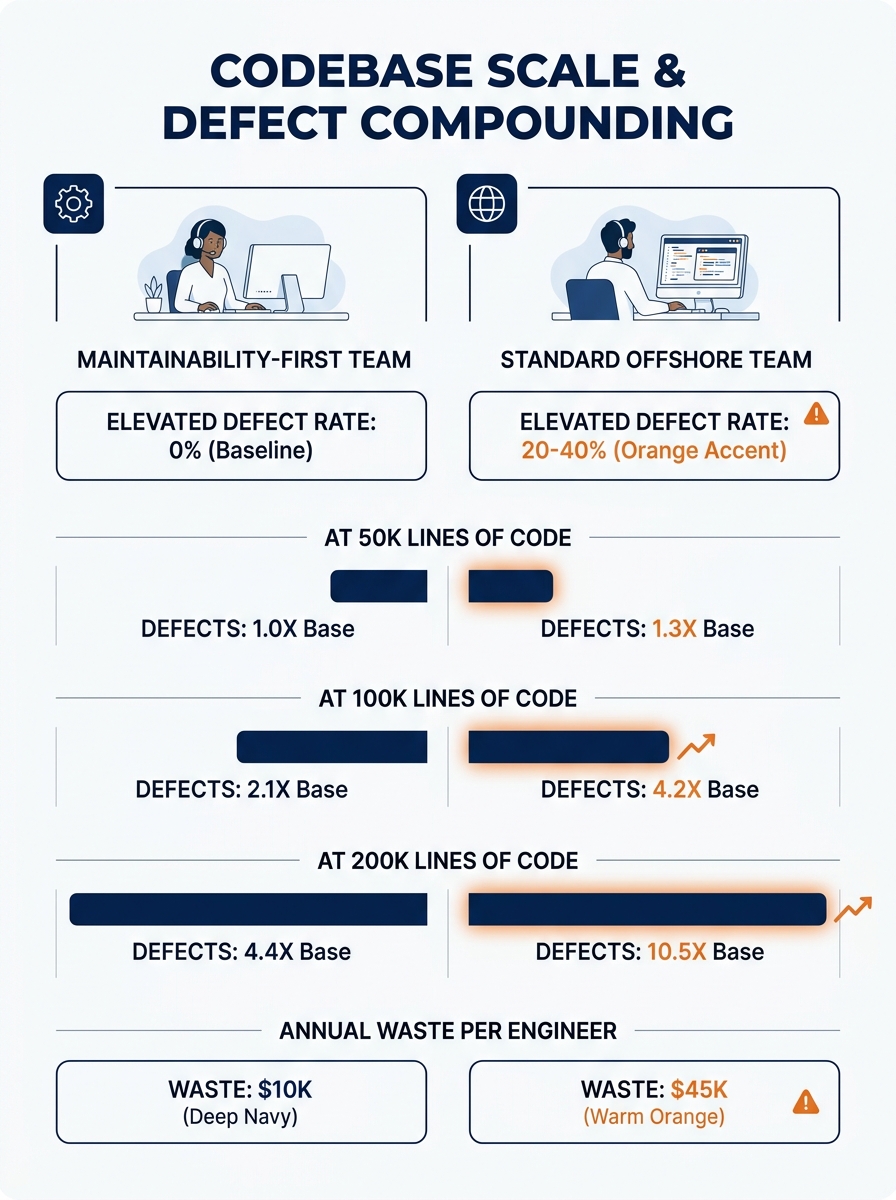
Defect rates in offshore-developed code run 20–40% higher than equivalent onshore output, according to industry data from offshore development centers. When you pair that elevated defect rate with a growing codebase, the support math turns punishing. The industry-accepted benchmark is 1 defect per 1,000 lines of code, and top teams push below that threshold. But the average offshore team without built-in quality gates operates well above it.
Here’s where it compounds. A 50,000-LOC application at the industry standard carries roughly 50 defects. At a 30% elevated rate (the midpoint of that 20–40% range), you’re looking at 65 defects. Scale that codebase to 200,000 LOC over 18 months of feature development, and you’re sitting on 260 latent defects instead of 200. Each one requires a support engineer to triage, reproduce, fix, test, and deploy. The support team that was adequate at launch is now underwater.
Technical debt accounts for 20–40% of a company’s total technology estate value and consumes roughly one-third of engineers’ total working time. That’s engineers spending 13+ hours per week on debt instead of building features. When you’re paying $35–50/hour for Philippine senior developers (rates that Flexiple’s 2026 analysis confirms have risen because senior talent demand remains strong and security expectations are stricter), those 13 hours per week per engineer represent $23,660–$33,800 per year per developer burned on debt maintenance alone.
The conventional response is to hire more support staff. But as we’ve covered in our analysis of why flexible outsourcing models break down at scale, adding headcount to a fundamentally architectural problem just moves the bottleneck. You get more people triaging the same structural issues, not fewer issues to triage.
Modular Architecture Eliminates the Root Cause
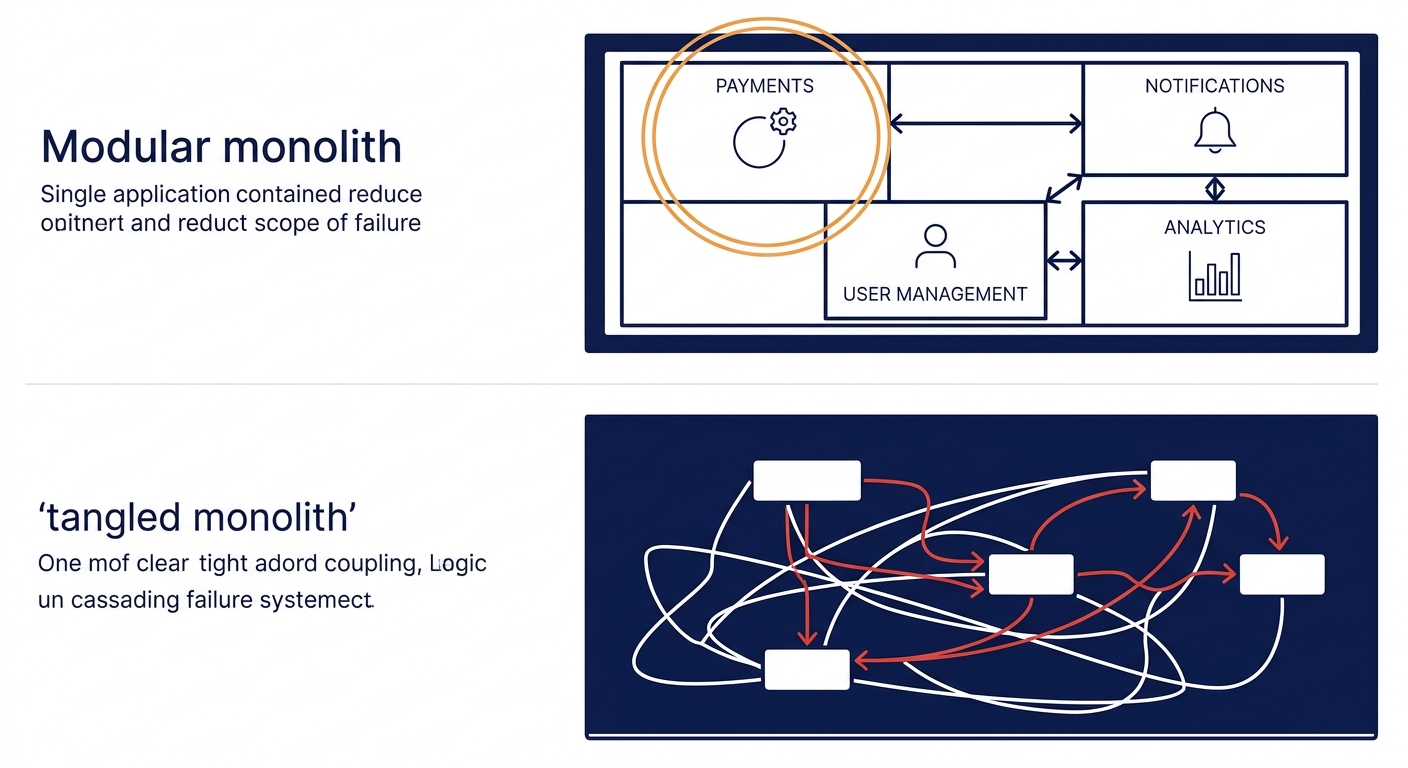
Philippine dev teams that have internalized this problem build applications using composable modular monoliths rather than jumping to premature microservices. The Bulletproof React architecture, an open-source project structure widely referenced by Philippine development teams, organizes React applications into features, components, and services that are loosely coupled. When a marketing team needs to add a new conversion tracking integration, the developer modifies the tracking service module without touching the checkout flow, the user dashboard, or the authentication layer.
This matters for production support cost reduction because loosely coupled modules contain blast radius. A bug in the payment processing module doesn’t cascade into the notification system. A support engineer diagnosing a checkout failure doesn’t need to understand the entire 200,000-LOC codebase. They need to understand the 8,000-LOC checkout module and its explicit interfaces with adjacent services.
The practical impact shows up in three measurable ways:
- Mean time to resolution (MTTR) drops because engineers can isolate failures to specific modules instead of tracing through tangled dependencies
- Onboarding time for new support engineers shrinks from weeks to days when the architecture is self-documenting through clear module boundaries
- Regression rate falls because changes to one module are structurally prevented from affecting others through enforced interface contracts
A bug in the payment processing module doesn’t cascade into the notification system. That’s what modular architecture buys you: contained blast radius that keeps support costs flat as the codebase grows.
Teams building scalable web app architecture with distributed developers already understand the coordination benefits of modularity. The production support benefit is the second-order effect: applications built this way require fewer support engineers per 100,000 LOC because each engineer can operate effectively within a smaller cognitive scope.
This approach extends beyond React applications. Philippine teams working on white-label WordPress development apply similar principles through plugin architecture and hook-based customization that isolates client-specific modifications from core functionality. When a white-label client’s custom feature breaks, the support path stays contained to that client’s plugin rather than sprawling through a monolithic functions.php file that touches everything.
Sprint Discipline and Pipeline Enforcement Close the Gap
Architecture alone doesn’t solve the defect density problem in offshore development. Code quality degrades sprint over sprint without active enforcement. The Philippine teams that maintain low defect density over multi-year engagements dedicate approximately 20% of each sprint’s capacity to refactoring and debt reduction. That’s a hard allocation, not a suggestion. It prevents the architectural drift responsible for most production support escalations.
The enforcement mechanism lives in the CI/CD pipeline. Every commit passes through automated checks for Core Web Vitals compliance (targeting INP ≤200ms, LCP ≤2.5s) and OWASP Top 10:2025 security standards before it reaches a staging environment. Performance-tracking systems implemented by outsourcing teams detect errors through systematic processes that maintain application integrity regardless of deployment urgency.
This pipeline-level quality gate is what separates production support cost reduction from production support cost deferral. Without automated enforcement, teams ship fast and accumulate defects that surface weeks or months later as support tickets. With enforcement, the defect is caught in CI before it ever reaches production. The support ticket never gets filed.
Explicit change control mechanisms add another layer. Written change orders for any request exceeding four hours of development time prevent scope creep and undocumented modifications, which are a primary source of technical debt in marketing web properties. We’ve written about how project scope creep derails development timelines, and the same dynamic applies to production support: undocumented changes are invisible to support engineers who weren’t involved in the original modification.
The lean manufacturing parallel is worth examining directly. Industry studies show that organizations implementing lean practices reduce costs by 5–20% in the first year alone, while improving defect reduction metrics by 25–90%. Software development teams adopting equivalent practices (waste elimination through refactoring sprints, automated quality inspection through CI/CD, standardized work through architectural patterns) see comparable production support cost trajectories.
Info: The 20% sprint allocation to refactoring isn’t wasted velocity. It’s the cost of avoiding the 33% of engineering time that technical debt consumes when teams skip maintenance. Teams that skip the 20% investment end up paying 33%, a 65% cost premium for the illusion of speed.
As systems grow past the point where a small team can maintain pipeline discipline manually, Philippine dev shops transition to dedicated DevOps and QA roles. These positions are the infrastructure that supports horizontal autoscaling and observability without requiring the kind of costly architectural rewrites that distributed team performance bottlenecks eventually demand.
The Claim, Revisited
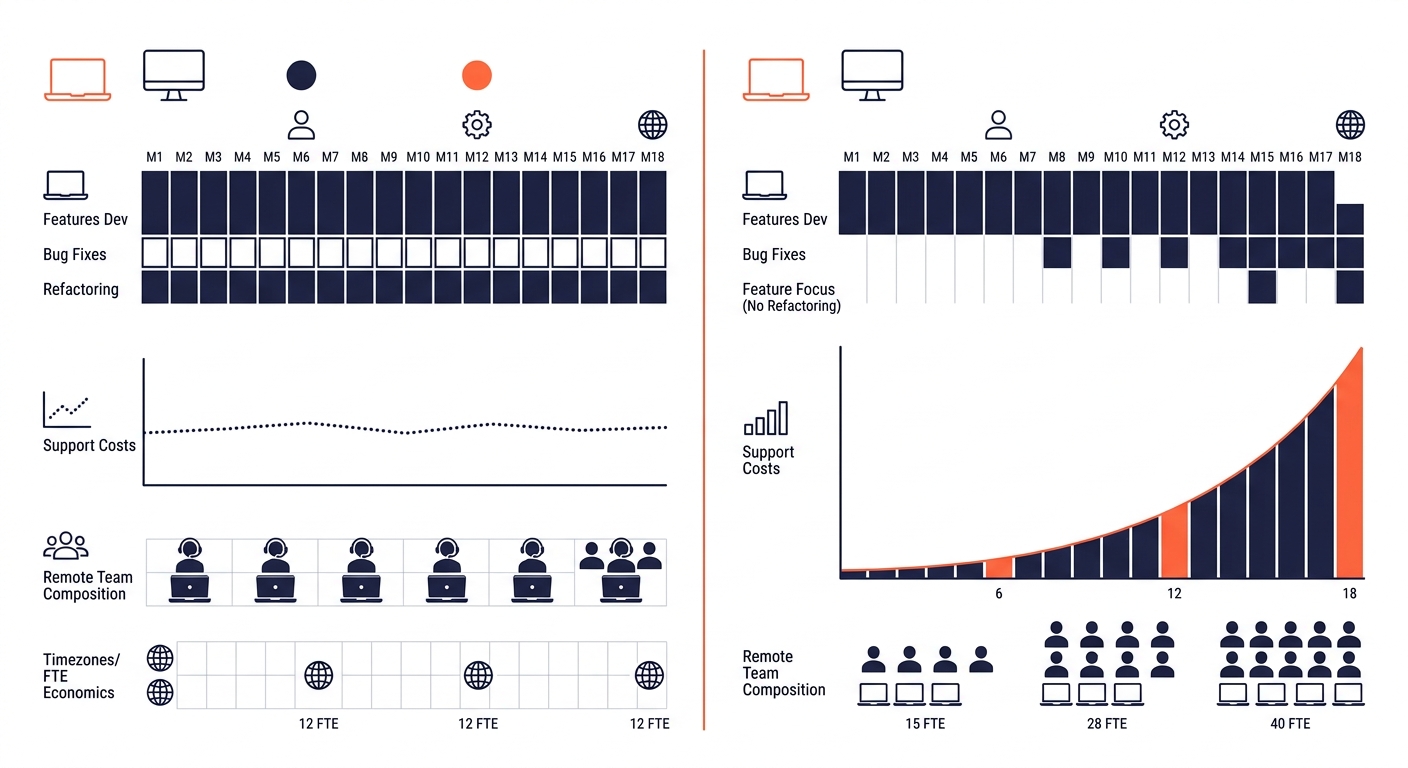
Production support headcount is a lagging indicator of architectural quality. Philippine web dev teams that build application maintainability into the development lifecycle through modular architecture, enforced sprint discipline, and pipeline-level quality gates don’t eliminate production support. They make it scale sub-linearly with codebase growth instead of super-linearly.
The numbers bear this out. When defect density in offshore development stays at or below 1 per 1,000 LOC instead of drifting 20–40% above that baseline, and when technical debt consumes 10% of engineering time instead of 33%, the economics of application maintainability outsourcing shift decisively. You’re paying Philippine rates ($35–50/hour for senior talent) for engineers who spend the majority of their time building features rather than fighting fires. The alternative is hiring more support engineers at similar rates to manage escalating defect loads, which is the production support treadmill that eats margins without improving the product.
Lower hourly rates, as Flexiple’s analysis emphasizes, do not reliably reduce total cost because total cost depends on rework, delivery predictability, and management overhead. Web app architecture for stability is where total cost gets determined, long before the first support ticket arrives.