
Outsourcing contracts are the backbone of successful partnerships, especially when dealing with providers in regions like the Philippines. Without clear terms, projects can face delays, budget overruns, or legal issues. Key contract clauses – such as confidentiality, dispute resolution, termination terms, service level agreements (SLAs), and intellectual property rights – help avoid these risks by clearly defining responsibilities and expectations.
Here’s what matters most:
- Confidentiality: Protect sensitive data with NDAs and ensure ownership of intellectual property.
- SLAs: Define performance metrics, uptime guarantees, and remedies for unmet standards.
- Termination Clauses: Plan for smooth exits with clear notice periods and transition processes.
- Legal Compliance: Align contracts with local laws like the Philippine Data Privacy Act or global standards like GDPR.
For example, 365Outsource.com, a provider in the Philippines, emphasizes local compliance, ADR for disputes, and strict data protection measures. General outsourcing providers, however, may include broader "Termination for Convenience" clauses but often at higher exit costs.
Takeaway: A well-structured contract minimizes risks, ensures accountability, and protects your interests. Whether you work with a provider like 365Outsource.com or a general firm, understanding these clauses is essential for long-term success.
1. 365Outsource.com

Confidentiality and Data Protection
Partnering with 365Outsource.com means your sensitive information is protected through Non-Disclosure Agreements (NDAs) and Non-Compete clauses. These contractual safeguards ensure that trade secrets, such as bookkeeping records or proprietary marketing strategies, remain secure and prevent the provider from working with direct competitors. Such measures are a cornerstone of outsourcing relationships in the Philippines, where maintaining client confidentiality is a top priority.
Additionally, contracts enforce compliance with global data protection standards. For U.S. businesses, this often includes references to regulations like the General Data Protection Regulation (GDPR) for EU clients or the Data Protection Act 2018 for UK operations. By adhering to these international standards, 365Outsource.com ensures that its data handling practices align with global expectations, reducing risks of breaches or regulatory fines.
Service Level Agreements
Service Level Agreements (SLAs) are a critical part of contracts with 365Outsource.com. These documents set clear expectations around service quality, performance metrics, and remedies for any shortcomings. SLAs cover essential details like service availability, performance benchmarks, and response times for urgent matters.
For example, they often include uptime guarantees and specific response windows to ensure timely support. If agreed-upon standards aren’t met, the SLA outlines remedies such as service credits or fee reductions. This mutual understanding helps maintain accountability and fosters a productive working relationship.
Termination and Transition Clauses
Termination clauses in contracts with 365Outsource.com are designed to protect business continuity. They differentiate between termination for cause (e.g., a contract breach) and termination for convenience (e.g., ending the relationship early for any reason). Written notice – typically 30, 60, or 90 days in advance – is required in most cases. This notice period gives both parties time to prepare for the transition, reducing the risk of operational disruptions.
Transition clauses further ensure a smooth exit process. These provisions detail how knowledge transfer, data handover, and ongoing project management will be handled during the transition period. By addressing these aspects, the contract minimizes service interruptions and ensures a seamless handoff.
2. General Outsourcing Providers
Confidentiality and Data Protection
When working with general outsourcing providers, it’s crucial to ensure that contracts clearly state who owns the data. The agreement should explicitly confirm that you retain ownership of all data and intellectual property. It should also ensure that the provider cannot withhold your information due to non-payment – a key safeguard if the partnership ends abruptly.
Security is another cornerstone. Providers should adhere to established standards like ISO 27001, ISO 27002, and SSAE 18 (SOC 2/3). These certifications show that the provider has robust data protection measures in place.
Be specific about where your data will be stored. This helps clarify which privacy laws apply and ensures compliance with GDPR transfer rules if applicable. At the end of the relationship, require the provider to issue destruction certificates, signed by authorized personnel, to confirm all data has been securely deleted.
Liability for data breaches has also shifted. While unlimited liability was once common, providers now tend to use "super caps" – higher limits ranging from 100% to 500% of annual fees – for breaches involving confidentiality or data protection. This marks a departure from the typical 200% cap seen in general business outsourcing agreements.
By setting clear data protection terms, you establish a solid foundation for holding providers accountable.
Service Level Agreements
Service Level Agreements (SLAs) with general outsourcing providers focus on measurable outcomes. These agreements should outline specific guarantees, such as uptime percentages, response times for urgent issues, and financial penalties if standards aren’t met. Performance-based compensation tied to milestones ensures accountability.
Termination and Transition Clauses
Planning for the end of a contract is just as important as starting one. General providers often accept liability caps of 200% or more of fees paid, a much higher threshold compared to the typical 12-month fee cap seen in SaaS contracts.
"A service provider is typically in a position to cause far greater damage to its customer than vice versa." – Norton Rose Fulbright
Include a detailed transition plan in your contract. This plan should outline clear timelines and require the return of your data in neutral, accessible formats to avoid vendor lock-in. To maintain service quality during the exit period, consider adding higher liquidated damages for SLA breaches. This ensures that providers remain accountable, even as they prepare to exit.
Lessons from past failures, like the BBC–Siemens deal, underscore the risks of rigid exit clauses.
Compliance with Legal Obligations
Meeting legal requirements strengthens your outsourcing strategy. Providers cannot exclude liability for death, personal injury caused by negligence, or fraud. Beyond these basics, contracts should address regulations relevant to your industry, such as GDPR, PCI DSS for payment processing, or CCPA for California consumer data.
In industries like banking, contracts are increasingly including assumed losses clauses. These allow recovery of specific costs – like re-procurement expenses or regulatory fines – that might otherwise be considered indirect losses.
Finally, make sure your contract includes audit rights. This allows you to conduct regular penetration tests and security reviews, ensuring the provider remains compliant throughout the partnership.
23 Procurement Contract Clauses You NEED to KNOW 🧠
sbb-itb-5665bbf
Pros and Cons
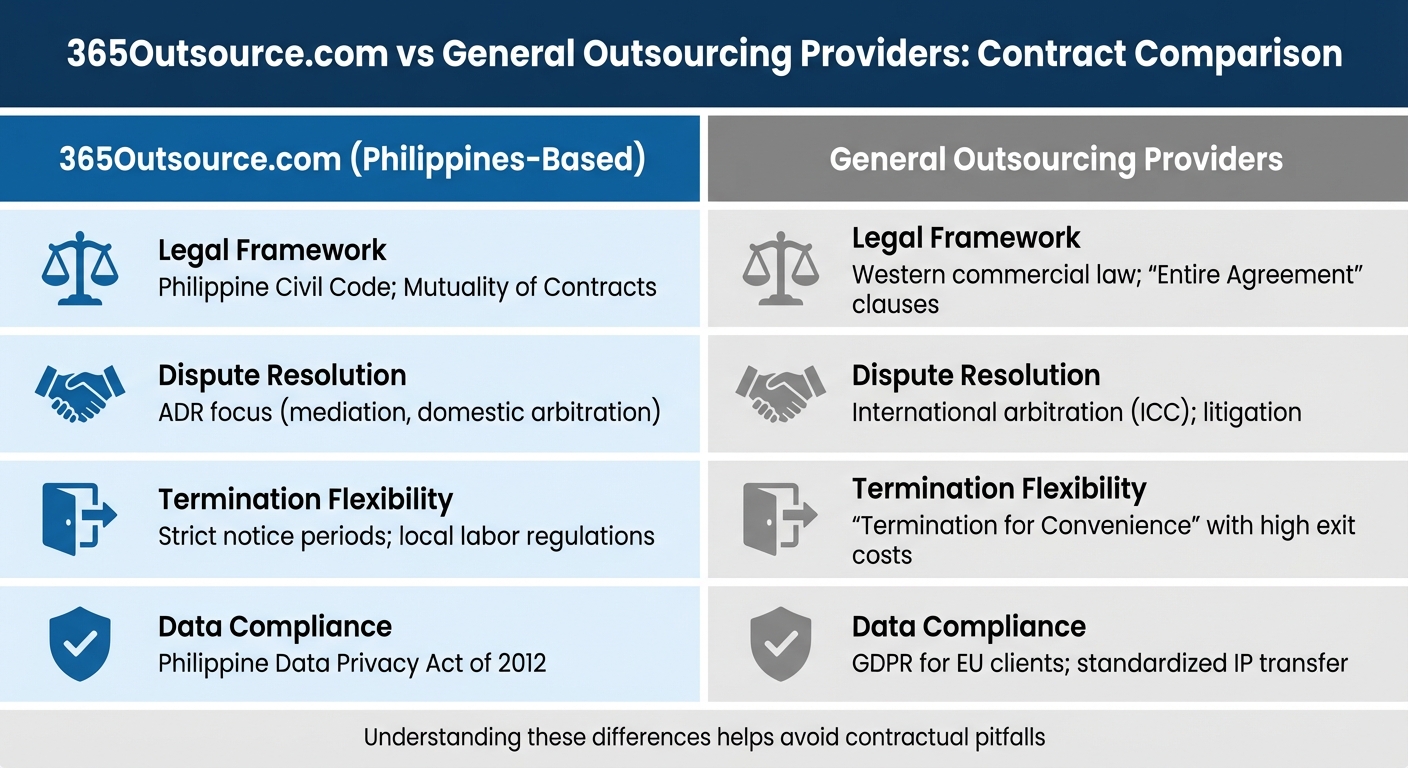
365Outsource.com vs General Outsourcing Providers: Key Contract Differences
Taking a closer look at the key clauses, it’s clear how the advantages and challenges of different outsourcing approaches play out in real-world contracts.
For example, 365Outsource.com operates under the Civil Code of the Philippines, which prioritizes "Mutuality of Contracts." This means neither party can alter the terms without mutual consent. They emphasize Alternative Dispute Resolution (ADR), which offers quicker and less formal ways to resolve disputes. These legal and operational practices make their approach distinct from that of general outsourcing providers.
On the other hand, general outsourcing providers often follow Western commercial law, which leans heavily on "Entire Agreement" clauses. These providers typically include "Termination for Convenience" clauses, allowing clients flexibility to end agreements early. However, this flexibility can come with hefty financial penalties that catch clients off guard. Dispute resolution for these providers often involves international arbitration through organizations like the ICC. While effective, this process can be both costly and time-consuming.
Cost structures also vary significantly. General providers frequently impose exit management fees to cover all transfer costs, while Philippine-based providers like 365Outsource.com must adhere to local labor laws, which impact termination claims. Michael Edwards, a Commercial Corporate Solicitor, highlights the risks of poorly structured termination clauses:
"A poorly drafted termination clause with insufficient notice periods could leave a business scrambling to find a new provider, while excessively long notice periods could lock a company into an unproductive relationship for months or even years".
Here’s a quick side-by-side comparison of the two approaches:
| Feature | 365Outsource.com | General Outsourcing Providers |
|---|---|---|
| Legal Framework | Philippine Civil Code; Mutuality of Contracts | Western commercial law; "Entire Agreement" clauses |
| Dispute Resolution | ADR focus (mediation, domestic arbitration) | International arbitration (ICC); litigation |
| Termination Flexibility | Strict notice periods; local labor regulations | "Termination for Convenience" with high exit costs |
| Data Compliance | Philippine Data Privacy Act of 2012 | GDPR for EU clients; standardized IP transfer |
Whether you go with a provider based in the Philippines or a more general outsourcing firm, understanding these differences is crucial. It helps you sidestep common contractual missteps and ensures better risk management.
Conclusion
The way providers handle legal risks often shapes their contractual structures. For example, 365Outsource.com focuses on customized legal agreements, while some providers stick to generic templates, which can lead to confusion and potential issues.
These contrasting strategies can significantly impact the success of partnerships. Failure rates in outsourcing highlight the importance of having clear, well-drafted contracts. As Brad Peterson, Partner at Mayer Brown, explains:
"When contract language is unclear, the parties develop different interpretations of the contract and those differences lead to disputes".
To reduce these risks, it’s wise to negotiate personalized agreements instead of depending on one-size-fits-all templates. Key elements to include are clauses on project scope, SLAs, intellectual property, data security, and business continuity. It’s also essential to define material breaches, establish clear liability limits, and plan exit strategies right from the beginning.
The bottom line? Clarity is everything. Spell out subcontracting terms, require written notices for issues, and consult local legal professionals to navigate potential risks. These steps are critical to protecting your interests and avoiding expensive disputes.
FAQs
What are the essential clauses to include in an outsourcing contract?
When putting together an outsourcing contract, including specific clauses is essential to safeguard your business and encourage a smooth working relationship. Here are some critical elements to consider:
- Scope of Work (SOW): Lay out the details of the services, deliverables, and responsibilities. This helps set clear expectations and prevents confusion down the line.
- Confidentiality: Protect your sensitive business information by ensuring it won’t be shared or used without your consent.
- Intellectual Property Rights: Clarify who owns any work or materials created during the collaboration to avoid disputes later.
- Payment Terms: Detail when and how payments will be made, including penalties for delays or missed payments.
- Dispute Resolution: Define how disagreements will be handled – whether through mediation, arbitration, or another process.
- Termination Conditions: Specify the situations under which either party can terminate the agreement and the steps involved.
- Data Security and Compliance: Address compliance with data protection laws and outline measures for securely handling sensitive data.
By including these clauses, you can reduce risks, promote transparency, and set the stage for a successful outsourcing partnership.
What impact do termination clauses have on outsourcing agreements?
Termination clauses are an essential part of outsourcing agreements. They spell out the steps, notice periods, and any costs involved in ending the contract. This clarity ensures both parties are on the same page about their responsibilities and rights, reducing the chances of disputes or legal issues.
By setting clear terms for ending the partnership, these clauses help maintain professionalism, even when the agreement comes to an end. They safeguard both the client and the outsourcing provider, ensuring trust and smoother transitions when parting ways.
Why is it important to ensure legal compliance in outsourcing contracts, and what key laws should be addressed?
Ensuring legal compliance in outsourcing contracts is critical for avoiding risks like legal disputes, financial penalties, or damage to your reputation. It establishes a framework where both parties operate within the boundaries of relevant laws, building a secure and reliable working relationship.
Some key areas to focus on include data protection and privacy laws (like GDPR for EU interactions or CCPA for California residents), intellectual property rights, employment laws, and cross-border trade regulations. These considerations become even more important when outsourcing internationally, as they address challenges such as data security, labor standards, and dispute resolution mechanisms. By making compliance a priority, businesses can better protect their operations and create more seamless outsourcing partnerships.