
Outsourcing quality assurance (QA) can save businesses up to 70% in costs while improving efficiency and product quality. By leveraging external QA teams, companies gain access to skilled testers, reduce overhead, and speed up release cycles by 30–40%. This guide explains how to outsource QA effectively, covering key benefits, engagement models, and best practices.
Key Takeaways:
- What is QA Outsourcing? Delegating testing tasks to external teams (nearshore or offshore) for functional, performance, security, and usability testing.
- Why Outsource QA? Save costs, access expert talent, and scale resources flexibly.
- Benefits: Cost reduction, faster defect detection, and access to specialized tools and skills.
- How to Succeed: Define testing needs, choose the right provider, and ensure smooth onboarding and communication.
- Legal & Security: Use contracts, NDAs, and strong data security measures to protect sensitive information.
QA outsourcing transforms testing into a scalable, results-driven process, helping businesses maintain high-quality standards while focusing on core innovation.
The Ultimate Guide to Outsourcing QA Success
sbb-itb-5665bbf
Benefits of Outsourcing QA
Outsourcing quality assurance can bring about three major advantages that directly impact your operational efficiency and bottom line. By understanding these benefits, you’ll be better equipped to determine when and how to leverage external testing expertise in your processes. These advantages build on earlier insights, making QA outsourcing a strategic move for modern organizations.
Lower Costs and Smarter Resource Allocation
Outsourcing QA delivers immediate cost savings. Companies often see a 60–70% reduction in expenses compared to building in-house QA teams. For example, Western European companies can save around 25% on QA costs, while U.S.-based firms see savings of up to 66%. This shift transforms fixed salary expenses into flexible, usage-based costs that align with actual testing needs. It also cuts down on overhead expenses like office space, testing hardware, and software licenses. Plus, it eliminates the time and money spent on recruiting, onboarding, and training specialized staff.
"The cost to fix defects grows exponentially the later they’re found – outsourced QA shifts discovery earlier, where remediation is cheapest and least disruptive." – Kimon Services
Outsourcing also allows your internal development team to focus on core product features and innovation. External QA specialists can implement shift-left testing, identifying defects earlier in the development lifecycle when they’re easier and cheaper to fix. This approach can speed up release cycles by 30–40%.
Access to Expert QA Talent
With outsourcing, you gain instant access to skilled professionals in specialized areas your in-house team may lack, such as AI-driven testing, performance engineering, security audits, accessibility compliance, and fraud detection. These experts bring industry-tested methods that reduce the learning curve and deliver faster results.
Outsourcing providers handle the entire recruitment process, including vetting for technical skills, tool expertise, and even language proficiency. This means you avoid the lengthy hiring process while gaining access to pre-qualified talent from top outsourcing destinations. Additionally, these teams often come equipped with the latest testing tools and frameworks, such as Selenium, Cypress, Playwright, and Appium, saving you the cost of licenses and training. Whether you need Software Developers in Test (SDETs), Automation Testers, or QA Directors for strategic oversight, outsourcing provides a full range of QA roles.
Scalability and Flexibility
Outsourcing QA also offers unmatched flexibility, allowing you to scale resources up or down depending on your project needs. On-demand QA teams can be deployed in as little as 48 hours, making it easy to address production defects or meet tight release deadlines.
The pay-as-you-go model ensures you only pay for testing when it’s performed. This is especially useful for handling peak periods, like Black Friday or tax season, and scaling down afterward without the burden of permanent salaries. Additionally, global QA teams operating across time zones ensure continuous testing and monitoring, which is crucial for maintaining quality in fast-paced environments.
This flexibility also applies to specialized projects. Need experts for performance testing, security audits, or accessibility compliance? Outsourcing allows you to bring in specialists temporarily for these initiatives, avoiding the need for full-time hires. This agile approach can deliver up to an 80% increase in ROI and 50% cost savings compared to maintaining internal teams.
How to Outsource QA Successfully
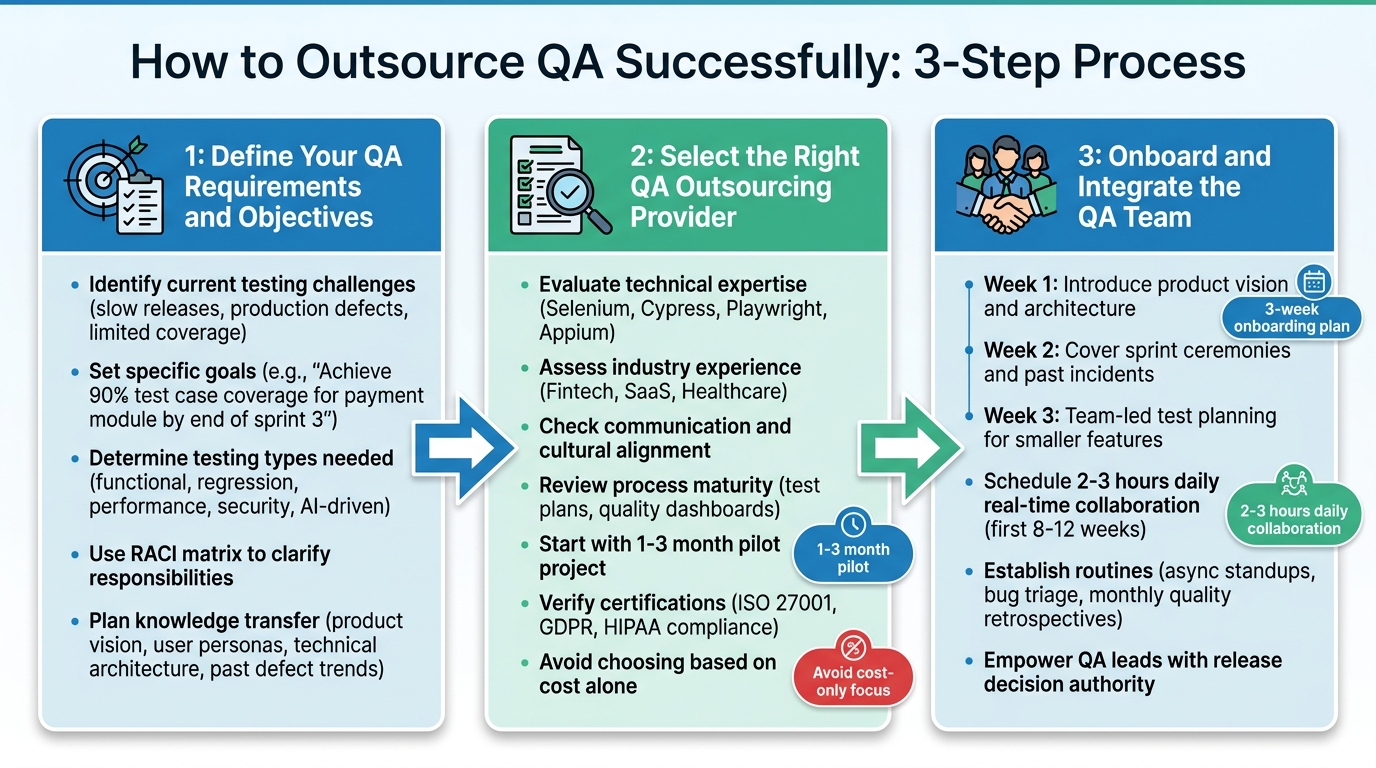
3-Step Process for Successful QA Outsourcing Implementation
Outsourcing QA isn’t just about hiring a vendor and handing over test scripts. It takes a well-thought-out plan that aligns your business goals with the provider’s strengths while ensuring your remote team is set up for success. Here’s how to turn QA outsourcing into a strategic asset.
Step 1: Define Your QA Requirements and Objectives
Start by identifying your current testing challenges. Are you struggling with slow release cycles, frequent production defects, or limited test coverage? Use these pain points to set specific goals. For instance, if your payment module has been a recurring issue, you might aim for something like: “Achieve 90% test case coverage for the payment module by the end of sprint 3”.
Next, determine the types of testing you need – functional, regression, performance, security, or even AI-driven testing. Define what “quality” looks like for your product. This could mean pinpointing critical user flows that must remain error-free or setting acceptable defect levels for different severity categories. Also, decide on the expertise you require, whether it’s manual testers, automation engineers, or Software Developers in Test (SDETs).
To avoid confusion, use a RACI matrix to clarify responsibilities. For example, Product Managers might own acceptance criteria, Developers handle unit testing, and QA teams validate overall functionality. Additionally, plan for knowledge transfer by sharing details about your product vision, user personas, technical architecture, and past defect trends.
Once your objectives are clear, you’re ready to find a provider that aligns with these needs.
Step 2: Select the Right QA Outsourcing Provider
Choosing a QA partner involves more than just comparing hourly rates. Look for technical expertise with tools like Selenium, Cypress, Playwright, or Appium. Industry experience matters too – whether it’s Fintech, SaaS, or Healthcare – since familiarity with your field often means better understanding of compliance requirements and common quality pitfalls.
Don’t underestimate the importance of communication and cultural alignment. During initial discussions, assess their English proficiency and communication style to ensure smooth collaboration. Ask for examples of their process maturity, like test plans or quality dashboards. Providers with clear workflows and metrics tracking can demonstrate their ability to manage defects effectively.
Start with a 1–3 month pilot project to evaluate their technical skills, communication, and ability to scale. This trial period also helps you gauge their ability to replace key personnel quickly if needed. For projects involving sensitive data, verify certifications like ISO 27001 and compliance with GDPR or HIPAA.
Avoid making decisions purely based on cost. Low-cost providers often skimp on training and processes, which can lead to delays that outweigh any initial savings. Instead, look for partners who are upfront about pricing and willing to discuss trade-offs honestly.
Once you’ve selected a provider, focus on integrating them into your team effectively.
Step 3: Onboard and Integrate the QA Team
For your outsourced QA team to succeed, they need to feel like an integral part of your product team. As Debasis Pradhan, Founder and CEO of CredibleSoft, explains:
"Your developers feel like part of our product team, but your QA team feels external".
This disconnect can hurt collaboration and quality ownership.
Adopt a structured onboarding plan over three weeks. In Week 1, introduce your product vision and architecture. Week 2 can focus on sprint ceremonies and past incidents, while Week 3 involves team-led test planning for smaller features. This approach fosters a deeper understanding of your product and goals, rather than overwhelming the team with endless documentation.
During the first 8 to 12 weeks, schedule 2–3 hours of real-time collaboration each day to help the team settle in. Define clear handoff protocols for work that happens asynchronously. Establish routines like asynchronous standups, bug triage sessions, and monthly quality retrospectives to keep everyone aligned, even across time zones.
Empower your QA team by giving them shared responsibility for quality. High-performing teams allow QA leads to influence release decisions and even veto releases if quality standards aren’t met. This level of trust turns outsourced QA into a true partnership, ensuring your product and customers are well-protected.
How to Maintain Consistency in Remote QA Teams
Once your remote QA team is onboarded, the next hurdle is ensuring consistency across different time zones, work environments, and cultural differences. The key to success lies in having clear and accessible processes. Let’s dive into some practical strategies to help maintain consistency in your remote QA operations.
Create Clear QA Processes and Documentation
Having well-defined processes and responsibilities is crucial. Whether it’s functional testing, automation, performance validation, or regression cycles, everyone on the team should know their role and tasks. This clarity eliminates confusion and ensures accountability.
Centralize all documentation – setup guides, API details, code logic explanations, and change logs – in a searchable platform like Confluence or GitBook. A structured code review process can also make a big difference. Use tools like SonarQube for automated pre-reviews, followed by developer self-checks, peer reviews, and final sign-offs from technical leads. This multi-step approach helps catch defects early, with studies showing up to 60% of issues can be identified before testing even starts.
To keep reviews efficient, limit sessions to an hour and focus on 200–400 lines of code at a time. Treat documentation updates as seriously as code changes by requiring peer reviews through pull requests. Top-performing teams aim for 90% documentation coverage and update it weekly to keep information relevant. Considering that 78% of businesses using offshore teams report quality improvements due to strong frameworks, investing in structured documentation is a no-brainer.
With clear documentation in place, you can establish reliable metrics to measure success.
Set and Track Quality Metrics
Define measurable quality goals that align with your business objectives. For example, aim for a defect density of less than 2 per 1,000 lines of code or ensure at least 80% test coverage for key components.
Automated quality gates in your CI/CD pipeline can help enforce these standards. Set thresholds for coverage, security, and complexity, such as keeping logic complexity (CCN) below 15 and code duplication under 5%. These automated checks provide instant feedback, ensuring consistency regardless of time zones.
Monitor trends like Mean Time to Detect (MTTD) and Mean Time to Resolve (MTTR) for vulnerabilities. Effective initial reviews should aim for post-review code churn below 15%. Companies that adopt structured quality control systems often see a 65% boost in project success rates, while specific QA practices can reduce defects by 75% and improve project outcomes by 30%.
| Metric Category | Target Threshold | Measurement Method |
|---|---|---|
| Defect Density | < 2 per 1,000 LOC | Automated scan |
| Test Coverage | > 80% | Coverage reports (e.g., JaCoCo) |
| Logic Complexity | < 10-15 per function | PMD or SonarQube |
| Code Duplication | < 5% | ESLint or CodeClimate |
Build Strong Communication and Collaboration
Effective communication can make or break remote QA teams. Treat your QA team as an integral part of your organization, not just an external vendor. A structured communication plan is essential – define what information needs to be shared, who handles responses, and which tools to use, such as Slack, Teams, or Jira.
Balance synchronous and asynchronous work. Use daily asynchronous standups to maintain visibility without disrupting workflows, while ensuring 2–3 hours of real-time overlap for live discussions. Regularly scheduled meetings, such as weekly bug triage sessions, monthly quality reviews, and quarterly performance evaluations, help align priorities and tackle blockers. For complex tasks, record demo sessions or use video conferencing to provide clarity across distances.
Empowering your QA team is equally important. Give offshore QA leads the authority to halt releases if quality benchmarks aren’t met. For example, a SaaS company working with CredibleSoft scaled from 50,000 to over 500,000 users between 2024 and 2026. By embedding their offshore QA team into sprint planning and granting them veto power over releases, they reduced production defects by nearly 50% within six months. This approach shifts the QA team’s role from simple testers to strategic partners, fostering critical thinking and user-focused solutions.
Legal and Security Considerations for QA Outsourcing
When outsourcing QA, it’s not just about aligning processes and ensuring smooth communication. You’re also handing over access to your code, user data, and business logic – making legal and security precautions absolutely critical. As Conectys explains:
"Outsourcing does not absolve a company of its legal responsibility for its data. Even when a third-party provider… manages customer or business information, the company remains accountable".
With GDPR fines surpassing $2.1 billion in 2024 alone, overlooking these considerations could be a costly mistake.
Use Proper Contracts and Agreements
The contract you establish is the backbone of your outsourcing relationship. Start with a Master Service Agreement (MSA) to define the overall rights, responsibilities, and obligations of both parties. Then, add Statements of Work (SOWs) to detail specific aspects like service levels, performance metrics, payment terms, and scope. Be sure to include intellectual property clauses that clearly define ownership of code, test scripts, and documentation. This is especially important in regions where legal enforcement can be slow, as it helps prevent expensive disputes.
Non-Disclosure Agreements (NDAs) are another must. They safeguard your trade secrets and proprietary information. Additionally, your contracts should include data protection clauses to ensure compliance with regulations like GDPR, HIPAA, and data residency laws. These clauses should extend to subcontractors, requiring them to meet the same standards. Don’t forget provisions for data breach notifications, incident response protocols, and clear processes for dispute resolution and contract termination.
Once your legal framework is solid, the focus shifts to implementing technical protections.
Apply Strong Data Security Measures
Protecting your data starts with robust security practices. Use end-to-end encryption, enforce multi-factor authentication (MFA), and regularly review access permissions. Given that over 80% of companies faced at least one insider security incident in 2024, access controls and ongoing staff training on phishing and data handling are non-negotiable.
Before signing any agreements, verify that your provider meets global security standards, such as ISO 27001 or SOC 2 certifications. By early 2025, privacy regulations were in place in 144 countries, covering 80% of the global population. Compliance isn’t just a formality – it’s a necessity. Include audit rights in your contract to enable regular security reviews and ensure transparency in how data is handled. Automated monitoring tools can help detect unusual activity early, while collaborative planning with your outsourcing partner can strengthen incident response and disaster recovery efforts.
| Security Measure | Implementation Detail |
|---|---|
| Encryption | Applied to data in transit and at rest across all systems |
| Access Control | Multi-factor authentication (MFA) with periodic reviews of permissions |
| Compliance | Adherence to GDPR, CCPA, HIPAA, or industry-specific regulations |
| Staff Training | Regular sessions on recognizing phishing attempts and handling data securely |
| Risk Assessment | Continuous evaluation of new threats with updates to security measures |
Conclusion
By adopting these strategies, QA outsourcing can shift from being a fixed cost center to a flexible service that speeds up release cycles by 30–40% and brings in specialized expertise – all while reducing testing costs by an impressive 60–70%.
Approach your QA partner as an integral part of your team, not just another vendor. Start with a 1–3 month pilot to assess both technical capabilities and team compatibility. From day one, establish clear quality benchmarks, and prioritize thorough onboarding and effective communication protocols. As Rupesh Garg, Founder at Frugal Testing, aptly explains:
"Outsourced QA fails when communication, documentation, and expectations break down… with the right structure, process, and vendor alignment, outsourced QA becomes a growth multiplier".
When you’re ready to take the plunge into QA outsourcing, consider 365Outsource.com. Their Philippines-based talent pool, combined with personalized account management, ensures consistency across remote teams. They also provide cost-effective staffing solutions across digital marketing, IT support, data processing, and virtual assistance – helping businesses scale efficiently without compromising on quality.
FAQs
When should I outsource QA instead of hiring in-house?
Outsourcing QA works well when companies need to save money, ramp up testing efforts quickly, or tap into specialized skills they lack internally. It’s particularly helpful for projects that demand adaptability, fast scaling, or advanced testing techniques. By outsourcing, businesses can concentrate on their main operations while still ensuring top-notch results. This approach is especially practical for large-scale or complex projects where keeping a full in-house QA team just isn’t realistic.
How do I protect my code and customer data with an outsourced QA team?
When working with an outsourced QA team, protecting your code and customer data requires a proactive approach. Start by implementing robust security measures. Encryption is critical for safeguarding sensitive information, while access controls ensure only authorized individuals can interact with your systems. Additionally, compliance with recognized standards like ISO 27001 or SOC 2 helps establish a strong foundation for data security.
Clear, well-defined contracts are another essential layer of protection. Include Non-Disclosure Agreements (NDAs) to maintain confidentiality, Data Processing Agreements (DPAs) to clarify data handling, and Service Level Agreements (SLAs) to set performance expectations. These agreements help outline responsibilities and reduce potential risks.
To stay compliant with regulations such as GDPR or HIPAA, conduct regular security audits and monitoring. These practices not only ensure adherence to legal requirements but also help identify and address vulnerabilities before they become issues.
Ultimately, while outsourcing can streamline processes, your business remains accountable for data security. Taking these steps ensures that your systems and customer trust are well-protected.
What should I track to prove outsourced QA is working?
To show that outsourced QA works, focus on tracking key metrics such as interaction evaluations, calibration consistency, and defect tracking. Keep an eye on improvements in customer satisfaction, adherence to testing protocols, and how quickly issues are resolved. Regular reviews are essential to maintain scoring consistency and drive ongoing improvements. These metrics not only measure the success of your QA efforts but also pinpoint areas where you can grow.