
Outsourcing pay-per-click (PPC) advertising can help nonprofits overcome common challenges like tight budgets, limited expertise, and time constraints. By working with specialized agencies, nonprofits can boost their PPC campaigns, reduce costs, and focus on their mission. Key takeaways include:
- Cost Savings: Outsourcing eliminates the need for full-time staff and includes access to premium tools, saving up to 50% on expenses.
- Expertise Access: Agencies provide skilled professionals who ensure campaigns are optimized and budgets are used effectively.
- Improved Results: Better targeting, ad copy, and tracking lead to more donations, volunteer sign-ups, and event participation.
- Scalability: Agencies can quickly adjust campaigns during fundraising peaks without long-term commitments.
Outsourcing PPC allows nonprofits to maximize their impact while focusing on what matters most – advancing their cause.
How to Leverage Digital Marketing to Drive Donations
sbb-itb-5665bbf
Common PPC Challenges for Nonprofits
While PPC offers incredible opportunities for nonprofits, managing these campaigns internally often comes with serious challenges. Tight budgets, lack of expertise, and overextended teams can make running effective PPC campaigns a tough task. These hurdles highlight why seeking outside PPC expertise can make a big difference in achieving success.
Limited Budgets and Resources
For nonprofits, hiring a dedicated PPC specialist can feel like a gamble – especially when there’s no guarantee of immediate results. On top of that, the tools needed for PPC management don’t come cheap. Platforms like SEMRush ($119/month), Unbounce ($80/month), and tools like MagicX or Wordstream ($49/month) can quickly add up. When campaigns are handled by inexperienced staff, ad budgets often get wasted on trial-and-error approaches. For example, targeting broad audiences that are unlikely to convert or running ads with high cost-per-click can drain funds fast.
Another common pitfall? Skipping negative keyword strategies. Without them, ads can show up in irrelevant searches – like someone looking for "free" products – wasting precious dollars.
"If you don’t know what you’re doing, you’ll soon blow your ad budget as you learn what works and what doesn’t. It could be weeks or months (and thousands of dollars) before you get an effective system in place." – PPC.io
These inefficiencies make a strong case for bringing in experts who can stretch every dollar further.
Missing Technical Expertise
Running successful PPC campaigns isn’t just about placing ads – it takes a mix of skills like platform-specific strategies, persuasive copywriting, graphic design, and technical know-how. For nonprofits, this can mean setting up conversion tracking, optimizing landing pages, or even handling advanced features like GCLID tracking and offline conversion imports. Unfortunately, most nonprofit teams don’t have specialists on hand to tackle these tasks.
To make things harder, advertising platforms constantly update their algorithms and ad formats. Keeping up with these changes while juggling other responsibilities is a tall order for internal teams.
"Hiring a team with this type of expertise… is unattainable for most small or medium-sized businesses." – PPC.io
Even achieving a high Quality Score – key to lowering cost-per-click and improving ad rank – requires technical finesse. Factors like mobile page load speeds under two seconds and highly relevant content play a huge role. Without the right expertise, these technical gaps can amplify risks and reduce campaign effectiveness.
Time Limitations and Scaling Issues
Nonprofit teams are often stretched thin, balancing multiple priorities at once. This can lead to diluted marketing efforts and even burnout. The reality is that about 20% of marketing channels typically drive 80% of website traffic or conversions. But without the time to dig into data and identify these high-performing channels, nonprofits may end up spreading their resources too thin.
During critical fundraising periods, quick adjustments and constant optimization are crucial. However, small teams often struggle to keep up with this fast pace. On top of that, scattered data can make it tough to scale campaigns effectively without centralized analytics. When teams can’t focus on the best-performing keywords or ads, they risk missing out on major opportunities during peak fundraising times.
These challenges show why outsourcing PPC management can be a game-changer. It not only lightens the load for internal teams but also improves campaign efficiency and results.
Benefits of Outsourcing PPC for Nonprofits
Nonprofits often face tight budgets, limited expertise, and time constraints. Outsourcing PPC (pay-per-click) campaigns can help tackle these challenges by cutting costs, tapping into professional expertise, and enhancing donor outreach. These advantages directly address the hurdles nonprofits encounter and enable more impactful engagement with supporters.
Lower Costs and Flexible Pricing
Outsourcing PPC campaigns eliminates the need to hire and maintain a full-time in-house team. That means no expenses for salaries, benefits, or specialized equipment. As Lisa Richards, CEO of The Candida Diet, puts it:
"This allows us to avoid investing in equipment, software, or the hiring of full-time employees dedicated exclusively [to] this work."
Agencies often bundle the costs of essential PPC tools into their fees, which can reduce spending by as much as 30–50%. Management fees are typically a small fraction of your ad budget – often as low as 12% – and monthly costs for outsourcing range from $1,500 to $10,000, depending on the complexity of the campaigns. Additionally, experts help avoid unnecessary expenses; for example, poor targeting can waste nearly 25% of PPC budgets.
Access to Skilled PPC Professionals
Cost savings are just the start. With outsourcing, you gain access to an entire team of specialists, including copywriters, designers, and technical experts who handle advanced tracking setups. Matt Little, Owner of Festoon House, highlights this benefit:
"PPC agencies are constantly aware of the newest tactics, algorithms, and trends; they’re experts in this field".
These professionals use advanced techniques like A/B testing, negative keyword management, and real-time bid adjustments to refine campaigns and minimize wasted spend. Agencies also understand nonprofit-specific rules, such as the IRS’s "33 percent rule" for maintaining 501(c)(3) status, and apply donor segmentation strategies. This is crucial since 80% of total fundraising revenue often comes from just 20% of donors.
Better Campaign Results
The expertise of outsourced teams often leads to noticeable improvements in campaign performance. By using data-driven strategies, they optimize campaigns for better outcomes. For instance, Andrew Cussens, owner of FilmFolk, shared that working with a specialized agency in early 2024 led to a 150% increase in website traffic – 75% of which came from new visitors – and a 30% boost in bookings for their drone photography services. Agencies also provide transparent reporting and conduct audits to identify and eliminate inefficient ad spend, ensuring every dollar is used effectively.
Easy Scaling During Fundraising Campaigns
Outsourcing offers flexibility, especially during high-pressure fundraising periods. Campbell Tourgis, COO of Wainbee, explains:
"Outsourcing PPC advertising to specialized agencies accelerates campaign setup and launch. This distinctly saves businesses valuable time".
Agencies can quickly scale campaigns up or down without requiring long-term commitments, making them perfect for seasonal or short-term initiatives. This allows your internal team to focus on critical tasks like donor stewardship – a key area, given that donor retention rates across nonprofits often see a decline of around 4.2%.
In-House vs. Outsourced PPC: A Comparison
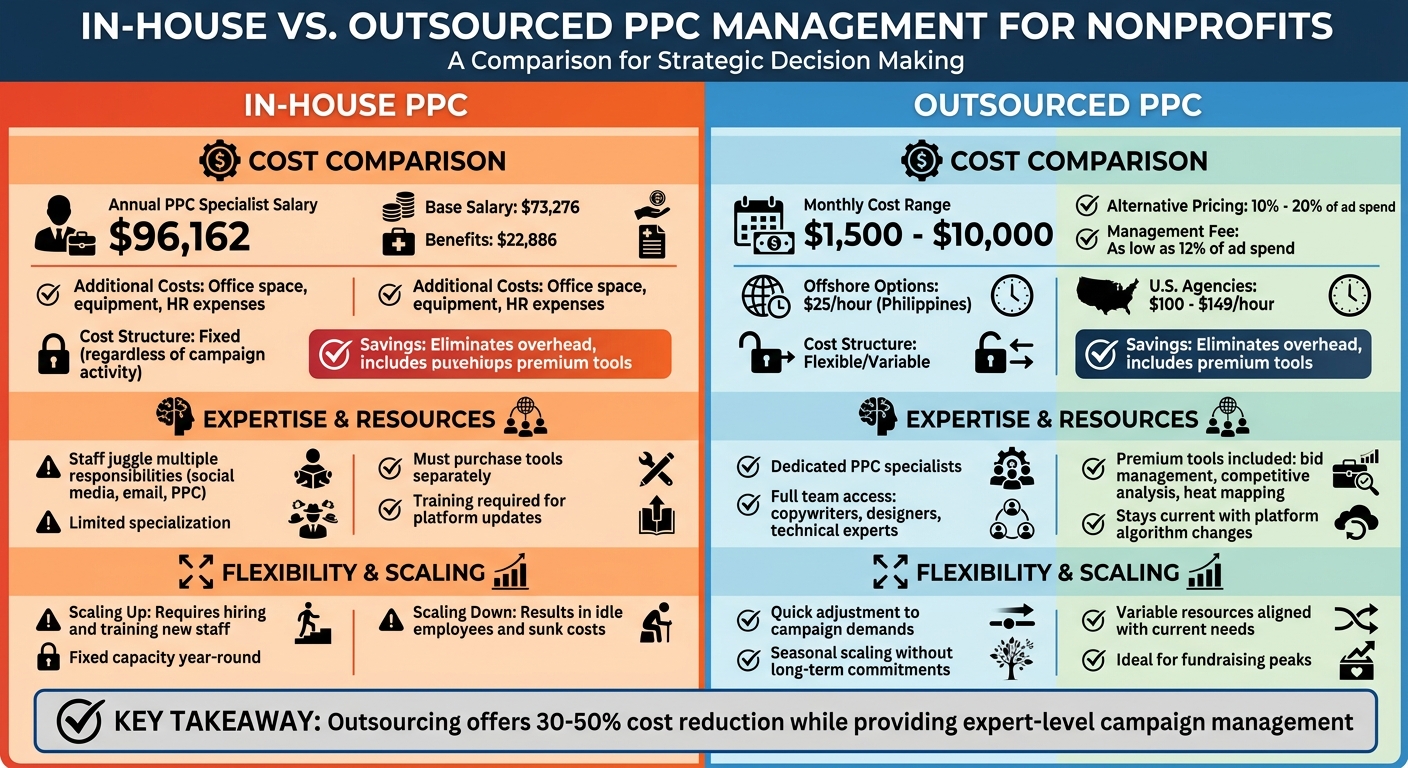
In-House vs Outsourced PPC Management for Nonprofits Cost and Resource Comparison
Managing PPC campaigns is a pivotal decision for nonprofits, especially when working within tight budgets and limited expertise. The choice between in-house management and outsourcing involves weighing costs, expertise, and operational flexibility – each with its own influence on campaign outcomes.
Cost Differences
The financial commitment for in-house and outsourced PPC management varies greatly. In-house setups involve fixed costs that remain steady regardless of campaign activity. For example, the average annual compensation for a PPC specialist in the U.S. is about $96,162, which includes a base salary of $73,276 and an additional $22,886 in benefits. Beyond salaries, nonprofits must also account for office space, equipment, and HR expenses.
Outsourcing, however, follows a more flexible pricing model. Agencies typically charge between $1,500 and $10,000 per month, or 10% to 20% of ad spend. This approach eliminates many overhead costs while offering access to premium tools. Nonprofits with tighter budgets might consider offshore agencies in the Philippines, where rates can be as low as $25 per hour. In comparison, U.S.-based specialized agencies often charge between $100 and $149 per hour. By partnering with firms like 365Outsource, nonprofits can tap into affordable talent without sacrificing quality. These cost differences highlight the trade-offs that extend into expertise and resources.
Expertise and Resource Levels
The skill and resource gap between in-house teams and agencies can be significant. In-house staff often juggle multiple responsibilities – social media, email marketing, and PPC – limiting their ability to specialize [2, 18].
Agencies, on the other hand, provide instant access to dedicated PPC specialists. As Kayla J., a PPC expert at WebFX, puts it:
"As the paid landscape rapidly evolves, there are always new platforms (and changes within existing platforms) to stay aware of… driving success from PPC requires a lot of dedicated time".
Agencies also invest in high-end tools for bid management, competitive analysis, and heat mapping – resources that are typically too costly for a single nonprofit to acquire independently [4, 19]. This level of expertise and access to tools gives agencies a clear edge.
Flexibility and Scaling Ability
Flexibility is another area where outsourcing shines. Agencies can adapt quickly to changing campaign demands. Francisco Kraefft from iVirtual explains:
"Need to ramp up spend for a seasonal promotion or scale back during slower periods? Agencies can typically adjust resources and campaign intensity more fluidly than hiring or reducing internal staff".
This adaptability is crucial during peak fundraising seasons, allowing nonprofits to scale up with strategists, copywriters, and designers without committing to year-round salaries [2, 18].
In contrast, in-house teams face challenges when scaling. Expanding capacity often means hiring and training new staff, while scaling down leads to idle employees and sunk costs. Outsourced agencies sidestep these issues by offering variable resources that align with current needs. This frees internal teams to focus on donor relationships and other core activities rather than getting bogged down by campaign logistics.
Why 365Outsource Works for Nonprofit PPC
When it comes to PPC (pay-per-click) advertising, nonprofits face unique challenges. They juggle tight budgets, mission-focused goals, and the need to show measurable results. That’s where 365Outsource steps in, offering solutions tailored specifically to meet these needs. By combining skilled expertise with cost-effective services, they help nonprofits achieve their advertising goals without breaking the bank.
Tailored PPC Campaign Management
Nonprofit advertising isn’t about selling products – it’s about driving action. Whether it’s acquiring donors, raising funds, or engaging communities, nonprofit campaigns need a different approach. 365Outsource crafts strategies that focus on storytelling, compelling visuals, and clear calls to action. They also fine-tune landing pages for better conversions and implement detailed performance tracking.
As Ngo Ads highlights:
"PPC allows nonprofits to target specific audiences, ensuring their budget is used efficiently and effectively."
This targeted approach ensures nonprofits get the most out of their advertising spend, creating cost efficiencies that matter.
Affordable Philippines-Based Talent
Budget constraints are a constant for nonprofits, which makes affordability a top priority. 365Outsource offers access to skilled professionals – PPC experts, copywriters, and designers – all based in the Philippines. This setup delivers significant savings compared to hiring full-time staff, as it eliminates expenses like salaries, benefits, and overhead costs.
Their pricing is straightforward and transparent, with management fees starting at just 12% of your total ad spend. Plus, essential software subscriptions are included, making it easier to manage costs.
Cost savings aside, nonprofits also benefit from the flexibility and expertise these professionals bring to the table.
Dedicated Support and Easy Integration
Managing PPC campaigns can be overwhelming, but 365Outsource simplifies the process by assigning dedicated account managers. These managers provide regular updates, clear communication, and focused oversight, ensuring your team stays on track. Whether through Slack, email, or project management tools, they make collaboration seamless.
Their experience comes from handling hundreds of campaigns, which means they know how to avoid common pitfalls and implement successful PPC campaign strategies that work. This allows your staff to focus on what matters most – building donor relationships and advancing your mission – while leaving campaign execution in expert hands.
Conclusion
Nonprofits often face challenges with PPC campaigns due to tight budgets, limited in-house expertise, and the constant pressure to deliver results. Outsourcing digital marketing tasks like PPC management can be a game-changer, offering immediate access to specialists who understand the intricacies of running successful campaigns. As Carrie Shefchik, CNAP at Wegner CPAs, puts it:
"Nonprofits don’t need to do everything in-house to do it well. Rather than maintaining full-time staff for every function, nonprofits can contract out specific tasks… especially those that are specialized, seasonal, or outside your core competencies."
This approach can lead to noticeable improvements – better keyword targeting, sharper ad copy, and more effective landing pages – handled by professionals who stay up-to-date with evolving platform algorithms and industry trends.
Outsourcing also helps cut operational costs, such as salaries, benefits, and software expenses, while freeing up your team to focus on what truly matters: engaging donors and advancing your mission. It also provides flexibility, allowing nonprofits to scale campaigns up or down based on fundraising needs, ensuring resources are used wisely.
FAQs
How do I know if my nonprofit is ready to outsource PPC?
If managing your nonprofit’s PPC campaigns feels like it’s eating up too much time, or your team doesn’t have the expertise to get the most out of them, outsourcing might be the solution. Partnering with professionals can help you improve campaign performance, make the most of your budget, and stay on top of PPC trends – all without stretching your internal resources too thin. If these challenges sound familiar, it could be the right moment to bring in expert help.
What should I ask a PPC agency before signing a contract?
Before committing to a PPC agency, it’s crucial to dig into their expertise and experience to ensure they can handle your campaigns successfully. Ask about the specific services they provide, such as campaign optimization, reporting, and strategy development. It’s also important to understand how they manage ad spend to minimize wasted budget.
To gauge their ability to deliver results for your nonprofit, request case studies or references. This will give you a clearer picture of their track record and whether they’ve achieved measurable outcomes for similar organizations.
How can I track donations and other offline results from PPC ads?
To keep tabs on donations and other offline outcomes from PPC ads, use tools that allow you to bring offline donation data into your online tracking system. For instance, you can manually input offline donations – like cash or checks – or upload them in bulk to keep your records accurate. By tying these donations to PPC campaigns through tracking codes or unique identifiers, you can evaluate campaign performance and properly attribute donor contributions.