
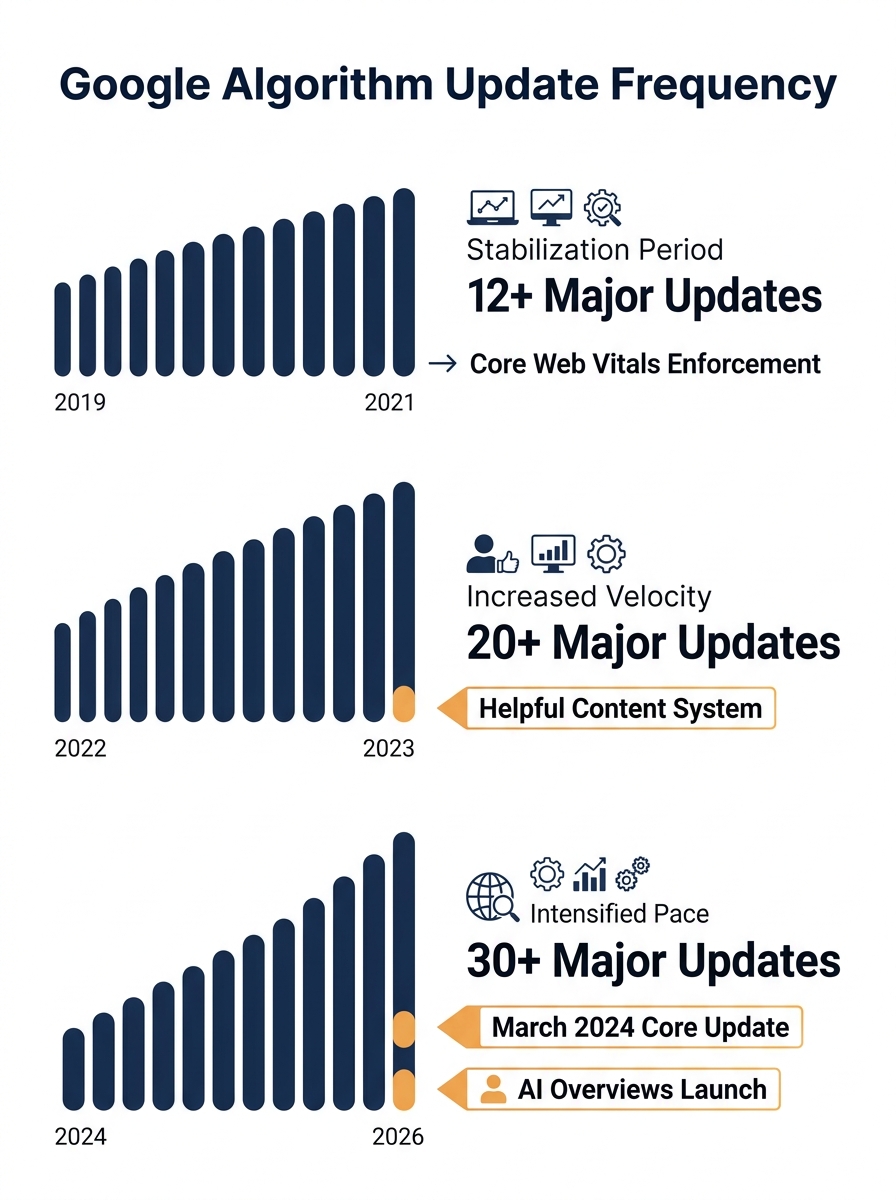
Google’s helpful content classifier, first deployed in August 2022, ran site-wide. One section of thin content could drag rankings across an entire domain, including pages that were genuinely useful. That single architectural decision inside Google’s algorithm changed the economics of content production for every US small business with organic traffic as a revenue channel. And it was the first in a cascade of updates that has, over the past four years, quietly redrawn the line between what SMBs can handle internally and what they should be sending to an offshore team.
The outsourcing decision framework most founders rely on is simple: “Can I afford it?” The more useful question, and the one Google’s update cadence keeps reshaping, is: “At my current revenue, can I afford the expertise this now requires?”
When One Marketer Could Handle Google
Before 2022, a competent generalist marketer could manage SEO, run Google Ads, write blog posts, and keep a WordPress site from falling apart. The knowledge required to stay competitive in search updated slowly. Core algorithm updates happened a few times per year, and the adjustments they demanded were manageable for someone wearing multiple hats.
For SMBs generating under $2 million in annual revenue, this arrangement made financial sense. A single full-time marketing hire at $55,000–$75,000 per year covered most digital needs. Google’s bar for content quality was lower, page speed requirements weren’t tied to ranking signals, and paid search campaigns could be managed with basic platform knowledge.
The cost-benefit analysis for offshore teams at this stage was hard to justify. There wasn’t enough specialized work to fill even a part-time outsourced role.
Helpful Content and Core Web Vitals Changed the Cost Structure
Two shifts happened in close succession. The helpful content system (August 2022, with a major overhaul in September 2023) penalized entire sites for hosting sections of low-quality content. And Core Web Vitals, which had been a ranking signal since mid-2021, started receiving enough weight that businesses with slow, poorly structured sites saw measurable drops.
These updates split what used to be one person’s job into at least two distinct skill sets. Content production now required someone who understood topical authority, internal linking architecture, and the difference between pages that satisfy search intent and pages that look like they do. Core Web Vitals demanded a developer who could diagnose Largest Contentful Paint issues, optimize JavaScript execution, and fix layout shifts that a marketer would never notice.
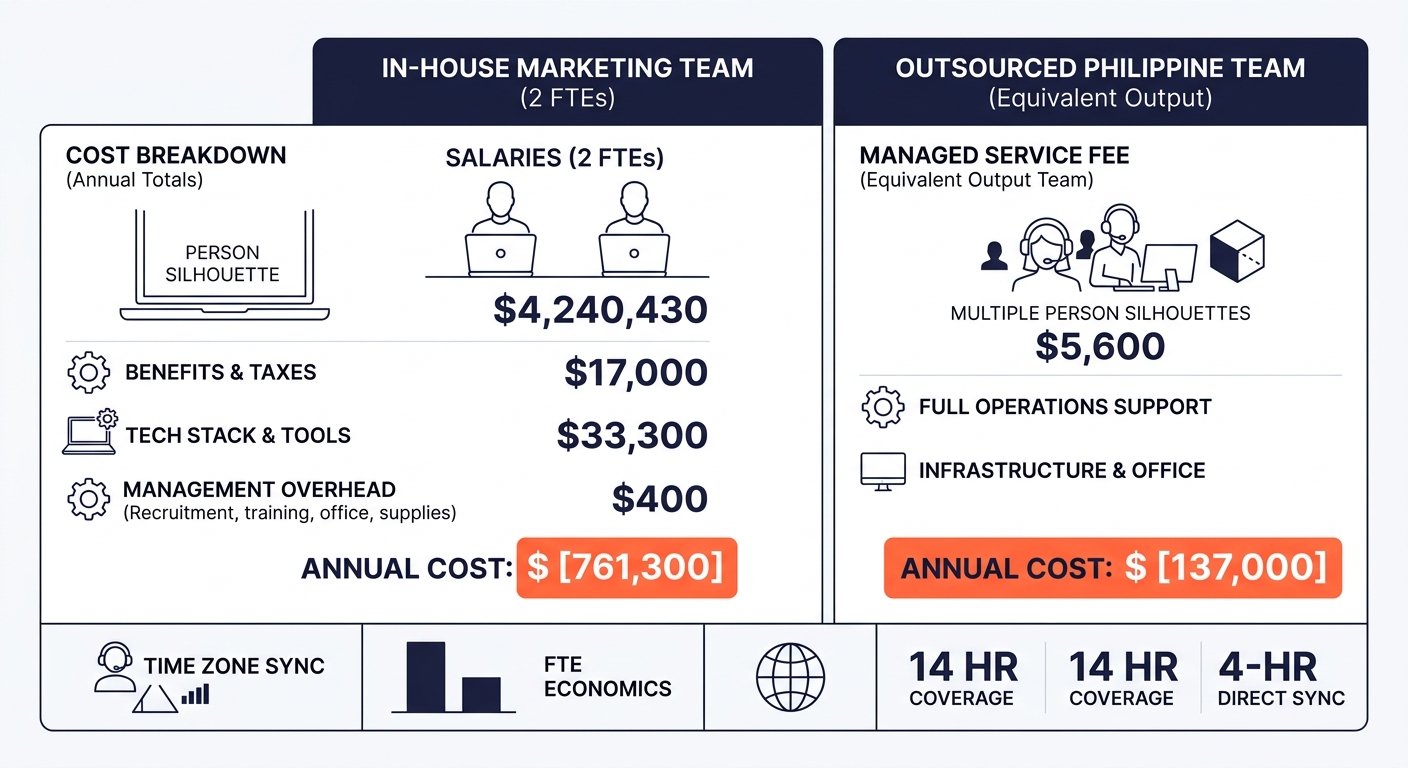
Building an in-house team with both capabilities means, at minimum, a content strategist and a front-end developer. According to NetSuite’s analysis of production economics, building internal teams involves significant capital expenses in hiring, onboarding, and ongoing overhead that scale faster than many SMB owners expect. Loaded cost for two full-time employees in a mid-tier US metro: $140,000–$190,000 per year before tools, software, or management time.
For businesses in the $1M–$3M revenue range, that’s 7–19% of gross revenue on two roles. The math started tilting toward outsourcing, and the SMB scaling revenue thresholds began to shift downward.
The March 2024 Core Update Broke the Generalist Model
Google’s March 2024 core update was the largest in years. It ran for 45 days, incorporated the helpful content classifier directly into the core ranking system, and deindexed a significant volume of sites that relied on scaled content production without editorial oversight.
For SMBs, the practical impact was this: the update punished exactly the kind of content that generalist marketers produce under time pressure. Thin service pages, keyword-stuffed blog posts, and AI-generated articles published without human editing all took hits. Recovery required content audits, strategic pruning, and rewriting at a pace that no single employee could sustain while also managing ads and day-to-day operations.
This is when the outsourcing question shifted from “can I afford to outsource?” to “can I afford not to?” If your site lost 30% of its organic traffic, you needed someone working on recovery full-time for weeks. An outsourced digital marketing team already staffed with SEO specialists and content editors could absorb that workload without the lag of posting a job listing, interviewing, and onboarding.
Each Google update raises the specialization floor. The revenue threshold where outsourcing makes sense drops every time the required expertise goes up.
Ramp-up time matters here. We’ve written about how offshore digital marketing teams outpace new full-time hires in the first 90 days, and the March 2024 update was the scenario that proved it. Businesses that could deploy a trained team within a week recovered faster than those that started hiring.
AI Overviews and Paid Search Migrations Added Another Layer
Google’s rollout of AI Overviews in search results and the auto-migration of Dynamic Search Ads to AI Max in early 2026 added two more specialization requirements to the stack.
AI Overviews compress the organic click-through funnel. Pages that used to earn clicks from position three or four now lose visibility to AI-generated summaries at the top of the results page. Competing for the remaining organic traffic requires structured data markup, content formatted for citation extraction, and an understanding of how Google’s large language models select source material. This is specialized knowledge that most in-house generalists don’t have and can’t acquire quickly.
On the paid search side, the AI Max migration broke campaigns for advertisers who didn’t understand the new automation logic. Businesses that needed to rebuild campaign performance after a migration went wrong discovered that fixing AI Max requires a different skill set than managing traditional keyword-targeted campaigns.
The decision between outsourcing and building in-house, as one analysis put it, should be grounded in operating constraints, product maturity, and the speed at which an organization must capture learning. Google’s pace of change has made that speed requirement much faster than most SMBs can match with internal hiring cycles.
The Revenue Thresholds That Hold Up
After tracking how these updates have reshaped staffing needs, here’s the cost-benefit analysis for offshore teams at each growth stage. The numbers assume US-based SMBs in service industries, ecommerce, or SaaS with meaningful dependence on Google for leads or sales.
Under $1M annual revenue: Outsource everything you can’t do yourself. At this stage, you’re choosing between doing it badly for free or paying $2,000–$4,000/month for a Philippine digital marketing team that handles SEO, content, and basic paid search. The in-house alternative costs $6,000–$8,000/month for one FTE who still can’t cover all three disciplines.
$1M–$3M annual revenue: The core outsourcing window. You need specialized content production, technical SEO, and someone managing paid campaigns. Hiring three people in-house runs $180,000–$270,000/year loaded. Outsourced content production paired with offshore PPC management delivers comparable output for $5,000–$10,000/month. According to Callbox’s research, 35% of companies outsourcing digital marketing cite the ability to scale without growing headcount as the primary driver.
$3M–$10M annual revenue: Hybrid territory. Keep strategy and brand decisions in-house with a marketing director or VP. Outsource execution: web development outsourcing for site performance and feature builds, offshore content teams for production volume, and specialized PPC management for campaign optimization. Your in-house lead sets direction; the outsourced team ships the work.
Above $10M annual revenue: You can afford in-house specialists, but the question is whether you should. Businesses at this stage still outsource 40–60% of execution because the growth-stage outsourcing timing advantage doesn’t disappear at scale. It shifts from cost savings to speed and flexibility. When Google ships a major update, an outsourced team with dedicated SEO analysts can respond within days. An in-house team of two or three people has to triage.
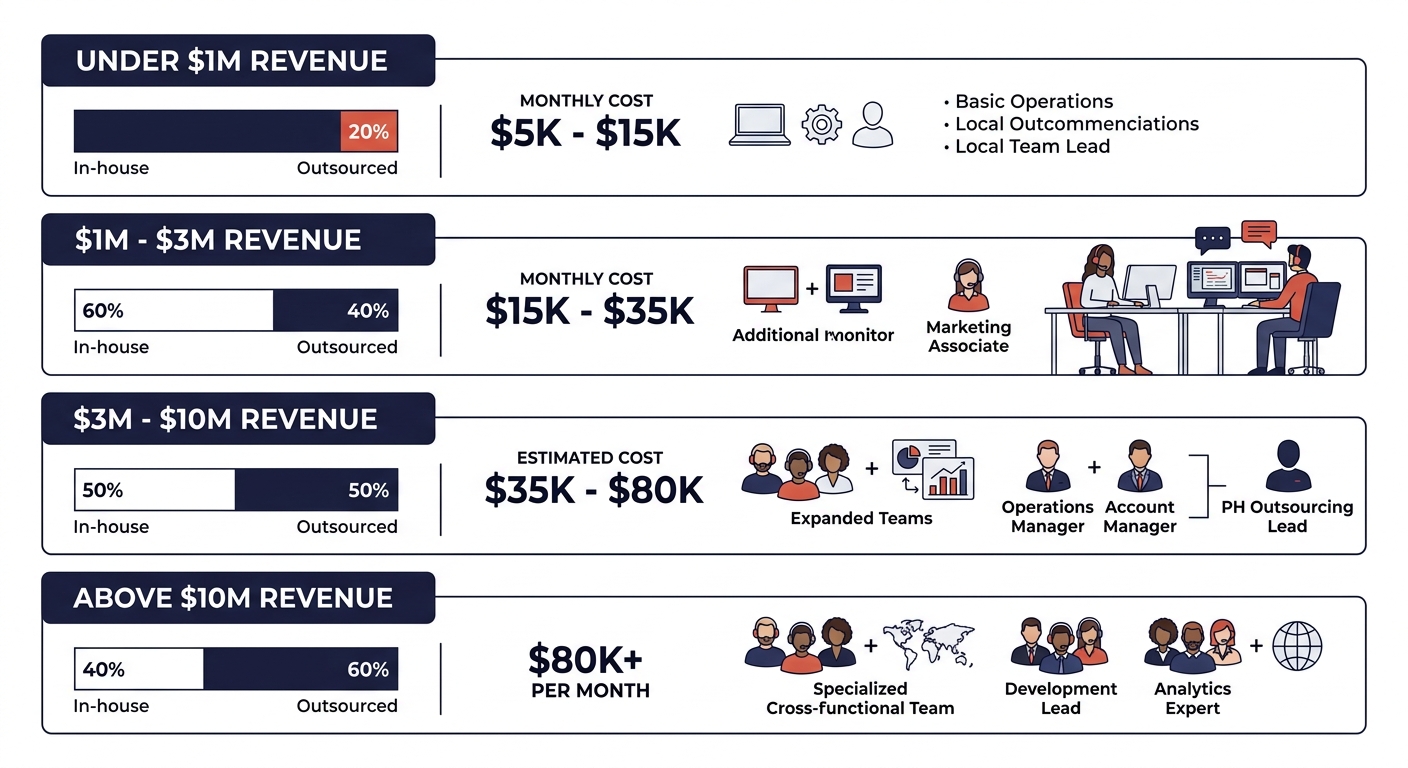
Tip: The threshold isn’t static. Every major Google update that adds specialization requirements pushes the break-even point for outsourcing lower. Review your team structure after each core update, not on an annual planning cycle.
Where The Numbers Land Today
Google shipped more ranking system changes between 2022 and early 2026 than in the preceding five years combined. Each one raised the expertise floor for when to outsource digital marketing, web development, and content production. The practical result: the revenue threshold where outsourcing makes financial sense has dropped from roughly $5M (where it sat in 2020) to under $1M for many service-based SMBs.
The businesses that adapted fastest to each update shared a common pattern. They didn’t try to hire their way through the disruption. They partnered with teams that had already solved the problem for other clients, absorbed the learning curve once, and applied it at scale. Companies that avoided common outsourcing mistakes around communication and ROI tracking saw returns within the first quarter.
If you’re running a US SMB and your revenue sits anywhere below $10M, the question isn’t whether to outsource. It’s how much of your Google-dependent marketing and development work you can afford to keep in-house while the platform keeps changing the rules underneath you. The data consistently points the same direction: the smaller you are, the stronger the case for sending specialized execution offshore and keeping strategic decisions close to the founder.