
AI-first development tools are restructuring Philippine web outsourcing economics because they collapse the performance gap between mid-level and senior output. When over 51% of GitHub commits involve AI-generated or AI-assisted code, a mid-level Filipino developer running Copilot delivers work that previously required a senior US-based engineer billing at triple the rate.
Fifty-One Percent of GitHub Commits Now Touch AI
The Stack Overflow Developer Survey for 2026 reported that more than half of all code pushed to GitHub was either generated or substantially assisted by AI tools, a threshold that would have seemed absurd two years ago. Deloitte projects that AI will drive productivity gains of 30–35% across the full software development lifecycle, and the early data from outsourcing operations suggests those numbers hold up in distributed teams. For Philippine dev shops, this means the value proposition has shifted from “we cost less per hour” to “we ship more per dollar,” which is a fundamentally different sales conversation with US and Australian clients.
The cost arithmetic tells the story plainly. AI web development tools in 2026 add roughly $200–400 per developer per month in tooling costs, covering GitHub Copilot Business licenses, API calls to models like Gemini and Claude, and specialized testing agents. Philippine senior developers earn between $6,400 and $8,900 monthly, while their US counterparts command $15,600–$19,500 for equivalent roles. That 40–60% cost gap existed before AI tools entered the picture, but now the gap compounds because the AI tools deliver the same absolute productivity lift to both populations. A Filipino developer who gets 35% faster with Copilot saves the client more per dollar than a US developer who gets 35% faster at three times the labor cost.
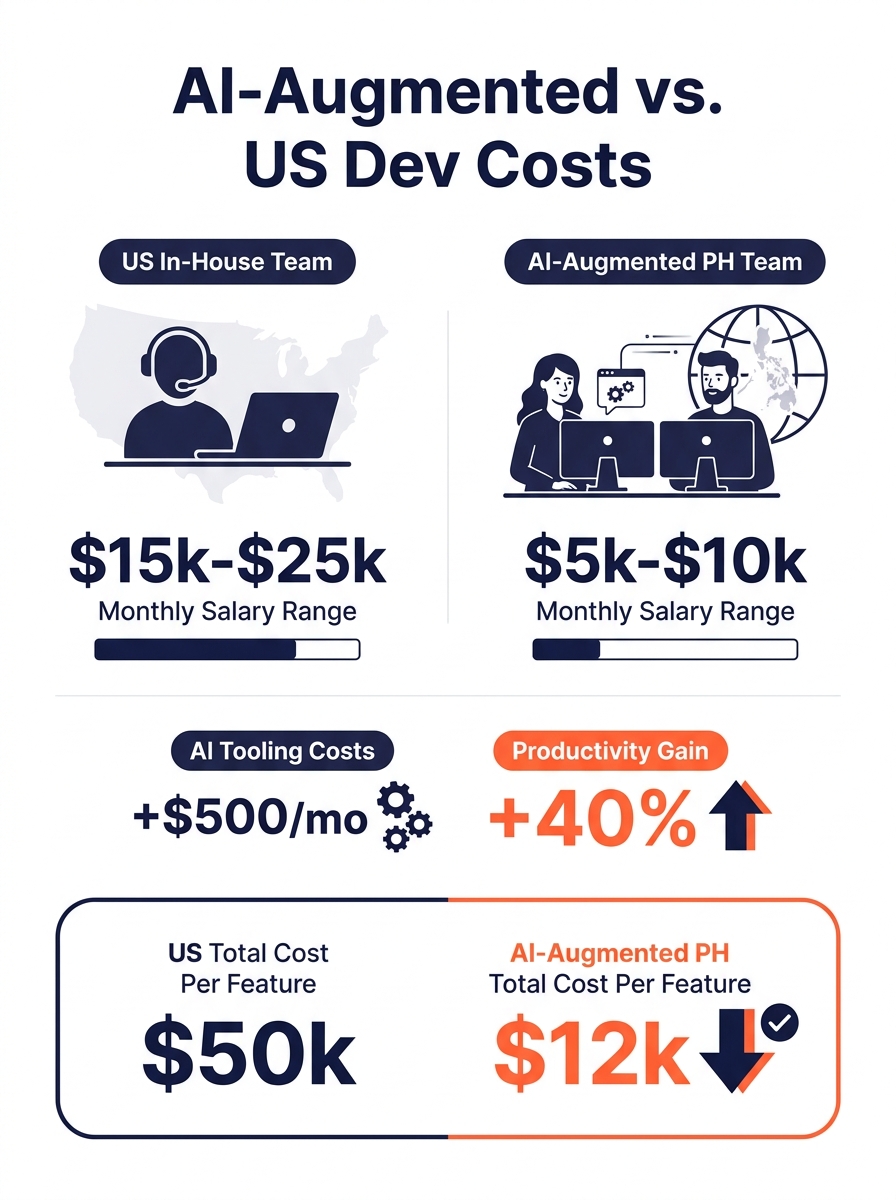
Google’s announcements at I/O on May 19 accelerated this dynamic. The Gemini 3.5 series and the Antigravity agent-first development platform introduced Chrome DevTools for agents and the HTML-in-Canvas API, giving offshore teams new capabilities for building immersive, searchable web experiences. And in April, Google released Gemma 4, an open-source model under Apache 2.0, optimized for agentic workflows. Philippine agencies can now build custom AI agents without expensive per-request API costs, maintaining economic viability at scale. These aren’t theoretical tools sitting in beta. They’re shipping in production environments within weeks of release, and the teams that integrate them first win the next round of client work.
The Three-Tier Team Replacing Headcount Scaling
The old outsourcing math was straightforward: you needed more features, you hired more developers. AI-first tools have broken that equation. The effective Philippine dev team AI adoption pattern now follows a three-tier structure where AI handles boilerplate code generation at Tier 1, mid-to-senior engineers serve as AI pilots at Tier 2, and senior architects focus exclusively on system design at Tier 3. Teams running this model report double or triple release velocity compared to traditional staffing. Deployment frequency shifts from weekly to daily, and AI-enabled Philippine BPO operations have documented a 71% reduction in production incidents alongside a 66% improvement in Mean Time to Restore.
As a Fortune contributor argued on May 29, the historical pattern holds: twenty years ago at Microsoft, tools emerged that should have eliminated entire engineering roles, and demand for engineers exploded instead. The same dynamic is playing out with generative code outsourcing. The productivity gains from AI don’t eliminate developer roles; they make each developer more valuable and raise the ceiling on what a five-person offshore team can deliver. A client who once needed eight developers for a React and Next.js application can now get equivalent output from five engineers running AI-assisted workflows, with the savings redirected to architecture quality and production-ready code practices that reduce long-term maintenance costs.
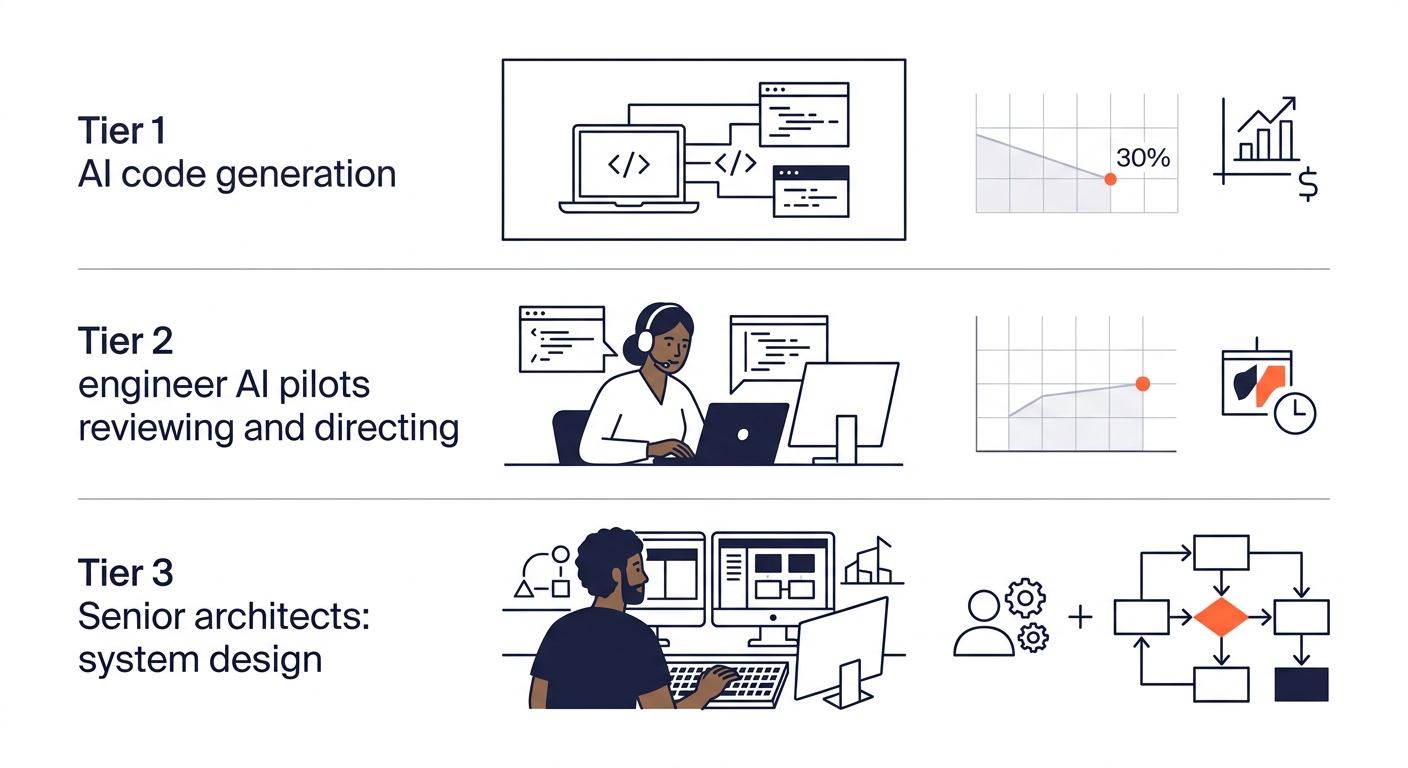
This restructuring has specific implications for outsourced mobile app development as well. The same three-tier model applies whether teams are building web applications or native mobile experiences, because the AI tools operate at the code layer rather than the platform layer. Copilot doesn’t care if it’s generating Swift, Kotlin, or TypeScript. The organizational shape stays the same. What changes is that clients can now engage smaller, more senior Philippine teams and get output that rivals what a 15-person US shop produces, at 35–55% faster development cycles and 30–45% lower total engineering costs. For agencies already running distributed teams, the question isn’t whether to adopt AI tools but how fast to reorganize around them before competitors do.
The productivity gains from AI don’t eliminate developer roles; they make each developer more valuable and raise the ceiling on what a five-person offshore team can deliver.
Wide Adoption, Shallow Roots
Here’s where the optimistic narrative runs into a wall. The Philippine AI Report 2025, published by Manila Bulletin in March 2026, found that “while adoption is widespread, it is remarkably shallow.” Filipino companies are using generative AI in daily tasks, according to industry leaders quoted by Context.ph on May 12, but experts warned that the next challenge is helping businesses build the skills, systems, and strategies needed to scale AI effectively. Using Copilot to autocomplete a function is adoption. Restructuring your entire development workflow around AI-assisted code review, automated testing pipelines, and agentic debugging is capability building. Most Philippine dev shops are still in the first camp.
The gap matters because GitHub Copilot outsourcing arrangements increasingly depend on teams that can do more than paste AI-generated code into a repository. Reddit’s r/ExperiencedDevs community has been tracking this pattern closely: the real productivity gains from AI come from outsourcing boilerplate work where strong reference implementations already exist, and from targeted debugging assistance. Without senior engineers who understand the architecture well enough to direct AI tools effectively, the generated code creates technical debt faster than it creates features. Teams that avoid the scaling trap of adding headcount without adding capability are the ones pulling ahead.
This shallow-versus-deep divide is splitting the Philippine outsourcing market into two tiers, a pattern that mirrors what’s happening in India’s IT services sector, where AI adoption is reshaping hiring patterns and making legacy skills obsolete. Philippine BPO operations that invest in AI capability building, including training engineers as AI pilots rather than code typists, are capturing premium contracts. Those that treat Copilot as a typing speed enhancer are competing on the same hourly-rate basis they always have, except now with thinner margins because clients expect AI-level productivity from every provider.
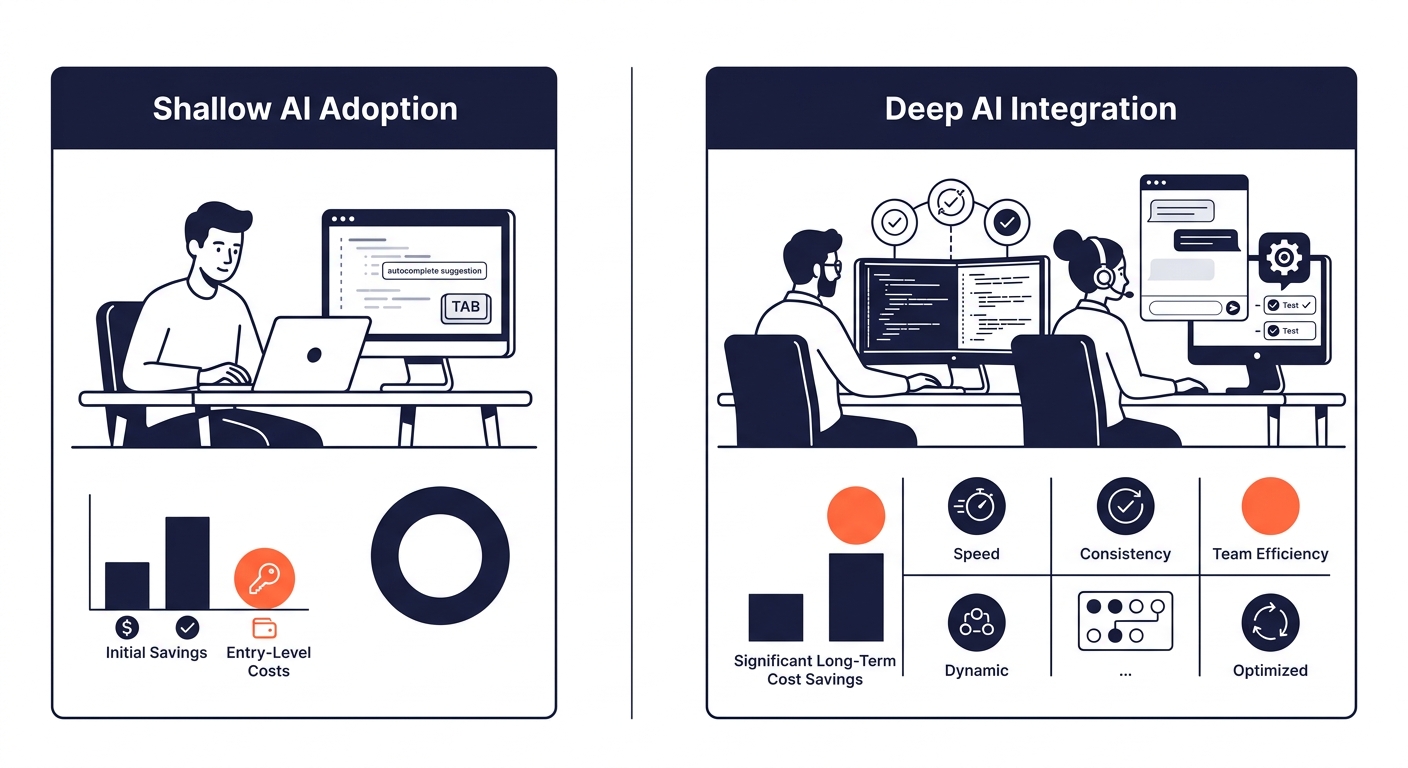
The AI-driven design feedback loops that DesignRush documented as a 2026 trend illustrate the depth gap well. Tools that analyze live user interactions and instantly suggest layout or UX improvements require teams that understand both the AI tooling and the design principles behind the suggestions. An engineer who blindly accepts every AI recommendation ships a different product than one who evaluates each suggestion against the client’s conversion data and brand guidelines. Capability building is what separates a $35/hour team from a $65/hour team, and both exist in Manila right now.
The Uncomfortable Part of This Acceleration
The data makes a strong case that AI-first development tools are good for Philippine outsourcing economics in aggregate. Faster cycles, lower costs, fewer production incidents, daily deployments instead of weekly ones. But the benefits flow disproportionately to teams that were already strong. A shop with senior architects who can evaluate AI output and restructure workflows around agentic tools will compound its advantages. A shop staffed primarily with juniors using AI as a crutch will produce code that looks right in pull requests and fails in production, and the client won’t discover the difference until months later when maintenance costs spike.
The Philippine AI Report’s finding about shallow adoption isn’t a temporary growing pain. It reflects a structural challenge: capability building requires investment in training, mentorship, and workflow redesign that many smaller BPO operations can’t afford while simultaneously competing on price. The teams building scalable web architectures with distributed engineers have the margins to invest in AI capability. The teams scraping by on low-rate contracts don’t. And AI tools, which should theoretically democratize access to senior-level output, are instead widening the gap between the top tier and the bottom tier of Philippine dev outsourcing.
For US and Australian SMBs evaluating offshore development partners in the coming months, the practical implication is that vetting AI capability has become as important as vetting technical skill. Asking a prospective Philippine team “do you use Copilot?” tells you nothing. Asking “show me how your engineers review and refine AI-generated code before it enters your main branch” tells you everything. The tools are available to everyone. The discipline to use them well remains scarce, and that scarcity is where the real pricing power in generative code outsourcing will concentrate for the foreseeable future.