
The virtual assistant services industry reached $19.6 billion in 2025, up from $4.12 billion in 2021, according to market analysis published by Today’s Woman, with IT-specialized virtual assistants accounting for a growing share as businesses shift technical support functions offshore to control costs and access round-the-clock coverage.
TL;DR: The VA services market grew 376% between 2021 and 2025, driven by AI tool adoption that delivers 2.4× productivity gains and cost structures running $15K-$40K annually versus $70K-$120K for US in-house IT hires.
Remote IT Support Becomes Core Operations Decision
The shift from in-house to remote IT support reflects structural changes in how businesses manage technical infrastructure, not temporary cost-cutting. Today’s Woman reported that 73% of virtual assistants now use AI-powered tools at least weekly, yielding an average 2.4× productivity increase over manual task execution. Providers like Virtudesk have built service models around certified remote professionals managing helpdesk queues, cloud infrastructure monitoring, and cybersecurity incident response entirely from offshore locations.
The market is projected to reach $25.6 billion by 2027, indicating sustained demand rather than cyclical experimentation. Companies are committing to virtual assistant models as permanent operational architecture, particularly for IT functions that require specialized credentials but don’t justify full-time US headcount.
Cost Gap Drives Permanent Shift in Hiring Strategy
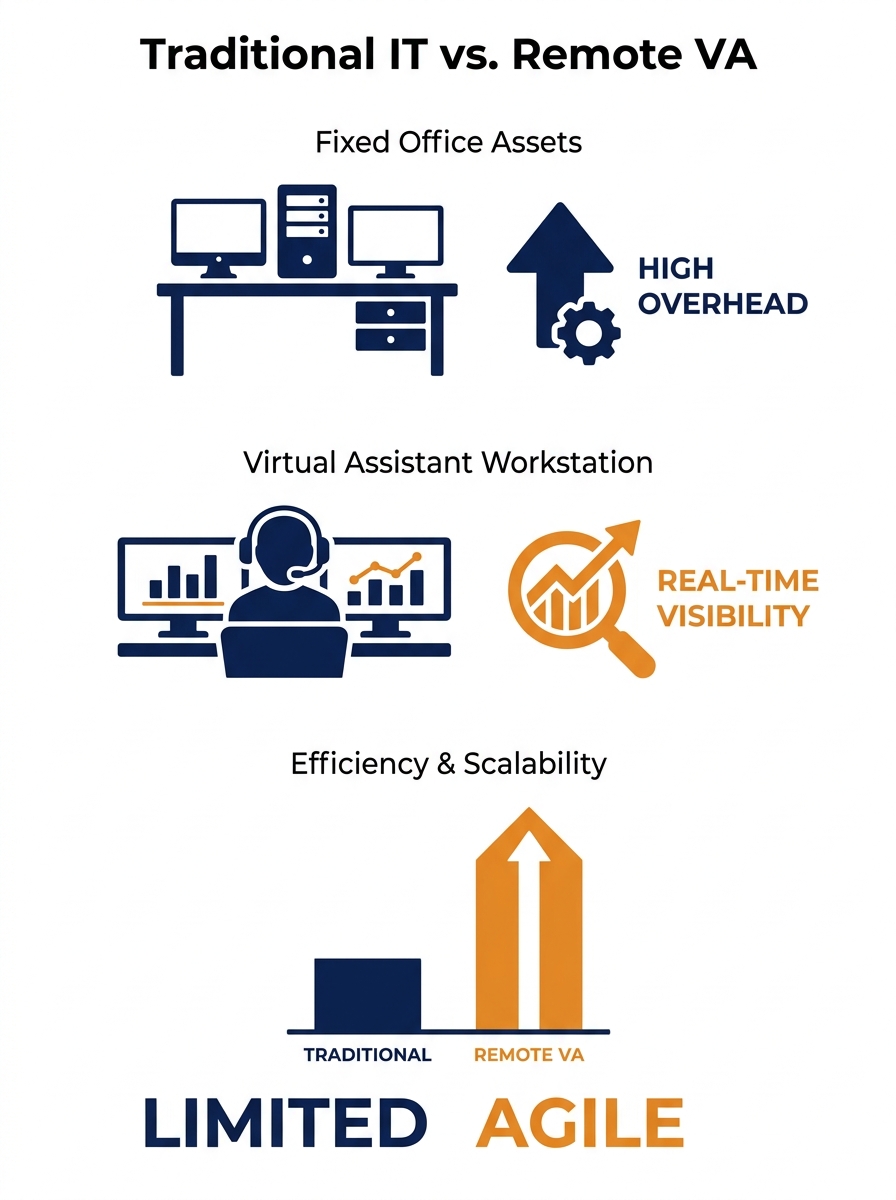
A full-time US-based IT employee costs between $70,000 and $120,000 annually when salary, benefits packages, and physical equipment overhead are factored in, according to the analysis. IT virtual assistant services typically run $15,000 to $40,000 per year with no additional infrastructure requirements—a 58-79% cost reduction for comparable technical work.
That differential matters most to businesses operating on constrained payroll budgets while facing expanded IT complexity from distributed workforces. Remote work infrastructure spans home networks, personal devices, and multiple time zones, creating support demands that single-location IT teams struggle to cover without premium staffing levels.
The scalability advantage compounds the cost savings. Traditional IT hiring requires weeks to months for candidate sourcing, interviews, and onboarding. Virtual assistant providers onboard certified professionals within days, allowing businesses to flex technical capacity during software rollouts, compliance projects, or seasonal traffic spikes without HR lead times.
AI Integration Multiplies Output Without Headcount
IT virtual assistants working with automation scripts, AI-powered diagnostic platforms, and workflow tools deliver output levels that exceed what manual processes allowed. The 73% adoption rate for AI tools among VAs represents a fundamental shift in how technical support work gets executed, with predictive maintenance, automated security auditing, and compliance documentation now standard rather than premium services.
This productivity use changes the economics of outsourcing decisions. Businesses evaluating virtual assistant retention rates now weigh AI-enhanced output capacity alongside traditional cost-per-FTE calculations. A single VA using diagnostic automation can resolve incident volumes that previously required multiple tier-one technicians working manually.
The AI tooling also narrows the performance gap between mid-level and senior technical resources. Junior offshore developers using GitHub Copilot and automated testing frameworks ship code quality that approaches what senior US developers produced without AI assistance—a pattern already reshaping web development outsourcing.
Geographic Constraints No Longer Limit Technical Talent Access
The virtual assistant model eliminates location-based hiring restrictions, opening access to cloud architects, network engineers, and cybersecurity analysts worldwide. Healthcare organizations deploy VAs for HIPAA compliance work and EHR system management. E-commerce companies use them to maintain server uptime during high-traffic sales events. Finance firms rely on offshore IT support for data integrity checks and trading platform integrations.
Agencies particularly benefit from round-the-clock coverage. Technical incidents don’t pause overnight, and cybersecurity threats operate continuously. IT virtual assistants monitor systems outside standard US business hours, flag anomalies early, and handle patch management proactively—sustained vigilance that lean internal teams can’t maintain without premium overtime costs.
Startups lean on IT VAs for cloud migrations during growth phases. Agencies use them for CRM integrations, client portal management, and software onboarding. The scope extends beyond basic helpdesk work to include security auditing, compliance reporting, and infrastructure optimization—functions that overlap with accounting virtual assistant roles in larger service packages.
Provider Selection Determines Outcome Quality
Not all virtual assistant providers deliver equivalent results. Businesses evaluating offshore IT support should prioritize verifiable technical certifications (CompTIA, AWS, Microsoft credentials), explicit service-level agreements, and documented data privacy standards. The quality variance between providers can undermine the entire cost-efficiency model if inexperienced VAs generate more incidents than they resolve.
The analysis emphasized that businesses should assess provider track records in their specific industry vertical, particularly for regulated sectors like healthcare and finance where compliance requirements add complexity. Law firm virtual assistant services, for example, require specialized understanding of legal technology stacks and confidentiality protocols that general IT VAs may lack.
Provider transparency around AI tool usage also matters. Virtual assistants relying on automation scripts and diagnostic platforms deliver the 2.4× productivity gains the market data shows; those still executing manual processes produce output comparable to lower-cost freelance alternatives without the service guarantees.
What This Means for US
The $19.6 billion market size confirms that virtual assistant services have moved from experimental to mainstream operational infrastructure. US SMBs and agencies evaluating offshore IT support in 2026 face a matured market with established service tiers, verifiable productivity metrics, and cost structures that run 58-79% below domestic full-time equivalents.
The AI productivity multiplier—2.4× output gains for VAs using automation tools weekly—matters more than the raw hourly rate differential. Businesses should evaluate providers on AI tooling sophistication and measured output per dollar, not on lowest cost per hour. A $25/hour VA using diagnostic automation delivers more incident resolution than a $15/hour VA working manually.
The 24/7 coverage advantage creates immediate value for businesses operating across time zones or managing customer-facing infrastructure that can’t afford downtime windows. Companies currently routing after-hours IT incidents to on-call in-house staff paying overtime premiums will find the virtual assistant cost structure favorable even before factoring the base salary savings.