
Seventy percent of prospective clients evaluate an architecture firm’s website before making contact. More than half leave when service pages fail to explain offerings or next steps clearly. The firms winning qualified leads build each service page as a standalone conversion funnel with location signals, structured content, and social proof placed precisely where buying decisions happen.
TL;DR: Architecture firm service pages convert when each service gets its own URL with localized keywords, client-facing problem language, testimonials placed near CTAs, and structured content entities that search engines can parse. Treat service pages as lead-generation infrastructure, not portfolio extensions.
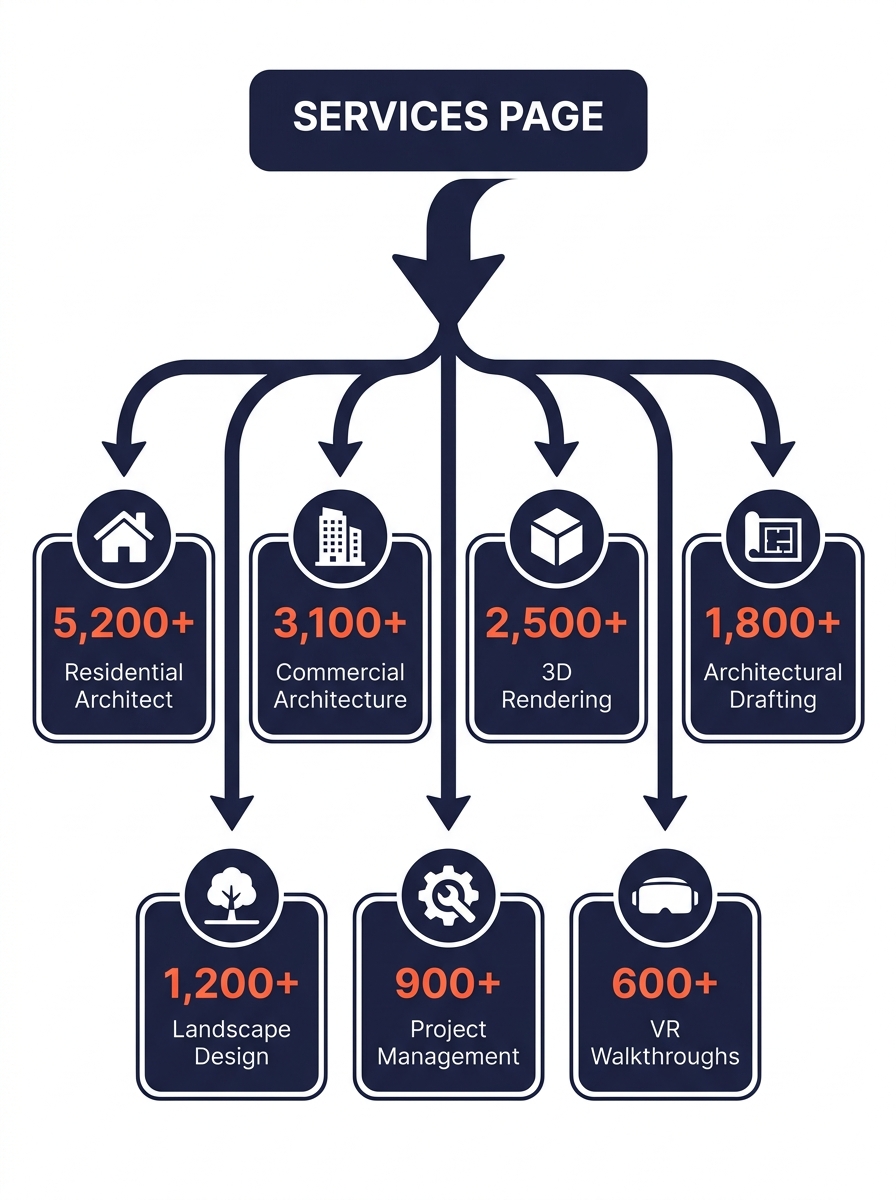
Dedicate One URL to Every Distinct Service
Architecture firms commonly pack residential design, commercial architecture, interior planning, master planning, and 3D rendering onto a single “Services” page. That structure kills search visibility. Google ranks individual pages for individual queries, and a page targeting 6 services simultaneously ranks well for none of them.
WebFX’s research on SEO for architecture firms confirms that each keyword deserves its own dedicated page. “Architectural 3D rendering” and “residential architect” are different search intents requiring different page content, different imagery, and different calls to action. A firm offering 7 services should have 7 service page URLs, each with a unique H1, unique meta title, and unique body copy of at least 800 words.
The math is straightforward. A single “Services” page competes for 1 keyword cluster. Seven individual pages compete for 7 clusters. If each page captures even 15 organic visits per month, that’s 105 monthly sessions versus the 20-30 a consolidated page typically produces. Over 18 months, the compounding effect is significant. As Uncommon Architects documented, “the content published in month three is still generating traffic in month eighteen” when service pages are treated as long-term SEO infrastructure.
Put the Location in the H1, Not the Footer
Why do architecture firms bury their service area in the footer copyright line? Because they’re designing for peer architects, not for the commercial developer in Houston searching “commercial architect Houston TX.” Locational keywords are the backbone of architecture firm web design, and they belong in the most prominent positions on the page.
WebFX’s guidance emphasizes that locational terms help local clients find your website, and those terms need to appear in the page title, H1 tag, and first 100 words of body content. A page titled “Commercial Architecture Services in Phoenix, AZ” outperforms “Our Commercial Architecture Approach” for every local query variation.
Google Map Pack results dominate the top of local searches, and firms that integrate service area maps or Google Map embeds into individual service pages strengthen their proximity signals. The H1 format should follow a consistent pattern: “[Service Type] in [City/Region].” If you serve 3 metro areas, consider creating location-specific variants, which means a firm with 7 services across 3 metros could maintain up to 21 indexable URLs. That’s a lot of content. And that’s exactly why firms working with outsourced content production gain an edge, because the volume required exceeds what a 2-person marketing team can produce alongside project deadlines.
Write for the Client’s Problem, Not Your Process
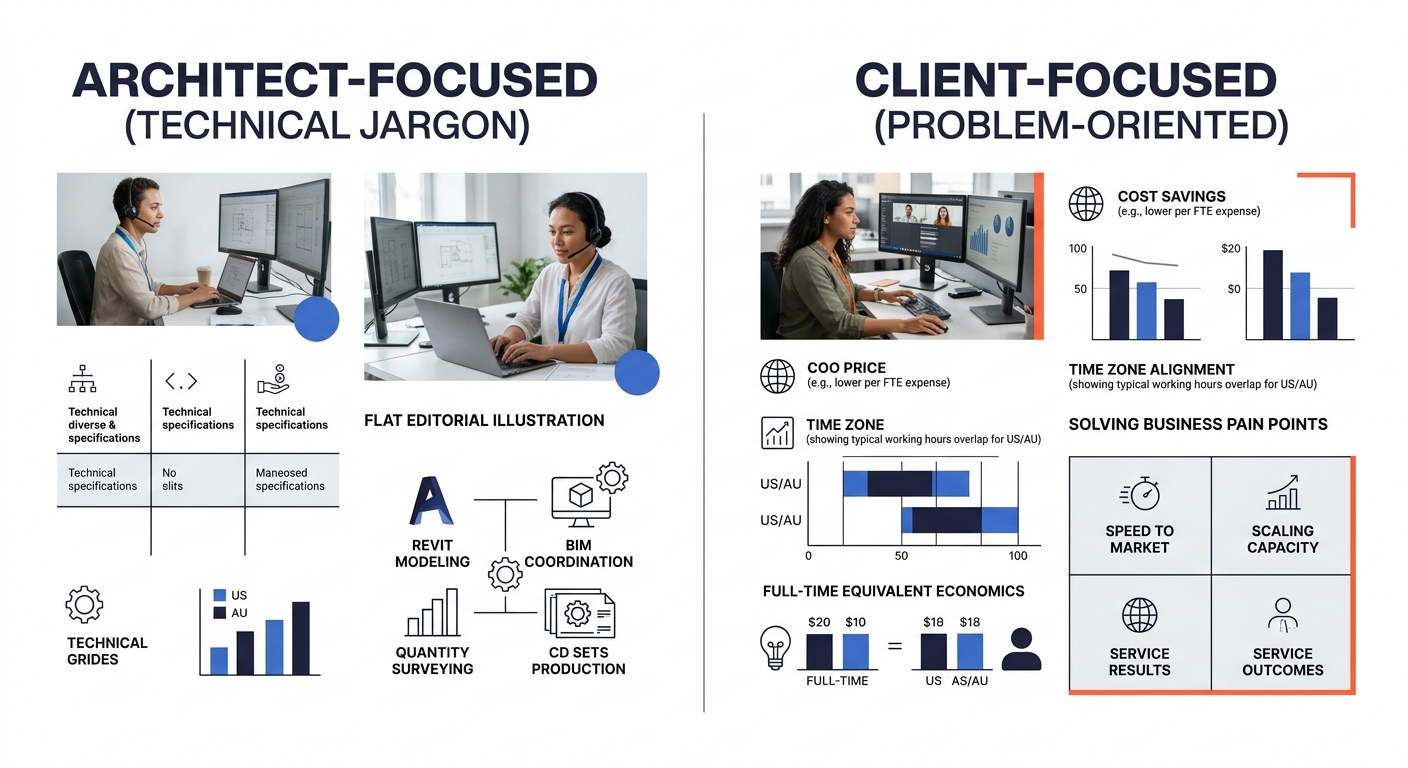
The gap between what architects write and what clients search reveals itself immediately in keyword data. Architects write about “parametric facade design methodology.” Clients search “how much does a building facade cost” or “architect for office renovation near me.” INSIDEA’s analysis of top architecture SEO agencies found that successful firms begin with keyword clustering and market-specific competitor analysis, then write content matching searcher vocabulary.
Padula Media’s guide on SEO for architects recommends drafting keywords that genuinely represent your services as clients describe them, not as you describe them internally. “Building design” outperforms “architectural design methodology” for lead quality because the person typing “building design” is closer to a buying decision.
Each service page should open with the client’s pain point in the first paragraph. A page for healthcare facility design should lead with something like “Hospitals and clinics operate under strict regulatory, infection-control, and patient-flow requirements that general contractors aren’t equipped to solve” rather than “Our team brings 20 years of award-winning healthcare design excellence.” The first version matches search intent. The second reads like a trophy case. If you’ve explored why architecture firms’ digital marketing fails before it starts, this client-language gap is one of the root causes.
Place Social Proof Within Scrolling Distance of Every CTA
Conversion-focused web architecture positions testimonials and case studies within 200 pixels of the primary call-to-action button. The decision sequence on a service page follows a predictable rhythm: the visitor reads about the service, wonders if the firm can actually deliver, then looks for evidence before clicking “Schedule a Consultation.”
According to conversion optimization research from Alecan Marketing, best practices for landing page experience include placing trust signals adjacent to conversion points. For architecture firms, this means a 2-3 sentence project testimonial positioned directly above or beside the contact form on each service page. Video testimonials perform even stronger as trust signals, and firms using them report measurably higher form completion rates.
The architecture-specific challenge is that most firms bury case studies in a separate “Projects” section, disconnected from the service pages where buying decisions happen. Each service page should include at least 1 embedded mini case study (150-250 words) with project specs: square footage, timeline, budget range, and the specific outcome the client valued. REVERB’s guide on AEC website lead generation reinforces this: refining service pages and creating engaging content are the two highest-impact changes for AEC firms.
A testimonial buried in a “Projects” tab three clicks away from your service page is a testimonial that never influences a buying decision.
Structure Content as Reusable Entities, Not Prose Blocks
Percepture’s Architect Portfolio Visibility System treats each service page as a structured entity with standardized, reusable components: pricing guidance, benefits list, FAQ schema, process timeline, and CTA. This approach improves both search performance and maintenance efficiency, because updating a pricing range or adding a new FAQ answer doesn’t require rewriting entire pages.
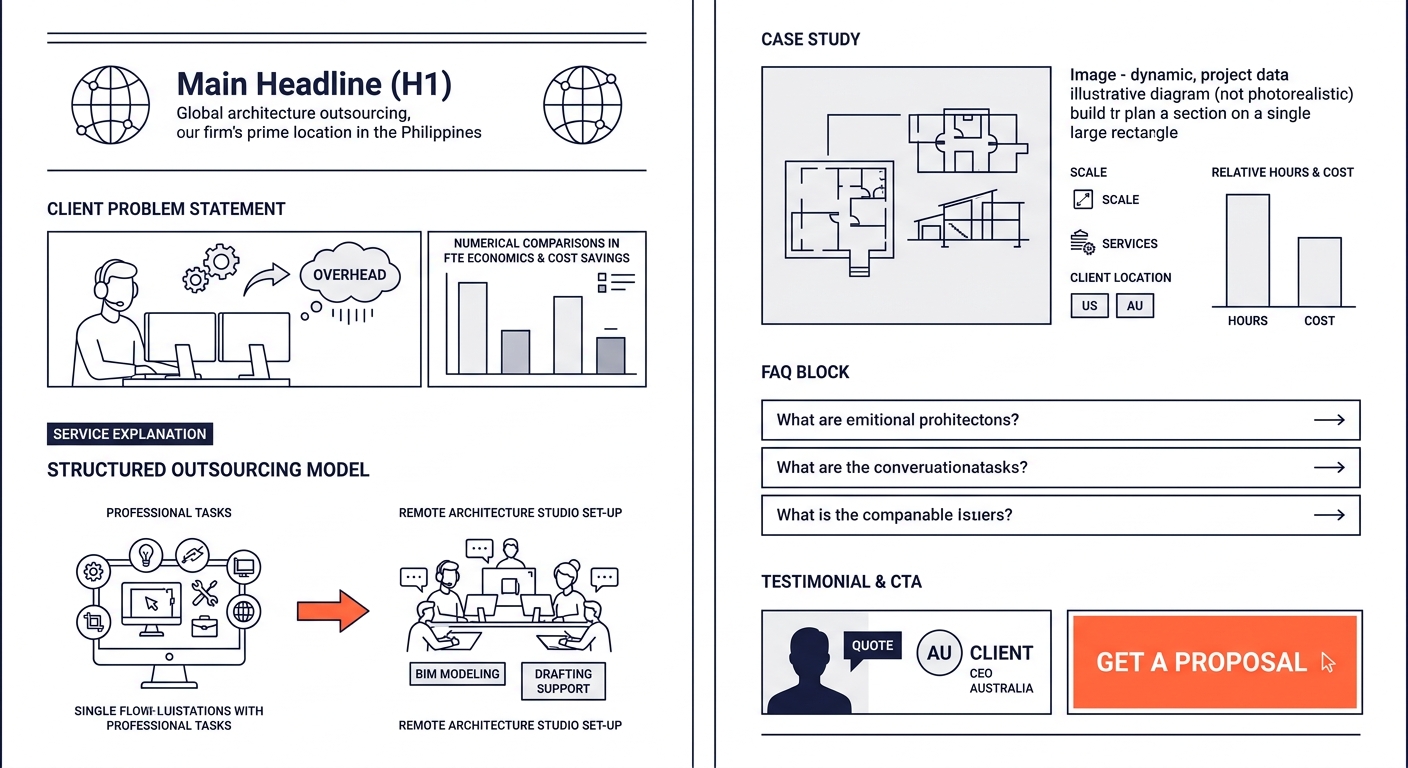
For service page SEO optimization, the entity model means every service page follows a consistent content scaffold:
- H1: Service name + location
- Opening paragraph: Client problem (80-100 words)
- Section 2: How the service works (150-200 words, written in client language)
- Section 3: Mini case study with project data (150-250 words)
- Section 4: FAQ block with 4-6 questions in schema markup
- Section 5: Testimonial + CTA
This consistent scaffold makes it dramatically easier to scale AEC industry web development content across multiple services and locations. A firm that uses a dedicated SEO outsourcing partner can template this structure and produce 5-7 service pages per month without sacrificing quality, because the framework eliminates the “blank page” problem that stalls most architecture firm content efforts.
FAQ schema markup deserves special attention. Pages with properly implemented FAQ schema earn rich results in Google’s search listings, which increases click-through rates by 20-30% compared to standard blue links. Each service page should include at least 4 unique questions matching real search queries, such as “How long does a commercial renovation project take?” or “What does an architect charge for a restaurant design?”
Load Every Service Page in Under 2.5 Seconds on Mobile
Architecture firms love high-resolution project photography. Google’s Core Web Vitals don’t. The tension between visual quality and page speed is the defining technical challenge of AEC industry web development, and most firms resolve it by ignoring speed entirely.
That’s a mistake with measurable consequences. Pages loading in over 3 seconds on mobile lose approximately 53% of visitors according to Google’s own benchmarking data. For an architecture firm generating 500 monthly service page visits, a 3.5-second load time means roughly 265 potential leads never see the content. Firms that address web performance bottlenecks across distributed teams have a structural advantage because their development workflows include automated speed testing at every deployment.
The fix involves 3 technical interventions: compress all images to WebP format (typically reducing file size by 25-35% versus JPEG), implement lazy loading so below-the-fold images don’t block initial render, and serve the page through a CDN with edge caching. These changes typically bring a 4-5 second page down to 1.8-2.2 seconds without sacrificing visual quality.
Tip: Test every service page URL through Google PageSpeed Insights monthly. A page that scored 90 at launch can degrade to 65 within 6 months as new images, scripts, and third-party embeds accumulate.
When These Rules Conflict
A firm with 12 services across 4 metros faces 48 potential service page URLs. At 800+ words each, that’s 38,400 words of original content. The entity framework and templated structure reduce the writing burden, but the volume still exceeds what a lean marketing team can produce while maintaining quality. At some point, you have to decide whether to go wide (more location variants with thinner content) or deep (fewer pages with richer case studies and longer copy).
Go deep first. A firm with 7 strong, 1,200-word service pages targeting its primary metro will outperform a firm with 28 thin 400-word pages spread across 4 cities. Google’s content quality signals penalize thin service pages that exist primarily for keyword coverage. Once the primary pages rank and generate leads, expand to secondary markets with location variants. The architecture firms seeing the strongest organic pipeline are the ones that treated service page SEO optimization as ongoing infrastructure, building and refining pages quarter after quarter. The content compounds. The leads follow the same curve.